At a Glance
| Mushroom | Key Compounds | Primary Evidence | Typical Dose |
|---|---|---|---|
| Reishi (Ganoderma lucidum) | Triterpenes, beta-glucans | Immune modulation, sleep, liver support | 1.5–9 g dried extract/day |
| Cordyceps (C. sinensis / militaris) | Cordycepin, adenosine | VO₂max, fatigue, ATP production | 1–3 g/day |
| Turkey Tail (Trametes versicolor) | PSK, PSP (polysaccharopeptides) | Cancer adjunct, gut microbiome, NK cells | 1–3 g PSK equivalent/day |
| Chaga (Inonotus obliquus) | Betulinic acid, melanin, SOD | Antioxidant, anti-inflammatory, DNA protection | 1–2 g extract/day |
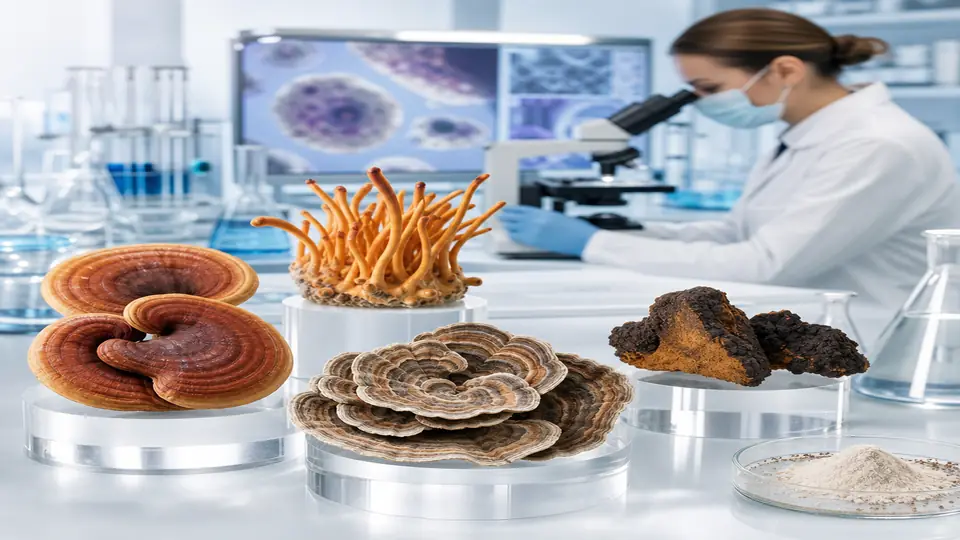
Four mushrooms. Distinct biochemistry. Genuinely different clinical applications. Yet most practitioners lump them together as “immune support” — a category so broad it obscures what each one actually does. Having used medicinal mushrooms in clinical practice, I want to give you the evidence hierarchy rather than the marketing sheet.
What Makes a Mushroom “Medicinal”?
The term covers hundreds of species, but the ones with the strongest human clinical data share three structural advantages over conventional supplements.
Beta-glucans are the foundational class of compounds. These branched polysaccharides — specifically (1→3)(1→6)-β-D-glucans — are recognized by Dectin-1 receptors on dendritic cells, macrophages, and neutrophils. Dectin-1 activation triggers a downstream signalling cascade through Syk kinase and NF-κB, upregulating TNF-α, IL-12, and interferon-γ. The net effect is trained innate immunity — epigenetic reprogramming of monocytes and NK cells toward a sustained state of heightened responsiveness: NK cells become more cytotoxic, macrophages more phagocytic. This is not theoretical — it is the mechanism behind Japan’s approved pharmaceutical PSK (derived from turkey tail), which has been in clinical use for post-surgical cancer support since 1977.
Triterpenes (ganoderic acids in reishi, betulinic acid in chaga) work primarily through anti-inflammatory and hepatoprotective channels. Many are cytotoxic to cancer cell lines in vitro, though this does not automatically translate to clinical anti-cancer effects in humans — a distinction I will be careful about throughout this article.
Nucleoside analogues — particularly cordycepin (3’-deoxyadenosine) from cordyceps — structurally mimic adenosine and can influence ATP production, adenosine receptor signalling, and even mTOR pathway activity.
The critical caveat: nearly all mushroom products on the market consist of dried, powdered mycelium grown on grain substrate. Myceliated grain products often contain minimal beta-glucans from the mushroom itself and predominantly starch from the growth medium. Independent testing has found some popular brands contain less than 1% actual beta-glucans. The only products worth recommending clinically are hot-water extracts (for beta-glucans) or dual extracts (hot water + alcohol, for both beta-glucans and triterpenes), with a certificate of analysis confirming ≥30% beta-glucan content.
Reishi (Ganoderma lucidum) — Immune Regulation and Neuromodulation
Reishi has the broadest traditional use and the most diverse modern research base. I reach for it in three specific clinical contexts:
Immune Dysregulation and Autoimmunity
Unlike echinacea or elderberry, which push the immune system toward stimulation, reishi acts as a bidirectional modulator. In Th2-dominant states (allergic disease, certain autoimmune patterns), its triterpenes suppress IgE-mediated mast cell degranulation and inhibit histamine release. In Th1-deficient states (chronic viral latency, cancer recovery), its beta-glucans boost NK cell activity. A 2012 randomised controlled trial in patients with neurasthenia found reishi extract significantly reduced fatigue and improved well-being scores vs placebo — the fatigue-immune connection being a likely mediator.
Sleep Architecture
Ganoderic acids inhibit ACE (angiotensin-converting enzyme) mildly, but more relevant to sleep are their effects on central inhibitory neurotransmission. Animal data shows increased total sleep time and NREM sleep duration via adenosine receptor modulation. Human evidence is limited to small studies, but anecdotally, patients with HPA-axis dysregulation frequently report improved sleep depth with reishi taken 1–2 hours before bed. I typically use 1.5 g of a standardised extract (10:1) in this context.
Hepatoprotection
Multiple RCTs demonstrate reishi reduces ALT and AST in patients with non-alcoholic fatty liver disease and viral hepatitis B. The mechanism involves ganoderic acid–mediated induction of hepatic antioxidant enzymes (catalase, SOD). I consider this for patients on long-term antibiotics or antifungal regimens where liver enzyme monitoring is part of the protocol.
Practical note: Reishi thins blood via platelet aggregation inhibition. Discontinue 7–10 days before surgery and use cautiously with anticoagulants.
Cordyceps (Sinensis and Militaris) — Mitochondrial Energy and Endurance
The original Cordyceps sinensis — the caterpillar fungus — is now effectively unobtainable in pharmacological quantities due to cost and CITES restrictions. The cultivated Cordyceps militaris contains higher concentrations of cordycepin than wild sinensis and is what you will find in every reputable supplement.
ATP and VO₂max
The most replicated finding in cordyceps research is improved exercise capacity. A 2010 double-blind RCT in older adults (mean age 61) found 3 g/day of C. sinensis extract over 12 weeks significantly improved VO₂max and ventilatory threshold. A 2017 study using C. militaris confirmed improved VO₂max in young, healthy adults within 3 weeks of supplementation. The proposed mechanism: cordycepin’s structural mimicry of adenosine enhances mitochondrial adenosine uptake, increasing ATP synthesis efficiency.
I use cordyceps routinely in patients with:
- Post-infectious fatigue (Lyme, EBV, post-COVID)
- Athletes seeking performance support without stimulant side effects
- Older patients with documented mitochondrial dysfunction
Typical protocol: 1–3 g of a standardised C. militaris extract daily, preferably in the morning.
Renal Protection
A Cochrane-reviewed meta-analysis of 22 RCTs found cordyceps preparations significantly reduced serum creatinine and improved creatinine clearance in chronic kidney disease. While causation is debated, the anti-fibrotic and anti-inflammatory renal effects are the most consistent finding in cordyceps human literature. For patients on nephrotoxic agents, I consider this low-risk, potentially beneficial supplementation.
Turkey Tail (Trametes versicolor) — The Most Evidenced Cancer Adjunct
Turkey tail is the only medicinal mushroom with a pharmaceutical derivative approved for clinical use in Japan, China, and South Korea. PSK (polysaccharide-K, trade name Krestin) is administered post-surgically in colorectal, gastric, and breast cancer patients to reduce recurrence risk.
Oncology Evidence
A landmark 2013 JNCI publication by Wasser and colleagues synthesised 30+ years of PSK RCT data. Meta-analysis of colorectal cancer adjunct trials showed a statistically significant improvement in 5-year overall survival (OR 1.32) with PSK vs chemotherapy alone. A Phase I trial funded by the NIH’s National Cancer Institute (2012) confirmed safety and demonstrated increases in NK cell activity and CD8+ T cell counts in breast cancer patients using whole turkey tail powder post-chemotherapy.
To be clear: turkey tail does not treat cancer. It appears to partially restore the immune surveillance function that both the tumour and conventional treatment suppress. This is a meaningful distinction for conversations with oncology colleagues.
Gut Microbiome
A 2014 randomised trial demonstrated that PSP (polysaccharopeptide, a related extract) significantly altered gut microbiome composition, increasing Bifidobacterium and Lactobacillus populations while reducing Clostridium and Staphylococcus. This bifidogenic effect makes turkey tail a useful adjunct in dysbiosis protocols and during or after antibiotic courses.
I typically use 1–2 g of a standardised turkey tail extract (verified PSK content) during and after antibiotic protocols, and in any patient with a cancer history who is interested in immune optimization.
Chaga (Inonotus obliquus) — Antioxidant Load and Chronic Inflammation
Chaga is the highest ORAC-scored natural substance tested to date, primarily due to melanin pigments and superoxide dismutase (SOD) enzyme content. It grows on birch trees as a slow-forming sclerotium and concentrates the tree’s betulinic acid and triterpenes.
Antioxidant and DNA Protection
Betulinic acid inhibits topoisomerase, an enzyme active in rapidly dividing cells — the basis for its cytotoxic activity against melanoma and glioma cell lines in vitro. Human RCT data is limited. However, a small human trial (2021) found 8 weeks of chaga extract reduced oxidative stress markers (8-OHdG, F2-isoprostanes) in patients with inflammatory bowel disease. Animal data consistently shows reductions in NF-κB activity and inflammatory cytokines.
What Chaga Cannot Do
I want to be direct: claims that chaga “cures” or “fights” cancer in humans are not supported by clinical trial evidence. The in vitro cytotoxicity data is interesting but does not translate to human clinical outcomes without controlled trials. I use chaga for its antioxidant burden in patients with high oxidative stress (mold illness, heavy metal toxicity, post-infectious inflammation) — not as an anti-cancer agent.
Safety flag: Chaga contains high oxalate levels. Patients with a history of calcium oxalate kidney stones or hyperoxaluria should avoid it or use very low doses with high fluid intake.
How I Use Medicinal Mushrooms in Practice
My most common clinical combinations:
Chronic infection / post-infectious fatigue (Lyme, EBV, post-COVID): Cordyceps (1.5 g) + Reishi (1.5 g) in the morning. Rationale: cordyceps for mitochondrial energy, reishi for immune modulation and sleep quality.
Cancer history / immunosuppression: Turkey tail (1–2 g) daily as an ongoing protocol. If the patient is in active chemo or radiation, I defer to their oncologist before adding any supplement.
Dysbiosis / post-antibiotic microbiome recovery: Turkey tail (1 g) + a targeted probiotic. The bifidogenic effect of PSP complements direct probiotic reseeding.
High oxidative stress states (mold, heavy metals, chronic inflammation): Chaga (1 g extract) in the evening, combined with glutathione precursors (NAC) and SOD-boosting interventions.
Choosing a Quality Product
The single biggest predictor of clinical response is product quality. My checklist:
- Fruiting body, not myceliated grain. The label should say “fruiting body extract” — not “mycelium” or “full spectrum.”
- Hot water or dual extraction. Beta-glucans require hot water extraction; triterpenes require alcohol. Dual-extracted products cover both.
- Beta-glucan content stated. Target ≥30% beta-glucans by certified assay. Many brands will list “polysaccharides” — this includes starch from grain substrate and is meaningless.
- Third-party testing. Look for certificates of analysis from independent labs (not in-house testing).
- No myceliated grain fillers. If the label lists “organic brown rice” or “organic oats,” the mycelium was grown on grain and the beta-glucan content is likely minimal.
Related Articles
- Lion’s Mane Mushroom: Neurotrophin Support and Cognitive Function
- Lion’s Mane Dosage Protocol: Titration, Cycling, and Indication-Specific Dosing
- Quercetin as a Senolytic: Evidence and Protocols
- Thymosin Alpha-1: Immune Restoration in Chronic Infection
- Gut-Brain Axis: How Microbiome Health Shapes Immunity and Cognition
- Supplement Timing Guide: When to Take What and Why
References
- Wasser SP. “Current findings, future trends, and unsolved problems in studies of medicinal mushrooms.” Appl Microbiol Biotechnol. 2011;89(5):1323–1332. PMID: 21190105
- Stamets P, Zwickey H. “Medicinal mushrooms: ancient remedies meet modern science.” Integr Med (Encinitas). 2014;13(1):46–47. PMID: 26770081
- Gao Y, et al. “A randomized, placebo-controlled, multicenter study of Ganoderma lucidum (W. Curt.: Fr.) Lloyd (Aphyllophoromycetideae) polysaccharides (Ganopoly) in patients with advanced lung cancer.” Int J Med Mushrooms. 2003;5(4):369–381.
- Torkelson CJ, et al. “Phase 1 clinical trial of Trametes versicolor in women with breast cancer.” ISRN Oncol. 2012;2012:251632. PMID: 22701186
- Pallav K, et al. “Effects of polysaccharopeptide from Trametes versicolor on the gut microbiome of healthy volunteers.” Gut Microbes. 2014;5(4):458–467. PMID: 25006989
- Géry A, et al. “Chaga (Inonotus obliquus), a future potential medicinal fungus in oncology? A chemical study and a comparison of the cytotoxicity against human lung adenocarcinoma cells (A549) and human bronchial epithelial cells (BEAS-2B).” Integr Cancer Ther. 2018;17(3):832–843. PMID: 29484963