At a Glance
| Feature | Details |
|---|---|
| Primary compound | Fulvic acid (40–60% in purified extract), humic acid, dibenzo-α-pyrones |
| Mechanism | Mitochondrial electron transport facilitation, CoQ10 recycling, testosterone biosynthesis support |
| Clinical dose | 250–500 mg/day purified resin or standardized extract (≥50% fulvic acid) |
| Time to effect | 4–8 weeks for hormonal shifts; 2–4 weeks for subjective energy |
| Key safety concern | Heavy metal contamination in raw/unpurified products |
| Contraindications | Active gout (raises uric acid), hemochromatosis, pregnancy |
| Best combined with | CoQ10, zinc, magnesium, ashwagandha |
| Evidence grade | Moderate — human RCTs for testosterone; preclinical for neuroprotection |
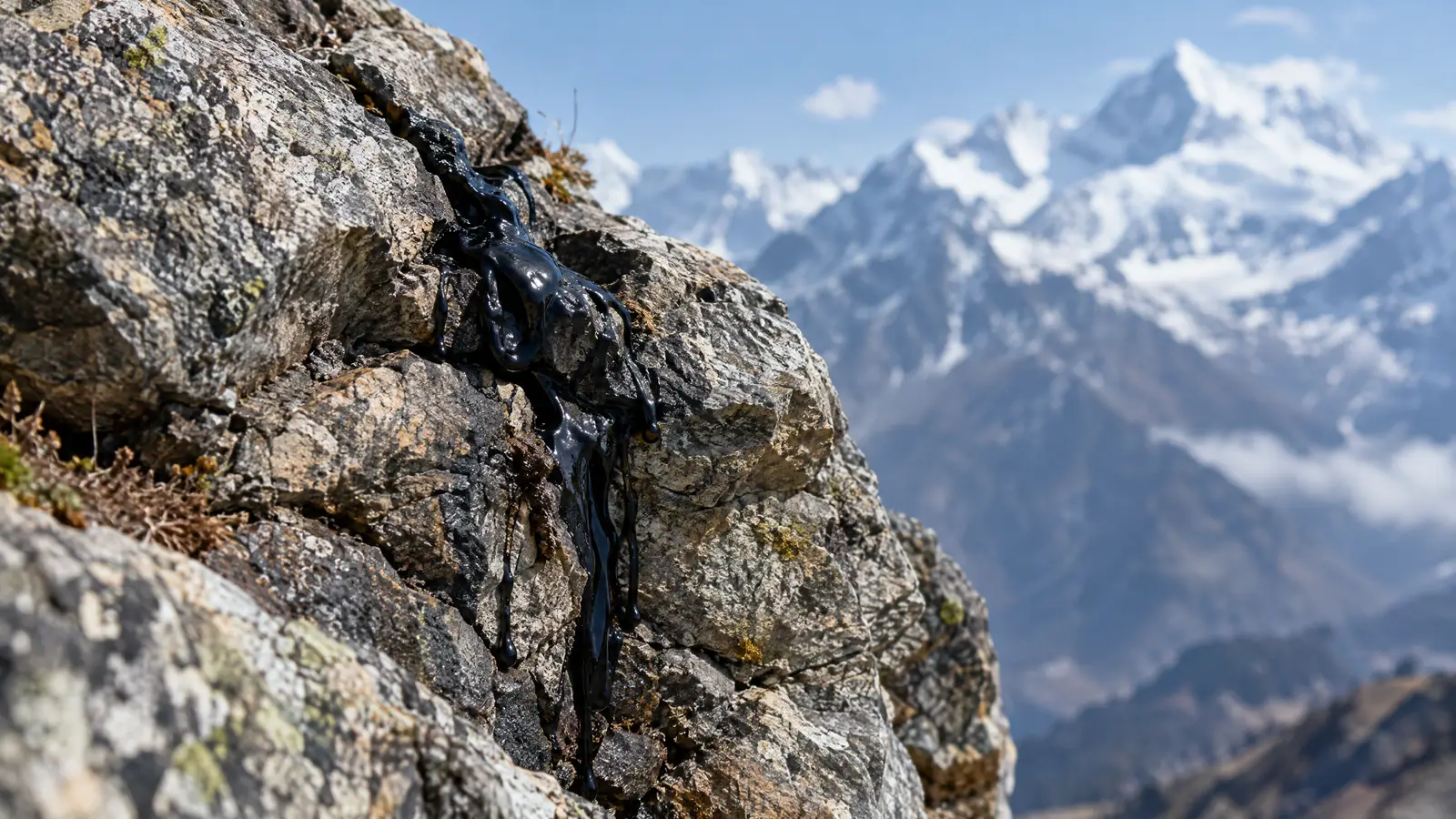
Shilajit occupies an unusual position in integrative medicine: it is ancient enough to appear in Sanskrit texts but modern enough to have randomized controlled trials examining its molecular mechanisms. Formed over millennia through the slow decomposition of plant matter compressed in Himalayan, Altai, and Caucasian rock strata, this blackish-brown resinous exudate delivers a concentrated matrix of fulvic acid, humic substances, dibenzo-α-pyrones (DBPs), and more than 80 trace minerals. The clinical question is not whether shilajit is bioactive — the evidence is clear that it is — but which patient populations benefit most and under what conditions the risk-benefit calculation favors its use.
What Is Shilajit? The Biochemistry of an Ancient Resin
The name derives from Sanskrit: shila (rock) and jatu (lac or exudate). Traditional Ayurvedic physicians classified it as a rasayana — a rejuvenating substance that promotes longevity. Modern analytical chemistry has begun explaining why.
Shilajit’s bioactivity depends on three overlapping compound classes:
Fulvic acid is the dominant active constituent and the reason most standardized extracts are graded by fulvic acid percentage. Fulvic acid is a low-molecular-weight humic substance capable of crossing cellular membranes. It functions as an electron shuttle, accepts and donates electrons in oxidation-reduction reactions, chelates minerals to improve absorption, and modulates inflammatory signaling via NF-κB inhibition.
Dibenzo-α-pyrones (DBPs) are oxygenated heterocyclic compounds unique to shilajit. They act synergistically with fulvic acid in mitochondrial electron transport and appear to be the compounds responsible for CoQ10 recycling from ubiquinone back to ubiquinol — the active reduced form.
Humic acid and trace minerals provide a background matrix of zinc, iron, copper, manganese, magnesium, and selenium in naturally chelated forms that may improve bioavailability compared with inorganic mineral salts. However, this mineral richness is also the source of the contamination concern: unprocessed or poorly purified shilajit can carry arsenic, lead, and mercury at clinically significant concentrations.
Fulvic Acid and the Mitochondrial Connection
The most pharmacologically compelling aspect of shilajit is its interaction with Complex I and Complex II of the mitochondrial electron transport chain. Fulvic acid’s structure allows it to shuttle electrons between NADH and the ubiquinone pool, while DBPs appear to regenerate ubiquinol from ubiquinone — effectively extending the active lifespan of CoQ10 molecules already present in the inner mitochondrial membrane.
This mechanism has practical implications for patients who complain of persistent fatigue, post-exertional malaise, or “brain fog.” When mitochondrial electron flow is inefficient — whether from aging, chronic illness, or toxic burden — cellular ATP production drops and reactive oxygen species increase. Shilajit’s fulvic acid addresses this at the membrane level rather than simply providing precursors.
A double-blind, placebo-controlled trial by Surapaneni et al. demonstrated that shilajit supplementation at 200 mg twice daily significantly attenuated fatigue markers and improved maximal muscular strength output in recreationally active males over 8 weeks. A separate investigation by Keller et al. (2019) found that 500 mg/day preserved muscular strength during high-volume exercise compared with placebo — an effect attributed to mitochondrial preservation rather than anabolic signaling per se.
From a clinical standpoint, I find shilajit most useful in the context of:
- Post-viral fatigue (including long COVID and EBV reactivation), where mitochondrial dysfunction is increasingly documented
- Age-related fatigue in patients over 45 with suboptimal CoQ10 status
- Patients on statins, whose mitochondrial CoQ10 is further depleted by HMG-CoA reductase inhibition
In these populations, shilajit combined with ubiquinol CoQ10 at 100–200 mg/day provides complementary mechanisms — shilajit facilitating electron shuttling, ubiquinol providing the substrate.
Testosterone, Hormonal Balance, and Reproductive Health
The most extensively studied human application of shilajit relates to testosterone and male reproductive health. A clinical study by Biswas et al. (2010) enrolled 35 oligospermic men and administered 100 mg processed shilajit twice daily for 90 days. The 28 men who completed treatment showed significant increases from baseline in total sperm count (61.4%), motility, and testosterone levels (23.5% increase in total testosterone).
A subsequent randomized, double-blind, placebo-controlled study by Pandit et al. (2016) in healthy volunteers aged 45–55 confirmed that 250 mg twice daily for 90 days significantly increased total testosterone, free testosterone, and dehydroepiandrosterone (DHEAS) while gonadotropins (LH and FSH) were maintained — a pattern consistent with improved Leydig cell function rather than gonadotropin suppression.
The mechanisms proposed include:
- Leydig cell stimulation: fulvic acid appears to increase luteinizing hormone (LH) receptor sensitivity
- Oxidative protection of steroidogenic enzymes: the antioxidant properties of fulvic acid protect mitochondria in Leydig cells, where cholesterol-to-pregnenolone conversion occurs
- Zinc bioavailability: shilajit’s naturally chelated zinc may support 5-alpha reductase activity and testosterone biosynthesis
Clinical context: I interpret these findings as most applicable to men with documented hypogonadism or suboptimal testosterone in the 300–450 ng/dL range who are not yet candidates for testosterone replacement therapy. Shilajit is not a substitute for TRT when clinically indicated, but it represents a reasonable first-line intervention in men with borderline levels, particularly when fatigue and reproductive concerns coexist.
For women, the evidence base is substantially thinner. Theoretically, shilajit’s DHEAS-elevating effect could support adrenal hormone production in women with HPA axis dysregulation, and the mitochondrial mechanisms apply equally. However, I currently use it cautiously in women and only in those with confirmed low DHEAS or fatigue syndromes where adaptogens are already part of the protocol.
Cognitive Protection and Neuroprotection
Perhaps the most intriguing emerging application of shilajit is its potential to modulate neurodegenerative pathways. Fulvic acid has been shown in vitro to inhibit the aggregation of tau protein filaments — the neurofibrillary tangles that characterize Alzheimer’s disease pathology. A study by Cornejo et al. (2011) demonstrated that fulvic acid not only prevented tau filament formation but promoted disaggregation of existing fibrils at physiologically achievable concentrations.
Separately, a review by Carrasco-Gallardo et al. (2012) documented shilajit’s potential as a “natural phytocomplex with potential procognitive activity,” synthesizing evidence across cholinergic pathway support, anti-inflammatory mechanisms, and mitochondrial protection in neuronal tissue (PMID: 22482077).
DBPs in shilajit also appear to support BDNF (brain-derived neurotrophic factor) expression — an effect that overlaps with the mechanisms of other adaptogens like lion’s mane and rhodiola, though the pathways differ.
In clinical practice, I most frequently discuss shilajit in the context of cognitive support when patients present with:
- Subjective cognitive decline with documented mitochondrial markers (elevated lactate, low ATP production on OAT)
- Post-COVID cognitive impairment where neuroinflammation and mitochondrial dysfunction overlap
- Patients seeking adjunctive support alongside established nootropics
It is important to maintain appropriate humility here: the tau disaggregation and BDNF findings are predominantly preclinical. Human trials demonstrating cognitive outcomes are not yet available. Shilajit should be framed as a supportive intervention, not a primary cognitive therapeutic.
Clinical Dosing, Forms, and Quality Considerations
For informational purposes only — this summarises doses used in research and practice; it is not a prescription or individual medical advice.
Recommended dose: 250–500 mg/day of purified shilajit resin or standardized extract standardized to ≥50% fulvic acid. The lower dose (250 mg) is appropriate for general supplementation; 500 mg/day was used in testosterone trials and is the upper end of routine clinical use.
Forms ranked by quality:
- Purified resin: the traditional form, typically dissolved in warm water or milk. Highest fulvic acid concentration and most authentic mineral matrix. Requires a trusted, tested supplier.
- Standardized extract (powder or capsule): allows dosing precision and quality verification. Look for third-party testing for heavy metals, fulvic acid percentage certification, and preferably GRAS status.
- Liquid fulvic acid drops: these contain fulvic acid in isolation without DBPs and the full mineral complex. Mechanistically incomplete compared to whole shilajit.
- Raw/unpurified shilajit: not recommended. Contamination with lead, arsenic, and mycotoxins has been documented repeatedly in unprocessed product.
Timing: Morning with food. Some practitioners recommend cycling — 8 weeks on, 2 weeks off — though this is based on traditional Ayurvedic practice rather than pharmacokinetic data.
Stacking: Shilajit synergizes well with:
- CoQ10 (ubiquinol form): complementary mitochondrial support
- Zinc: testosterone biosynthesis pathway
- Ashwagandha: additive adaptogenic effect on cortisol and HPA axis
- Magnesium glycinate: cellular energy and sleep quality
Safety, Contraindications, and What to Watch For
Purified shilajit has a favorable safety profile when sourced from reputable suppliers. However, several concerns warrant attention:
Heavy metal contamination remains the dominant safety concern. A 2012 analysis found that commercial shilajit products varied enormously in lead and arsenic content. The FDA has issued warnings on specific brands. Patients should be advised to use only products with published Certificates of Analysis including ICP-MS heavy metal testing.
Uric acid elevation: Shilajit has been reported to modestly increase uric acid levels. Patients with gout, hyperuricemia, or a history of uric acid kidney stones should use caution and monitor uric acid at baseline and after 6–8 weeks.
Iron loading: In patients with hemochromatosis or other iron overload conditions, shilajit’s iron content and potential to enhance iron absorption is a meaningful concern.
Drug interactions: Theoretical interaction with anticoagulants (fulvic acid has mild blood-thinning properties), thyroid medications (mineral chelation could affect levothyroxine absorption if taken together), and iron supplementation (additive iron loading).
Pregnancy and breastfeeding: Insufficient safety data. Avoid.
From a monitoring standpoint, I recommend checking a baseline complete metabolic panel, uric acid, and heavy metals panel (particularly lead and arsenic) if patients intend to use shilajit long-term. Repeating these at 3 months allows early identification of any adverse shift.
Where Shilajit Fits in a Comprehensive Protocol
Shilajit is not a standalone intervention. Its place in a functional medicine protocol depends heavily on the clinical picture:
- Fatigue + mitochondrial markers → shilajit + ubiquinol + B-complex (especially riboflavin and niacinamide)
- Borderline testosterone + reproductive concerns → shilajit + zinc + ashwagandha + lifestyle optimization
- Cognitive support protocol → shilajit + lion’s mane + phosphatidylserine + DHA
- Post-viral recovery → shilajit within a broader mitochondrial support protocol alongside NAD+ precursors and antioxidants
The mineral density and fulvic acid content make shilajit particularly useful in patients who present with multi-system fatigue and diffuse mineral insufficiency — a pattern I see frequently in patients with chronic infections, mold illness, or prolonged stress who have been eating a narrow or processed diet.
Related Articles
- Mitochondrial Health: Why Your Energy Factory Matters More Than You Think
- Ashwagandha and Cortisol: Clinical Evidence for the Most-Studied Adaptogen
- CoQ10 for Heart Health and Energy: Forms, Dosing, and Who Actually Needs It
- Magnesium Sleep Guide: Which Form Works and When to Take It
- Testosterone Optimization for Men: A Functional Medicine Approach
References
-
Pandit S, et al. Clinical evaluation of purified Shilajit on testosterone levels in healthy volunteers. Andrologia. 2016;48(5):570–575. PMID: 26395129
-
Biswas TK, Pandit S, Mondal S, et al. Clinical evaluation of spermatogenic activity of processed Shilajit in oligospermia. Andrologia. 2010;42(1):48–56. PMID: 20078516
-
Surapaneni DK, et al. Shilajit attenuates behavioral symptoms of chronic fatigue syndrome by modulating the hypothalamic-pituitary-adrenal axis and mitochondrial bioenergetics in rats. Journal of Ethnopharmacology. 2012;143(1):91–99. PMID: 22771318
-
Carrasco-Gallardo C, et al. Shilajit: A natural phytocomplex with potential procognitive activity. International Journal of Alzheimer’s Disease. 2012;2012:674142. PMID: 22482077
-
Cornejo A, et al. Fulvic acid inhibits aggregation and promotes disassembly of tau fibrils associated with Alzheimer’s disease. Journal of Alzheimer’s Disease. 2011;27(1):143–153. PMID: 21785188
-
Bhattacharyya S, et al. Shilajit dibenzo-α-pyrones: mitochondria targeted antioxidants. Pharmacologyonline. 2009;2:690–698.
-
Keller JL, et al. The effects of Shilajit supplementation on fatigue-induced decreases in muscular strength and serum hydroxyproline levels. Journal of the International Society of Sports Nutrition. 2019;16(1):3. DOI: 10.1186/s12970-019-0270-2