At a Glance
| Parameter | Detail |
|---|---|
| Compound | Sulforaphane (SFN) |
| Source | Glucoraphanin hydrolyzed by myrosinase (broccoli sprouts, seeds) |
| Primary Mechanism | NRF2 / KEAP1 pathway activation |
| Key Downstream Effects | HO-1, NQO1, GST, GCLC upregulation; phase II detoxification |
| Clinical Evidence Tier | Phase I–II human trials + robust preclinical data |
| Typical Clinical Dose | 30–60 mg sulforaphane equivalent daily (or 50–100 g fresh sprouts) |
| Best Form | Stabilized glucoraphanin + active myrosinase; or fresh broccoli sprouts |
| Safety | Excellent at dietary-equivalent doses; high-dose GI tolerability varies |
| Relevant Patients | Detoxification burden, metabolic syndrome, chronic inflammation, neuroinflammation, cancer risk reduction |
Most antioxidant supplements work by donating electrons directly — a one-for-one exchange that is used up quickly. Sulforaphane operates differently: it amplifies your body’s own antioxidant enzyme production through a transcriptional switch called NRF2. A single exposure can elevate protective enzymes for 48–72 hours. That mechanistic distinction is why sulforaphane has attracted sustained interest from both academic researchers and integrative clinicians over the past three decades, while many other “antioxidant” supplements have quietly faded.
In our clinic, sulforaphane has earned a place in several protocols — detoxification support, metabolic optimization, and adjunctive care for patients with high oxidative stress burden. This article reviews the mechanism, the human evidence, and how I approach dosing in practice.
What Is Sulforaphane and How Does It Form?
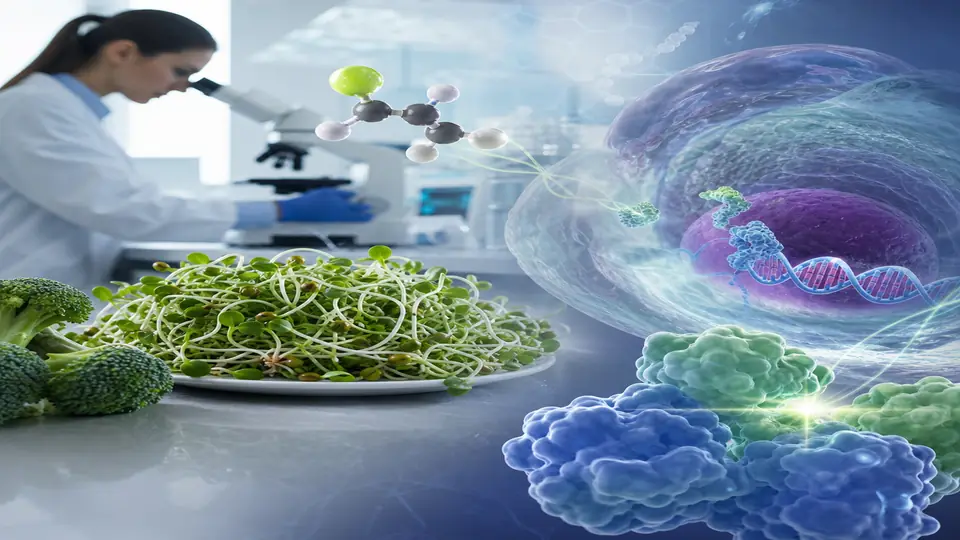
Sulforaphane is an isothiocyanate — a sulfur-containing molecule found in cruciferous vegetables, highest in broccoli sprouts and seeds. It does not exist preformed in the plant. The precursor, glucoraphanin, is stored in the plant’s vacuoles. When plant tissue is damaged (chewing, chopping, blending), it contacts the enzyme myrosinase, which catalyzes hydrolysis to yield sulforaphane.
This enzyme-substrate relationship has direct clinical implications:
- Cooking destroys myrosinase. Boiling or steaming broccoli for more than 3–5 minutes substantially reduces sulforaphane yield by denaturing the enzyme. Lightly steaming (3 min), chewing thoroughly, or eating raw sprouts preserves activity.
- Gut microbiome provides backup myrosinase. Even from cooked glucoraphanin, colonic bacteria can produce some sulforaphane — but yield is lower and more variable between individuals.
- Supplements vary critically in this regard. Many sulforaphane products contain only stabilized glucoraphanin without active myrosinase, which depends entirely on colonic conversion. Products that pair glucoraphanin with myrosinase (from daikon radish or mustard seed) consistently produce higher plasma sulforaphane levels in human pharmacokinetic studies.
Broccoli sprouts, harvested at 3–5 days of growth, contain 20–50× more glucoraphanin per gram than mature broccoli florets. They are the most accessible whole-food source for clinical-level dosing.
The NRF2 Pathway: Why It Matters for Longevity and Detoxification
NRF2 (Nuclear factor erythroid 2-related factor 2) is a transcription factor that functions as the master regulator of cellular defense gene expression. Under basal conditions, NRF2 is sequestered in the cytoplasm by its repressor, KEAP1, which continuously targets it for proteasomal degradation — keeping baseline antioxidant gene expression low.
Sulforaphane modifies critical cysteine residues on KEAP1 through a Michael addition reaction. This conformational change releases NRF2, which translocates to the nucleus and binds antioxidant response elements (ARE) in the promoters of over 200 cytoprotective genes. Key upregulated gene products include:
| Gene | Protein / Function |
|---|---|
| HO-1 | Heme oxygenase-1 — anti-inflammatory, cytoprotective |
| NQO1 | NAD(P)H quinone oxidoreductase — neutralizes reactive quinones |
| GCLC / GCLM | Glutamate-cysteine ligase — rate-limiting step in glutathione synthesis |
| GST | Glutathione S-transferases — phase II conjugation of electrophiles and carcinogens |
| TXNRD1 | Thioredoxin reductase — thioredoxin system regeneration |
| SQSTM1 (p62) | Autophagy receptor — links NRF2 to autophagic clearance |
The practical consequence: sulforaphane does not simply scavenge free radicals. It programs cells to become more resistant to oxidative, electrophilic, and inflammatory insults for an extended window after exposure. This is why researchers call sulforaphane an “indirect antioxidant” — the effect is both amplified and more durable than direct radical scavenging.
NRF2 activity declines with age, contributing to the accumulating oxidative stress and reduced detoxification capacity that characterizes biological aging. Restoring youthful NRF2 tone is one of the mechanistic rationales for long-term sulforaphane supplementation in longevity protocols. Patients following our longevity protocols often have sulforaphane included as a foundational daily element.
Clinical Evidence: What the Human Trials Actually Show
Detoxification of Environmental Pollutants
One of the most compelling human studies involved 291 participants in rural China exposed to high levels of benzene and acrolein — environmental carcinogens with well-characterized metabolite profiles. Participants given a broccoli sprout beverage (providing ~40 µmol sulforaphane daily) showed a 61% increase in urinary benzene mercapturic acid excretion and a 23% increase in acrolein excretion compared to placebo, without serious adverse effects. The effect was sustained over the 12-week study period and correlated directly with urinary sulforaphane metabolite levels. This remains one of the cleanest human trials demonstrating real-world detoxification benefit.
Hepatic Steatosis (Fatty Liver Disease)
A 2017 randomized controlled trial published in Science Translational Medicine assigned 97 obese patients with type 2 diabetes and fatty liver to receive broccoli sprout extract or placebo for 12 weeks. The sulforaphane group showed significant reductions in hepatic fat content (measured by MRI spectroscopy), fasting blood glucose, and HbA1c compared to placebo. The proposed mechanism involves NRF2-mediated reduction in hepatic lipogenesis and improved insulin signaling. Given the prevalence of metabolic liver disease in patients presenting for longevity evaluation, this is clinically actionable data.
Cardiometabolic Risk Markers
Multiple trials have examined sulforaphane’s effect on markers relevant to cardiovascular risk. A 2022 meta-analysis of 9 RCTs found statistically significant reductions in LDL cholesterol, triglycerides, and fasting glucose in subjects receiving broccoli-derived isothiocyanates compared to controls. Effect sizes were moderate — not replacements for pharmacotherapy in established disease, but meaningful in the context of a broader cardiometabolic protocol. Patients managing metabolic syndrome often benefit from sulforaphane alongside berberine and optimized sleep, as we discuss in our metabolic supplement guide.
Neurodevelopmental and Neuroinflammatory Applications
A small but carefully conducted Phase II trial (n=29) at Johns Hopkins examined sulforaphane in young men with moderate-to-severe autism spectrum disorder. After 18 weeks, the treatment group showed statistically significant improvements on the Aberrant Behavior Checklist and Social Responsiveness Scale compared to placebo. The proposed mechanism involves NRF2-driven reduction in neuroinflammation and oxidative stress — pathways implicated in ASD pathophysiology. This remains preliminary data requiring replication in larger trials, but it points toward sulforaphane’s potential in neuroinflammatory conditions more broadly, including post-infectious brain fog states.
Cancer Prevention
The preclinical evidence base for sulforaphane’s anti-tumor properties is extensive: induction of apoptosis in cancer cell lines, inhibition of histone deacetylase (HDAC) activity, epigenetic reactivation of silenced tumor suppressor genes, and anti-angiogenic effects. Human cancer prevention trials are inherently long-term, so direct evidence is limited. However, a prospective study in men with high-grade prostate intraepithelial neoplasia (HGPIN) showed that 20 weeks of sulforaphane supplementation significantly reduced the rate of progression to prostate cancer compared to controls. This data, combined with its favorable safety profile, makes sulforaphane a reasonable addition to integrative oncology support protocols under physician supervision.
Form and Bioavailability: Not All Products Are Equivalent
As noted above, the glucoraphanin-to-sulforaphane conversion is the critical variable. Human pharmacokinetic studies have directly compared formulation strategies:
Fresh broccoli sprouts (50–100 g): Peak plasma sulforaphane within 1–2 hours; high bioavailability when chewed thoroughly. Practical for motivated patients; requires sourcing.
Glucoraphanin + myrosinase (stabilized): Products like those providing standardized glucoraphanin with co-formulated myrosinase approach fresh sprout bioavailability. Look for products standardized to total glucosinolate content with explicit myrosinase activity stated.
Glucoraphanin alone (no myrosinase): Dependent on colonic conversion; peak plasma levels occur later (4–6 hours) and are lower and more variable. Patients with dysbiosis may have substantially impaired conversion.
“Sulforaphane” isolate without stabilization: Sulforaphane is chemically unstable. Unstabilized isolates lose significant potency before ingestion. Some preparations use cyclodextrin complexation to improve stability — these can be effective when formulated correctly, but verification is difficult for consumers.
Practical recommendation: Standardized glucoraphanin extracts co-formulated with myrosinase, or fresh daily broccoli sprout preparation, are the most reliable options for consistent clinical dosing.
Dosing in Clinical Practice
There is no established RDA for sulforaphane. Clinical trials have used a wide range. My approach is stratified by indication:
Maintenance / longevity baseline:
- 30–50 mg sulforaphane equivalent daily
- Can be achieved via 50–70 g fresh broccoli sprouts or a standardized supplement at the lower clinical range
- Timing: with breakfast; fat co-ingestion may modestly improve absorption
Active detoxification support (high pollutant burden, post-mold exposure, occupational chemical exposure):
- 50–100 mg sulforaphane equivalent daily for 8–12 weeks
- Pair with glutathione support (N-acetylcysteine or liposomal glutathione) to avoid depleting cysteine reserves at higher doses
- Monitor liver enzymes at baseline and 6–8 weeks in patients with pre-existing hepatic impairment
Metabolic liver disease / insulin resistance:
- 40–60 mg sulforaphane equivalent, based on the Science Translational Medicine trial parameters
- Minimum 12-week commitment to assess response; HbA1c and liver function at baseline and follow-up
Adjunctive oncology support:
- Only under direct physician oversight
- Coordinate with oncologist regarding timing relative to chemotherapy or radiation (NRF2 upregulation has theoretical implications for some treatment protocols)
Patients who already prioritize mitochondrial health through CoQ10 and other antioxidants often notice additive benefit when sulforaphane is added, given the convergent support for oxidative stress reduction and cellular resilience.
Patient Profiles: Who Benefits Most in Our Experience
The metabolically compromised patient: Fatty liver, insulin resistance, or elevated liver enzymes in the absence of clear etiology often respond well. We commonly add sulforaphane to protocols already including berberine and intermittent fasting support.
The high-toxin-burden patient: Patients with documented heavy metal accumulation, mold/mycotoxin exposure, or occupational chemical exposure benefit from sulforaphane’s phase II enzyme induction as part of a broader detoxification strategy.
The chronic inflammation patient: NRF2 has a well-characterized reciprocal inhibitory relationship with NF-κB, the primary pro-inflammatory transcription factor. Sulforaphane’s anti-inflammatory effect is thus mechanistically grounded, not hypothetical. Patients with elevated hs-CRP, IL-6, or TNF-alpha in the context of metabolic or autoimmune disease are candidates.
The longevity-oriented patient: Those pursuing a comprehensive aging protocol — including senolytics, NAD precursors, and lifestyle optimization — fit sulforaphane logically into the stack given its epigenetic and NRF2-mediated mechanisms. Patients tracking biological age markers through methylation panels often use sulforaphane as part of the intervention arm. Sulforaphane’s HDAC inhibition and influence on DNA methylation patterns make it one of the more biologically plausible “epigenetic supplements” currently available.
Tolerability note: Most patients tolerate sulforaphane well at dietary-equivalent doses. GI discomfort (bloating, loose stool) is occasionally reported at higher doses, particularly in patients with existing dysbiosis. Starting at lower doses and titrating up over 2–4 weeks generally resolves this.
Related Articles
- Quercetin as a Senolytic: Evidence and Dosing
- Mitochondrial Health: The Physician’s Framework
- Autophagy: How to Activate Your Cellular Recycling System
- Detoxification Protocol: A Clinical Approach
- Tracking Biological Age: Methylation and Biomarkers
References
-
Zhang Y, Talalay P, Cho CG, Posner GH. “A major inducer of anticarcinogenic protective enzymes from broccoli: isolation and elucidation of structure.” Proc Natl Acad Sci USA. 1992;89(6):2399–2403. PMID: 1549603
-
Egner PA, Chen JG, Zarth AT, et al. “Rapid and sustainable detoxication of airborne pollutants by broccoli sprout beverage: results of a randomized clinical trial in China.” Cancer Prev Res. 2014;7(8):813–823. PMID: 24913818
-
Axelsson AS, Tubbs E, Mecham B, et al. “Sulforaphane reduces hepatic fat content in type 2 diabetes: a randomized controlled trial.” Sci Transl Med. 2017;9(394):eaah4477. PMID: 28592562
-
Singh K, Connors SL, Macklin EA, et al. “Sulforaphane treatment of autism spectrum disorder (ASD).” Proc Natl Acad Sci USA. 2014;111(43):15550–15555. PMID: 25313065
-
Fahey JW, Talalay P. “Antioxidant functions of sulforaphane: a potent inducer of Phase II detoxication enzymes.” Food Chem Toxicol. 1999;37(9–10):973–979. PMID: 10541453
-
Houghton CA. “Sulforaphane: Its ‘Coming of Age’ as a Clinically Relevant Nutraceutical in the Prevention and Treatment of Chronic Disease.” Oxid Med Cell Longev. 2019;2019:2716870. PMID: 31737168
-
Alumkal JJ, Slottke R, Schwartzman J, et al. “A phase II study of sulforaphane-rich broccoli sprout extracts in men with recurrent prostate cancer.” Invest New Drugs. 2015;33(2):480–489. PMID: 25431127
-
Shapiro TA, Fahey JW, Dinkova-Kostova AT, Holtzclaw WD, Talalay P. “Safety, Tolerance, and Metabolism of Broccoli Sprout Glucosinolates and Isothiocyanates: A Clinical Phase I Study.” Nutr Cancer. 2006;55(1):53–62. PMID: 16965241