
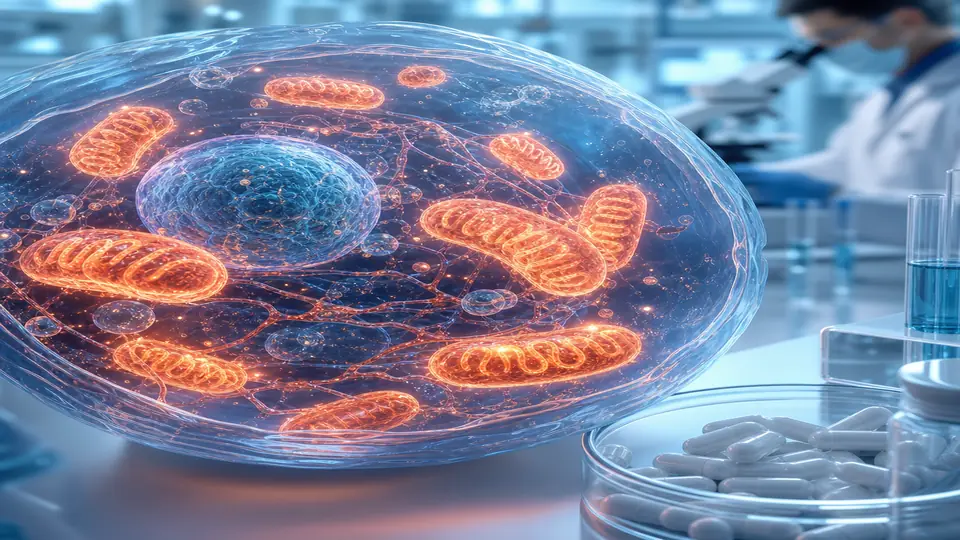
At a Glance
| Feature | Detail |
|---|---|
| Full name | Pyrroloquinoline quinone (PQQ) |
| Mechanism | PGC-1α activation → mitochondrial biogenesis; CREB / NGF signalling |
| Key benefits | Mitochondrial density, cognitive performance, antioxidant defence, NGF support |
| Clinical dose range | 10–20 mg/day (food-derived PQQ disodium salt) |
| Best stacked with | CoQ10 (ubiquinol), NMN or NR, Acetyl-L-Carnitine |
| Safety profile | Well tolerated; mild GI upset at high single doses |
| Evidence level | Human RCTs for cognition and energy; mechanistic data robust |
| Food sources | Fermented soy (natto), kiwi, green pepper, breast milk |
PQQ sits at a unique intersection in integrative medicine: it is not a classic vitamin, yet it behaves like one — a redox-active cofactor found in virtually every living organism. What distinguishes it clinically is the evidence that it can grow new mitochondria, not merely protect existing ones. For patients presenting with post-viral fatigue, cognitive slowing, or accelerated ageing, that distinction changes the therapeutic calculus.
What Is PQQ and Why Does It Matter for Mitochondria?
Pyrroloquinoline quinone was first characterised in 1979 as a bacterial cofactor and was later identified in human breast milk, plants, and fermented foods. For years it was debated whether it constituted a genuine micronutrient; the functional question has since shifted to what it does rather than whether it belongs in the mammalian metabolome.
The mitochondrial story begins with PGC-1α (peroxisome proliferator-activated receptor gamma coactivator 1-alpha) — the master regulator of mitochondrial biogenesis. PQQ activates PGC-1α through a cascade involving DJ-1 protein stabilisation and CREB phosphorylation. In rodent models, PQQ-depleted diets produce measurable reductions in mitochondrial density within weeks; repletion restores it. This is mechanistically distinct from CoQ10, which supports electron transport chain efficiency but does not drive biogenesis.
A second mechanism operates via CREB-dependent nerve growth factor (NGF) signalling. PQQ stimulates NGF synthesis in fibroblasts and astrocytes, a pathway with clear implications for synaptic plasticity and neuroprotection. In a Japanese double-blind RCT (Itoh et al., 2016), 20 mg PQQ daily for 12 weeks improved composite cognitive scores — particularly attention, working memory, and processing speed — in healthy middle-aged adults compared with placebo.
PQQ as a Redox Catalyst
Conventional antioxidants quench free radicals once and are then consumed. PQQ operates as a redox catalyst: it cycles between oxidised and reduced states thousands of times before degradation, continuously scavenging reactive oxygen species. This catalytic recycling capacity is estimated at roughly 5,000 reaction cycles per molecule — orders of magnitude above ascorbic acid. In conditions of high oxidative burden (post-COVID, chronic Lyme, heavy metal exposure), this durability makes PQQ particularly relevant.
Clinical Evidence: Where Is the Signal Strongest?
Cognitive Performance
The most replicated human finding is improvement in attention and memory in adults over 40. The 2016 Itoh RCT, the earlier Itoh pilot (2009), and a 2011 Nakano trial (BioPQQ®, 20 mg/day, 8 weeks) all report statistically significant gains in cognitive composites. Effect sizes are modest but consistent across measures of working memory and mental processing speed — domains that map directly to patient complaints of “brain fog” and “cognitive slowing.”
Important nuance: these trials used food-derived PQQ disodium salt (BioPQQ®, manufactured by Mitsubishi Gas Chemical), not synthetic analogues. This distinction matters for sourcing recommendations.
Energy and Fatigue
An open-label Japanese study (Nakano, 2012) in 17 fatigued adults showed significant reductions in fatigue visual analogue scores after 8 weeks of 20 mg/day PQQ. Objective metabolic parameters (VO₂ measurements, mitochondrial respiration assays) have been explored in cell and animal models but RCT-level metabolic data in humans remain limited. In practice, patients with post-viral syndromes often report subjective energy improvement within 4–6 weeks, though controlled trials in this population are still needed.
Cardiovascular and Inflammatory Markers
A 2013 Rucker et al. review noted that PQQ supplementation in healthy volunteers reduced IL-6, CRP, and urinary methylamine — a marker of oxidative stress. These are surrogate markers rather than hard cardiovascular endpoints, but they support the anti-inflammatory positioning of PQQ in longevity protocols.
Who Benefits Most? Patient Profiles in My Practice
In fifteen years of integrative and longevity medicine, I reach for PQQ most consistently in four patient archetypes:
1. Post-viral cognitive fatigue — Patients recovering from COVID-19, EBV reactivation, or chronic Lyme frequently present with mitochondrial dysfunction confirmed by organic acid testing (elevated succinate, fumarate) and low natural killer cell function. PQQ’s biogenic and antioxidant mechanisms address both the energy deficit and the neuroinflammatory component.
2. Perimenopausal cognitive decline — Oestrogen withdrawal reduces mitochondrial efficiency in hippocampal neurons. Stacking PQQ with DHEA optimisation and phosphatidylserine has produced meaningful improvements in word-recall and task-switching speed in my female patients over 45.
3. Metabolic dysfunction with high oxidative load — In patients with insulin resistance, elevated HbA1c, or non-alcoholic fatty liver disease, mitochondrial density is demonstrably reduced. PQQ addresses the upstream deficit that metformin and berberine do not directly target.
4. Longevity-oriented high performers — In biologically healthy individuals seeking to maintain mitochondrial reserve, PQQ complements NAD precursors and CoQ10 to cover all three pillars of mitochondrial health: substrate supply (NAD⁺), electron transport efficiency (CoQ10/ubiquinol), and structural density (PQQ).
How to Take PQQ: Dosing, Timing & Stacking
Dose
The human clinical literature clusters around 10–20 mg per day. I typically start patients at 10 mg with breakfast and titrate to 20 mg after 4 weeks if no GI discomfort. Higher doses (≥40 mg) have been explored in animal models but offer no demonstrated additional benefit in humans and increase the likelihood of loose stools.
Timing
Take PQQ with food to improve absorption and reduce GI sensitivity. Morning dosing aligns with circadian-driven mitochondrial activity peaks and avoids any rare reports of sleep disruption (possibly related to increased cellular energy metabolism).
The Mitochondrial Stack
PQQ works synergistically across complementary mechanisms:
| Compound | Mechanism | Synergy with PQQ |
|---|---|---|
| Ubiquinol (CoQ10) | Electron transport chain | Improves ETC efficiency in newly generated mitochondria |
| NMN or NR | NAD⁺ restoration, sirtuin activation | Supplies substrate for PGC-1α-driven biogenesis |
| Acetyl-L-Carnitine | Fatty acid transport into mitochondria | Fuels the mitochondria that PQQ builds |
| Alpha-Lipoic Acid | Redox recycling, glucose transport | Complements PQQ’s antioxidant cycling capacity |
| L-Ergothioneine | Intra-mitochondrial ROS scavenging | Actively concentrated inside mitochondria to neutralize hydroxyl radicals and peroxynitrite in newly generated organelles |
In my longevity protocols, the core mitochondrial stack is: ubiquinol 200 mg + NMN 500 mg + PQQ 20 mg, taken together at breakfast. For patients with significant fatigue, I add Acetyl-L-Carnitine 1 g.
Sourcing Quality
Look for products specifying BioPQQ® (PQQ disodium salt) — the form used in the clinical trials. Third-party certificates of analysis confirming absence of pyrroloquinoline-3-carboxylic acid (a manufacturing impurity) are the key quality marker. PQQ degrades rapidly when exposed to light; amber glass packaging is a positive signal.
Safety and Contraindications
PQQ has a clean safety record across human studies up to 20 mg/day. The LD₅₀ in rodents is high, and mutagenicity assays have been negative. Relevant cautions in clinical practice:
- GI sensitivity: At doses ≥40 mg, some patients report nausea or loose stools. Food co-administration resolves most cases.
- Hypoglycaemia risk: Theoretically additive with insulin sensitisers (berberine, metformin). Monitor fasting glucose when combining.
- Pregnancy and lactation: Paradoxically, breast milk is among the richest dietary sources of PQQ, but supplemental doses beyond dietary equivalents have not been studied in pregnancy. Defer to standard caution.
- Drug interactions: No clinically significant CYP450 interactions documented. PQQ is not known to affect anticoagulant metabolism.
Laboratory Monitoring
PQQ supplementation does not require routine labs beyond baseline. In patients with mitochondrial dysfunction syndromes, I track:
- Organic acids test (OAT) at baseline and 3 months: elevation in citric acid cycle intermediates (succinate, fumarate, malate) indicates mitochondrial bottlenecks that resolve with effective treatment
- NK cell function panel: useful in post-viral patients where immune-mitochondrial coupling is relevant
- Cognitive test battery (e.g., CNS Vital Signs or Cambridge Brain Sciences): objective tracking of attention and memory domains
Related Articles
- CoQ10 for Heart Health: Ubiquinol Dosing and Statin Depletion
- Mitochondria: The Engine of Longevity
- NAD⁺ Supplement Guide: NMN, NR, and IV Options Compared
- Post-COVID Brain Fog: Mechanisms and Recovery Protocol
- Acetyl-L-Carnitine for Energy and Cognition
References
- Itoh Y, et al. “Effect of the supplementation of pyrroloquinoline quinone on the cognitive functions in healthy volunteers.” Journal of Nutritional Science and Vitaminology. 2016;62(3):233–238. PMID: 27480564
- Nakano M, et al. “Effect of pyrroloquinoline quinone (PQQ) on mental status of middle-aged and elderly persons.” FOOD Style 21. 2009;13(7):50–53.
- Rucker R, et al. “Biochemical roles of pyrroloquinoline quinone (PQQ) and PQQ-containing proteins in the nervous system: implications for neuroprotection and disease.” Journal of Nutritional Biochemistry. 2021;91:108602. PMID: 33482284
- Harris CB, et al. “Dietary pyrroloquinoline quinone (PQQ) alters indicators of inflammation and mitochondrial-related metabolism in human subjects.” Journal of Nutritional Biochemistry. 2013;24(12):2076–2084. PMID: 24231099
- Chowanadisai W, et al. “Pyrroloquinoline quinone stimulates mitochondrial biogenesis through cAMP response element-binding protein phosphorylation and increased PGC-1α expression.” Journal of Biological Chemistry. 2010;285(1):142–152. PMID: 19861415
- Akagawa M, et al. “Functional role of pyrroloquinoline quinone as an antioxidant cofactor in human fibroblasts.” Free Radical Biology and Medicine. 2016;100:178–187. PMID: 27609246
- Stites TE, et al. “Pyrroloquinoline quinone modulates mitochondrial quantity and function in mice.” Journal of Nutrition. 2006;136(2):390–396. PMID: 16424117