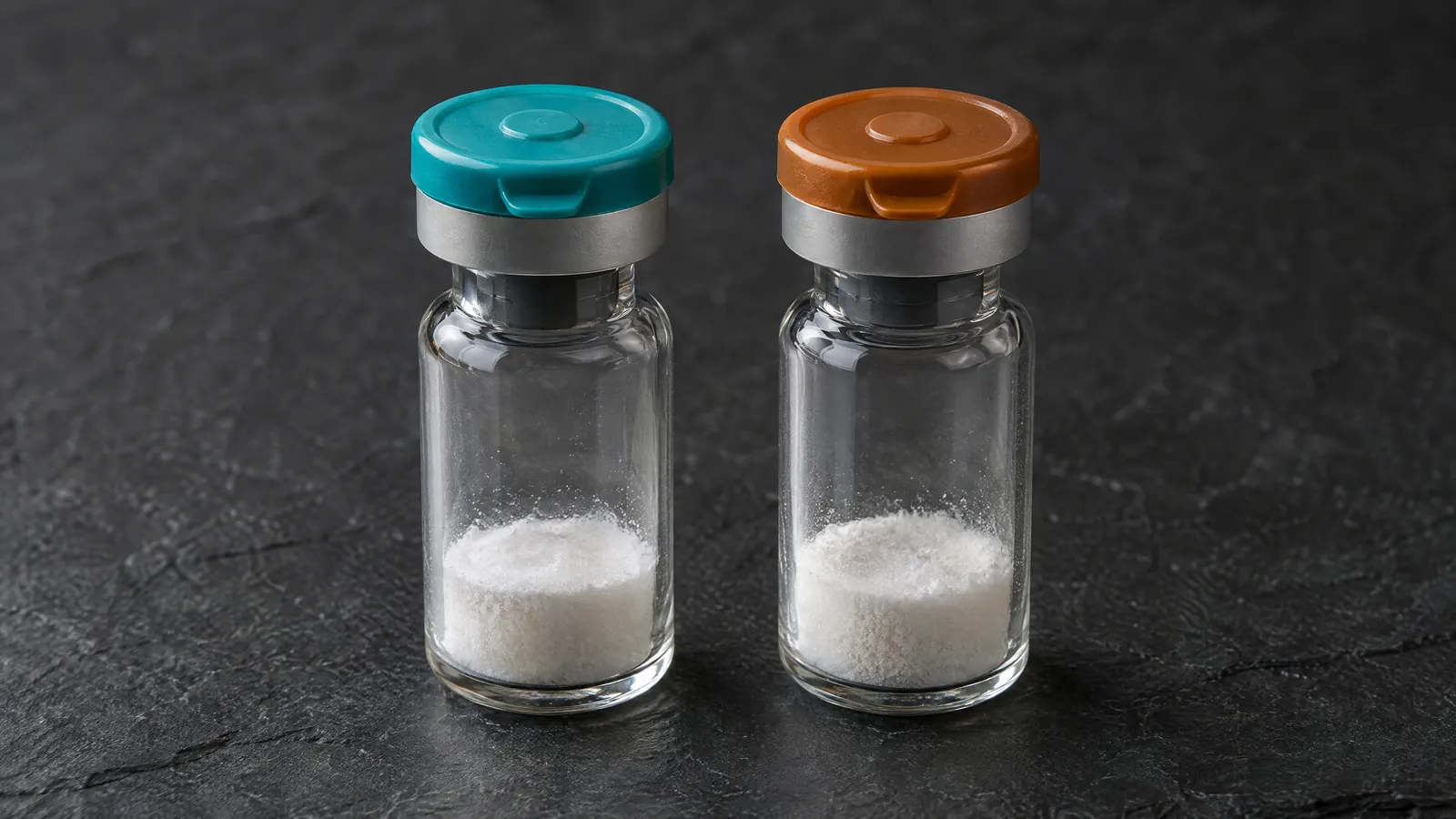
This is the question I hear most frequently from patients who have done their own research on repair peptides: should I use BPC-157, TB-500, or both? It is a reasonable question, and the answer requires understanding what each peptide actually does at the molecular level — because despite both being categorized as “tissue repair peptides,” their mechanisms, evidence bases, and clinical applications are substantially different.
Here is what the evidence shows, what is observed in clinical practice, and how to think about choosing between them.
At a Glance
| Property | BPC-157 | TB-500 |
|---|---|---|
| Origin | Gastric juice (body protection compound) | Thymus gland (thymosin beta-4 fragment) |
| Evidence Level | Emerging (extensive preclinical, minimal human trials) | Emerging (moderate preclinical, minimal human trials) |
| Primary Mechanism | Angiogenesis, growth factor modulation, nitric oxide system | Cellular migration (actin polymerization), anti-inflammation |
| Strongest Evidence For | GI healing, tendon repair, wound healing | Cardiac repair, muscle healing, dermal wound closure |
| Route | Subcutaneous or oral | Subcutaneous |
| Human Trial Data | Very limited | Very limited (TB-500 fragment itself: none) |
| Regulatory | Not approved; FDA safety-risk list; WADA S0 | Not approved; FDA safety-risk list; WADA S2 |
BPC-157: The Gastric Protector
BPC-157 (Body Protection Compound-157) is a synthetic pentadecapeptide derived from a protein found in human gastric juice. It does not exist as a free peptide in the body — it is a stable fragment of a larger gastric protein, engineered for therapeutic stability [1].
Mechanism of Action
BPC-157 operates through several interconnected pathways:
Angiogenesis promotion. BPC-157 upregulates vascular endothelial growth factor (VEGF) expression and stimulates new blood vessel formation. This is fundamental to tissue repair — damaged tissue cannot heal without adequate blood supply. In preclinical models, BPC-157 accelerates angiogenesis in ischemic tissues, healing wounds, and tendon injuries [2].
Nitric oxide system modulation. BPC-157 interacts with the nitric oxide (NO) system, both promoting and protecting NO synthesis depending on the tissue context. This dual role appears to underlie its protective effects on vascular endothelium and its ability to counteract the damage caused by NO synthase inhibitors in animal models.
Growth factor upregulation. BPC-157 increases expression of growth hormone receptor, EGF receptor, and several downstream signaling molecules involved in tissue repair. It appears to coordinate rather than simply amplify the healing response [3].
Cytoprotection. In the gastrointestinal tract specifically, BPC-157 has demonstrated protective effects against virtually every experimental insult tested: NSAIDs, alcohol, acid, ischemia-reperfusion injury, and even surgical anastomosis leakage.
Where the Evidence Is Strongest
The BPC-157 literature spans over 100 published studies, almost entirely preclinical. The strongest evidence exists for:
- Gastrointestinal healing: Gastric ulcers, inflammatory bowel disease models, esophageal damage, anastomotic healing, fistula closure. This is where BPC-157’s gastric origin is most relevant — it appears to have particular affinity for GI tissue repair [1].
- Tendon and ligament repair: Accelerated healing of Achilles tendon, medial collateral ligament, and rotator cuff injuries in rat models. Improved collagen organization and biomechanical strength [4].
- Wound healing: Faster closure, improved tensile strength, enhanced angiogenesis in surgical wound and burn models.
- Neuroprotection: Peripheral nerve healing, protection against traumatic brain injury and spinal cord injury in animal models. I discuss the broader neuroprotective potential in detail here.
Limitations
Let me be honest about what we do not know. Despite over two decades of preclinical research — much of it from a single research group at the University of Zagreb — there are no published Phase II or Phase III human clinical trials for BPC-157 for any indication. The preclinical data is extensive, consistent, and mechanistically coherent. But the history of medicine teaches us that preclinical promise does not guarantee clinical efficacy.
The peptide community has embraced BPC-157 based largely on preclinical data plus clinical observation. Practitioners use it because they see consistent results. But I owe the patients I coach and my readers the honest acknowledgment that “it is seen to work” and “it has been proven in controlled human trials” are different evidentiary statements.
TB-500: The Thymic Healer
TB-500 is a synthetic fragment of thymosin beta-4 (TB4), a 43-amino acid peptide originally isolated from the thymus gland. TB4 is one of the most abundant intracellular peptides in mammalian cells and plays fundamental roles in cellular architecture and motility [5].
Mechanism of Action
Actin polymerization regulation. TB4’s primary function is sequestering G-actin monomers, regulating the dynamic assembly and disassembly of the actin cytoskeleton. This directly controls cell migration, shape change, and division — all essential processes in tissue repair.
Cellular migration promotion. By modulating actin dynamics, TB4/TB-500 promotes the migration of endothelial cells, keratinocytes, and stem cells to sites of injury. It essentially recruits the repair machinery to where it is needed [6].
Anti-inflammatory effects. TB4 downregulates pro-inflammatory cytokines and has been shown to reduce NF-kB activation. This anti-inflammatory action is more pronounced and more systemic than BPC-157’s inflammatory modulation.
Cardiac protection. TB4 is expressed at high levels in the developing heart and has demonstrated cardioprotective effects in multiple models of cardiac injury, including myocardial infarction. It promotes cardiac progenitor cell activation and reduces fibrosis [7].
Where the Evidence Is Strongest
TB-500/TB4 has a more diverse preclinical evidence base:
- Cardiac repair: Post-myocardial infarction recovery, reduced fibrosis, improved ejection fraction in animal models. RegeneRx Biopharmaceuticals conducted early-phase human trials for cardiac applications.
- Dermal wound healing: RGN-137 (a TB4 formulation) reached Phase III clinical trials for epidermolysis bullosa simplex and venous stasis ulcers — making TB4 further along the human clinical development pipeline than BPC-157 for at least one indication [8].
- Corneal repair: RegeneRx also completed Phase II trials for neurotrophic keratopathy (corneal wound healing), with positive results.
- Muscle injury: Accelerated recovery from muscle tears and contusions in animal models.
- Neurological repair: Improved outcomes in traumatic brain injury and stroke models, with evidence of enhanced neurogenesis and oligodendrocyte differentiation.
Limitations
TB-500 shares BPC-157’s fundamental limitation: the bulk of the evidence is preclinical. However, TB4 has progressed further in formal clinical development than BPC-157, with multiple registered clinical trials. The dermal wound healing and corneal applications have human efficacy data, even if the trials were small.
A theoretical concern with TB4 is its effect on cell migration and proliferation. Some researchers have raised the question of whether these properties could theoretically promote tumor cell migration or metastasis. The current evidence does not support this concern — in fact, several studies suggest anti-tumor properties — but it is a question that has not been definitively answered in long-term human use [5].
Head-to-Head Comparison
Tissue Specificity
BPC-157 has particular affinity for the gastrointestinal tract. Its origin in gastric juice and its demonstrated effects across virtually every GI pathology model tested make it the clear choice for gut healing applications. It also shows strong evidence for tendon and ligament repair.
TB-500 is more systemically distributed. Its role in actin regulation means it functions in virtually every cell type, but the strongest clinical signals are in cardiac, dermal, and muscle tissue repair.
Mechanism Complementarity
This is the critical insight: BPC-157 and TB-500 work through fundamentally different mechanisms. BPC-157 builds new blood supply and modulates growth factor signaling. TB-500 recruits cells to the injury site and modulates inflammation. These are sequential and complementary phases of tissue repair.
Think of it this way: TB-500 brings the repair crew to the construction site. BPC-157 builds the road system that allows materials and nutrients to reach them. Both are necessary for optimal repair.
Onset and Duration
In clinical observation:
- BPC-157 tends to show effects within one to two weeks, particularly for GI and tendon applications
- TB-500 often has a somewhat slower onset (two to four weeks) but a more sustained effect, particularly for systemic inflammation and muscle recovery
These observations are clinical impressions, not controlled trial data. Individual variation is significant.
Administration
For informational purposes only — this summarises doses used in research and practice; it is not a prescription or individual medical advice.
BPC-157 can be administered both subcutaneously and orally. Oral administration appears to retain some efficacy, particularly for GI targets, due to the peptide’s unusual stability in gastric acid. Subcutaneous injection near the site of injury is the preferred route for musculoskeletal targets. More on routes in BPC-157 oral vs injection.
TB-500 is administered subcutaneously only. Oral bioavailability has not been demonstrated. Injection does not need to be local to the injury — TB-500’s systemic distribution means subcutaneous injection at any site reaches the target tissue via circulation. Its parent protein, thymosin beta-4, has been studied in formal trials, but the TB-500 fragment itself has no human exposure data according to the FDA.
Can You Combine Them?
Yes. Combination use is common, and practitioners who use both often report it as more effective than either peptide alone. The rationale follows directly from their complementary mechanisms. No controlled study has yet compared the combination with either peptide alone.
When the Combination Is Used
- Post-surgical recovery: BPC-157 for angiogenesis and local tissue healing, TB-500 for cellular migration and systemic anti-inflammation
- Complex musculoskeletal injuries: Especially injuries with both tendon/ligament and muscle involvement
- Post-infectious tissue repair: In patients recovering from Lyme disease or post-COVID with multiple tissue systems affected
- Chronic inflammatory conditions: Where both gut healing (BPC-157) and systemic inflammation reduction (TB-500) are therapeutic goals
A Typical Combination Protocol
For informational purposes only — this summarises doses used in research and practice; it is not a prescription or individual medical advice.
For a tendon injury with concurrent gut inflammation — a common presentation in chronic infection patients — the protocol most commonly used is:
- BPC-157: 250-500 mcg subcutaneous daily, near injury site, plus 500 mcg oral for GI target. Four-to-six-week cycle.
- TB-500: 2.5 mg subcutaneous twice weekly for loading (first two weeks), then 2.5 mg weekly for maintenance. Four-to-six-week cycle.
This protocol is based on clinical observation and extrapolation from preclinical dosing, not human dose-finding studies. I want to be clear about that limitation. Dosing for BPC-157 is discussed in more detail here, and for TB-500 here.
Timing
The loading phases are typically staggered slightly — starting TB-500 first for its anti-inflammatory and cell migration effects, then adding BPC-157 three to five days later for angiogenic and growth factor support. This is based on the logical sequence of tissue repair (inflammation resolution, then cell recruitment, then tissue building) rather than published comparison studies. For a structured approach to running BPC-157 and TB-500 alongside additional peptides such as GHK-Cu or Thymosin Alpha-1, the peptide stacking guide covers phased protocols across the full tissue-repair arc.
Where Each Peptide Fits
BPC-157 shines for gut and tendon. People with NSAID-damaged gut mucosa, leaky gut, or chronic tendinopathy are where the most reliable improvement with BPC-157 is reported. The GI effects are often noticeable within days.
TB-500 shines for muscle and systemic recovery. Athletes with muscle injuries, post-surgical patients, and people with systemic inflammatory conditions are where the most consistent benefit from TB-500 is reported.
Combination produces the broadest coverage. Where tissue damage is multisystem, as after Lyme disease or post-COVID, the combination approach is the one most often used. This rests on clinical observation and mechanism, not a controlled trial.
Individual response varies significantly. Some people respond dramatically to BPC-157 and minimally to TB-500, or vice versa. We do not yet have reliable predictors of response. A pragmatic approach — starting one, assessing response, adding or switching — is what the current evidence level supports.
Peptide quality matters enormously. The unregulated peptide market means that what is labeled as BPC-157 or TB-500 may be degraded, underdosed, or contaminated, and a “research use only” label does not make a product approved or tested for human use. My advice is to insist on pharmaceutical-grade peptides from verified sources. This is not an area where cost savings are worth the risk.
Safety and Considerations
Both peptides have favorable safety profiles in clinical observation, but formal human safety data are missing and several points merit attention. The FDA lists both among compounding substances that may present significant safety risks, citing immunogenicity, impurities and little or no human safety data (for the TB-500 fragment, no human exposure data at all).
BPC-157:
- Generally well tolerated at standard doses
- No significant adverse effects reported in the published preclinical literature
- Theoretical concern: angiogenesis promotion could theoretically support tumor vasculature, so active cancer is a clear reason to avoid it.
- Safety considerations discussed in detail here
TB-500:
- Generally well tolerated
- Mild injection site discomfort and transient fatigue reported occasionally
- Same theoretical concern regarding cell migration and active malignancy
- Has undergone more formal toxicology evaluation than BPC-157 through the RegeneRx clinical development program
Combination:
- No known adverse interaction between the two peptides (formal interaction studies have not been done)
- Combined cost is meaningful — factor this into treatment planning
- Both should be used in defined cycles, not indefinitely, unless ongoing tissue repair is clinically indicated
The Bottom Line
BPC-157 and TB-500 are complementary tools, not competitors. BPC-157 is the gastric peptide that builds blood supply and modulates growth factors — strongest for gut and tendon. TB-500 is the thymic peptide that recruits repair cells and reduces inflammation — strongest for cardiac, muscle, and systemic repair. Combining them leverages both mechanisms. The caveat remains: human clinical trial data is limited for both, neither is approved, and all use is informed by preclinical evidence plus clinical observation. The emphasis belongs on careful monitoring and honest expectations about where the evidence stands.
References
- Sikiric P, et al. Brain-gut axis and pentadecapeptide BPC 157: theoretical and practical implications. Current Neuropharmacology. 2016;14(8):857-865. doi:10.2174/1570159X13666160502153022.
- Seiwerth S, et al. BPC 157 and blood vessels. Current Pharmaceutical Design. 2014;20(7):1121-1125. PMID: 23782145.
- Sikiric P, et al. Stable gastric pentadecapeptide BPC 157: novel therapy in gastrointestinal tract. Current Pharmaceutical Design. 2011;17(16):1612-1632. PMID: 21548867.
- Chang CH, et al. The promoting effect of pentadecapeptide BPC 157 on tendon healing involves tendon outgrowth, cell survival, and cell migration. Journal of Applied Physiology. 2011;110(3):774-780. doi:10.1152/japplphysiol.00945.2010.
- Goldstein AL, et al. Thymosin β4: a multi-functional regenerative peptide. Basic properties and clinical applications. Expert Opinion on Biological Therapy. 2012;12(1):37-51. PMID: 22074294.
- Philp D, et al. Thymosin beta-4 promotes angiogenesis, wound healing, and hair follicle development. Mechanisms of Ageing and Development. 2004;125(2):113-115. PMID: 15037013.
- Bock-Marquette I, et al. Thymosin beta-4 activates integrin-linked kinase and promotes cardiac cell migration, survival and cardiac repair. Nature. 2004;432(7016):466-472. doi:10.1038/nature03000.
- Dunn SP, et al. Treatment of chronic nonhealing neurotrophic corneal epithelial defects with thymosin beta-4. Annals of the New York Academy of Sciences. 2010;1194:199-206. doi:10.1111/j.1749-6632.2010.05471.x.
This content is educational and does not constitute medical advice. BPC-157 and TB-500 are investigational peptides without FDA approval for therapeutic use. They are not authorised by the FDA, EMA or BfArM, and no supplier makes them an approved, tested medicine. Talk to a physician before considering any peptide.