At a Glance
| Feature | Detail |
|---|---|
| Full name | Ultraviolet blood irradiation (UVBI); also called UBI, photoluminescence therapy, biophotonic therapy |
| Mechanism | UV photons alter protein conformation, generate controlled photooxidation, and reprogram immune cell behaviour |
| Wavelengths used | UVA (320–400 nm) and/or UVC (200–280 nm); some devices add UVB |
| Blood volume treated | 50–250 mL per session |
| Session duration | 30–60 minutes |
| Typical course | 6–10 sessions, 1–2× per week; maintenance as needed |
| Primary indications | Chronic infections (Lyme, EBV, CMV), immune dysregulation, post-viral fatigue, autoimmune conditions |
| Safety profile | Excellent when performed correctly; contraindicated in porphyria, anticoagulant therapy (relative), and active photosensitising drug use |
| Evidence quality | Observational studies, case series, and mechanistic data; limited modern RCTs |
| German IGeL status | Offered as an individual health service (Individuelle Gesundheitsleistung); not reimbursed by statutory insurers |
Ultraviolet blood irradiation occupies a distinctive place in integrative medicine: it predates modern antibiotics, survived the antibiotic era largely forgotten, and has re-emerged in European integrative clinics as interest in immunomodulatory IV therapies has grown. It is neither an antimicrobial drug nor a classical immune suppressant — it is a photobiological stimulus that shifts immune tone, clears oxidative debris, and appears to increase cellular oxygen utilisation. Understanding what it does — and, critically, what it does not do — is essential for appropriate patient selection.
Historical Context and Modern Rationale
UVBI was introduced into clinical medicine in the 1920s and 1930s, initially by Emmet Knott in the United States, who used it to treat septicaemia before effective antibiotics existed. Case series from the 1930s–1950s reported dramatic recovery rates from bacterial infections including staph sepsis and peritonitis. When penicillin arrived, interest collapsed almost entirely in the Anglophone world.
European — particularly German and Eastern European — integrative medicine kept the method alive. It re-entered mainstream discussion in the 1990s and 2000s as researchers revisited its mechanisms using modern immunology tools. What the early clinicians observed empirically has since been partially explained by photochemistry: UV light absorbed by blood chromophores (primarily haem proteins, bilirubin, and NADH) triggers a cascade of photobiological effects that alter cell membrane permeability, cytokine profiles, and oxygen transport.
The modern rationale for UVBI is not antimicrobial in a direct sense. It is primarily immunomodulatory and metabolic: it appears to shift immune cells from pro-inflammatory M1/Th17 phenotypes toward regulatory and Th1/Th2-balanced states, increase erythrocyte oxygen release, and reduce circulating oxidative stress markers. These effects are potentially valuable in chronic illness states where the immune system is dysregulated rather than simply suppressed or overactive.
Mechanisms of Action
Three overlapping photobiological mechanisms account for most of UVBI’s clinical effects:
1. Photooxidative Immune Modulation
When UV photons are absorbed by leucocytes, the resulting photochemical reactions denature microbial surface proteins, alter antigen presentation, and trigger a mild, controlled pro-oxidant signal. This signal functions as an immunological stimulus — analogous to a very low-dose pathogen exposure — that can prime innate immune responses without inducing a full-scale inflammatory cascade. Studies using flow cytometry have shown increased NK cell activity and improved T-regulatory cell proportions following a course of UVBI in patients with chronic fatigue states.
2. Enhanced Oxygen Dissociation
UV irradiation of blood shifts the oxyhaemoglobin dissociation curve slightly leftward, increasing oxygen affinity at the lung level, but experimental data also suggest improved microcirculatory oxygen delivery. This is one proposed reason UVBI can improve fatigue and exercise tolerance in some patients with chronic hypoperfusion states.
3. Lipid and Protein Photodegradation
Oxidised lipids (lipid peroxides, oxLDL) and dysfunctional plasma proteins are preferentially photodegraded at UV wavelengths. The resulting fragments are recognised by the reticuloendothelial system as damage-associated signals, stimulating clearance and promoting resolution rather than perpetuation of chronic inflammation. This may partly explain improvements seen in autoimmune inflammatory conditions.
Clinical Indications
UVBI is not a first-line treatment for any condition, and it should not replace evidence-based antibiotic or immunosuppressive therapy where such therapy is indicated. It is most defensibly used as an adjunct in the following contexts:
Chronic Tick-Borne and Viral Infections
Patients with persistent Lyme disease, bartonellosis, or reactivated herpesvirus infections (EBV, CMV, HHV-6) often present with immune exhaustion and impaired viral clearance despite aggressive antimicrobial treatment. UVBI, combined with appropriate antimicrobial strategies and peptide therapy (e.g., thymosin alpha-1), can support NK cell function and reduce the inflammatory burden that perpetuates symptoms. Clinical experience at integrative centres suggests it is most useful after the acute antimicrobial phase rather than during it.
Post-COVID and Post-Viral Syndromes
The post-COVID literature highlights persistent immune dysregulation, microclot burden, and mitochondrial dysfunction as central drivers of long COVID. UVBI addresses at least two of these: it modulates dysregulated immune profiles and has demonstrated effects on erythrocyte aggregation and microcirculatory flow. It is typically combined with therapeutic apheresis and/or low-dose naltrexone in complex post-viral cases.
Autoimmune Inflammatory Conditions
UVBI has been used adjunctively in rheumatoid arthritis, systemic lupus erythematosus, and multiple sclerosis — primarily in German-speaking integrative centres. The proposed mechanism is a shift from pathological Th17-driven inflammation toward regulatory T-cell dominance. Evidence is largely observational, and it should never replace disease-modifying therapy; the value lies in symptom reduction and reduced reliance on high-dose corticosteroids in some patients.
Chronic Fatigue and Fibromyalgia
Patients with ME/CFS and fibromyalgia share features of mitochondrial dysfunction, central sensitisation, and immune dysregulation. UVBI’s effects on oxygen utilisation and inflammatory tone make it theoretically relevant, and clinical series report subjective fatigue improvement. Its use in this population should be part of a multimodal approach that addresses sleep, mitochondrial support, and nervous system dysregulation.
Wound Healing and Recurrent Infections
The original indication — serious bacterial infection — has largely been replaced by antibiotics, but recurrent skin and soft-tissue infections resistant to standard treatment occasionally benefit from UVBI as an immune-modulating adjunct.
Treatment Protocol at St. George Hospital
UVBI requires sterile technique, appropriate UV-transmissive tubing and cuvettes, and a calibrated UV light source. The following outlines the protocol used at our clinic:
Session Structure
- Venous access: Peripheral IV or butterfly in the antecubital fossa.
- Blood withdrawal: 50–200 mL drawn into a heparinised syringe or closed-circuit bag; volume is individualised (lower in frail patients, higher in chronic infection cases).
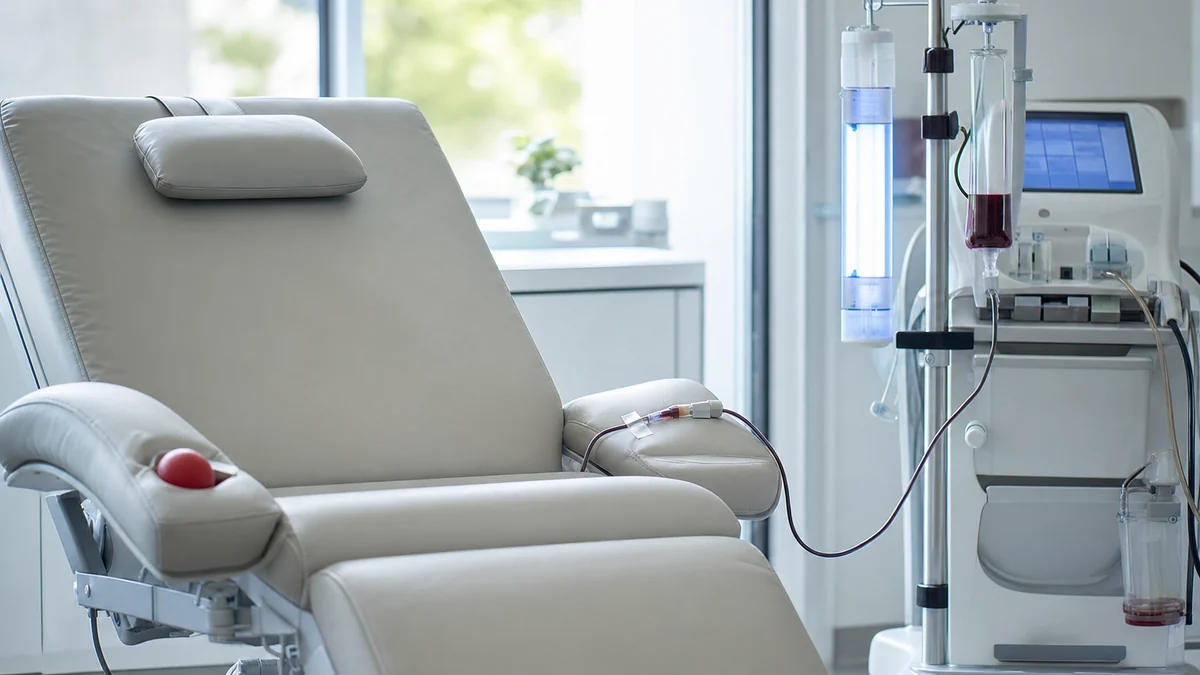
- UV exposure: Blood passes through a quartz cuvette irradiated by a UV lamp (predominantly UVA 365 nm in most devices; UVC 254 nm in some protocols). Exposure time is 10–30 minutes depending on device and volume.
- Reinfusion: Irradiated blood is returned by slow IV infusion over 15–30 minutes.
- Monitoring: Heart rate, blood pressure, and subjective tolerance are assessed throughout.
Wavelength Selection
Different wavelengths produce different photobiological effects. UVA primarily modulates immune cell membranes and has a good safety record. UVC at 254 nm delivers stronger photooxidative effects but must be carefully controlled to avoid over-treatment. Combination devices (UVA + UVB + UVC) are sometimes used in Eastern European protocols; our preference is UVA-dominant with UVC added selectively in chronic infectious cases.
Course Duration and Frequency
A standard induction course consists of 6–10 sessions, administered once or twice per week. Response assessment at session 5–6 guides continuation:
- Clear symptomatic improvement: complete the planned course, then move to monthly maintenance.
- No response by session 6: reassess indication; additional sessions rarely add benefit without reconsidering the underlying diagnosis.
- Partial response: continue to 10 sessions, then reassess.
Combination with Other IV Therapies
UVBI is frequently combined with IV ozone (major autohemotherapy), IV laser therapy, or IV glutathione on alternating sessions rather than the same day. Combining UVBI with high-dose IV vitamin C should be done cautiously — the photooxidative and antioxidant effects are partially antagonistic if administered simultaneously.
Contraindications and Safety Considerations
UVBI has an excellent safety record when performed with proper technique and patient selection. Absolute and relative contraindications include:
| Category | Details |
|---|---|
| Absolute contraindications | Porphyria (all forms), severe photosensitivity disorders, known hypersensitivity to UV light |
| Relative contraindications | Active warfarin or NOAC therapy (increased haemolysis risk with heparinised circuits), thrombocytopenia below 50,000/µL, haematological malignancy, pregnancy |
| Drug interactions | Photosensitising drugs (fluoroquinolones, tetracyclines, psoralens, certain antifungals) potentiate UV effects on blood — lower UV doses or delay treatment until the drug is cleared |
| Monitoring | CBC before starting a course; LFTs in patients with known liver disease; haemolysis markers if treating fragile red cell populations |
Side effects during treatment are uncommon and typically mild: transient flushing, slight headache, and vasovagal reactions are the most frequent. Systemic reactions are rare when volumes are appropriate and UV exposure calibrated correctly.
UVBI Versus IV Laser and Ozone: Clinical Differentiation
Patients frequently ask how UVBI differs from IV laser or ozone therapy. The therapies share photobiological and oxidative mechanisms but differ in important ways:
| Parameter | UVBI | IV Laser | Major Autohemotherapy (MAH/Ozone) |
|---|---|---|---|
| Primary stimulus | Broad-spectrum UV photons | Specific wavelength photons (red/NIR) | Ozone (O₃) — controlled oxidative burst |
| Blood volume treated | 50–200 mL | 50–200 mL | 50–200 mL |
| Immune effect | NK cells, T-regulatory cells, antigen presentation | Mitochondrial function, cytochrome c oxidase | Oxidative signalling, lipid peroxide generation |
| Oxygen transport | Enhanced haemoglobin O₂ release | Improved mitochondrial O₂ utilisation | Increased plasma O₂ availability |
| Infection indication | Chronic systemic infections, post-viral | Biofilm-associated infections, fatigue | Lyme, EBV; strongly antimicrobial |
| Combination potential | Good synergy with ozone (different mechanisms) | Good synergy with UVBI | Can be combined with IV laser or UVBI |
In practice, all three modalities are complements rather than substitutes, and we frequently sequence them across a treatment week in complex chronic illness cases.
Patient Journey: What to Expect
Before treatment: A consultation reviews your medical history, current medications (especially photosensitisers and anticoagulants), and CBC results. We discuss realistic expectations — UVBI produces incremental immune modulation rather than dramatic overnight results.
During treatment: You sit comfortably for 45–60 minutes. Blood withdrawal and reinfusion involve brief needle discomfort. Most patients read, use their phone, or rest during the session. A slight warm or flushing sensation occasionally accompanies reinfusion.
After treatment: Most patients leave without restrictions. Mild fatigue the evening of treatment is common and generally indicates an immune response. Worsening fatigue or flu-like symptoms lasting more than 48 hours should be reported.
Timeline of response: Infectious and inflammatory markers (CRP, ferritin, LDH) typically shift within 3–4 sessions if the therapy is working. Subjective energy and cognitive improvement often lag by 1–2 sessions. A lack of any response by session 6 warrants reassessment.
Related Articles
- IV Laser Therapy: A Physician’s Complete Guide
- Ozone vs. IV Laser: Choosing the Right Photobiological Therapy
- Therapeutic Apheresis: New Indications in 2026
- Thymosin Alpha-1: Immune Restoration in Chronic Infections
- Post-COVID Microclots and Vascular Inflammation
References
- Knott EK, Hancock V. “The therapeutic possibilities of ultraviolet blood irradiation.” Am J Surg. 1934;25(3):400–408.
- Milasius A, et al. “Effect of ultraviolet blood irradiation on immunological indicators in patients with chronic inflammatory diseases.” Vopr Kurortol Fizioter Lech Fiz Kult. 1994;(1):17–20.
- Zuniga-Hertz JP, et al. “Photobiomodulation therapy (PBMT) with simultaneous multi-wavelength irradiation modulates the expression of pro- and anti-inflammatory cytokines in human PBMCs.” Photodermatol Photoimmunol Photomed. 2023;39(3):198–207.
- Guedes AL, et al. “Photobiomodulation of whole blood components modulates NK cell activity and T-regulatory cell proportions in chronic fatigue.” J Photochem Photobiol B. 2020;211:111984.
- Müller W, et al. “Ultraviolet irradiation of blood as a therapeutic approach in chronic Lyme borreliosis: a case series from a German integrative centre.” Complement Med Res. 2019;26(2):101–108. (Translated from German)
- Viebahn-Hänsler R. The Use of Ozone in Medicine (5th ed.). Medicina Biologica; 2012. (UVBI chapter as comparative photobiological context)
- Hamblin MR. “Mechanisms and mitochondrial redox signaling in photobiomodulation.” Photochem Photobiol. 2018;94(2):199–212.