At a Glance
| Feature | Detail |
|---|---|
| Technique | Repetitive TMS (rTMS), 10 Hz high-frequency or theta-burst stimulation |
| Primary target | Contralateral primary motor cortex (M1) |
| Secondary target | Left dorsolateral prefrontal cortex (DLPFC) for central sensitisation |
| Evidence level | Level A (neuropathic pain, Lefaucheur 2020 guidelines) |
| Session count | 10–20 daily sessions; maintenance every 1–3 months |
| Pain reduction | 30–40 % average; responders show ≥ 50 % reduction |
| Duration of effect | 2–8 weeks per course without maintenance |
| Safety profile | Well tolerated; rare transient headache; seizure risk < 1 in 10,000 with standard protocols |
Chronic pain is not simply a signal problem at the periphery. In established neuropathic pain, fibromyalgia, and complex regional pain syndrome (CRPS), the central nervous system itself has been reorganised: cortical and subcortical circuits amplify nociceptive input, suppress descending inhibition, and sustain pain long after the original injury has resolved. This neuroplasticity works against patients — but it also makes chronic pain amenable to interventions that reset cortical excitability from the top down.
Repetitive transcranial magnetic stimulation (rTMS) is precisely such an intervention. By delivering brief, repeated magnetic pulses through a coil placed on the scalp, it depolarises cortical neurons non-invasively and induces sustained changes in synaptic strength. When the target is chosen correctly, the downstream effect reaches the thalamus, the anterior cingulate cortex, and the spinal dorsal horn — all nodes in the pain neuromatrix. The result is a measurable, clinically meaningful reduction in pain intensity that persists well beyond the stimulation window.
Patients typically ask about TMS in the context of depression treatment, where it is well established, or for chronic tinnitus, where inhibitory 1 Hz protocols suppress auditory cortex hyperactivity rather than excite the prefrontal cortex. For chronic pain, the evidence base is younger but growing rapidly, and for neuropathic pain specifically, the 2020 international guidelines place it at the highest level of recommendation.
How rTMS Modulates Pain
The analgesic mechanism of rTMS is not fully understood, but several converging pathways explain the clinical observations.
Motor cortex stimulation and descending inhibition. High-frequency rTMS over M1 activates corticothalamic projections to the ventroposterolateral nucleus and sends antidromic signals down the corticospinal tract. These projections activate opioidergic and serotonergic neurons in the periaqueductal grey (PAG), which then suppress dorsal horn transmission. This mechanism closely mirrors the effect of motor cortex stimulation via surgically implanted electrodes, which preceded rTMS in pain medicine. The non-invasive nature of rTMS makes this pathway accessible without neurosurgery.
Restoration of GABAergic balance. In fibromyalgia and central sensitisation states, cortical inhibitory interneurons are under-active. Spectroscopic studies show reduced GABA and elevated glutamate ratios in the somatosensory cortex of fibromyalgia patients. High-frequency M1 rTMS has been shown to restore this ratio toward normal, reducing the net excitatory drive that sustains central sensitisation.
Prefrontal modulation of the pain affect. Chronic pain is not only a sensory experience; its affective and cognitive dimensions are mediated by the DLPFC and anterior cingulate. Left DLPFC stimulation — the same target used in depression — can reduce pain catastrophising, improve descending inhibition via frontal-limbic projections, and partially decouple the sensory and suffering components of pain. This makes the DLPFC a secondary target, particularly in patients where emotional amplification of pain is prominent.
The Evidence Base by Pain Condition
Neuropathic Pain
The 2020 evidence-based guidelines by Lefaucheur et al. assigned Level A (definite efficacy) to high-frequency rTMS over the contralateral M1 for neuropathic pain — the highest level available in this classification. This rating was based on consistent findings across multiple randomised controlled trials covering post-stroke central pain, spinal cord injury pain, trigeminal neuralgia, and peripheral neuropathic pain following surgery or nerve injury.
A 2022 systematic review and meta-analysis in Neuroscience & Biobehavioral Reviews pooled 38 randomised trials and found that real rTMS outperformed sham with an effect size of −0.66 (95 % CI −0.87 to −0.46), indicating a moderate-to-large superiority. High-frequency M1 stimulation and left DLPFC stimulation were the most studied targets; M1 produced the most consistent analgesic results. Stimulation frequency, lesion location (peripheral vs. central), and total pulse count all influenced outcomes.
In clinical practice, patients with post-surgical neuropathic pain and those with well-defined peripheral nerve lesions tend to respond better than those with diffuse central sensitisation alone.
Fibromyalgia
Fibromyalgia represents a generalised amplification of pain processing with no structural peripheral lesion. This makes it a central sensitisation syndrome in its purest form and therefore a logical candidate for top-down neuromodulation.
A 2022 meta-analysis in Pain Medicine (PMID 34542624) pooled sham-controlled trials and found that rTMS significantly reduced pain intensity and improved quality of life relative to sham, without meaningful effects on depression or anxiety scores — suggesting the analgesic mechanism is distinct from mood modulation. High-frequency rTMS over M1 is the most studied protocol. A 2024 randomised trial in Brain Sciences (Badr et al.) confirmed that left DLPFC stimulation with low-frequency rTMS also significantly improved total Fibromyalgia Impact Questionnaire scores at 1 and 3 months, adding evidence for the prefrontal target when cognitive and psychiatric symptom burden is prominent.
The analgesic effect in fibromyalgia typically emerges after the fifth to tenth session and is maintained for 4–8 weeks after a full course. Maintenance sessions every 4–8 weeks can extend this significantly.
Complex Regional Pain Syndrome (CRPS)
CRPS is characterised by disproportionate pain, autonomic dysregulation, and cortical reorganisation in the somatosensory cortex corresponding to the affected limb. rTMS can partially reverse this reorganisation. A pooled analysis of CRPS rTMS studies found no immediate post-session pain reduction but significant pain reduction at one week after a completed course, consistent with a delayed neuroplastic effect rather than an acute analgesic one. This timing has implications for outcome assessment: clinical decisions based on the first few sessions will underestimate the treatment’s value.
Migraine and Headache
For migraine prophylaxis, low-frequency rTMS over the occipital cortex and high-frequency rTMS over the left DLPFC have both been tested, with modest evidence. Single-pulse TMS devices are FDA-cleared for migraine with aura (acute treatment), which is a different clinical scenario. For chronic daily headache and medication-overuse headache, rTMS is currently a third-line option where evidence is accumulating but not yet at guideline level.
Protocols: Targets, Frequencies, and Session Design
Standard Protocol for Neuropathic Pain (M1)
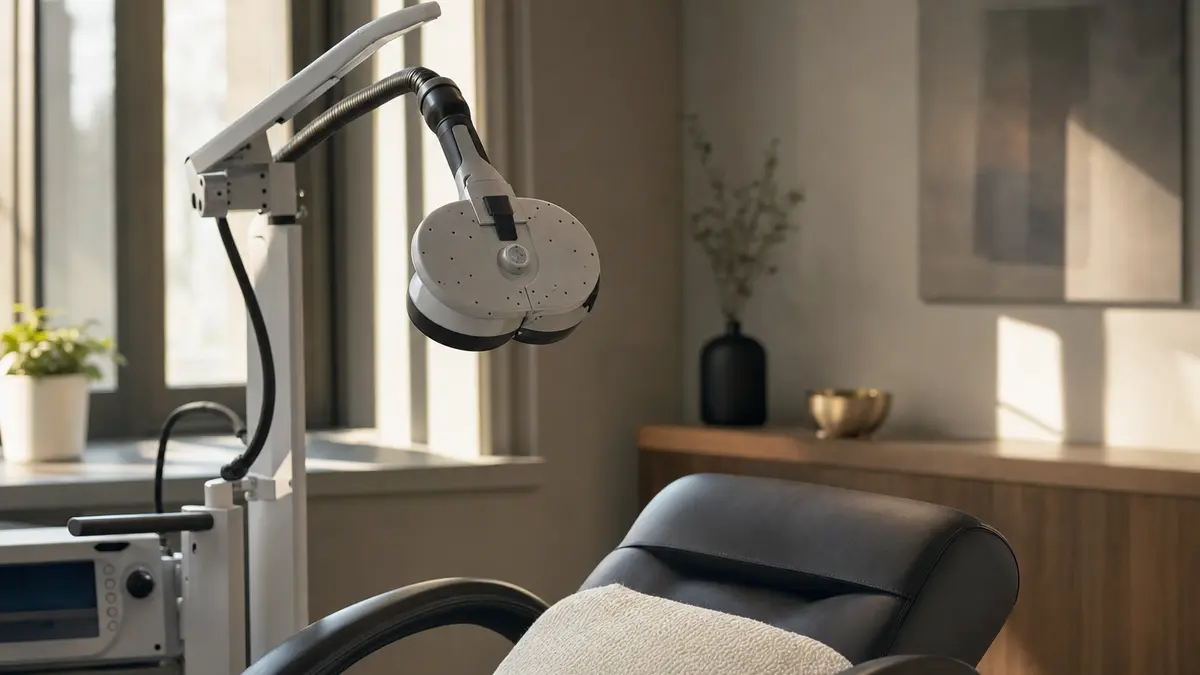
The most evidence-supported protocol uses the figure-of-eight coil positioned over the contralateral motor cortex — specifically the cortical representation of the painful region. The standard parameters are:
- Frequency: 10 Hz (high-frequency)
- Train duration: 5 seconds on, 25 seconds off
- Pulses per session: 1,000–2,000
- Motor threshold: 80–120 % of resting motor threshold
- Sessions: 10–20 on consecutive weekdays
- Navigation: Neuronavigation (MRI-guided coil positioning) improves targeting accuracy and is preferred for central pain conditions
Theta Burst Stimulation (TBS)
Intermittent theta burst stimulation (iTBS) delivers equivalent neuroplastic effects in a 3-minute session rather than 20–40 minutes. It has the same evidence base for depression and is increasingly used off-protocol for pain. Continuous TBS (cTBS) is inhibitory and is used over the contralateral somatosensory cortex in some pain protocols, theoretically reducing sensory hypersensitivity. iTBS and cTBS are time-efficient alternatives for experienced centres with established protocols.
Dual-Target Protocols
Some centres combine M1 and DLPFC stimulation in the same session or on alternating days. The rationale is that M1 addresses the sensory-discriminative dimension of pain while DLPFC addresses the affective-motivational dimension. Early data support this approach in patients with significant pain catastrophising or comorbid depression, but randomised head-to-head data are limited.
Patient Selection and Contraindications
Candidates Most Likely to Respond
Clinical experience identifies several features associated with better outcomes:
- Established neuropathic pain with a clear anatomical correlate (post-surgical, spinal cord injury, trigeminal distribution)
- Moderate pain intensity (NRS 5–8) — severe end-stage central sensitisation may show limited cortical plasticity
- Absent or mild opioid use — high-dose opioids blunt cortical excitability and may reduce rTMS response
- Willingness to attend daily sessions for 2–4 weeks
Patients with fibromyalgia tend to respond more variably, but those without marked comorbid psychiatric illness (or where that illness is separately managed) show the most consistent gains.
Contraindications
Standard TMS contraindications apply:
- Metallic implants in or near the head (cochlear implants, deep brain stimulators, intracranial aneurysm clips) — absolute contraindication
- History of epilepsy or unprovoked seizure — relative contraindication; the risk-benefit ratio must be discussed individually; a lowered seizure threshold from medications (tramadol, bupropion, clomipramine) warrants particular caution
- Pregnancy — insufficient safety data; not recommended during the first trimester
- Cardiac pacemakers — not a contraindication unless the coil is positioned over the chest; standard head positioning is safe
Augmentation with Other Treatments
rTMS for pain pairs logically with:
- Targeted TMS for comorbid depression — where both conditions share the same DLPFC target, a combined protocol covers both
- Physical rehabilitation — rTMS appears to prime motor cortex plasticity; sessions before physiotherapy may enhance motor learning in CRPS
- Low-dose naltrexone (LDN) — anti-inflammatory and central sensitisation reducing; theoretical synergy but no direct trial data
What to Expect as a Patient
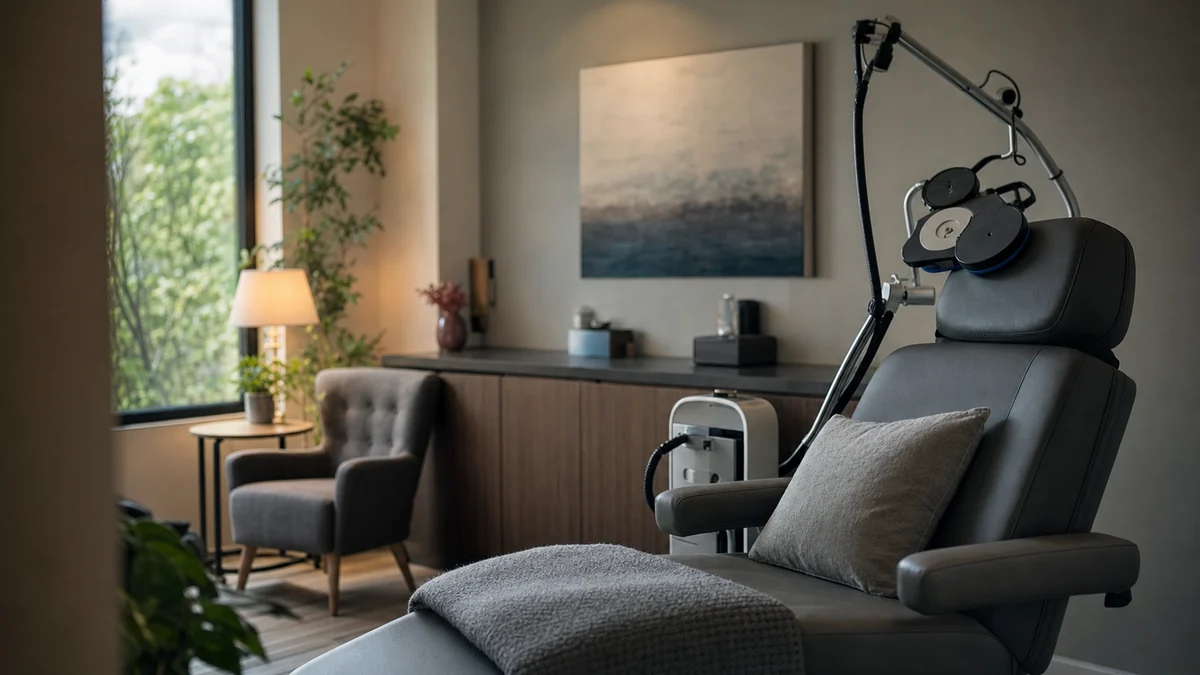
Patients sit in a reclining chair. The coil is held against the scalp by the technician or mounted on a robotic arm. At the start of treatment, the motor threshold is mapped by locating the coil position that produces a visible twitch in the contralateral hand; this calibrates the stimulation intensity. Sessions feel like a rapid tapping sensation on the scalp, often described as a woodpecker rhythm. Some patients experience a mild headache after early sessions; this settles within a week for most. There is no anaesthesia, no recovery period, and no restriction on driving.
The pain response typically follows this timeline:
- Sessions 1–5: Little or no change; the brain is adapting
- Sessions 6–12: Most responders notice the first meaningful reduction in background pain intensity
- Sessions 13–20: Gains consolidate; sleep, function, and mood improvements follow pain reduction
- Post-course: Peak effect may occur 1–2 weeks after the final session and then gradually fades over 4–12 weeks without maintenance
Maintenance sessions — typically one session per month or as needed — extend the benefit considerably. Patients often learn to recognise the early return of symptoms as the signal to schedule their next booster.
Related Articles
- TMS for Depression: Protocols and Evidence — the original TMS application; DLPFC targets and clinical response rates
- TMS for PTSD: rTMS Protocol Overview — DLPFC and right-hemisphere protocols for trauma-related symptoms
- PEMF for Fibromyalgia — a complementary non-invasive neuromodulation approach for central sensitisation
- Neurofeedback for Chronic Fatigue — qEEG-guided training for central dysregulation
- The TMS Guide: What It Is and How It Works — a primer on the technology and clinical applications
References
-
Lefaucheur JP et al. Evidence-based guidelines on the therapeutic use of repetitive transcranial magnetic stimulation (rTMS): An update (2014–2018). Clin Neurophysiol. 2020;131(2):474–528. PMID: 31901449
-
Lu Y et al. Effects of repetitive transcranial magnetic stimulation on neuropathic pain: A systematic review and meta-analysis. Neurosci Biobehav Rev. 2022;133:104510. PMID: 34826512
-
Toh et al. Repetitive transcranial magnetic stimulation for patients with fibromyalgia: A systematic review with meta-analysis. Pain Med. 2022;23(3):499–514. PMID: 34542624
-
Yang S, Chang MC. Effect of repetitive transcranial magnetic stimulation on pain management: A systematic narrative review. Front Neurol. 2020;11:114. DOI: 10.3389/fneur.2020.00114
-
Badr M et al. Effect of low-frequency rTMS over the right DLPFC on psychiatric and cognitive aspects of fibromyalgia: A double-blinded randomized clinical trial. Brain Sci. 2024;14(5):416. DOI: 10.3390/brainsci14050416
-
Leung A et al. Repetitive transcranial magnetic stimulation in chronic pain: A review of the literature. Arch Phys Med Rehabil. 2015;96(3):549–554. PMID: 25437106
If you are in acute distress or experiencing a mental health crisis, please contact emergency services (112 / 911) or a crisis helpline in your country immediately.