At a Glance
| Device | Technology | FDA decision | Indication | Session protocol |
|---|---|---|---|---|
| ProlivRx (Neurolief) | eCOT-NS (peripheral nerve stimulation — trigeminal + occipital) | PMA December 31, 2025 | Adjunctive; ≥1 failed antidepressant | Twice daily, 40 min/session |
| Flow FL-100 (Flow Neuroscience) | tDCS (transcranial direct current stimulation) | PMA December 8, 2025 | Monotherapy or adjunctive; moderate–severe MDD | Daily 30-min sessions, 10-week course |
| In-clinic rTMS / TBS | Pulsed magnetic fields | FDA-cleared since 2008 | Treatment-resistant depression (and multiple other indications) | 20–37 min, 20–36 sessions |
Both new devices require a physician prescription. Neither is the same as the TMS machines used in neuromodulation clinics — a distinction that matters when choosing the right intervention.
The end of 2025 brought a genuine shift in what psychiatrists can prescribe for home use. Within three weeks, the FDA issued premarket approvals for two independent, physician-directed brain stimulation devices — one delivering transcranial direct current stimulation, the other targeting peripheral branches of the trigeminal and occipital nerves. Both are worn as headsets. Both have randomized controlled trial data behind them. And both are frequently — and incorrectly — described in lay media as “at-home TMS.” They are not TMS, and understanding the difference matters for every patient considering them.
This article places the new devices in context, reviews the pivotal trial evidence at a clinical level, outlines patient-selection criteria, and explains where in-clinic TMS with qEEG-guided targeting remains the stronger tool.
Why Clinicians Are Watching At-Home Neuromodulation
Access has long been the Achilles heel of clinic-based brain stimulation. A standard rTMS course requires 20 to 36 visits over four to six weeks, often at specialized centers. For patients in rural areas, those with mobility limitations, or those who cannot take time away from work, this is a real barrier. At the same time, the pool of adults with major depressive disorder (MDD) who have not responded adequately to at least one antidepressant — the FDA’s current threshold for most stimulation therapies — is large and growing.
The two 2025–2026 approvals represent the FDA’s first endorsements of at-home brain stimulation for depression under the most stringent pathway it applies to medical devices: Premarket Approval (PMA), which requires the sponsor to demonstrate reasonable assurance of safety and effectiveness based on valid scientific evidence. This places both devices in a different regulatory category from the many consumer-grade “brain stimulation” gadgets sold online without a prescription.
Physicians prescribing these devices are, in the FDA’s framing, expected to supervise treatment remotely — confirming electrode placement, reviewing response, and adjusting the plan. This physician-directed model is part of what distinguishes them from direct-to-consumer devices.
ProlivRx: What It Is and What the Evidence Shows
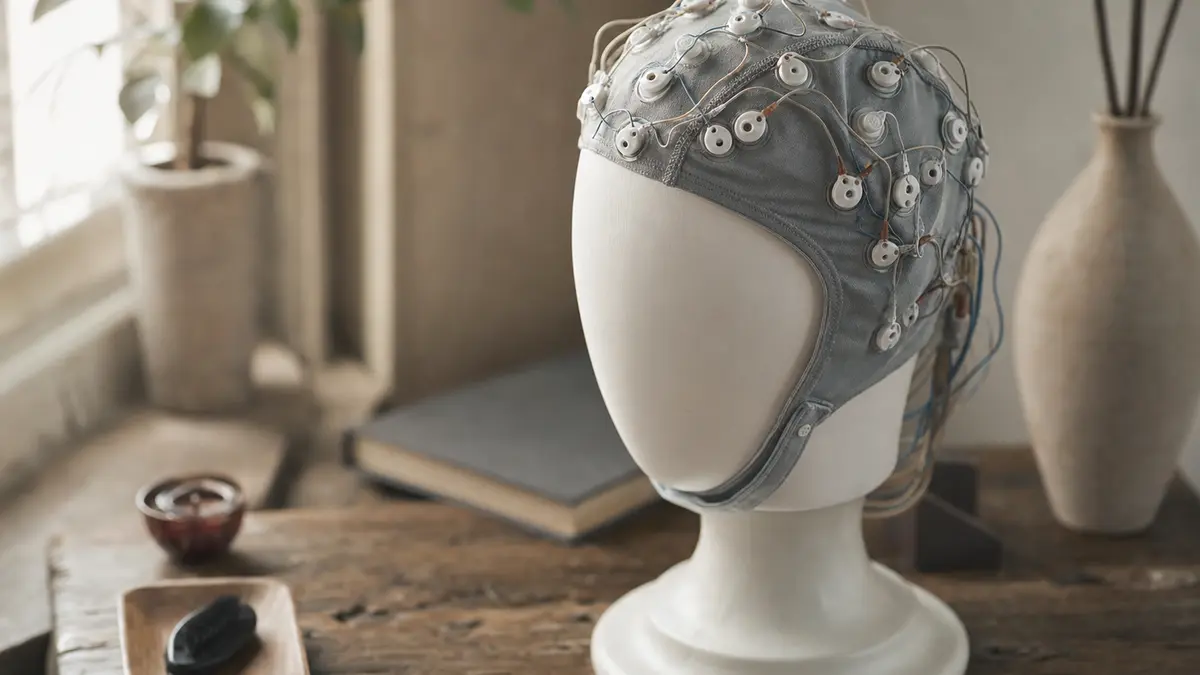
ProlivRx is a soft headset that delivers External Combined Occipital and Trigeminal Nerve Stimulation (eCOT-NS) — a form of transcutaneous electrical nerve stimulation applied through three pairs of electrodes positioned at the forehead and the base of the skull. The mechanism is peripheral rather than cortical: it activates sensory afferents of the trigeminal and occipital nerve branches, which project to brainstem nuclei with well-established connections to limbic circuits involved in mood regulation. This is distinct from TMS, which induces electrical currents in cortical neurons directly through time-varying magnetic fields.
The MOOD Trial
The pivotal evidence for ProlivRx comes from the MOOD study, a double-blind, sham-controlled, multicenter randomized trial conducted at 13 sites across the United States and Israel from September 2021 to June 2024. The trial enrolled 124 adults with MDD and an inadequate response to at least one antidepressant course (baseline HDRS₂₁ score ≥ 20).
Participants were randomized equally to active eCOT-NS or sham stimulation for eight weeks, with twice-daily 40-minute home sessions. The primary outcome was change on the Hamilton Depression Rating Scale–17 item version (HDRS₁₇).
Key findings:
- Mean HDRS₁₇ reduction: 8.62 points (active) vs 6.01 points (sham), p = 0.0196
- Remission at 8 weeks (HDRS₁₇ ≤ 7): 21.3% (active) vs 6.0% (sham), NNT ≈ 7
- In an open-label extension to week 16, remission climbed to 32% in the active group
- Most common adverse event: headache. No serious device-related adverse events reported
The FDA’s review noted a “moderate level of uncertainty” about the magnitude of benefit — appropriate language for a trial of 124 patients with a 2.6-point mean HDRS₁₇ difference. The remission ratio (21.3% vs 6.0%) is clinically meaningful, particularly given the modest drug augmentation achievable at the same treatment stage. The result was published in Brain Stimulation 2025;18(5):1695–1704 (DOI: 10.1016/j.brs.2025.08.022).
Flow FL-100: What It Is and What the Evidence Shows
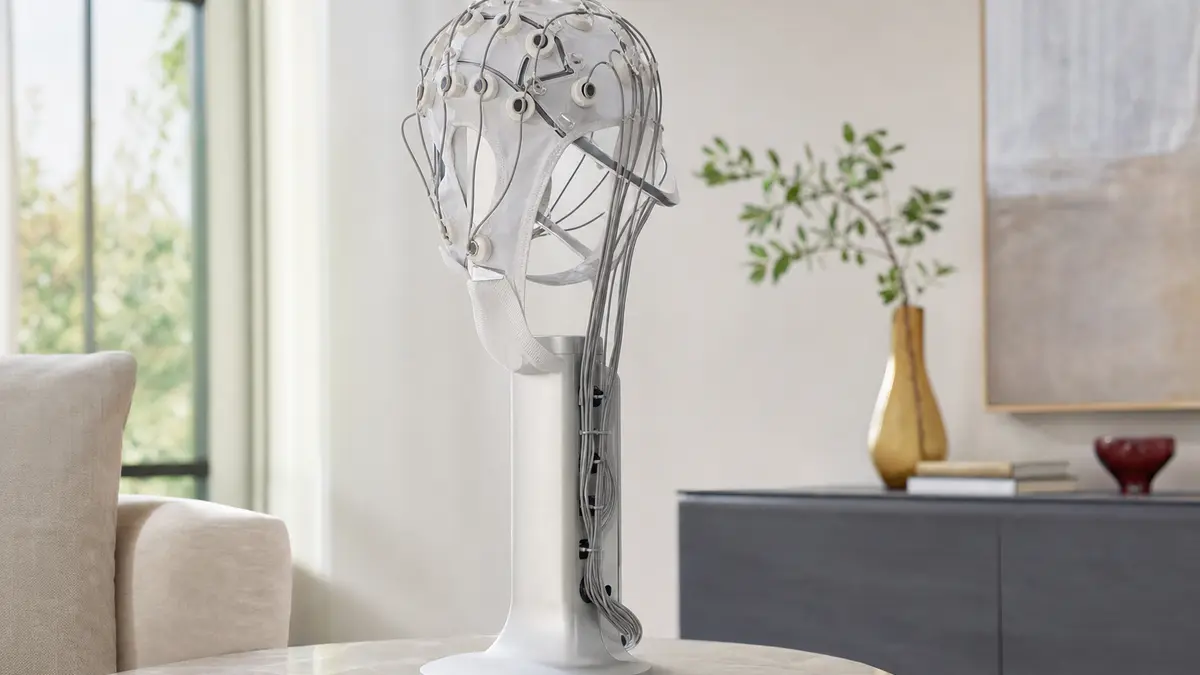
The Flow FL-100 uses transcranial direct current stimulation (tDCS) — a constant low-intensity electrical current (typically 2 mA) delivered through scalp electrodes. The anode is placed over the left dorsolateral prefrontal cortex (DLPFC) and the cathode over the right supraorbital area, the most studied montage for depression. Unlike TMS, tDCS does not trigger action potentials; it modulates neuronal resting membrane potential, with anodal placement increasing cortical excitability.
The Pivotal Trial
The FL-100 approval rests primarily on a large phase 2 fully remote randomized sham-controlled trial published in Nature Medicine (DOI: 10.1038/s41591-024-03305-y; Nat Med 31:87–95, 2025). The trial enrolled 174 adults with moderate-to-severe MDD in the United States and United Kingdom, with participants self-administering daily 30-minute sessions at home over 10 weeks.
Key findings:
- 57–58% remission in the active group at 10 weeks, versus meaningfully lower rates in sham
- Active stimulation produced two to three times higher response and remission rates than sham
- Safety profile comparable to sham; self-administration with remote supervision was feasible across both countries
The FDA approved the FL-100 on December 8, 2025, as both monotherapy and adjunctive treatment for adults 18 and older with moderate-to-severe MDD in a current episode — a broader label than ProlivRx, which requires prior antidepressant failure.
The FL-100 became commercially available in the United States in fall 2026.
”At-Home TMS” Is a Misnomer — Here Is Why It Matters
A wave of press coverage has described both devices as “at-home TMS.” Neither is TMS:
- ProlivRx stimulates peripheral sensory nerves through the skin. No magnetic coil. No cortical activation. The mechanism is fundamentally afferent — brainstem-upward — rather than the direct cortical depolarization that rTMS and TBS produce.
- Flow FL-100 delivers tDCS — a small constant direct current, not the millisecond-duration rapidly alternating magnetic pulses that characterize TMS.
This distinction is clinically important for three reasons. First, true TMS can be spatially targeted to specific cortical circuits with millimeter precision when guided by qEEG brain mapping — matching stimulation parameters to the patient’s identified network dysfunction. Neither at-home device offers this. Second, the evidence base for TMS in treatment-resistant depression runs to hundreds of randomized trials and is consistently robust across meta-analyses (see PMID 39980592), while the new home devices have one or two pivotal trials each. Third, response rates in highly treatment-resistant populations are likely to be lower with weaker stimulation modalities.
Patient Selection: Who Are These Devices For?
ProlivRx is a reasonable first- or second-line adjunct for:
- Adults with MDD who have failed ≥ 1 antidepressant and prefer a non-drug add-on
- Patients who cannot travel to a clinic for TMS but have a physician who will supervise remotely
- Patients in an acute-to-moderate depression episode (HDRS₁₇ ≥ 14) rather than severe or treatment-refractory
Flow FL-100 is appropriate for:
- Adults with moderate-to-severe MDD seeking non-drug monotherapy or augmentation
- Patients earlier in the treatment pathway who want a drug-free option before or alongside first-line antidepressants
- Those who cannot attend a clinic and have adequate health literacy for self-administration
Red flags for home devices — in-clinic TMS (or more intensive evaluation) is preferred when:
- The patient has failed ≥ 3 antidepressant trials (highly treatment-resistant)
- qEEG or functional connectivity imaging shows lateralized network dysfunction requiring targeted stimulation
- The clinical picture includes comorbid chronic infection, neuroinflammation, or autonomic dysregulation that needs a parallel workup
- Suicidal ideation is active — these patients require close monitoring and may need TMS combined with ketamine as a bridging protocol
Anyone in immediate danger should contact emergency services or a crisis line without delay.
Where In-Clinic TMS Still Leads
For patients who have failed multiple antidepressants, the evidence for clinic-based rTMS and theta burst stimulation (TBS) is substantially stronger, and the ability to personalize stimulation remains a critical advantage. A 2025 meta-analysis of five randomized trials in Frontiers in Psychiatry found no clinically meaningful difference between rTMS and TBS in depression outcomes (PMID 39980592), confirming that both are effective tools — the question is which protocol fits the network pathology.
At St. George Hospital, our approach to treatment-resistant depression starts with qEEG brain mapping to identify the dysfunctional network — hypoactivation in left DLPFC is the most common pattern, but posterior cortical and right-hemisphere phenotypes are not rare. We then design a TMS protocol that matches the stimulation target, frequency, and intensity to that individual network signature. This is not something a fixed-electrode home device can replicate.
Ketamine or esketamine may be added as a time-limited bridge for patients in acute suicidal crisis while the TMS course takes effect, but these are never offered as a stand-alone pharmacological strategy. Before any stimulation protocol begins, we also evaluate for treatable biological contributors: inflammatory markers (CRP, cytokine panels), evidence of chronic infection (Lyme disease, co-infections, reactivated viruses such as EBV and HHV-6), and the patient’s relational environment — because an abusive or chronically invalidating relationship drives depression as reliably as any neurochemical imbalance, and no headset corrects that.
Related Articles
- ECT Side Effects and Alternatives: Why TMS and IV Ketamine Are Changing the Standard of Care
- TMS for Depression: The Evidence and What to Expect
- Ketamine-TMS Bridge Protocol for Treatment-Resistant Depression
- qEEG Brain Mapping: How It Guides Personalized TMS
- Accelerated TMS Protocols: Faster Treatment Courses
References
- Roth Y et al. A novel home-based, combined occipital and trigeminal afferent stimulation therapy for major depressive disorder: efficacy and safety results from a double-blind multicenter randomized sham-controlled study. Brain Stimulation. 2025;18(5):1695–1704. DOI: 10.1016/j.brs.2025.08.022
- Alonzo A et al. Home-based transcranial direct current stimulation treatment for major depressive disorder: a fully remote phase 2 randomized sham-controlled trial. Nat Med. 2025;31:87–95. DOI: 10.1038/s41591-024-03305-y
- Brunoni AR et al. US FDA approves home-delivered tDCS for treating depression. Brain Stimulation. 2026;19(1):103021. PMID: 41475514
- Tao X et al. Comparative effectiveness of repetitive transcranial magnetic stimulation and theta burst stimulation for treatment-resistant depression: a systematic review and meta-analysis. Front Psychiatry. 2025;15:1504727. PMID: 39980592
- Bikson M et al. tDCS at home for depressive disorders: an updated systematic review. Eur Arch Psychiatry Clin Neurosci. 2023. PMID: 37191697
- Haimi M et al. Remotely supervised, home-based transcranial direct current stimulation for major depressive disorder: systematic review and meta-analysis. JMIR Ment Health. 2026;13:e92522. DOI: 10.2196/92522