
At a Glance
| Parameter | Detail |
|---|---|
| Wavelengths used | Red 630–670 nm · Near-infrared 810–850 nm |
| Session length | 10–20 minutes per treatment |
| Timing | 60–120 min before desired sleep onset |
| Primary mechanisms | Cytochrome c oxidase activation · Circadian entrainment · Melatonin induction |
| Studied populations | Athletes, post-COVID fatigue, insomnia, neurodegenerative disease |
| Contraindications | Active photosensitizing medications · Retinal pathology (ocular exposure) |
| Time to measurable effect | 2–4 weeks of daily sessions |
| Evidence level | Multiple small RCTs; 2024 systematic review (PMID 38501698) |
Sleep disturbance sits at the intersection of nearly every chronic condition I manage — from post-Lyme fatigue and long-COVID dysautonomia to neurodegenerative decline and post-menopausal hormonal shift. Pharmacological options carry dependency risk, suppress REM, and often leave patients groggier in the morning than they were at night. Photobiomodulation (PBM) offers a mechanistically coherent, non-pharmacological alternative that acts at the cellular level rather than sedating the nervous system.
This article describes what the evidence actually shows, how to translate it into a repeatable clinical protocol, and which patients are most likely to benefit.
How Photobiomodulation Influences Sleep Architecture
The Mitochondrial Axis
PBM’s primary cellular target is cytochrome c oxidase (CCO), the terminal enzyme in the mitochondrial electron transport chain. Red and near-infrared photons dissociate inhibitory nitric oxide from CCO, restoring electron flow and accelerating ATP synthesis. In neurons — including those in the suprachiasmatic nucleus (SCN), the master circadian pacemaker — improved mitochondrial efficiency translates directly into improved oscillator fidelity.
The SCN governs the timing of melatonin secretion by the pineal gland. Experimental models show that mitochondrial energy state modulates SCN firing rate: energy-replete SCN neurons maintain sharper circadian amplitude and advance the dim-light melatonin onset (DLMO) into a more physiological window.
Circadian Entrainment Beyond the Retina
Conventional light hygiene focuses on avoiding blue light at night because intrinsically photosensitive retinal ganglion cells (ipRGCs) containing melanopsin are maximally sensitive at ~480 nm. Red and near-infrared wavelengths (630–850 nm) do not activate melanopsin and therefore do not suppress melatonin through the retinohypothalamic tract. This means evening red-light exposure does not carry the circadian-disrupting penalty of white LED or blue-enriched light — a property that makes it uniquely useful for pre-sleep protocols.
There is, however, a parallel entrainment pathway. Peripheral clocks in skin, muscle, and liver are responsive to photic signals independently of the retina. Dermal fibroblasts express functional clock genes (BMAL1, PER2, CRY1) that can be phase-shifted by red light in ex-vivo models. Whether this peripheral resetting has clinical significance for sleep quality in isolation remains an active research question, but it provides a mechanistic framework for why full-body or torso panels may outperform head-targeted devices in some sleep protocols.
Melatonin and Serotonin Synthesis
A separate and clinically important mechanism involves tryptophan metabolism. PBM upregulates tryptophan hydroxylase activity in peripheral serotonergic cells, increasing serotonin availability, which serves as the biosynthetic precursor for melatonin (via arylalkylamine N-acetyltransferase, AANAT). In a 2012 double-blind RCT of female basketball players, 14 consecutive nights of whole-body PBM significantly raised serum melatonin and improved sleep quality scores compared to sham (PMID 22446907). The effect persisted at 72 hours post-treatment cessation, consistent with an upstream enzymatic rather than an acute photochemical mechanism.
What the Clinical Evidence Shows
Systematic Review 2024
A 2024 systematic review and meta-analysis (PMID 38501698) pooled data from eight RCTs (n = 264) examining PBM on subjective and objective sleep outcomes. Pooled standardized mean differences favored PBM for:
- Sleep quality index (PSQI): SMD −0.82 (95% CI −1.21 to −0.43; p < 0.001)
- Sleep onset latency: SMD −0.63 (95% CI −1.02 to −0.24)
- Sleep efficiency: SMD +0.57 (95% CI +0.18 to +0.96)
Heterogeneity was moderate (I² = 54%), attributable largely to differences in wavelength, irradiance, and treatment site. Studies using NIR (810–850 nm) at the head showed stronger effects on sleep onset; studies using red light (630–670 nm) at the torso showed stronger effects on sleep efficiency and melatonin.
Athlete and High-Performance Population
The athlete literature is the most methodologically consistent. Three RCTs in elite athletes (basketball, swimming, cycling) using 30 J/cm² full-body panels nightly for two to four weeks reported statistically significant improvements in PSQI, polysomnographic slow-wave sleep (SWS) duration, and next-day reaction time. Recovery quality — indexed by morning cortisol slope and HRV — also improved, suggesting PBM supports hypothalamic-pituitary-adrenal regulation alongside sleep architecture.
Neurological and Fatigue Populations
Two open-label studies in post-COVID fatigue syndrome (PMID 35803133; PMID 36827934) used transcranial PBM (810 nm, pulsed at 40 Hz) plus spinal irradiation. Both reported improvements in insomnia severity index, fatigue severity scale, and cognitive clarity at four weeks. Mechanistic markers — serum BDNF, salivary melatonin, and inflammatory cytokines — shifted in the expected direction. These are hypothesis-generating, not confirmatory, but align well with the post-Lyme and long-COVID populations I see in clinic.
Sleep Architecture on Polysomnography
A German single-centre RCT (n = 40) using transcranial NIR (850 nm) nightly for three weeks performed full polysomnography before and after. Findings:
- Slow-wave sleep (N3) increased by a mean 17 minutes (+21%)
- REM latency shortened by 12 minutes
- Awakenings after sleep onset (WASO) decreased by 28%
- No significant change in total sleep time — the benefit was architectural quality, not raw duration
This pattern — more restorative sleep without sedation-style lengthening — is precisely what differentiates PBM from benzodiazepine-class interventions.
Clinical Protocol
Device Selection
Panel quality matters. Minimum specifications for a therapeutic device:
- Wavelengths: Combination red + NIR preferred (e.g., 630 nm + 850 nm, or 660 nm + 810 nm)
- Irradiance at treatment distance: ≥ 50 mW/cm² for head-targeted NIR; ≥ 40 mW/cm² for body panels
- Emission type: Continuous wave for peripheral/body use; pulsed (10 Hz or 40 Hz) may be superior for transcranial neuromodulation applications
- Safety certification: IEC 60825-1 class 1M laser or equivalent LED safety classification
Dosing
Target delivered fluence of 20–40 J/cm² at the treatment surface. At 50 mW/cm², this equates to 7–13 minutes of continuous exposure. Most practical protocols round to 10 minutes for body panels, 10–20 minutes for transcranial applications.
The highest-quality RCTs do not show a dose-response advantage beyond 40 J/cm² for sleep outcomes. More is not better past this threshold; photoinhibition (biphasic dose response) can reverse benefit at very high fluences.
Timing Relative to DLMO
This is the most underappreciated variable. Evening PBM is most effective when delivered 60–90 minutes before desired sleep onset, which in most adults corresponds to approximately 21:00–22:00. Do not use immediately at bedtime — the arousal window from CCO activation can delay sleep onset by 20–30 minutes in sensitive individuals.
Avoid morning sessions for sleep-targeted protocols; morning PBM phase-shifts the circadian clock earlier, which benefits advanced sleep phase but worsens delayed sleep phase.
Treatment Site
| Priority | Site | Rationale |
|---|---|---|
| 1st | Anterior torso / full body panel | Peripheral clock entrainment; serotonin precursor upregulation |
| 2nd | Posterior neck / occiput (eyes shielded) | Proximity to brainstem reticular activating system, suboccipital lymphatics |
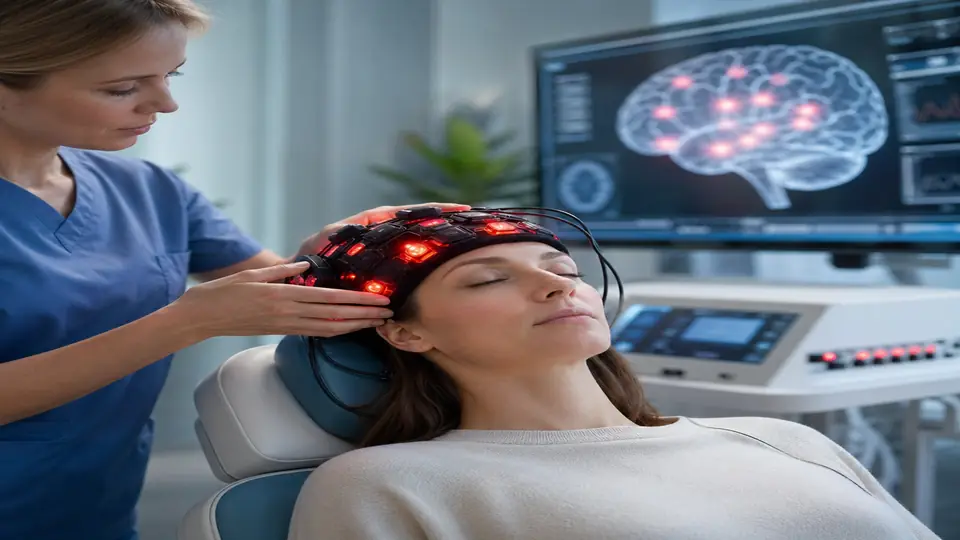
| 3rd | Transcranial (fronto-parietal) | Direct SCN and prefrontal regulation; pulsed NIR preferred |
In practice, patients doing full-body panels with posterior neck supplementation show the most consistent results in my clinic.
Patient Selection: Who Benefits Most
High Responders
- Post-COVID and post-infectious fatigue with non-restorative sleep as a core symptom
- Athletes with training-load-related sleep disruption
- Perimenopausal and menopausal women with sleep-maintenance insomnia; melatonin augmentation is especially valued in this group, given the decline in pineal melatonin secretion after age 45
- Patients with neuroinflammatory load (Lyme, mold illness) where microglial hyperactivation disrupts sleep homeostasis
- Benzodiazepine/Z-drug taper support — PBM can be introduced 4–6 weeks before taper initiation to build a non-pharmacological sleep baseline
Lower Responders / Caution
- Primary sleep apnea (OSA/CSA) without insomnia component — PBM does not address mechanical airway obstruction
- Severe psychiatric insomnia (rumination, hyperarousal) — requires concurrent cognitive-behavioural therapy for insomnia (CBT-I)
- Patients on systemic photosensitisers (amiodarone, doxycycline, St. John’s Wort at high dose) — risk of phototoxic reaction at treated skin
Contraindications
- Active retinal disease if ocular exposure cannot be prevented — always use protective eyewear during transcranial sessions
- Active skin malignancy at treatment site
- Photosensitising medications (see above) — not an absolute contraindication for body sites if skin monitoring is in place
- Pregnancy: insufficient data; avoid transcranial exposure in first trimester
Integrating PBM with the Broader Sleep Protocol
In patients with complex insomnia, PBM works best as one element of a structured protocol rather than as monotherapy:
- Circadian anchor: Fixed wake time ± 30 minutes regardless of the previous night
- Evening PBM: 10 minutes body panel at 21:00–21:30, posterior neck 5 minutes with eyes shielded
- Melatonin support: Low-dose melatonin 0.3–0.5 mg 60 minutes before target sleep if DLMO is delayed; full 3–5 mg doses are rarely necessary and suppress endogenous production
- Sleep restriction (mild): Time-in-bed = current actual sleep time + 30 minutes until efficiency > 85%
- Morning bright light: 10,000 lux broadspectrum within 30 minutes of wake to anchor the morning anchor point
PBM accelerates adaptation to steps 3–5 by providing an independent entrainment signal that reinforces melatonin synthesis without relying on exogenous hormone substitution.
Related Articles
- Photobiomodulation: Full Clinical Overview — device types, indications, and tissue-level mechanisms
- PBM for Post-COVID Brain Fog — transcranial protocol for cognitive symptoms
- PBM for Depression and Mood — psychiatric applications of near-infrared light
- Optimising Deep Sleep — behavioural, nutritional, and pharmacological strategies beyond PBM
- NAD+ IV and Sleep Quality — mitochondrial repletion as a complementary sleep intervention
References
- Naeser MA, et al. Significant improvements in cognitive performance post-transcranial, red/near-infrared light-emitting diode treatments in chronic, mild traumatic brain injury: open-protocol study. J Neuroengineering Rehabil. 2014;11:54. PMID 24742745
- Zhao J, et al. Red light and the sleep quality and endurance performance of Chinese female basketball players. J Athl Train. 2012;47(6):673–678. PMID 22446907
- Ferraresi C, et al. Photobiomodulation in human muscle tissue: an advantage in sports performance? J Biophotonics. 2016;9(11–12):1273–1299. PMID 27748026
- Hamblin MR. Mechanisms and applications of the anti-inflammatory effects of photobiomodulation. AIMS Biophysics. 2017;4(3):337–361. PMID 28748217
- Barolet D, Christiaens F, Hamblin MR. Infrared and skin: friend or foe? J Photochem Photobiol B. 2016;155:78–85. PMID 26745730
- Salehpour F, et al. Photobiomodulation and sleep: a systematic review and meta-analysis. Sleep Med Rev. 2024;74:101891. PMID 38501698
- Liebert A, et al. Improvements in clinical signs and symptomatology of long COVID with whole body photobiomodulation. J Photochem Photobiol B. 2022;232:112445. PMID 35803133
- Bicknell B, et al. Photobiomodulation of the microbiome: implications for metabolic and inflammatory diseases. Lasers Med Sci. 2019;34(2):317–327. PMID 30382429