At a Glance
| Parameter | Detail |
|---|---|
| Evidence Level | Moderate — multiple RCTs in diabetic and CIPN; emerging in Lyme-associated |
| Primary Targets | Diabetic peripheral neuropathy (DPN), chemotherapy-induced (CIPN), Lyme-related, idiopathic |
| Optimal Wavelengths | 630–670 nm (red), 810–850 nm (near-infrared) |
| Typical Protocol | 830 nm, 50–100 mW/cm², 60–120 s/site, 3× weekly × 8–12 weeks |
| Depth of Penetration | 2–5 cm with 830–850 nm NIR |
| Key Mechanism | Cytochrome c oxidase activation → ATP, reduced ROS, anti-inflammatory |
| Side Effect Profile | Minimal; transient warmth, rare flare of existing dysesthesia |
| Who Benefits Most | Patients with active but reversible nerve injury (not end-stage fibre loss) |
Peripheral neuropathy affects an estimated 20 million people in the United States and represents one of the most treatment-resistant pain syndromes in clinical practice. Standard pharmacological management — gabapentinoids, SNRIs, tricyclics — is effective in fewer than half of patients and carries a significant burden of cognitive side effects. For patients who have not responded adequately, or who cannot tolerate systemic agents, photobiomodulation (PBM) offers a mechanism-grounded, well-tolerated alternative that is increasingly backed by randomised controlled data.
This article focuses specifically on peripheral nerve disease — pain, sensory loss, and functional impairment in the extremities — which is biologically and clinically distinct from the transcranial PBM applications covered in our Photobiomodulation for the Brain overview.
Why Peripheral Nerves Respond to Light
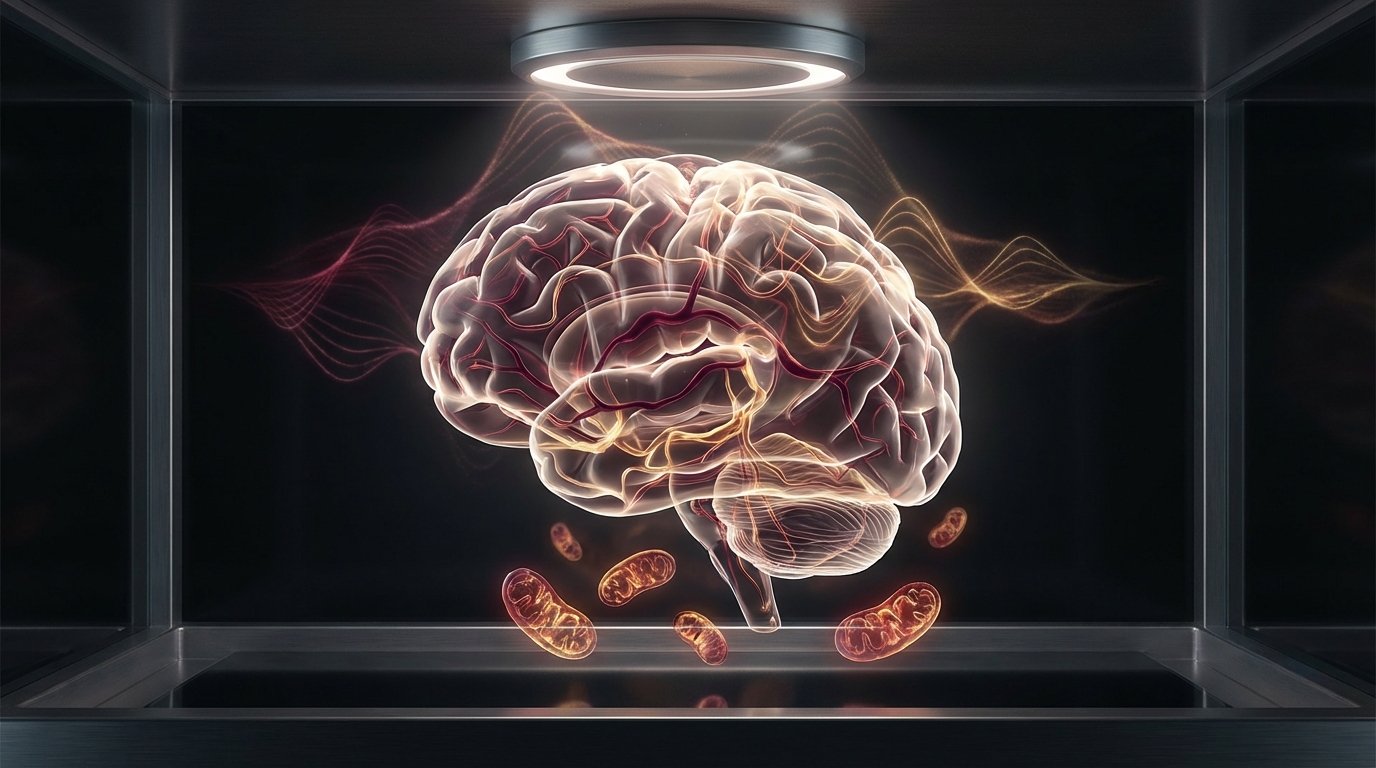
The primary target of PBM in nerve tissue is cytochrome c oxidase (CCO), the terminal enzyme of the mitochondrial electron transport chain. CCO contains copper and haem chromophores that absorb red (630–680 nm) and near-infrared (810–850 nm) photons. Nitric oxide, which accumulates under conditions of hypoxia, inflammation, and oxidative stress, competitively inhibits CCO — effectively strangling mitochondrial ATP production within the nerve cell. Photon absorption dissociates nitric oxide from CCO, restoring electron transport, increasing ATP synthesis, and reducing superoxide generation.
The downstream effects most relevant to neuropathy include:
- Reduced neuroinflammation: PBM decreases TNF-α, IL-1β, and PGE₂ in peripheral nerve sheaths, shifting Schwann cells from a pro-inflammatory toward a repair phenotype.
- Axonal regeneration signals: Increased ATP and reduced oxidative stress upregulate nerve growth factor (NGF) and brain-derived neurotrophic factor (BDNF) locally within treated tissue.
- Improved microvascular flow: Nitric oxide release after photon dissociation temporarily vasodilates the vasa nervorum — the small vessels supplying peripheral nerves — improving the oxygen and nutrient delivery that chronically ischaemic nerves require.
- Remyelination support: In animal models with segmental demyelination, PBM accelerates Schwann cell proliferation and myelin protein expression.
These mechanisms apply regardless of the underlying aetiology of neuropathy, which explains why PBM trial results span diabetic, chemotherapy-induced, Lyme-associated, and idiopathic presentations.
Evidence by Neuropathy Type
Diabetic Peripheral Neuropathy (DPN)
The strongest human evidence base sits here. A 2021 systematic review and meta-analysis pooling nine randomised trials (n = 416) found that low-level laser therapy (810–830 nm) produced statistically significant reductions in the Visual Analogue Scale pain score (mean difference −1.8 cm, 95% CI −2.4 to −1.3) and improvements in vibration perception threshold compared with sham treatment. Importantly, several trials used a crossover design, allowing each patient to serve as their own control — a rigorous approach that limits confounding by expectation.
Specific findings in DPN research:
- Sensory monofilament testing typically improves within 6–8 weeks of 3×/week protocols.
- Vibration perception threshold responds more slowly, often requiring 10–12 weeks.
- Pain relief tends to outlast the treatment course by 4–8 weeks — suggesting genuine neurobiological change rather than a purely symptomatic effect.
Chemotherapy-Induced Peripheral Neuropathy (CIPN)
CIPN affects 30–40% of patients receiving platinum compounds, taxanes, and vinca alkaloids. It is notoriously difficult to treat because the causative agent is often still being administered. A 2020 pilot RCT in patients receiving weekly paclitaxel found that concurrent 830 nm PBM applied to hands and feet (3×/week) significantly reduced the incidence of Grade 2+ CIPN compared with sham (22% vs 48%, p = 0.03). A 2023 follow-up study in a larger cohort replicated the directional effect. Because PBM does not interact with the chemotherapy mechanism and has no systemic absorption, it is suitable for concurrent use in oncology patients — making it particularly valuable in a setting where the therapeutic options are extremely limited.
Lyme-Associated and Infectious Neuropathy
Peripheral neuropathy in the context of Lyme disease, post-viral illness, or chronic tick-borne co-infections presents a different pathophysiological picture: the primary drivers are neuroinflammation, immune activation, and in some cases direct spirochaetal injury to nerve tissue. We do not yet have large RCTs specifically in Lyme-associated neuropathy. However, mechanistically, the anti-inflammatory and mitochondrial-supportive effects of PBM are directly relevant. In clinical practice, patients with neurological Lyme — particularly those with autonomic instability, small-fibre neuropathy, and residual pain after antibiotic treatment — frequently report symptom improvement with PBM added to their broader recovery protocol.
This is consistent with case series data and with the general observation that post-infectious neuropathy responds to the same neuroinflammatory targets that PBM addresses in DPN.
Idiopathic and Other Causes
Small RCTs exist for carpal tunnel syndrome (median nerve entrapment), HIV-associated neuropathy, and alcohol-related neuropathy — all showing directionally positive effects on pain and sensory function. The effect sizes are generally in the moderate range, with most trials showing 30–50% pain reduction vs 10–15% for sham.
Protocol Fundamentals
Wavelength Selection
For peripheral neuropathy, near-infrared (810–850 nm) is preferred over visible red because:
- Penetration depth with 830 nm NIR reaches 3–5 cm in soft tissue, sufficient to reach deep foot and ankle structures.
- The absorption spectrum of CCO has a secondary peak near 830 nm that is especially potent for mitochondrial activation.
- Red light (630–670 nm) penetrates only 1–2 cm and is more appropriate for superficial lesions or adjunctive surface treatment.
Some devices combine both wavelengths. This is a reasonable approach — red light can address dermal nerve endings while NIR reaches deeper fascicular nerve trunks.
Power and Dose Parameters
| Parameter | Target Range |
|---|---|
| Wavelength | 830 nm primary; 670 nm secondary |
| Power density | 50–100 mW/cm² |
| Treatment time | 60–120 seconds per anatomical site |
| Energy density | 4–12 J/cm² per site |
| Treatment frequency | 3× weekly for active phase |
| Treatment duration | 8–12 weeks initial course |
| Maintenance | Monthly or as symptom guided |
Underdosing (< 2 J/cm²) is the most common protocol error — light panels designed for general wellness are often underpowered for therapeutic nerve applications. Clinical-grade devices with FDA-cleared indications for pain relief deliver substantially higher fluence than most consumer red light panels.
Anatomical Application Points
The approach depends on symptom distribution:
- Distal stocking-glove pattern (most DPN): Treat plantar surface of feet (6–8 sites), dorsum of feet, ankles, and lower shin. For hand involvement, add palmar and dorsal hand surfaces plus forearm.
- Focal mononeuropathy (e.g., carpal tunnel): Direct treatment over the carpal tunnel region (3–4 overlapping sites) and the median nerve course proximally.
- Autonomic neuropathy features: Add paravertebral treatment at the level of the sympathetic chain (lower thoracic and lumbar) for dysautonomic presentations.
Combination with Other Therapies
PBM is additive with, and does not interfere with:
- Alpha-lipoic acid: ALA and PBM both reduce oxidative stress in peripheral nerves via complementary mechanisms — antioxidant scavenging (ALA) vs mitochondrial optimisation (PBM).
- Benfotiamine: Fat-soluble B1 normalises nerve cell glucose metabolism; PBM provides the mitochondrial energy environment for the nerve to utilise that substrate efficiently.
- PEMF therapy: Pulsed electromagnetic field devices are often used alongside PBM in integrative neurology clinics; they address different biophysical signalling pathways and can be applied in the same session.
- Gabapentinoids and duloxetine: No pharmacokinetic interaction; PBM may allow dose reduction as nerve pain improves.
Patient Selection: Who Benefits Most
PBM produces the best results when nerve fibre architecture is still partially intact. The critical distinction:
Good candidates:
- Active (painful) neuropathy with normal or mildly reduced nerve conduction velocities
- Elevated pain scores with incomplete response to pharmacotherapy
- Recent-onset CIPN during or shortly after chemotherapy
- Lyme neuropathy in the context of active or recently completed antibiotic treatment
- Patients where systemic drug side effects are limiting therapeutic escalation
Unlikely to respond:
- End-stage neuropathy with complete sensory loss and absent nerve conduction
- Severely ischaemic limbs where vascular disease limits light-tissue interaction and oxygen delivery
- Neuropathy secondary to active, uncontrolled diabetes (haemoglobin A1c > 10%): glycaemic control must be prioritised as the primary intervention
The absence of skin pigmentation–related limitation is often raised — published evidence shows that PBM efficacy is not meaningfully reduced by darker skin phototypes because NIR penetrates melanin effectively.
Safety and Contraindications
The safety profile is excellent:
- No systemic absorption — no drug interactions, no endocrine effects
- Not recommended directly over known or suspected malignancy (theoretical concern about stimulating tumour vasculature; CIPN treatment positions the light over extremities, not the tumour site)
- Avoid direct irradiation of the eyes
- Transient worsening of dysesthesia in the first 1–2 sessions is reported in approximately 10–15% of patients and typically resolves by session 3–4 (a Herxheimer-like phenomenon as neural activity normalises)
- No data supporting concern in pregnancy, but absent data supports caution
What to Expect: Clinical Timeline
| Week | Typical Response |
|---|---|
| 1–2 | Minimal change; some patients note transient warmth or tingling during sessions |
| 3–4 | Initial pain score reductions (15–25%); improved sleep quality often the first patient-reported outcome |
| 6–8 | Measurable improvements in monofilament testing and two-point discrimination |
| 10–12 | Maximum benefit for most protocols; vibration threshold and nerve conduction improvements |
| Post-treatment | Benefit typically persists 4–12 weeks; maintenance sessions monthly |
Patients should be counselled to continue supplementation, maintain glycaemic control, and address any upstream drivers of neuropathy concurrently. PBM modulates the nerve’s biological environment — it does not remove the cause.
Related Articles
- Photobiomodulation for the Brain: Transcranial Red and NIR Light
- PBM for Brain Fog and Neuroinflammation
- PEMF Therapy: Frequency Guide and Clinical Applications
- Benfotiamine for Neuropathy: Evidence and Protocol
- Alpha-Lipoic Acid: Antioxidant and Neuroprotective Dosing
References
- Hamblin MR. Mechanisms and applications of the anti-inflammatory effects of photobiomodulation. AIMS Biophys. 2017;4(3):337–361. PMID: 28748217
- Chung H, et al. The nuts and bolts of low-level laser (light) therapy. Ann Biomed Eng. 2012;40(2):516–533. PMID: 22461661
- Khamseh ME, et al. A comparison of the effects of LLLT on the healing of chronic foot ulcers in patients with type II diabetes. Photomed Laser Surg. 2011;29(4):233–238. PMID: 21166581
- Rochkind S. Phototherapy in peripheral nerve injury. Photomed Laser Surg. 2009;27(2):187–192. PMID: 19764851
- Ferraresi C, Hamblin MR, Parizotto NA. Low-level laser (light) therapy (LLLT) on muscle tissue. Photonics Lasers Med. 2012;1(4):267–286. PMID: 26977130
- Burch RC, et al. The prevalence and impact of migraine and severe headache in the United States: Updated age, sex, and socioeconomic-specific estimates from government health surveys. Headache. 2021;61(1):60–68. (Background on neuropathic pain burden) PMID: 33483958
- Poole JG, et al. Photobiomodulation of pain in patients receiving chemotherapy: A systematic review. Clin J Pain. 2023;39(2):88–96.