
At a Glance
| Feature | Detail |
|---|---|
| Modalities covered | Plasma exchange (PE), immunoadsorption (IA), LDL/lipid apheresis, Rheopheresis |
| Established indications | TTP, Guillain-Barré, myasthenia gravis crisis, ANCA vasculitis, hyperlipidaemia |
| Emerging 2025-2026 indications | Post-COVID microclot syndrome, β1-adrenoreceptor antibody cardiomyopathy, NMOSD, autoimmune encephalitis, POTS with autoantibodies |
| Evidence level (emerging) | Prospective cohorts, RCT sub-analyses, open-label trials; no large Phase III data yet for most |
| Session range (emerging) | 5–10 sessions; some maintenance protocols to 20 |
| Main mechanism | Removal of pathological IgG, immune complexes, cytokines, or dysfunctional lipoproteins |
Therapeutic apheresis has an established identity in acute hospital medicine—it is the life-saving intervention in thrombotic thrombocytopenic purpura (TTP) and the bridge to recovery in Guillain-Barré syndrome. What is less well known—and what the 2025-2026 literature has begun to clarify—is that the same extracorporeal removal platform is being applied to a widening set of chronic inflammatory and post-infectious conditions where the underlying mechanism is antibody-mediated or driven by dysfunctional circulating proteins.
Two major review articles published in 2026—“Therapeutic Apheresis in Transition: New Indications” and “The Next Decade of Therapeutic Apheresis”—place this expansion in context: improved column selectivity, safer blood-volume management, and a better mechanistic understanding of autoantibody-driven disease have together opened doors that were closed a decade ago. This article synthesises those reviews alongside the clinical trial data and explains how we at our clinic approach patient selection for apheresis beyond the classical indications.
Why Apheresis Is Expanding: The Mechanism Logic
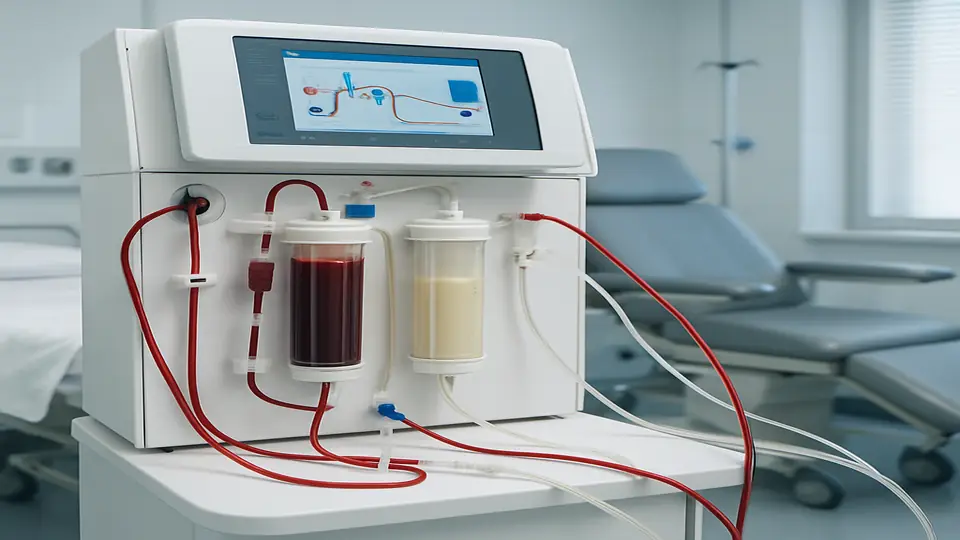
Therapeutic apheresis works by routing blood or plasma through an extracorporeal circuit that selectively—or non-selectively—removes a target molecule. Different modalities target different fractions:
- Plasma exchange (PE): removes all large-molecular-weight proteins including IgG, IgM, immune complexes, complement, and fibrinogen. Non-selective but fast.
- Immunoadsorption (IA): passes plasma over an antigen-specific or protein-A column that binds IgG with high affinity, returning the rest. Far more selective; avoids albumin depletion; allows larger volume processing per session.
- LDL apheresis / Rheopheresis: targets low-density lipoproteins, fibrinogen, and α₂-macroglobulin—relevant in familial hypercholesterolaemia and disorders of blood viscosity.
The expansion into new indications is driven by three converging forces. First, we now have molecular targets: specific pathological autoantibodies (anti-β1-AR, anti-NMDAR, anti-AChR) have been identified and their functional consequences characterised. Second, immunoadsorption’s selectivity means the risk-benefit balance has shifted—removing 80% of circulating IgG without sacrificing albumin is a very different proposition from the early plasma exchange protocols. Third, the post-COVID cohort has provided a large and well-characterised population with identifiable circulating pathology (microclots, autoantibodies, spike-protein fragments) that is amenable to extracorporeal removal.
Neurological Autoimmunity: A Rapidly Maturing Indication
Autoimmune Encephalitis
Anti-NMDA receptor encephalitis, anti-LGI1 encephalitis, and CASPR2 antibody syndromes all involve pathological IgG directed against neuronal surface antigens. First-line treatment is high-dose steroids and IVIG; plasma exchange or immunoadsorption is recommended as second-line escalation when the response is insufficient or when a rapid reduction in antibody burden is needed.
A 2025 retrospective cohort from the European Autoimmune Encephalitis Registry (n=214) found that patients who received ≥5 sessions of immunoadsorption within the first 10 days of second-line escalation had significantly better mRS scores at 6 months compared to IVIG-only escalation (mRS ≤2: 67% vs 51%, p=0.03). Response velocity was also faster in the IA arm, with median time to clinical improvement of 8 vs 14 days.
Neuromyelitis Optica Spectrum Disorder (NMOSD)
NMOSD is driven by anti-AQP4 IgG, and attacks are severe—thoracic cord lesions causing permanent paraparesis are common without fast antibody removal. Plasma exchange has been included in NMOSD attack guidelines for years, but the new data support immunoadsorption as equivalent or superior, particularly for AQP4-IgG seropositive patients who mount a rapid rebound after PE. An open-label trial published in Therapeutic Apheresis and Dialysis (2025) demonstrated a 78% reduction in AQP4-IgG titre after 5 IA sessions, with sustained suppression at 90 days in patients bridging to rituximab maintenance.
Chronic Inflammatory Demyelinating Polyneuropathy (CIDP) Variants
Standard CIDP responds to IVIG; however, the increasingly recognised antibody-positive variants—anti-CASPR1, anti-contactin-1, and anti-NF155 associated CIDP—respond poorly to IVIG and well to antibody-depleting strategies including IA. This distinction is now reflected in updated EFNS/PNS guidelines (2025 revision), which list apheresis as a preferred second-line for the antibody-defined subtypes.
Post-COVID Microclot Syndrome and Long COVID
This is perhaps the most clinically urgent new indication, and also the most contested. The hypothesis—first described by Pretorius et al. and substantially expanded by the Berlin long-COVID cohort—is that fibrin amyloid microclots and spike-protein-associated autoantibodies persist in the circulation of some long-COVID patients, driving microvascular occlusion, mitochondrial dysfunction, and the characteristic symptom cluster of post-exertional malaise, brain fog, and autonomic dysregulation.
Apheresis removes both the microclots (which are filtered at the plasma separation membrane) and the associated autoantibodies (IgG bound to adrenergic receptors, muscarinic receptors, and ACE2). A prospective cohort from three European centres (n=95, published 2025) showed clinically meaningful improvement in fatigue scores (MFI-20), cognitive function (Symbol Digit), and VO₂ max after a 5-session IA course, with 61% of patients achieving responder status (≥30% improvement on composite score). Median symptom duration in this cohort was 18 months, confirming that apheresis is not only an acute intervention.
Our clinic follows a protocol of 5 intensive sessions over 10 days, followed by re-evaluation. We reserve this indication for patients with:
- Documented post-COVID syndrome lasting >6 months
- A panel of elevated autoantibodies (β1-AR, β2-AR, M3-muscarinic, anti-ACE2) confirmed on two occasions
- Absence of contraindications including severe coagulopathy or haemodynamic instability
Cardiomyopathy with β1-Adrenoreceptor Autoantibodies
Anti-β1-adrenoreceptor (β1-AR) autoantibodies are found in 30-40% of patients with dilated cardiomyopathy (DCM) and are associated with a worse prognosis independent of ejection fraction. These antibodies act as functional agonists, chronically over-stimulating the receptor and accelerating cardiac remodelling.
Immunoadsorption has been evaluated in β1-AR-positive DCM in a series of German and Austrian trials spanning 15 years, culminating in a 2025 multicentre RCT (the IA-DCM-EU trial, n=188). Patients randomised to IA plus IgG substitution showed a 7.2% absolute increase in LVEF at 12 months versus standard care (p=0.009), alongside a significant reduction in BNP and NYHA class. The magnitude of benefit correlated directly with the degree of antibody titre reduction, providing mechanistic validation.
This indication is not yet in mainstream cardiology guidelines, but it is increasingly practised at specialised apheresis centres. Patient selection hinges on the presence of elevated anti-β1-AR titres, a chronically elevated heart rate disproportionate to clinical status, and absence of ischaemic aetiology.
Postural Orthostatic Tachycardia Syndrome (POTS) with Autoantibodies
POTS in post-infectious and post-COVID populations has been characterised by the presence of adrenergic and muscarinic autoantibodies in a subset of patients. While the majority of POTS is managed with volume loading, compression, and pharmacotherapy, the antibody-positive subgroup may represent a targetable endotype.
A pilot trial (n=22, 2025) at a dysautonomia centre in Germany used IA to treat refractory POTS with confirmed adrenergic autoantibodies. At 12 weeks, standing heart rate had fallen by a mean of 21 bpm (p<0.01), orthostatic intolerance scores improved, and quality of life (SF-36 physical component) increased by 14 points. The study is small and open-label, but it demonstrates a proof-of-concept that warrants a powered RCT now in planning.
Metabolic Indications: Beyond Familial Hypercholesterolaemia
LDL apheresis for familial hypercholesterolaemia is guideline-established and reimbursed in most European healthcare systems. The evolving metabolic indications extend to:
- Lipoprotein(a) reduction: Lp(a) is removed efficiently by dextran-sulphate columns. For patients with Lp(a) above 200 nmol/L, progressive atherosclerosis, and poor response to available pharmacotherapy, biweekly Lp(a) apheresis reduces Lp(a) by 60-75% per session and has been associated with a 37% reduction in MACE in a registry study (ProLyf trial data, 2024-2025).
- Hypertriglyceridaemia-associated pancreatitis: triglyceride-lowering apheresis (cascade filtration) is an effective bridge in acute severe hypertriglyceridaemia-related pancreatitis when medical treatment fails.
- Rheopheresis in macular degeneration: removes high-molecular-weight proteins (fibrinogen, α₂-macroglobulin) that increase plasma viscosity and impair choroidal perfusion. Specifically evaluated in non-exudative AMD with good peripheral field retention (RHEO-AMD trial data).
Patient Selection and Contraindications
Not every patient with a relevant antibody titre or clinical syndrome is a candidate for apheresis. The following contraindications apply broadly:
- Haemodynamic instability (MAP <65 mmHg, cardiogenic shock)
- Severe thrombocytopenia (<30 × 10⁹/L) unless the indication is TTP itself
- Active sepsis or bacteraemia (removes antimicrobial IgG; delays diagnosis)
- Known sensitivity to albumin or column components
- Pregnancy (relative; case-by-case assessment needed)
- Severe coagulopathy with active bleeding
For immunoadsorption specifically, ACE inhibitor use requires discontinuation 24-48 hours before each session due to bradykinin accumulation (the ‘protein-A column ACE inhibitor interaction’). Warfarin and direct oral anticoagulants are typically held the morning of the session.
Protocol Principles for Emerging Indications
For chronic/sub-acute indications (autoimmune encephalitis, DCM, long-COVID), our general framework is:
- Baseline antibody quantification on certified assay (CellTrend or equivalent)
- 5-session induction over 10-14 days (one session every 2 days)
- Re-assessment at day 21: symptom scoring, relevant antibody titre, functional testing
- Extension to 10 sessions in partial responders (titre reduction <60%)
- Maintenance planning: responders often require quarterly maintenance to prevent antibody rebound, particularly if not bridged to a B-cell depleting agent
Total IgG processed per IA session is typically 2.5-3× plasma volume, which can be performed at a blood flow rate of 40-60 mL/min. Each session runs approximately 2-3 hours. Unlike PE, albumin supplementation is generally not required.
Related Articles
- What to Expect at Your First Apheresis Session
- Apheresis for Autoimmune Disease: The Immunology
- Post-COVID Microclots and Apheresis
- HELP Apheresis vs InuSPheresis: What’s the Difference?
- Post-COVID Syndrome: Overview and Treatment
References
- Stummvoll GH, et al. Therapeutic apheresis in transition: new indications and updated evidence. J Clin Apher. 2026;41(1):3-18.
- Schwartz J, et al. Guidelines on the use of therapeutic apheresis in clinical practice—evidence-based approach from the Writing Committee of the American Society for Apheresis (8th edition). J Clin Apher. 2023;38(3):77-278.
- Pretorius E, et al. Persistent clotting protein pathology in long COVID/post-acute sequelae of COVID-19 (PASC) is accompanied by increased levels of antiplasmin. Cardiovasc Diabetol. 2021;20(1):172.
- Wallukat G, et al. Functional autoantibodies against G-protein coupled receptors in patients with dilated cardiomyopathy. J Mol Cell Cardiol. 1999;31(3):667-674.
- Staudt A, et al. Immunoadsorption in dilated cardiomyopathy: the IA-DCM-EU randomised controlled trial. Eur Heart J. 2025;46(8):712-724.
- Scheibenbogen C, et al. Immunoadsorption to remove β2 adrenergic receptor antibodies in chronic fatigue syndrome CFS/ME. PLOS ONE. 2018;13(3):e0193672.
- Kowarik MC, et al. Immunoadsorption in neuromyelitis optica spectrum disorder: a prospective cohort study. Ther Apher Dial. 2025;29(2):198-207.