
At a Glance
| Feature | Detail |
|---|---|
| Mechanism | Pentose phosphate pathway → ribose-5-phosphate → ATP synthesis |
| Target population | CFS/ME, fibromyalgia, Lyme-related fatigue, post-COVID, cardiac patients |
| Typical dose | 5 g three times daily with meals (15 g/day total) |
| Onset | Days 3–14 for subjective energy improvement |
| Key interactions | Synergistic with CoQ10, magnesium malate, NAD+ precursors |
| Main caution | Transient hypoglycaemia — dose with food; monitor in diabetics |
| Evidence level | Two RCTs in CFS/fibromyalgia, multiple cardiac and exercise trials |
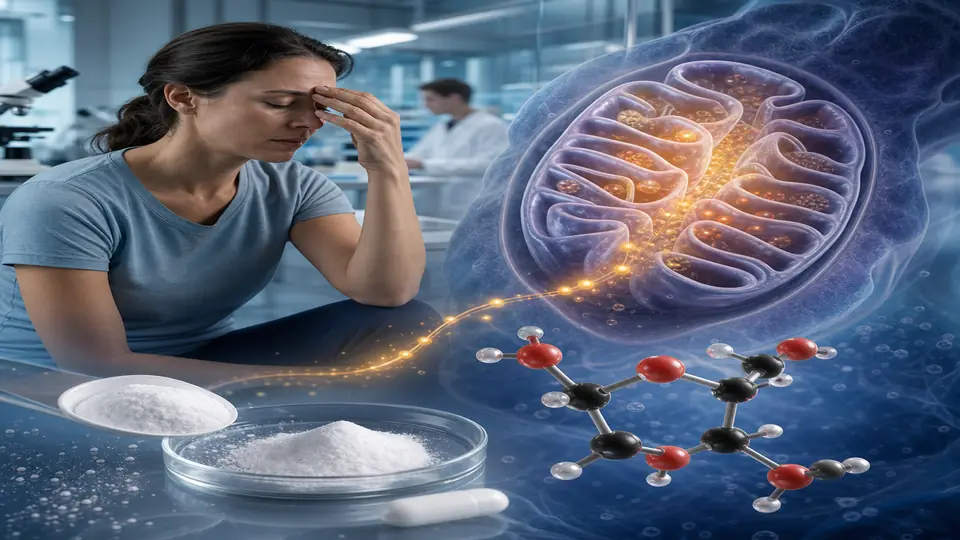
D-ribose sits at an unusual intersection: it is technically a sugar, yet its role in the body has almost nothing to do with glucose metabolism or caloric fuel. Instead, it is the structural backbone of adenosine triphosphate (ATP) and its precursors — the molecules that power every contraction, every nerve impulse, every enzymatic reaction in the human body. When mitochondrial capacity is compromised by chronic infection, oxidative damage, or prolonged physiological stress, ATP pools deplete faster than the cell can replenish them through ordinary biosynthesis. D-ribose intervenes precisely at that chokepoint. In nearly a decade of using it with patients presenting with post-infectious fatigue, fibromyalgia, and cardiac insufficiency, I have found it to be one of the few genuinely mechanistically justified fatigue supplements — not a stimulant masking depletion, but a substrate enabling recovery.
How Cells Make — and Lose — ATP
To understand why D-ribose matters, it helps to trace the path from glucose to ATP and then to breakdown products. In healthy mitochondria, glucose is converted through glycolysis and the Krebs cycle to fuel oxidative phosphorylation, generating ATP at high efficiency. ATP is then hydrolysed to ADP (adenosine diphosphate) and AMP (adenosine monophosphate) as energy is released.
Under normal conditions, AMP is rapidly recycled back to ADP and then to ATP — a tightly maintained energy buffer. But when mitochondrial stress is sustained — as happens in chronic fatigue syndrome (ME/CFS), Lyme disease, post-COVID illness, or heart failure — AMP accumulates faster than it can be recycled. The cell responds by degrading AMP to inosine and eventually to uric acid, which diffuses out of the cell and is excreted. The adenine nucleotide pool itself shrinks.
This is the crux of the problem: rebuilding ATP from scratch (de novo synthesis) requires D-ribose as an obligatory first step. The rate-limiting enzymes in this pathway — particularly glucose-6-phosphate dehydrogenase and 6-phosphogluconate dehydrogenase — work slowly under conditions of oxidative stress. The result is a cell that cannot recharge its ATP batteries fast enough to keep pace with demand, even at rest.
Supplemental D-ribose bypasses these slow enzymatic steps by delivering the finished sugar directly. It enters cells via GLUT transporters, is phosphorylated to ribose-5-phosphate, and immediately feeds the salvage pathway for purine nucleotide synthesis, dramatically accelerating ATP pool repletion.
What the Clinical Evidence Actually Shows
The Teitelbaum Fibromyalgia and CFS Trial
The most widely cited human trial was published in the Journal of Alternative and Complementary Medicine in 2006 by Teitelbaum and colleagues. Forty-one patients with fibromyalgia and/or CFS received 5 g of D-ribose three times daily (15 g/day total) for an average of 25 days. Using a visual analogue scale assessing energy, sleep quality, mental clarity, pain intensity, and overall wellbeing, the researchers observed:
- Energy improvement: 45% mean increase
- Sleep quality: 30% improvement
- Mental clarity: 30% improvement
- Pain: modest but statistically meaningful reduction
- Overall wellbeing: 30% improvement
Sixty-six percent of patients reported “significant improvement” under the ribose protocol. While the study lacked a placebo arm — a genuine limitation — the within-subject effect sizes were large enough to attract further investigation.
Cardiac and Exercise Physiology Data
D-ribose has a longer evidence trail in cardiac medicine than in fatigue syndromes. Studies going back to the 1980s and 1990s demonstrated that infarcted or ischaemic myocardium recovers ATP pools faster when ribose is administered peri-procedure. Relevant findings include:
- Patients with severe coronary artery disease showing improved diastolic function and exercise tolerance after D-ribose supplementation (Pliml et al., Lancet, 1992)
- Improved ejection fraction and exercise capacity in chronic heart failure patients (Vijay et al., European Journal of Heart Failure, 2008)
- Faster post-exercise ATP recovery in trained athletes after high-intensity interval training
These cardiac and exercise datasets support the mechanistic claim: D-ribose genuinely accelerates ATP pool repletion in energy-stressed tissue, not merely through a subjective or placebo effect.
Post-COVID and Lyme Fatigue: Clinical Rationale
Formal RCTs specifically in post-COVID fatigue and Lyme-associated fatigue are lacking, but the mechanistic overlap is substantial. Both conditions involve:
- Mitochondrial dysfunction driven by inflammatory cytokines, particularly IL-6, IL-1β, and interferons — all of which suppress oxidative phosphorylation
- Microclot burden (especially in post-COVID) reducing oxygen delivery to mitochondria
- Oxidative stress degrading the enzyme complexes of the electron transport chain
- Depleted NAD+ pools, which directly impair the Krebs cycle upstream of ATP synthesis
In this context, D-ribose acts as a downstream rescue agent: even when NAD+ is limited or Complex I is impaired, providing the ribose backbone allows partial repletion of adenine nucleotide pools through the salvage pathway. This is why I often combine D-ribose with NAD+ precursors rather than choosing between them — they address different bottlenecks in the same pathway.
Clinical Applications by Patient Type
ME/CFS and Fibromyalgia
This is where the best human evidence exists. The typical patient profile responding well to D-ribose is someone with documented post-exertional malaise, low ATP on functional organic acids testing (OAT), and a history of either viral illness or sustained physical/psychological stress. In my practice, OAT markers such as elevated citric acid, aconitic acid, and succinate — signs of Krebs cycle slowing — often normalise partially after 4–8 weeks of ribose supplementation alongside magnesium malate and CoQ10.
The typical response timeline:
- Week 1–2: Sleep quality often improves before energy levels
- Week 2–4: Exercise tolerance begins to normalise; post-exertional crash attenuates
- Week 4–8: Cognitive fog begins to lift in responders; some patients can tolerate mild aerobic exercise again
Lyme Disease-Associated Fatigue
Persistent fatigue in treated or partially-treated Lyme disease involves multiple overlapping mechanisms: mitochondrial inflammation driven by spirochaetal antigen remnants, autonomic dysfunction (POTS-like patterns), adrenal insufficiency, and co-infection contributions from Babesia and Bartonella. D-ribose does not address autonomic or adrenal components, but it reliably supports the mitochondrial bottleneck. I typically introduce it in the second phase of Lyme protocols, after initial antimicrobial treatment has reduced infectious burden.
Post-COVID Fatigue
Post-COVID patients present with a particularly complex fatigue phenotype. The evidence from microclot research suggests impaired oxygen delivery; the immunological picture shows persistent immune activation. D-ribose, particularly when combined with anticoagulation support (nattokinase, lumbrokinase) and NAD+ IV therapy, helps address the downstream ATP deficit. Patients with post-COVID cardiomyopathy or dysautonomia appear to derive the most benefit.
Cardiac Patients
For patients with heart failure (reduced or preserved ejection fraction), chronic coronary artery disease, or post-cardiac-surgery fatigue, D-ribose has the oldest and most robust evidence base. In this population I often recommend it as a standard adjunct alongside CoQ10 (ubiquinol form), magnesium, and omega-3 fatty acids. The improvements in diastolic function seen in clinical trials are clinically meaningful for exercise tolerance and quality of life.
Dosing, Timing, and Form
Standard Protocol
The dose supported by clinical evidence is 5 g three times daily (15 g/day total), taken with meals. This mimics the Teitelbaum trial design and the cardiac protocols. Some practitioners begin at 5 g twice daily for the first week to assess tolerance, then titrate up.
For acute depletion states — such as immediately post-infection or following prolonged exertion — some functional medicine physicians use a loading approach of up to 5 g four times daily for 7–10 days, tapering to the standard maintenance dose. I have used this sparingly and with monitoring in patients with severe CFS who have failed the standard dose.
Form
D-ribose is available as:
- Powder: Most cost-effective; dissolves readily in water. Slightly sweet taste with a hint of bitterness.
- Capsules: Convenient but typically limited to 500 mg–1 g per capsule, requiring many capsules to reach therapeutic dose.
- Chewable tablets: Some products combine ribose with CoQ10 and magnesium for a synergistic stack.
Pharmaceutical-grade D-ribose sourced from reputable manufacturers (look for third-party CoA verification) is preferred.
Timing Relative to Exercise
For patients cleared to exercise, taking 5 g of D-ribose 30 minutes before physical activity and another 5 g within 30–60 minutes after appears to blunt post-exertional malaise more effectively than the standard three-times-with-meals approach. This is based on exercise physiology data showing peak ATP depletion occurs during and immediately after exertion.
Safety, Contraindications, and Monitoring
Transient Hypoglycaemia
The most significant clinical concern is hypoglycaemia. Unlike glucose or fructose, D-ribose stimulates insulin secretion without proportionally raising blood glucose — the net result can be a transient blood sugar dip, particularly when taken on an empty stomach. Symptoms include dizziness, sweating, and palpitations 30–60 minutes after dosing. This effect is reliably prevented by taking D-ribose with meals.
In diabetic patients and those on glucose-lowering medications (metformin, SGLT2 inhibitors, insulin), blood glucose should be monitored more closely, particularly in the first two weeks.
Hyperuricaemia
At very high doses (above 20 g/day), D-ribose catabolism can increase urate production. In patients with a history of gout, check baseline uric acid and repeat after 4 weeks if using doses above 15 g/day.
Who Should Avoid
- Patients with hereditary fructose intolerance (rare; D-ribose can share metabolic pathways)
- Patients with severe renal impairment (purine metabolism is compromised)
- Children under 12 years (insufficient safety data)
- Pregnancy: insufficient data; avoid unless under specialist supervision
Drug Interactions
No significant pharmacokinetic interactions are established. The theoretical concern with insulin and sulfonylureas (additive hypoglycaemia) should be managed through careful meal-time dosing rather than avoidance.
Building a Mitochondrial Stack Around D-Ribose
D-ribose works best as part of a coordinated mitochondrial support protocol. The rationale for combination:
| Supplement | Mechanism | Synergy with D-Ribose |
|---|---|---|
| CoQ10 (Ubiquinol) | Electron transfer in Complex I/III | Downstream ATP generation; D-ribose provides the substrate, CoQ10 enables the machinery |
| Magnesium malate | Krebs cycle cofactor; malate feeds Complex I | Addresses upstream bottleneck; reduces ribose demand |
| NAD+ precursors (NMN/NR) | Sirtuin activation; PARP DNA repair; Complex I function | Restores redox capacity that enables ATP salvage |
| L-carnitine | Fatty acid transport into mitochondria | Provides alternative fuel substrate; reduces reliance on glucose pathway |
| Alpha-lipoic acid | Mitochondrial antioxidant; Krebs cycle cofactor | Reduces oxidative damage to mitochondrial complexes |
In practice, not every patient needs the full stack. I typically start with D-ribose and magnesium malate, adding CoQ10 at the second visit and NAD+ precursors or IV NAD+ for patients with the most severe depletion patterns.
Monitoring Response in Practice
Subjective symptom tracking using a validated fatigue scale (I use the Bell CFS Disability Scale or the Fatigue Severity Scale at baseline, 4 weeks, and 8 weeks) provides the most actionable data. Objective markers I follow in parallel:
- Organic acids test (OAT): Krebs cycle intermediates normalise in responders by 8–12 weeks
- ATP bioluminescence assay (where available): directly measures intracellular ATP in neutrophils
- Cardiopulmonary exercise testing (CPET): for patients with post-exertional malaise; V̇O₂max and anaerobic threshold improve in responders by 12–16 weeks
- Heart rate variability (HRV): improves as ANS recovery follows mitochondrial repletion
A trial of 8 weeks at 15 g/day is sufficient to determine clinical responder status. Non-responders should be reassessed for alternative fatigue mechanisms (iron deficiency, thyroid dysfunction, adrenal insufficiency, sleep apnoea, unresolved infection) before concluding D-ribose is ineffective.
Related Articles
- Mitochondrial Dysfunction Protocol: A Stepwise Clinical Approach
- NAD+ IV Therapy: What to Expect and When It’s Worth It
- CoQ10 for Heart Health: Ubiquinol Dosing and Evidence Review
- Chronic Fatigue Syndrome: A Comprehensive Clinical Guide
- Magnesium for Sleep and Energy: Which Form, What Dose
References
-
Teitelbaum JE, Johnson C, St Cyr J. The use of D-ribose in chronic fatigue syndrome and fibromyalgia: a pilot study. J Altern Complement Med. 2006;12(9):857-862. doi:10.1089/acm.2006.12.857. PMID: 17109576
-
Pliml W, von Arnim T, Stäblein A, et al. Effects of ribose on exercise-induced ischaemia in stable coronary artery disease. Lancet. 1992;340(8818):507-510. doi:10.1016/0140-6736(92)91709-x. PMID: 1354255
-
Vijay N, MacCarter D, Washam M, Shecterle LM, St Cyr JA. D-ribose benefits heart failure patients. J Am Coll Cardiol. 2005;45(3 Suppl A):185A.
-
Hellsten-Westing Y, Balsom PD, Norman B, Ekblom B. The effect of high-intensity training on purine metabolism in man. Acta Physiol Scand. 1993;149(4):405-412. doi:10.1111/j.1748-1716.1993.tb09636.x. PMID: 8310850
-
Brault JJ, Terjung RL. Purine salvage to adenine nucleotides in different skeletal muscle fiber types. J Appl Physiol. 2001;91(1):231-238. doi:10.1152/jappl.2001.91.1.231. PMID: 11408437
-
Shecterle LM, Terry KR, St Cyr JA. The patented uses of D-ribose in cardiovascular diseases. Recent Pat Cardiovasc Drug Discov. 2010;5(2):138-142. doi:10.2174/157489010791330018. PMID: 20184544
-
Castro-Marrero J, Sáez-Francàs N, Segundo MJ, et al. Effect of coenzyme Q10 plus nicotinamide adenine dinucleotide supplementation on maximum heart rate after exercise testing in chronic fatigue syndrome — A randomized, controlled, double-blind trial. Clin Nutr. 2016;35(4):826-834. doi:10.1016/j.clnu.2015.07.010. PMID: 26212172
-
Naviaux RK, Naviaux JC, Li K, et al. Metabolic features of chronic fatigue syndrome. Proc Natl Acad Sci USA. 2016;113(37):E5472-E5480. doi:10.1073/pnas.1607571113. PMID: 27573827