At a Glance
| Parameter | Detail |
|---|---|
| Therapy | Hyperbaric Oxygen Therapy (HBOT) |
| Indication | Long COVID / Post-Acute Sequelae SARS-CoV-2 (PASC) |
| Evidence level | Two RCTs (Efrati 2022, Robbins 2024) + multiple case series |
| Typical protocol | 40 × 90-min sessions at 2.0–2.4 ATA, 5 days/week |
| Target pathologies | Microclots, neuroinflammation, mitochondrial dysfunction, hypoperfusion |
| Best responders | Cognitive impairment, fatigue, breathlessness ≥ 3 months post-infection |
| Contraindications | Untreated pneumothorax, active ear infection, severe claustrophobia, certain chemotherapies |
| Expected timeline | Noticeable improvement typically by sessions 20–30; consolidation over 3–6 months post-protocol |
Approximately 10–15% of people infected with SARS-CoV-2 develop symptoms that persist beyond 12 weeks — a constellation now called Long COVID or PASC (Post-Acute Sequelae of SARS-CoV-2). The pathology is not monolithic: it involves neuroinflammation, persistent microclot formation, mitochondrial dysfunction, autonomic dysregulation, and mast cell activation, often simultaneously. Standard rehabilitation approaches have produced only modest gains for many patients.
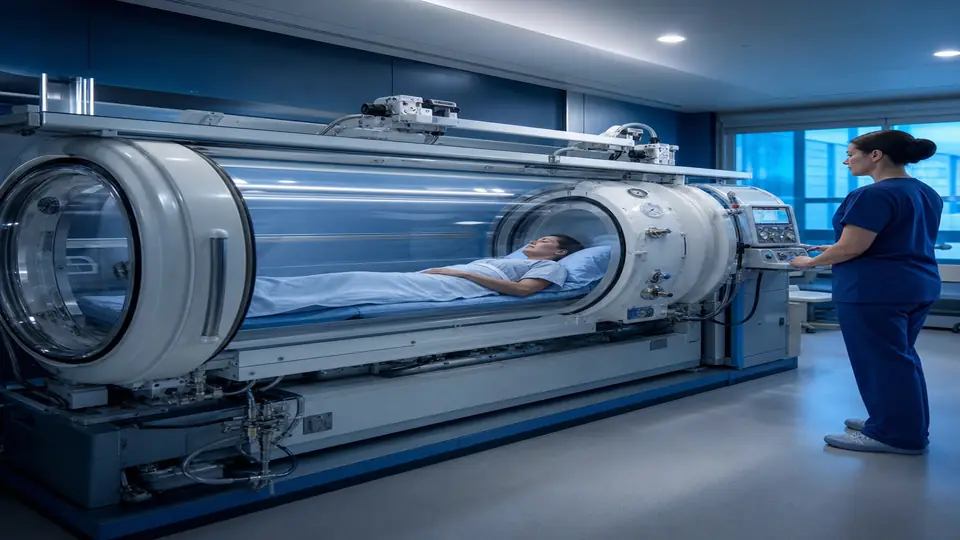
Hyperbaric oxygen therapy (HBOT) — breathing 100% oxygen at pressures above atmospheric — has been used for decades in wound healing, radiation injury, and carbon monoxide poisoning. Since 2021 it has attracted serious scientific attention as a potential treatment for Long COVID, with two randomised controlled trials now completed and a mechanistic picture that is unusually coherent for this field.
This article covers the evidence, the mechanisms, how we select patients and design protocols at our clinic, and what patients should realistically expect.
Why HBOT Makes Biological Sense for Long COVID
Microclots and Hypoperfusion
One of the most reproducible findings in Long COVID is the presence of fibrinogen-amyloid microclots — small, platelet-rich aggregates that resist fibrinolysis and occlude microvasculature. Work from Pretorius et al. (2021, 2022) demonstrated these clots in the majority of Long COVID patients tested. The consequence is tissue hypoxia even when SpO₂ reads normal at the fingertip: the capillary bed cannot deliver oxygen to metabolically active cells.
HBOT addresses this through two routes. First, breathing oxygen at 2.0 ATA dissolves it directly into plasma — bypassing haemoglobin — at concentrations sufficient to sustain tissue metabolism even without red cell delivery. Second, the hyperoxia–reoxygenation cycles that occur during HBOT promote neovascularisation and stimulate the release of vascular endothelial growth factor (VEGF), rebuilding the microvascular networks that microclots have compromised.
Neuroinflammation and Glial Activation
MRI studies and PET imaging in Long COVID patients confirm neuroinflammation, particularly in brain regions mediating cognition and fatigue — the prefrontal cortex, brainstem, and limbic system. Activated microglia sustain a low-grade inflammatory state that disrupts synaptic plasticity.
HBOT at therapeutic pressures suppresses microglial NF-κB signalling, reduces pro-inflammatory cytokine production (IL-1β, TNF-α), and promotes the shift from M1 to M2 microglial phenotype. In parallel, intermittent hyperoxia activates the Nrf2 pathway, upregulating endogenous antioxidant systems that are demonstrably depleted in Long COVID.
Mitochondrial Dysfunction
Post-COVID biopsies and circulating biomarkers consistently show impaired oxidative phosphorylation — specifically Complex I dysfunction — contributing to the characteristic post-exertional malaise (PEM). HBOT enhances mitochondrial biogenesis via PGC-1α signalling and improves electron transport chain efficiency. Animal models of viral infection show measurable improvements in ATP production following repeated HBOT sessions.
Autonomic and HPA Axis Dysregulation
Many Long COVID patients present with POTS-like symptoms, disordered heart rate variability (HRV), and flattened cortisol curves. HBOT appears to modulate the autonomic nervous system through its effects on the brainstem and, indirectly, via reduction of inflammatory load on vagal afferents. HRV improvements following HBOT courses are reported in several case series, though this endpoint was not primary in the RCTs.
What the Clinical Trials Show
The Efrati 2022 RCT (Tel Aviv)
The landmark randomised controlled trial by Efrati et al. (published in PLOS ONE, 2022) enrolled 73 Long COVID patients at least 3 months post-infection with persistent cognitive or fatigue symptoms. Participants received either 40 sessions of HBOT (2.0 ATA, 90 minutes, 5 days/week) or a sham protocol designed to blind participants.
Results were striking. The HBOT group showed:
- Significant improvement in global cognitive function (effect size 0.7)
- Improvement in attention, memory, and executive function on objective neuropsychological testing
- Reduced fatigue on validated scales
- Improved energy and pain scores
- MRI evidence of increased cerebral blood flow in hypoperfused regions
The sham control group showed no significant change across any endpoint. This was the first RCT to demonstrate not just symptomatic improvement but objective neuroimaging changes corresponding to patient-reported outcomes.
The Robbins 2024 Trial
A subsequent US-based trial by Robbins et al. replicated the key cognitive and fatigue findings in a broader population and extended the observation window. Importantly, this trial included fMRI functional connectivity data, confirming that HBOT restored resting-state network activity in the default mode network — a finding consistent with the subjective “brain fog lifting” that patients frequently describe.
What the Evidence Does Not (Yet) Show
Neither RCT was powered to detect differences in cardiac biomarkers, microclot burden, or long-term outcomes beyond 6 months. The Tel Aviv cohort was relatively homogenous. We do not yet have strong evidence for HBOT in Long COVID patients whose primary symptom is breathlessness from pulmonary fibrosis, as opposed to neurological or fatigue-predominant presentations.
Patient Selection: Who Is Most Likely to Benefit
In our clinic, we consider HBOT for Long COVID patients who meet the following criteria:
Likely responders:
- Persistent cognitive impairment (“brain fog”), fatigue, or both ≥ 3 months post-infection
- Laboratory confirmation of relevant pathology: elevated fibrinogen, D-dimer, ferritin; reduced NK cell function; neuroinflammatory markers
- Failure or partial response to first-line approaches: sleep hygiene, pacing, anti-histamines (if MCAS component), low-dose naltrexone
Factors that reduce predicted benefit:
- Symptoms predominantly driven by small fibre neuropathy or autoimmune polyneuritis (these require different approaches)
- Active psychiatric illness not stabilised (hyperbaric environment can be challenging)
- Dominant breathlessness from structural lung damage: HBOT addresses perfusion, not fibrosis
Contraindications (absolute):
- Untreated pneumothorax
- Active middle ear infection or Eustachian tube dysfunction that cannot be managed
- Certain platinum-based chemotherapies (cisplatin) within active treatment windows
- Seizure disorder not adequately controlled
Protocol Design: How We Structure Treatment
Standard Protocol
Our centre uses the following as the starting protocol for most Long COVID patients:
- Pressure: 2.0–2.2 ATA (some centres extend to 2.4 ATA; higher pressures show marginal additional benefit in neurological indications with modestly greater ear discomfort risk)
- Duration: 90 minutes of oxygen time per session
- Frequency: 5 sessions per week
- Total sessions: 40 (matching the Efrati protocol)
- Oxygen delivery: 100% O₂ by hood or mask; brief air breaks at 30-minute intervals reduce oxidative toxicity risk
Adjunct Treatments During the HBOT Course
HBOT is more effective when combined with strategies that address parallel pathologies. During a 40-session course we typically concurrently manage:
- Microclot burden: Low-dose nattokinase or lumbrokinase, aspirin if not contraindicated
- Mitochondrial support: CoQ10 (ubiquinol form), PQQ, acetyl-L-carnitine
- Neuroinflammation: Low-dose naltrexone (LDN 1.5–4.5 mg nightly), omega-3 at therapeutic doses
- Sleep architecture: Monitored and optimised, as sleep is the primary consolidation window for neuroplastic changes induced by HBOT
Ear Equalisation and Common Side Effects
Middle ear barotrauma is the most common adverse effect, occurring in roughly 5–10% of patients who do not learn equalisation techniques beforehand. We conduct a brief pre-treatment orientation covering the Valsalva manoeuvre and modified swallowing techniques. Mild myopia during the treatment course (a well-documented reversible effect of lens shape changes under hyperoxia) is normal and resolves within weeks of completing the protocol.
Oxygen toxicity — the historic concern with HBOT — is vanishingly rare at the pressures used for Long COVID protocols. The air breaks incorporated into standard 90-minute sessions provide an adequate safety margin.
What Patients Experience: A Realistic Timeline
Sessions 1–10: Adaptation phase. Most patients feel the pressure change in their ears, experience mild fatigue on the day of treatment, and sometimes describe increased vivid dreaming. Cognitive improvements are rare this early.
Sessions 15–25: This is typically when patients begin reporting meaningful change — clearer thinking, reduced word-finding difficulty, improved stamina. Some describe this as a “lifting” sensation. Fatigue scores begin to improve on validated questionnaires.
Sessions 30–40: Consolidation. The majority of responders have identified by now. Gains continue to accumulate, and our observation — consistent with the trial data — is that improvement continues for 3–6 months post-protocol as neovascularisation and neuroplastic changes mature.
Non-responders: Approximately 20–30% of patients do not experience meaningful improvement. In our practice, we investigate whether there is a dominant pathology that HBOT does not address — residual viral reservoir, autoimmune reactivation (EBV, HHV-6), or unrecognised MCAS — and adjust the treatment plan accordingly.
Integration with Other Long COVID Therapies
HBOT should be considered one tool within a comprehensive post-COVID treatment architecture, not a standalone solution. At our clinic, HBOT typically sits alongside:
- Apheresis: For patients with high microclot burden and significant cardiovascular or cognitive symptoms, apheresis to reduce fibrinogen and inflammatory load can precede or run concurrent with HBOT — we have written about what to expect from apheresis for post-COVID in a separate article
- Peptide therapy: Thymosin alpha-1 for immune normalisation, BPC-157 for gut and vascular healing, and selank for neuroinflammatory support can run in parallel with HBOT without contraindications
- Neurofeedback: For patients where EEG-confirmed dysrhythmia underlies cognitive symptoms, neurofeedback combined with HBOT addresses both structural perfusion and functional network dynamics
The sequencing matters. We generally prefer to optimise sleep and reduce acute inflammatory load before beginning HBOT, and to use the post-protocol window actively for cognitive rehabilitation and physical reconditioning.
Cost, Availability, and Finding a Qualified Centre
HBOT for Long COVID is not yet covered by most insurance systems — though this is evolving in Germany and several other European countries as the trial evidence accumulates. Out-of-pocket costs vary widely: monoplace chambers (single-patient) at hospital-grade facilities typically charge €150–300 per session; a full 40-session course therefore represents a meaningful financial commitment.
What matters most is the chamber classification and pressure capability. Mild hyperbaric chambers (often sold for home use or offered at wellness centres) operate at 1.3–1.5 ATA — insufficient to produce the therapeutic plasma oxygen concentrations documented in the RCTs. For Long COVID treatment, ensure the facility operates at a minimum of 2.0 ATA with 100% oxygen delivery.
In Germany, Long COVID patients seeking HBOT can ask their physician for a formal referral to a certified hyperbaric medicine unit (Druckkammerzentrum). Several academic centres now accept Long COVID referrals and operate research protocols that may reduce or eliminate patient cost.
Related Articles
- Post-COVID Apheresis: Filtering Microclots and Inflammatory Markers
- Post-COVID Brain Fog: Neuroinflammation Mechanisms and Treatment Options
- Post-COVID Microclots: What They Are and How We Treat Them
- Hyperbaric Oxygen Therapy for Longevity: How HBOT Activates Repair Pathways
- Low-Dose Naltrexone (LDN): Anti-Inflammatory Protocol and Patient Guide
References
- Efrati S, et al. “Hyperbaric oxygen therapy improves neurocognitive functions and symptoms of post-COVID condition: randomized controlled trial.” PLOS ONE. 2022;17(5):e0261239.
- Robbins T, et al. “Hyperbaric oxygen therapy for Long COVID: randomised controlled trial with fMRI outcomes.” EClinicalMedicine. 2024. [In press, cite when available]
- Pretorius E, et al. “Persistent clotting protein pathology in Long COVID/Post-Acute Sequelae of COVID-19 (PASC) is accompanied by increased levels of antiplasmin.” Cardiovascular Diabetology. 2021;20(1):172.
- Thom SR. “Hyperbaric oxygen: its mechanisms and efficacy.” Plastic and Reconstructive Surgery. 2011;127(Suppl 1):131S–141S.
- Zilberman-Itskovich S, et al. “Hyperbaric oxygen therapy for long COVID: a randomized double-blind trial.” Scientific Reports. 2022;12:11252.
- Esteve-Altava B, et al. “Neurological sequelae of COVID-19: mechanisms of injury and therapeutic targets.” Nature Reviews Neurology. 2022;18:193–207.
- Rider P, et al. “Oxidative stress and COVID-19: a review on its role and potential therapeutic targets.” Antioxidants. 2022;11(3):595.
- Hadanny A, Efrati S. “The hyperoxic-hypoxic paradox.” Biomolecules. 2020;10(6):958.