
At a Glance
| Parameter | Detail |
|---|---|
| Mechanism | 100% O₂ at 1.5–3.0 ATA → 10–15× plasma oxygen saturation |
| Session length | 60–90 min per dive |
| Typical course | 20–40 sessions for neurological or longevity protocols |
| Evidence quality | Strong for wound healing; emerging for longevity/neuro |
| Key studies | Efrati 2020 (telomeres), Harch 2019 (PTSD/TBI), Shapira 2021 (post-COVID) |
| Who benefits most | Post-COVID, chronic Lyme, TBI, diabetic ulcers, radiation injury |
| Contraindications | Untreated pneumothorax, certain chemotherapy agents, claustrophobia |
| Cost range | €150–€350/session; packages reduce per-unit cost |
Hyperbaric oxygen therapy (HBOT) has been part of wound care and diving medicine for decades, but the last five years have produced a wave of controlled trials repositioning it as a serious longevity and neurorehabilitation tool. As someone who has referred patients to HBOT chambers and reviewed the literature closely, I want to give you an honest, evidence-graded account — neither the breathless enthusiasm you find on wellness blogs nor the blanket dismissal from mainstream physicians who have not read the recent Tel Aviv data.
The short version: HBOT is a legitimate adjunct for specific indications. For the right patient, integrated into a broader protocol, it can meaningfully accelerate recovery and — based on emerging data — slow some cellular aging processes.
How HBOT Works: The Physiology
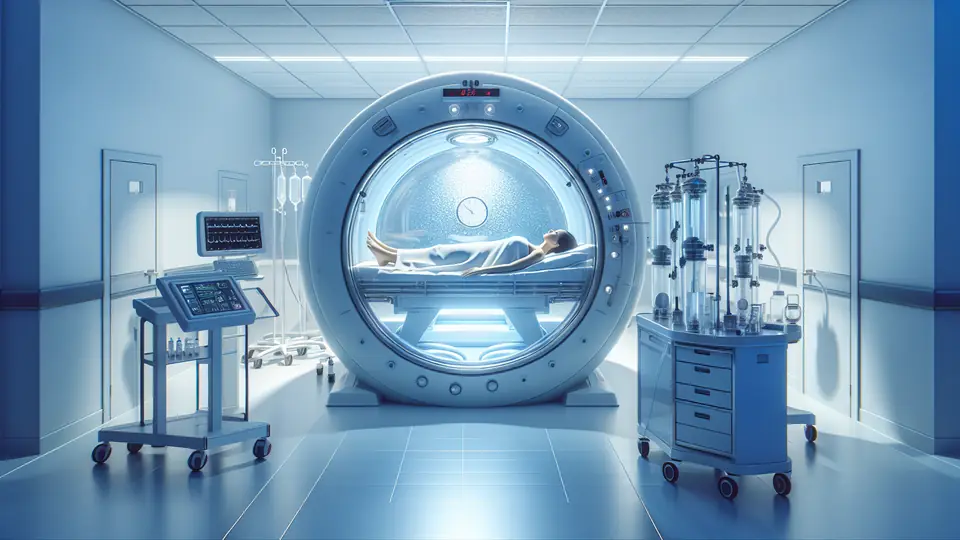
Under normal atmospheric pressure (1 ATA), hemoglobin carries essentially all the oxygen your blood transports. HBOT changes that equation dramatically. Inside a chamber pressurized to 2.0–2.4 ATA while breathing 100% oxygen, plasma oxygen tension rises from roughly 100 mmHg to 1,400–2,000 mmHg. That is 10–15 times the oxygen dissolved directly in plasma — independent of hemoglobin.
This “oxygen flood” does several things simultaneously:
- Hypoxic tissue rescue: Swollen, inflamed, or poorly perfused tissue — which haemoglobin cannot adequately oxygenate — receives oxygen via dissolved plasma delivery. This is why HBOT has decades of evidence in diabetic foot ulcers and radiation necrosis.
- HIF-1α and angiogenesis: Repeated cycles of hyperoxia followed by return to normobaric conditions activate hypoxia-inducible factor-1α, triggering new blood vessel formation and stem cell mobilization from bone marrow.
- NF-κB suppression: The hyperoxic environment downregulates nuclear factor-kappa B, reducing pro-inflammatory cytokine output — a mechanism particularly relevant for neuroinflammation in post-COVID and Lyme patients.
- Mitochondrial biogenesis: Elevated oxygen availability combined with oxidative preconditioning appears to upregulate PGC-1α signaling, promoting mitochondrial repair and replication.
The key insight is that HBOT is not simply “more oxygen.” The pressure-driven dissolution into plasma creates a pharmacological dose that reaches compartments hemoglobin-bound oxygen cannot.
The Longevity Data: What the Trials Actually Show
Telomere Length and Senescent Cells
The most talked-about longevity study on HBOT comes from the Sagol Center in Tel Aviv. Efrati and colleagues (2020) randomized 35 healthy adults over 64 to 60 sessions of HBOT (2.0 ATA, 100% O₂, 90 minutes) or a sham control. The HBOT group showed a mean 20–38% increase in telomere length in T-helper cells and a 10–37% reduction in senescent cell burden across immune cell populations — without dietary, pharmacological, or exercise intervention.
These are large effect sizes for a biological age marker. For context, no oral supplement has produced telomere lengthening of this magnitude in a controlled human trial. Whether telomere elongation translates into clinically meaningful longevity outcomes remains an open question, but the mechanistic plausibility is strong: HBOT-driven HIF-1α activation and mitochondrial biogenesis are established pathways upstream of telomere maintenance.
Cognitive Function in Aging
A follow-up from the same group (Shapira 2021) demonstrated significant improvement in processing speed, attention, and executive function in healthy older adults after 60 HBOT sessions, alongside MRI findings of increased perfusion in age-associated hypoperfused brain regions. These cognitive gains correlated with the telomere and senescence data, suggesting a coherent biological mechanism rather than a confounded outcome.
HBOT in Post-COVID and Long-COVID
Post-COVID brain fog, fatigue, and cognitive impairment have proven stubbornly difficult to treat. The underlying pathology appears to involve microclot burden, neuroinflammation, and mitochondrial dysfunction — all three of which HBOT addresses mechanistically.
A randomized trial published in Scientific Reports (Zilberman-Itskovich 2022) randomized 73 post-COVID patients with persistent cognitive symptoms to 40 HBOT sessions or a sham protocol. The HBOT group showed statistically significant improvements in:
- Global cognitive score
- Attention and information processing speed
- Pain interference
- Energy levels
Crucially, the MRI data showed increased white matter microstructural integrity and elevated cerebral blood flow in the HBOT group — structural changes, not just symptom self-report.
In my own referral experience, post-COVID patients who respond best to HBOT are those with documented microclot pathology and neurological symptoms persisting beyond six months. I typically combine it with nattokinase and lumbrokinase protocols for the fibrin component and address the immune dysregulation in parallel. For a dedicated deep-dive into patient selection criteria, session protocol, and expected recovery timeline specifically for Long COVID, see Hyperbaric Oxygen Therapy for Long COVID: Evidence, Protocol, and What to Expect.
Lyme Disease and Tick-Borne Co-Infections
HBOT has been used empirically in Lyme disease for years, with the rationale that Borrelia burgdorferi is a microaerophilic organism — it thrives in low-oxygen tissue environments. Raising local tissue oxygen to hyperoxic levels is theoretically bacteriostatic. However, controlled trial data in Lyme is thin; most published evidence is case series and retrospective chart reviews.
What is better supported is HBOT’s role in Lyme-associated neuroinflammation. Neuroborreliosis produces a pattern of white matter inflammation and mitochondrial dysfunction that overlaps substantially with the post-COVID neuropathology where HBOT has RCT data. The mechanisms (NF-κB suppression, angiogenesis, mitochondrial biogenesis) are transferable.
In patients with persistent neurological symptoms after antibiotic treatment for Lyme — who have often exhausted IV antibiotic courses and biofilm-disruption protocols — a 30-session HBOT course is a reasonable adjunct. I do not present it as curative, but a meaningful subset of patients report durable improvement in cognitive clarity and fatigue within 2–4 weeks of completing a course. For those with ongoing neuroinflammatory burden, combining HBOT with exosome therapy may further amplify microglial resolution through complementary mechanisms—HBOT delivers the oxygenation and angiogenesis stimulus while exosomal miRNA addresses the intracellular inflammatory signalling that oxygen alone cannot reach.
Herxheimer Reactions During HBOT
A practical note: some Lyme patients experience Herxheimer-like reactions (increased fatigue, flu symptoms, joint pain) in the first 5–10 sessions. This appears related to immune activation and cytokine release rather than bacterial die-off, and typically resolves after session 10–15. Pre-treating with anti-inflammatory support (omega-3, curcumin, adequate hydration) reduces severity.
Neurological and Psychiatric Applications
Beyond longevity and infection, the HBOT evidence base is strongest in:
Traumatic Brain Injury (TBI) and PTSD
Harch and colleagues have published multiple trials demonstrating structural MRI improvement and symptom reduction in veterans with blast-injury TBI and comorbid PTSD after 40 sessions at 1.5 ATA. The lower pressure used in this protocol is significant — it suggests maximum oxygenation is not always the goal; the angiogenic signaling triggered by oscillating O₂ gradients may be the key mechanism.
Radiation Necrosis and Late Radiation Injury
This is the oldest and most robustly evidenced HBOT indication outside of diving medicine. Radiation therapy creates permanently hypoxic tissue by obliterating microvasculature. HBOT-driven neovascularization is the only intervention that reliably improves oxygen delivery to these tissue beds. Most major oncology centers now include HBOT in their late-radiation-injury protocols.
Stroke Rehabilitation
Several Israeli and Chinese RCTs show improved neurological outcomes when HBOT is administered in the sub-acute phase post-stroke (weeks 3–12). The window for intervention appears narrow — early initiation yields larger gains.
Patient Selection: Who Should Consider HBOT
Strong candidates:
- Post-COVID with documented cognitive or fatigue symptoms persisting > 6 months
- Post-radiation tissue injury (jaw, rectum, bladder, chest wall)
- Chronic non-healing wounds with ischemic component
- TBI or concussion with persistent post-concussion syndrome
- Healthy adults > 55 pursuing comprehensive longevity protocols (Efrati-type protocol)
Reasonable adjunct (weaker evidence, clinical rationale):
- Persistent neurological Lyme after adequate antibiotic treatment
- Long-haul viral illness (EBV reactivation, HHV-6)
- Athletes seeking accelerated soft-tissue recovery
Needs careful screening:
- Patients on bleomycin, cisplatin, or doxorubicin (oxygen toxicity risk)
- Active eardrum perforation
- History of spontaneous pneumothorax
- Severe claustrophobia (soft-sided chambers may be an option)
- Uncontrolled seizure disorder
Soft vs. Hard Chambers
Consumer-grade “mild HBOT” portable chambers typically achieve 1.3 ATA breathing ambient air — equivalent to roughly 25–28% oxygen at pressure. This is substantially below the 2.0–2.4 ATA / 100% O₂ used in longevity and neurological trials. I am skeptical that mild HBOT produces the stem cell mobilization, senolytic, or angiogenic effects documented in RCTs. If you are pursuing HBOT for a serious indication, use a medical-grade hard chamber.
Integrating HBOT into a Longevity Protocol
HBOT does not replace the foundational pillars — sleep optimization, Zone 2 training, NAD⁺ repletion, and metabolic management. It is most valuable as a periodic intensive when specific goals are targeted: a 40-session neurological recovery course, an annual 20-session senolytic protocol in a patient with elevated biological age markers, or a targeted 30-session post-infection recovery block.
Stacking HBOT with NAD⁺ IV therapy during the same period makes biological sense: both upregulate mitochondrial repair pathways, and the mitochondrial biogenesis signal from HBOT is amplified when NAD⁺ substrate is abundant. I typically stagger them — HBOT in the morning, NAD⁺ IV the same afternoon or alternate days — to avoid combined oxidative loading.
Related Articles
- NAD⁺ IV Therapy: What to Expect
- Post-COVID Recovery Protocol
- Hyperthermia for Lyme Disease
- Biofilm Disruption Strategies
- Vagus Nerve Stimulation and Chronic Inflammation
References
- Hachmo Y, et al. Hyperbaric oxygen therapy increases telomere length and decreases immunosenescence in isolated blood cells: a prospective trial. Aging (Albany NY). 2020;12(22):22445–22456. PMID: 33221757
- Shapira R, et al. HBOT improves cognitive function and attention efficiency in healthy aging adults. Aging. 2021;13(17):20961–20980. PMID: 34479205
- Zilberman-Itskovich S, et al. Hyperbaric oxygen therapy improves neurocognitive functions and symptoms of post-COVID condition: randomized controlled trial. Sci Rep. 2022;12:11252. PMID: 35783231
- Harch PG, et al. Hyperbaric oxygen therapy for Gulf War Illness: a randomized controlled trial. PLoS ONE. 2019;14(5):e0215538. PMID: 31046765
- Thom SR. Hyperbaric oxygen: its mechanisms and efficacy. Plast Reconstr Surg. 2011;127(Suppl 1):131S–141S. PMID: 21200283
- Hadanny A, Efrati S. The hyperoxic-hypoxic paradox. Biomolecules. 2020;10(6):958. PMID: 32630465
- Huang L, et al. Hyperbaric oxygen therapy for stroke rehabilitation: a meta-analysis. J Stroke Cerebrovasc Dis. 2020;29(7):104890. PMID: 32331884