LL-37 is unlike most peptides discussed in the therapeutic peptide space. It is not a signaling molecule that modulates receptors. It is a weapon — the human body’s own antimicrobial peptide, part of the innate immune system’s first line of defense against pathogens. Its potential role in addressing biofilm-associated chronic infections, including chronic Lyme disease, makes it of particular interest to me as a physician who treats chronic infections.
At a Glance
| Property | Detail |
|---|---|
| Type | Endogenous antimicrobial peptide |
| Amino acid count | 37 |
| Primary mechanism | Direct antimicrobial activity, biofilm disruption strategies, immune modulation strategies |
| Evidence level | Extensive in vitro and animal data; limited therapeutic human studies |
| Regulatory status | Not approved as therapeutic; FDA-flagged compounding safety risk |
| Anti-doping (WADA 2026) | Not named; as a non-approved substance it falls under S0 (prohibited at all times) |
| Dosing | No established systemic dose. One topical trial compared three concentrations on leg ulcers (Grönberg 2014); community protocols use 100-200 mcg SC daily |
What Is LL-37?
LL-37 is the only cathelicidin antimicrobial peptide identified in humans. It is derived from the larger precursor protein hCAP18 (human cationic antimicrobial protein 18 kDa), which is cleaved by proteinase 3 to release the active 37-amino-acid LL-37 peptide. The “LL” designation refers to the two leucine residues at the N-terminus.

LL-37 is produced by neutrophils, macrophages, epithelial cells, and other cell types in response to infection and tissue injury. It is found in skin, the respiratory tract, the gastrointestinal tract, and in body fluids including sweat, saliva, and breast milk. Its expression is upregulated by vitamin D — which is why vitamin D status and innate immune defense are linked. This connection is explored in detail in our LL-37 and vitamin D article.
The biological role of LL-37 extends well beyond simple antimicrobial activity. It functions as a multifaceted immune effector molecule with roles in inflammation modulation, wound healing, and chemotaxis of immune cells to sites of infection.
Mechanism of Action
Primary Pathways
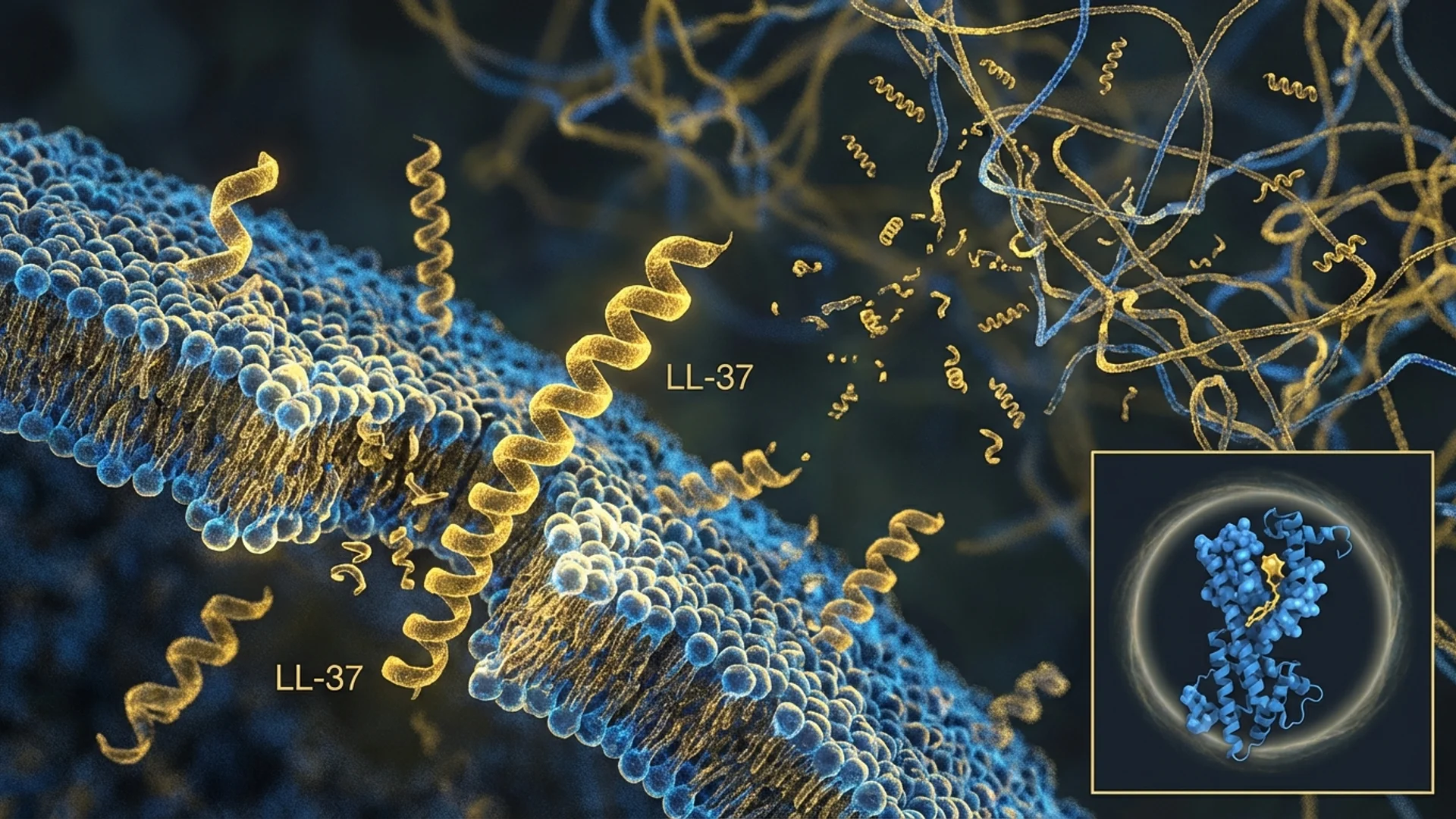
- Direct Antimicrobial Activity: LL-37 kills bacteria, fungi, and enveloped viruses through direct membrane disruption. As an amphipathic peptide (containing both hydrophobic and hydrophilic regions), LL-37 interacts with the negatively charged membranes of microorganisms, inserting into the lipid bilayer and forming pores or otherwise disrupting membrane integrity. This mechanism is rapid and difficult for pathogens to develop resistance against, because it targets the fundamental physical structure of the microbial membrane rather than a specific metabolic pathway.
- Biofilm Disruption: LL-37 has demonstrated the ability to prevent bacterial biofilm formation and to disrupt established biofilms. This is clinically significant because biofilm-associated infections are notoriously resistant to conventional antibiotics. Biofilms are structured communities of bacteria encased in a self-produced matrix of extracellular polymeric substances, and bacteria within biofilms can be 100-1,000 times more resistant to antibiotics than their planktonic (free-floating) counterparts. LL-37 appears to interfere with biofilm formation by reducing initial bacterial attachment and by destabilizing the biofilm matrix.
- Immune Cell Chemotaxis: LL-37 acts as a chemoattractant for neutrophils, monocytes, and T-cells, recruiting immune cells to sites of infection. This bridges the innate and adaptive immune responses by ensuring that the initial antimicrobial activity is followed by a coordinated immune cell response.
- Inflammation Modulation: LL-37 has both pro-inflammatory and anti-inflammatory effects, depending on the context. It can stimulate pro-inflammatory cytokine production in the presence of active infection (amplifying the immune response) while also modulating excessive inflammation through effects on NF-kB signaling and by promoting the clearance of cellular debris and apoptotic cells.
- Wound Healing: LL-37 promotes wound healing through stimulation of cell migration, proliferation, and angiogenesis at wound sites. It also enhances the production of growth factors and matrix metalloproteinases involved in tissue remodeling.
Research Assessment
What the Evidence Shows
| Claimed Effect | Evidence Level | Key Studies | Assessment |
|---|---|---|---|
| Biofilm disruption | In vitro, animal models | Overhage 2008, Dean 2011 | Promising |
| Anti-Borrelia activity | In vitro | Lusitani 2002; Sarkar 2009 | Conflicting |
| Wound healing promotion | Human skin biopsies; topical leg-ulcer trials | Heilborn 2003; Grönberg 2014; Mahlapuu 2021 | Mixed (positive first trial, negative phase 2b) |
| Immune cell recruitment | In vitro, animal studies | Yang 2000 | Strong mechanistic data |
| Antiviral activity | In vitro | Barlow 2011 | Preliminary |
The antimicrobial activity of LL-37 has been extensively characterized in vitro against a broad range of pathogens, including Gram-positive and Gram-negative bacteria, fungi (including Candida species), and enveloped viruses. The breadth of antimicrobial activity is consistent with its role as a first-line innate immune defense. For patients requiring mucosal-level antimicrobial support alongside LL-37, lactoferrin—a naturally occurring iron-binding glycoprotein with complementary antimicrobial and immune-modulating properties—is another tool worth considering, particularly for gut-associated pathogen burden.
The biofilm data is particularly relevant for clinical practice. Overhage and colleagues (2008) demonstrated that LL-37 could inhibit Pseudomonas aeruginosa biofilm formation at sub-antimicrobial concentrations and could reduce established biofilm biomass. Dean and colleagues (2011) extended these findings to other bacterial species.
For chronic Lyme disease the laboratory data point in two directions. In one study, B. burgdorferi was killed by LL-37 along with several other neutrophil components (Lusitani 2002); another laboratory found the spirochete resistant to high cathelicidin concentrations, above 200 µg/mL (Sarkar 2009). I found no published study that tested LL-37 against the stationary-phase persister forms thought to contribute to persistent infection.
What the Evidence Does Not Show
Systemic use of exogenous LL-37 has never been tested in a clinical trial. On the skin, the first leg-ulcer trial compared three concentrations and found faster healing at the two lower ones (Grönberg 2014), but the larger phase 2b trial in 148 patients showed no benefit over placebo in the full study population (Mahlapuu 2021). The in vitro antimicrobial and anti-biofilm data is compelling, but the translation to systemic therapeutic use faces significant challenges, including peptide stability in vivo, potential for host cell toxicity at high concentrations, and the question of whether systemically administered LL-37 can achieve effective concentrations at sites of infection.
The anti-Borrelia data is in vitro only. Whether systemically administered LL-37 can penetrate the tissues where Borrelia persists (joints, connective tissue, nervous system) at concentrations sufficient for antimicrobial or anti-biofilm effects has not been demonstrated.
What Is Known About Dosing
The only human dose comparison is topical: a trial in 34 people with venous leg ulcers applied 0.5, 1.6 or 3.2 mg/mL twice weekly for four weeks, and the two lower concentrations healed faster than placebo while the highest did not (Grönberg 2014). No trial has tested injected LL-37. In community and practitioner protocols it is given subcutaneously, most often 100-200 mcg once daily, 5 days on and 2 off (Practice protocol, see the table below). The amounts used informally are far lower than the concentrations shown to be antimicrobial in vitro, which raises the question of whether any effect could come from direct antimicrobial activity at all. The FDA lists LL-37 among compounding substances that may present significant safety risks, citing immunogenicity, impurities, and little or no human safety data, and no regulator has authorised it. A “research use only” product has been through no approval process and no testing for human use.
Protocol Table: Dose, Route, Timing and Basis
For informational purposes only — this summarises doses used in research and practice; it is not a prescription or individual medical advice.
One row per use case. Basis: Trial (published human study, PMID), Practice protocol (reported by at least two independent compilations), Anecdotal (community reports only). The trial rows are all topical or injected into a tumour; the community rows are subcutaneous, a route no published human study has used.
| Goal | Dose | Route | Frequency / timing | Cycle length | Basis |
|---|---|---|---|---|---|
| Hard-to-heal venous leg ulcers, first human trial | 0.5, 1.6 or 3.2 mg/mL | Topical, on the ulcer | Twice weekly | 4 weeks | Trial (34 patients; 0.5 and 1.6 mg/mL healed faster than placebo, 3.2 mg/mL did not; PMID 25041740) |
| Same indication, phase 2b | 0.5 or 1.6 mg/mL | Topical, with compression therapy | Per trial protocol | Per trial protocol | Trial (148 patients; no benefit over placebo in the full study population; PMID 34687253) |
| Melanoma skin metastases, phase 1 | Dose not given in the published case report | Injection into the tumour | Weekly | 8 injections in the reported patient | Trial (phase 1; case report of skin toxicity; PMID 29665030) |
| General immune support, community standard | 100-200 mcg (Peptide DB: 100-150 mcg) | SC | Once daily, 5 days on, 2 days off | 8-12 weeks | Practice protocol (Peptide Protocol Wiki; Peptide DB) |
| Slow titration | Start at 50 mcg, add 50 mcg per week to 200-400 mcg | SC | Once daily | 8-16 weeks | Anecdotal (Peptide Protocol Wiki) |
| Active infection | 200-400 mcg | SC | Once daily | 2-4 weeks | Anecdotal (Peptide Protocol Wiki; flu-like symptoms reported at the higher end) |
| Gut problems, usually with BPC-157 | 100 mcg | SC | Once daily | 4-8 weeks | Anecdotal (Peptide Protocol Wiki) |
| Combined with thymosin alpha-1 | LL-37 100-200 mcg daily + Ta1 1.5-1.6 mg twice weekly | SC | As listed | 8-12 weeks | Anecdotal (Peptide Protocol Wiki) |
Technique, reconstitution and storage are in the peptide injection guide.
What People Report: What Works and What Doesn’t
Sources: the aggregated community data set (Peptide Protocol Wiki, 45 reports), Peptide DB, and the human trials in the table above. The community data set is small and anecdotal.
Reported to work
- Fewer respiratory infections over weeks to months at 100-200 mcg SC daily, the most common claim.
- Less bloating and better digestion, nearly always when stacked with BPC-157.
- Faster healing of small wounds and fewer skin infections, in occasional reports. This is the one area with human trial support: in the first leg-ulcer trial, topical LL-37 reduced mean ulcer area by 68% at 0.5 mg/mL and by 50% at 1.6 mg/mL.
Mixed or unclear
- Leg ulcers themselves. The larger follow-up trial in 148 patients found no overall benefit; a post hoc subgroup analysis suggested one, which needs confirmation.
- More is not better, at least on skin: in the first trial the highest concentration (3.2 mg/mL) did no better than placebo.
- Lyme disease and biofilm claims. The anti-Borrelia and anti-biofilm data are laboratory findings, and community doses are far below the concentrations used there.
Reported not to work, or disappointing
- Low-grade fever, tiredness and body aches in the first days, which users read as immune activation and which usually ease with continued use or a lower dose. They are hard to tell apart from an infection.
- Worsening of autoimmune conditions, reported by people with autoimmune disease.
- In a melanoma patient given weekly injections into tumours in a phase 1 trial, multiple wart-like and blistering skin lesions appeared about six weeks after starting and cleared within two months of stopping.
What a properly designed trial would need to show: for subcutaneous use, any controlled human data at all: a dose-ranging safety study with antibody and autoimmune markers, followed by a placebo-controlled trial in people with recurrent respiratory infections that counts confirmed infections over a season.
Safety and Side Effects
Known
There are no systematic human safety data for injected LL-37. Anecdotal reports describe injection site reactions, which can be more pronounced than with other peptides due to LL-37’s pro-inflammatory properties, and transient flu-like symptoms, possibly reflecting immune activation. Absence of reported serious events is not evidence of safety.
Theoretical Concerns
At high concentrations, LL-37 can be cytotoxic to host cells, not just microorganisms. The therapeutic window — the range between immune-modulating doses and cytotoxic doses — requires characterization in humans. LL-37 has been implicated in the pathogenesis of certain autoimmune conditions (including psoriasis and rosacea, where excessive LL-37 contributes to inflammation), raising questions about whether exogenous administration could exacerbate these conditions.
Contraindications
Psoriasis (LL-37 is implicated in pathogenesis). Rosacea (same concern). Active autoimmune conditions with inflammatory skin involvement. Pregnancy and lactation (no data).
Drug and Supplement Interactions
Vitamin D supplementation increases endogenous LL-37 production, which could be additive with exogenous LL-37 administration. Immunosuppressive medications could theoretically blunt the immune-modulatory effects of LL-37. No formal interaction studies exist.
Clinical Perspective
LL-37 is a peptide that I find genuinely interesting in the context of chronic Lyme disease, which is a significant focus of our practice at St. George Hospital. The rationale is straightforward: Borrelia burgdorferi is hypothesized to form biofilms as a persistence mechanism, conventional antibiotics have limited efficacy against biofilm-associated bacteria, and LL-37 has demonstrated anti-biofilm activity in vitro.
I want to be transparent about the evidence gaps. Any clinical use of LL-37 means taking in vitro observations about biofilm disruption and applying them in a setting where no one can confirm that LL-37 reaches the relevant tissue sites at effective concentrations. This is an acknowledged limitation.
LL-37 is not a substitute for established Lyme disease treatment, and no controlled study has tested it as an add-on to antibiotics or to immune-modulating approaches. Individual reports of improvement cannot separate any effect of LL-37 from the other treatments, the natural course of the illness, or expectation.
The connection between vitamin D and LL-37 production is clinically actionable. Many chronic Lyme patients are vitamin D deficient, and correcting a documented deficiency is a simple, evidence-based step that supports the body’s own LL-37 production.
My read is that LL-37 has a strong mechanistic rationale for biofilm-associated infections, but we are working with in vitro data, not controlled trial results. Until there are human data on dose, tissue penetration, and safety, injected LL-37 remains experimental.
References
- Durr UH, et al. “LL-37, the only human member of the cathelicidin family of antimicrobial peptides.” Biochim Biophys Acta. 2006;1758(9):1408-1425. PMID 16716248
- Vandamme D, et al. “A comprehensive summary of LL-37, the factotum human cathelicidin peptide.” Cell Immunol. 2012;280(1):22-35. PMID 23246832
- Overhage J, et al. “Human host defense peptide LL-37 prevents bacterial biofilm formation.” Infect Immun. 2008;76(9):4176-4182. PMID 18591225
- Dean SN, et al. “Natural and synthetic cathelicidin peptides with anti-microbial and anti-biofilm activity against Staphylococcus aureus.” BMC Microbiol. 2011;11:114. PMID 21605457
- Lusitani D, et al. “Borrelia burgdorferi are susceptible to killing by a variety of human polymorphonuclear leukocyte components.” J Infect Dis. 2002;185(6):797-804. PMID 11920297
- Sarkar A, et al. “Borrelia burgdorferi resistance to a major skin antimicrobial peptide is independent of outer surface lipoprotein content.” Antimicrob Agents Chemother. 2009;53(10):4490-4494. PMID 19651916
- Yang D, et al. “LL-37, the neutrophil granule-and epithelial cell-derived cathelicidin, utilizes formyl peptide receptor-like 1 (FPRL1) as a receptor to chemoattract human peripheral blood neutrophils, monocytes, and T cells.” J Exp Med. 2000;192(7):1069-1074. PMID 11015447
- Heilborn JD, et al. “The cathelicidin anti-microbial peptide LL-37 is involved in re-epithelialization of human skin wounds and is lacking in chronic ulcer epithelium.” J Invest Dermatol. 2003;120(3):379-389. PMID 12603850
- Barlow PG, et al. “Antiviral activity and increased host defense against influenza infection elicited by the human cathelicidin LL-37.” PLoS One. 2011;6(10):e25333. PMID 22031815
- Grönberg A, et al. “Treatment with LL-37 is safe and effective in enhancing healing of hard-to-heal venous leg ulcers: a randomized, placebo-controlled clinical trial.” Wound Repair Regen. 2014;22(5):613-621. PMID 25041740
- Mahlapuu M, et al. “Evaluation of LL-37 in healing of hard-to-heal venous leg ulcers: a multicentric prospective randomized placebo-controlled clinical trial.” Wound Repair Regen. 2021;29(6):938-950. PMID 34687253
Disclaimer: This peptide profile is intended for educational purposes. LL-37 is not approved for therapeutic use by any regulatory agency. Consult a qualified physician before pursuing any peptide therapy.