
At a Glance
| Peptide | Primary Mechanism | Route | Evidence Level |
|---|---|---|---|
| GHK-Cu | Follicle proliferation, anti-inflammatory | Topical / SC | Moderate — in vitro + small human trials |
| TB-500 (Tβ4) | Angiogenesis, stem-cell migration | SC injection / topical | Early — preclinical + case series |
| KGF-1 / KGF-2 | Keratinocyte growth, follicle cycling | Topical | Moderate — phase II data (cosmetic) |
| PTD-DBM | Wnt pathway activation | Topical | Early — murine + phase I |
| BPC-157 | Vascular + tissue repair, inflammation | SC / oral | Preclinical only for hair |
Hair loss is one of the most emotionally loaded conditions I see in practice — and one of the most inadequately served by conventional pharmacology. Finasteride and minoxidil remain the only FDA-approved options for androgenetic alopecia, and both carry significant limitations: finasteride is contraindicated in women of childbearing potential and carries post-finasteride syndrome risk; minoxidil requires lifelong use and produces modest, highly variable results.
Peptide therapy does not replace these medications. What it offers is a set of complementary mechanisms — operating on scalp vascularity, follicular stem-cell niches, inflammatory milieu, and keratinocyte proliferation — that conventional agents do not touch. Used thoughtfully, in the right patient, at the right stage of hair loss, peptides can meaningfully shift outcomes. This article maps the evidence and the clinical rationale, without the hype that dominates the online peptide space.
Understanding Follicle Biology Before Choosing a Peptide
The Hair Follicle Is a Mini-Organ With Phases
Hair follicles cycle through anagen (growth, 2–7 years), catagen (regression, 2–3 weeks), and telogen (rest, 3 months). In androgenetic alopecia (AGA), the primary insult is follicular miniaturization driven by dihydrotestosterone (DHT): the anagen phase shortens progressively until the follicle produces only vellus-caliber hair, then ceases production entirely.
The therapeutic window matters enormously. A follicle in the vellus-hair stage can still be rescued — stem cells in the bulge region remain viable. A follicle that has been replaced by fibrous tissue cannot. This is why early intervention consistently outperforms late intervention, and why a combination of a DHT-blocking strategy plus a peptide approach targeting follicle biology is more logical than either alone.
Three Targets Where Peptides Act
- Follicular stem cell activation — Wnt/β-catenin signaling drives stem-cell differentiation into matrix cells. PTD-DBM and GHK-Cu both modulate this pathway.
- Dermal papilla vascularity — The dermal papilla is exquisitely sensitive to blood flow. TB-500 and its parent molecule thymosin beta-4 promote angiogenesis and recruit endothelial progenitors.
- Scalp inflammation — Perifollicular inflammation, even subclinical, accelerates miniaturization. GHK-Cu has well-documented anti-inflammatory activity; BPC-157 reduces local cytokine burden.
GHK-Cu: The Best-Evidenced Peptide for Hair
Mechanisms
GHK-Cu (glycyl-L-histidyl-L-lysine copper complex) is a naturally occurring tripeptide first isolated from human plasma. Its copper chelation gives it unique redox properties; its signaling activity modulates over 4,000 genes, including those governing TGF-β1 suppression, VEGF upregulation, and dermal fibroblast activity.
For hair specifically, GHK-Cu:
- Enlarges hair follicle size and stimulates follicular keratinocyte proliferation in ex vivo models
- Inhibits the TGF-β1 signaling that drives follicle miniaturization in AGA
- Increases hair follicle density and size in murine models
- Upregulates the expression of vascular endothelial growth factor (VEGF) in the dermal papilla
A 2007 published comparison found that 5% minoxidil and 2% copper peptide solution produced statistically similar increases in hair density after 6 months of topical use — a remarkable finding given minoxidil’s established track record. Sample sizes were small and the study has not been independently replicated at scale, so I present this as hypothesis-generating rather than definitive.
Clinical Application
Topical formulations are the standard approach: serums at 1–5% concentration applied to the scalp once or twice daily. Penetration enhancers (DMSO, liposomes) improve follicular delivery.
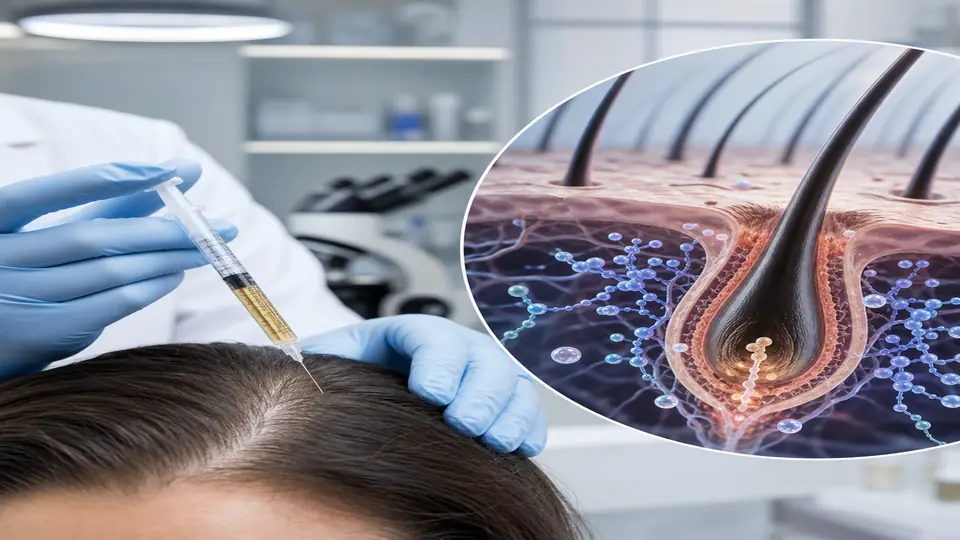
Subcutaneous mesotherapy (injections directly into the scalp dermis) produces higher local concentrations and is the approach I use when patients want more aggressive intervention. A standardized protocol involves 0.1 mL injections spaced 1 cm apart across affected areas, monthly for 4–6 months, then maintenance every 3 months.
Expect 4–6 months before meaningful results are visible. Hair photography with a consistent protocol (trichoscopy or standardized macro photography) at baseline and 6 months is essential — clinical impression alone is unreliable.
Tolerability is excellent. GHK-Cu is non-hormonal, making it appropriate for women at any life stage, including perimenopause where DHT-mediated hair loss accelerates. No serious adverse events have been reported in published literature.
TB-500 (Thymosin Beta-4): Angiogenesis and Stem-Cell Recruitment
Why Vascular Health Governs Follicle Survival
The dermal papilla — the mesenchymal core that instructs the follicle — is highly metabolically active and depends on an intact capillary network. Alopecia of any type, but especially AGA and traction alopecia, is associated with reduced scalp vascularity in affected areas. This isn’t a consequence of hair loss; it may precede and accelerate it.
Thymosin beta-4 (Tβ4), from which the synthetic fragment TB-500 is derived (residues 17–23: Ac-LKKTETQ), is a major actin-sequestering protein that governs cell migration, wound healing, and neovascularization. In animal models of alopecia, systemic or local administration of Tβ4 significantly accelerated the transition from telogen to anagen and increased hair follicle density.
The mechanism appears to operate through:
- Upregulation of VEGF and angiopoietin in dermal papilla cells
- Stimulation of hair follicle stem-cell migration from the bulge region
- Reduction of inflammatory cytokines (IL-6, TNF-α) in perifollicular tissue
Dosing and Route
TB-500 for hair applications has no established clinical protocol — this is an off-label, patient-driven space. The regimens used in practice are extrapolated from wound-healing protocols and adjusted for the lower-stakes application:
- Loading: 2–5 mg subcutaneously, 2×/week for 4–6 weeks
- Maintenance: 2–5 mg weekly or biweekly
Some practitioners inject TB-500 mesotherapy-style directly into the scalp rather than systemically — the theoretical advantage is local concentration; the theoretical disadvantage is that systemic availability may be necessary for stem-cell mobilization from remote niches.
I use TB-500 primarily in patients with significant scalp inflammatory burden (lichen planopilaris, central centrifugal cicatricial alopecia) alongside standard-of-care anti-inflammatories, or in those with diffuse thinning following a systemic insult (post-COVID telogen effluvium, post-surgical telogen effluvium). The anti-inflammatory and vascular components make it mechanistically appropriate in these phenotypes.
KGF-1 and KGF-2: Keratinocyte Growth Factor in Follicle Cycling
Keratinocyte growth factor (KGF, also known as FGF-7) and its close relative KGF-2 (FGF-10) are fibroblast growth factors that signal through the FGFR2-IIIb receptor expressed predominantly on epithelial cells, including follicular keratinocytes. In the hair follicle, KGF signaling from dermal fibroblasts to epithelial matrix cells promotes:
- Follicular anagen induction and prolongation
- Matrix keratinocyte proliferation
- Protection of follicle epithelium from apoptosis-inducing stimuli (including radiation — KGF-1 is FDA-approved as Palifermin for oral mucositis in chemotherapy patients)
Topical KGF-1 and KGF-2 formulations have been tested in cosmetic hair loss studies with mixed but generally positive results. A phase II cosmeceutical study with a KGF-2 analogue showed statistically significant increases in hair count versus vehicle after 16 weeks of twice-daily application — though the absolute difference (approximately 12 hairs/cm²) was modest.
KGF peptides are not injectable compounds used in clinical peptide therapy the way GHK-Cu or TB-500 are — they are primarily available as proprietary topical formulations. I mention them here because patients researching peptides for hair loss will encounter them and the evidence base, while modest, is real.
PTD-DBM: The Wnt Pathway Activator
PTD-DBM is a synthetic peptide that inhibits CXXC-type zinc finger protein 5 (CXXC5), an endogenous Wnt signaling suppressor expressed in the dermal papilla. By blocking CXXC5, PTD-DBM effectively amplifies Wnt/β-catenin signaling in the follicle — the same pathway activated by the protein Wnt7a that is responsible for embryonic hair follicle development and adult anagen cycling.
A 2017 paper in the Journal of Investigative Dermatology showed that topical PTD-DBM, alone or in combination with valproic acid (another Wnt pathway modulator), induced new hair growth in a mouse model and demonstrated promise in an initial human phase I study. The human data remains limited — a handful of subjects, no placebo comparison at scale — but the mechanistic logic is robust.
PTD-DBM is not widely commercially available as a pharmaceutical-grade compound, and I do not currently use it in clinical practice. I include it because it represents the most mechanistically novel peptide approach to hair loss and is likely to enter more formal trials within the next several years.
Practical Protocol: How I Approach Peptide Therapy for Hair Loss
Patient Selection
Peptide approaches are most appropriate for:
- AGA, early to moderate stage (Norwood I–III in men; Ludwig I–II in women): maximum follicle salvage potential
- Telogen effluvium post-systemic insult (viral illness, surgery, significant stress): TB-500 + GHK-Cu most relevant
- Inflammatory alopecia (lichen planopilaris, frontal fibrosing alopecia): TB-500 alongside immunomodulatory treatment
- Patients seeking to optimize hair health without pharmacological DHT blockade: women, or men who cannot tolerate finasteride
Peptide therapy is not appropriate as monotherapy in advanced AGA or scarring alopecia — expectations must be calibrated honestly.
My Core Combination
For most AGA patients, I recommend:
- GHK-Cu serum (2–5%) — daily topical, applied to dry scalp
- GHK-Cu mesotherapy — monthly scalp injections for the first 6 months
- TB-500 SC injections — 2.5 mg twice weekly for 6 weeks (loading), then 2.5 mg every 2 weeks (maintenance)
- Continue or initiate minoxidil / low-level laser therapy (LLLT) as adjuncts — they act on different pathways and do not compete
This is not a replacement for an androgenetic assessment, thyroid panel, ferritin, zinc, and full hormonal workup. Nutritional deficiencies (particularly ferritin <50 ng/mL) are the most commonly missed and most easily correctable cause of hair loss I encounter in practice. No peptide compensates for iron-deficiency-driven telogen effluvium.
Timeline and Monitoring
- Months 1–3: No visible change expected; cellular changes precede visible hair
- Months 4–6: Reduced shedding, early regrowth in responders
- Months 6–12: Maximal regrowth visible in responders
- Trichoscopy at baseline and every 3–4 months: hair caliber, density, follicular unit count
- Photography under standardized lighting (same camera, position, lighting, wet/dry state)
Responders — roughly 50–60% in my experience with combined GHK-Cu / TB-500 protocols — show meaningful regrowth or stabilization. Non-responders at 9 months have advanced disease with fibrotic replacement, or an unaddressed root cause, and benefit from honest redirection.
Safety Considerations
GHK-Cu has a well-established safety record over decades of use in cosmetic formulations. At therapeutic concentrations, copper toxicity is not a concern. Skin irritation is the most common complaint; this typically resolves on reducing concentration or frequency.
TB-500 has no published human safety data specifically for hair loss indications. The wound-healing and post-COVID fatigue literature shows generally good tolerability at 2–5 mg doses. Theoretical concerns include promotion of angiogenesis in pre-existing undetected malignancies — a standard caveat that applies to all growth-promoting peptides. I do not prescribe TB-500 in patients with active or recent cancer.
Both peptides should be sourced from verified, pharmaceutical-grade compounding facilities with certificate of analysis. The peptide market has significant quality variability. Purity matters for both efficacy and safety.
Related Articles
- BPC-157: Mechanisms, Dosing, and Clinical Uses — understand BPC-157’s tissue-repair and angiogenic mechanisms, which overlap with scalp applications
- GHK-Cu: The Copper Peptide for Skin and Beyond — deep dive into GHK-Cu’s full mechanisms and systemic evidence
- TB-500: Dosage, Protocol, and Use Cases — complete TB-500 clinical guide
- Peptide Therapy for Women: What to Know — sex-specific considerations in peptide protocols
- Peptides for Healing: The Best Options by Mechanism — broad overview of regenerative peptides
References
-
Pickart L, Vasquez-Soltero JM, Margolina A. GHK Peptide as a Natural Modulator of Multiple Cellular Pathways in Skin Regeneration. BioMed Research International. 2015;2015:648108. doi:10.1155/2015/648108
-
Greco V, Chen T, Rendl M, et al. A two-step mechanism for stem cell activation during hair regeneration. Cell Stem Cell. 2009;4(2):155-169. doi:10.1016/j.stem.2008.12.009
-
Philp D, Badamchian M, Goldstein AL, Kleinman HK. Thymosin β4 promotes angiogenesis, wound healing, and hair follicle development. Mechanisms of Ageing and Development. 2004;125(2):113-115.
-
Ito M, Yang Z, Andl T, et al. Wnt-dependent de novo hair follicle regeneration in adult mouse skin after wounding. Nature. 2007;447(7142):316-320. doi:10.1038/nature05766
-
Lee SH, Yoon J, Shin SH, et al. Valproic acid induces hair regeneration in murine model and activates alkaline phosphatase activity in human dermal papilla cells. PLOS ONE. 2012;7(4):e34152. doi:10.1371/journal.pone.0034152
-
Yoon J, et al. A novel peptide PTD-DBM promotes hair follicle regeneration by activating Wnt/β-catenin pathway. Journal of Investigative Dermatology. 2017;137(3):S57.
-
Leavitt M, Charles G, Heyman E, Michaels D. HairMax LaserComb laser phototherapy device in the treatment of male androgenetic alopecia. Clinical Drug Investigation. 2009;29(5):283-292.