GHK-Cu occupies an interesting position in the peptide therapy landscape. It is one of the few peptides with controlled human data for at least some of its applications, and its effects on gene expression are among the most extensively characterized of any therapeutic peptide. Whether those gene expression changes translate into the clinical anti-aging effects that are often attributed to it is a separate question — and one I will address honestly. Here is what the research actually says.
At a Glance
Property Detail
Type Endogenous tripeptide-copper complex
Amino acid count 3 (with copper ion)
Primary mechanism Gene expression modulation, tissue remodeling, anti-inflammatory
Evidence level Controlled human studies (topical); animal studies (systemic)
Regulatory status Available as cosmetic ingredient; not approved as pharmaceutical
Route of administration Topical, SC injection
What Is GHK-Cu?
GHK-Cu (glycyl-L-histidyl-L-lysine copper complex) is a naturally occurring tripeptide that binds copper with high affinity. It was first identified in human plasma by Loren Pickart in the 1970s, initially through the observation that plasma from young individuals stimulated hepatocyte growth more effectively than plasma from older individuals. The active factor responsible for this difference was identified as GHK-Cu.

GHK-Cu is found in plasma, saliva, and urine. Its concentration in plasma declines with age — from approximately 200 ng/mL at age 20 to approximately 80 ng/mL by age 60. This age-related decline has made it a candidate of particular interest in longevity medicine, though whether the decline is causally related to aging or is simply a biomarker remains an open question. The hallmarks of aging framework provides useful context for understanding how GHK-Cu may fit into broader anti-aging strategies.
Mechanism of Action
Primary Pathways
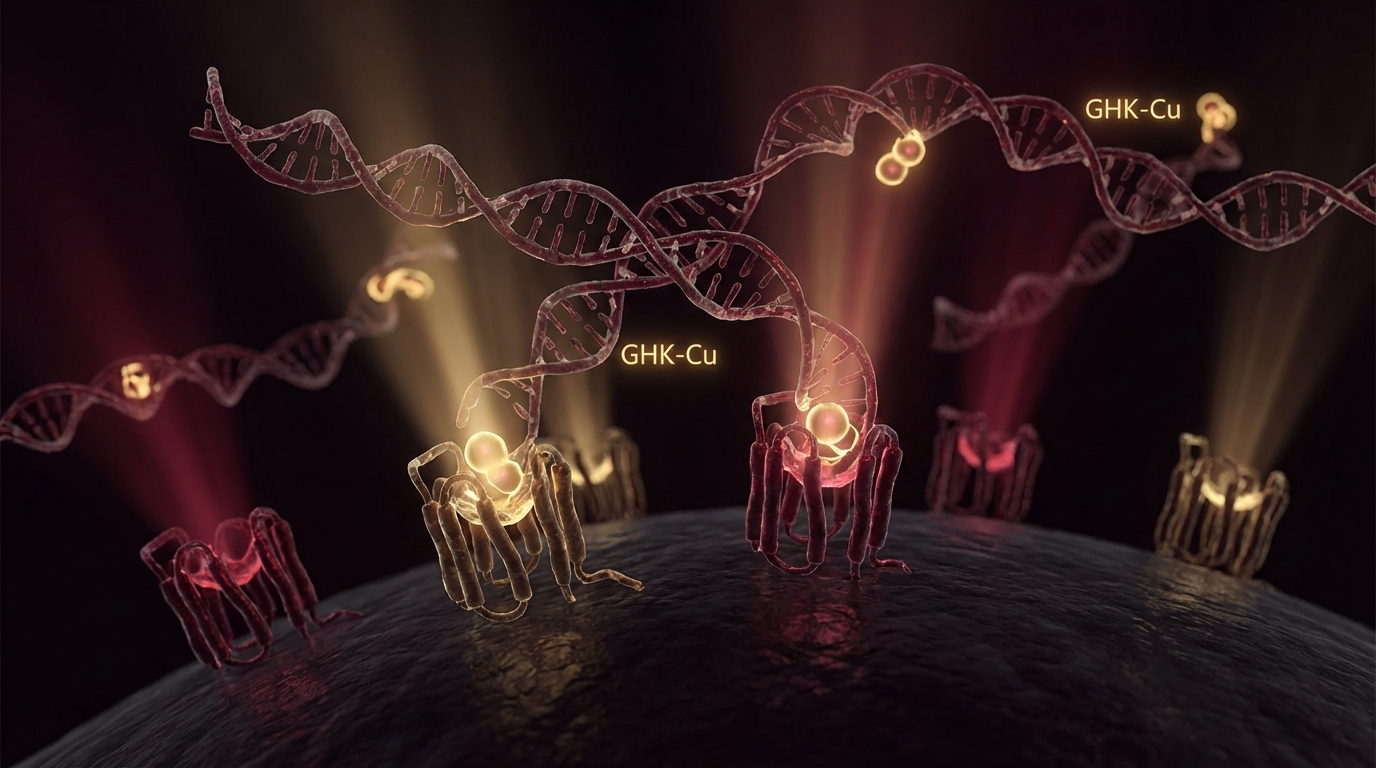
- Gene Expression Modulation: The most striking finding about GHK-Cu is the breadth of its effects on gene expression. A landmark study by Pickart, Vasquez-Soltero, and Margolina (2015) using the Broad Institute’s Connectivity Map identified over 4,000 genes whose expression was influenced by GHK-Cu. These include genes involved in DNA repair (GADD45A), antioxidant defense (superoxide dismutase, glutathione S-transferases), collagen synthesis, and the ubiquitin-proteasome system. The overall pattern of gene expression changes has been described as shifting cellular gene expression toward a “younger” profile.
- Extracellular Matrix Remodeling: GHK-Cu stimulates collagen synthesis while simultaneously promoting the controlled breakdown and remodeling of damaged extracellular matrix. This dual action — building new matrix while clearing damaged matrix — is particularly relevant for wound healing and skin rejuvenation. It upregulates several metalloproteinases (MMPs) and their tissue inhibitors (TIMPs) in a balanced fashion.
- Anti-inflammatory Effects: GHK-Cu reduces oxidative damage and inflammation through multiple mechanisms, including suppression of NF-kB signaling, reduction of TGF-beta-driven fibrosis, and enhancement of antioxidant enzyme expression. It also inhibits the expression of pro-inflammatory cytokines including IL-6 and TNF-alpha.
- Copper Delivery: The copper ion in GHK-Cu is biologically active and essential for the function of several enzymes involved in tissue repair, including lysyl oxidase (collagen cross-linking), superoxide dismutase (antioxidant defense), and cytochrome c oxidase (mitochondrial function). GHK-Cu may serve as a targeted delivery system for copper to tissues undergoing repair or remodeling.
Research Assessment
What the Evidence Shows
Claimed Effect Evidence Level Key Studies Assessment
Skin rejuvenation (topical) Controlled human studies Finkley 2005, Abdulghani 1998 Strong
Gene expression modulation In vitro, genomic studies Pickart 2015 Strong (mechanistic)
Systemic anti-aging Animal studies, mechanistic Campbell 2012 Preliminary
Hair growth stimulation Limited human studies Pyo 2007 Preliminary
Anti-inflammatory (systemic) Animal studies Canapp 2003 Preliminary
The topical evidence for GHK-Cu is among the strongest for any peptide in cosmetic and wound healing applications. Controlled human studies have demonstrated improvements in skin thickness, elasticity, and appearance with topical GHK-Cu application. In wound healing, topical GHK-Cu has been shown to accelerate closure and improve the quality of healed tissue. The same follicle-stimulating and anti-inflammatory properties make GHK-Cu one of the most mechanistically compelling options in peptide therapy for hair loss, where it is used both topically and via scalp mesotherapy injections.
The gene expression data is mechanistically compelling but requires careful interpretation. Demonstrating that a molecule changes the expression of thousands of genes does not, by itself, prove that those changes produce clinically meaningful outcomes in humans. Gene expression is the beginning of a biological process, not the end.
What the Evidence Does Not Show
The systemic anti-aging effects of GHK-Cu — the idea that subcutaneous injection of GHK-Cu produces meaningful body-wide rejuvenation — remain largely theoretical. The gene expression data and the topical efficacy data provide a reasonable mechanistic rationale, but controlled human studies of systemic GHK-Cu administration are lacking.
The decline of GHK-Cu levels with age is an observation, not proof that supplementation reverses aging. Correlation between declining levels and aging does not establish causation.
Dosing
Route Dose Range Frequency Duration Source of Data
Subcutaneous 1-2 mg Daily or 5 days/week 4-12 weeks Clinical practice
Note: Topical dosing is based on human study data. Subcutaneous dosing is based on clinical practice and is not derived from human dose-finding trials.
Safety and Side Effects
Known
GHK-Cu has a well-established safety profile for topical use. It has been used in cosmetic products for decades without significant safety concerns. For subcutaneous injection, the safety data is more limited but clinical experience has not revealed serious adverse events. Minor injection site reactions and transient nausea have been reported.
Theoretical Concerns
Copper overload is a theoretical concern with systemic GHK-Cu administration, particularly in patients with impaired copper metabolism (such as Wilson’s disease). However, the amounts of copper delivered by therapeutic doses of GHK-Cu are small relative to dietary copper intake, making this concern primarily relevant for patients with pre-existing copper metabolism disorders.
Contraindications
Wilson’s disease (impaired copper metabolism). Known hypersensitivity to copper compounds. Pregnancy and lactation (insufficient data for systemic use).
Drug and Supplement Interactions
No formal interaction studies have been conducted. Theoretical caution with copper supplements (additive copper load) and with medications that affect copper metabolism (penicillamine, zinc supplements in high doses).
Clinical Perspective
GHK-Cu is a peptide I approach with genuine interest and appropriate caution. The gene expression data is fascinating — the idea of a single molecule that can shift the expression of thousands of genes toward a more youthful pattern is exactly the kind of finding that longevity medicine needs to take seriously. But taking it seriously means subjecting it to the same evidence standards we apply to any intervention.
In my practice, I am most confident in GHK-Cu for topical applications — wound healing, post-procedure skin recovery, and skin quality improvement. The human data for these applications is solid. For systemic use as an anti-aging intervention, I am transparent with patients that we are working with mechanistic reasoning and clinical observation rather than controlled trial data. Those interested in tissue repair peptides may also want to read about BPC-157 and TB-500, which operate through complementary mechanisms.
What I find most interesting about GHK-Cu is not any single effect but the pattern of effects. This is not a molecule that does one thing well. It appears to coordinate a broad remodeling response — clearing damaged tissue, promoting new tissue formation, reducing inflammation, and enhancing antioxidant defenses. That pattern is consistent with a tissue repair signal rather than a simple drug-target interaction.
The honest answer is that we need more controlled human studies of systemic GHK-Cu before we can make confident claims about its role in longevity medicine. But the existing data makes a strong case for continued investigation.
References
- Pickart L, Vasquez-Soltero JM, Margolina A. “GHK Peptide as a Natural Modulator of Multiple Cellular Pathways in Skin Regeneration.” Biomed Res Int. 2015;2015:648108.
- Pickart L. “The human tri-peptide GHK and tissue remodeling.” J Biomater Sci Polym Ed. 2008;19(8):969-988.
- Finkley MB, et al. “Copper peptide and skin.” In: Cosmeceuticals and Active Cosmetics. 2005.
- Abdulghani AA, et al. “Effects of topical creams containing vitamin C, a copper-binding peptide cream and melatonin.” Skin Res Technol. 1998;4:130-138.
- Arul V, et al. “Biotinylated GHK peptide incorporated collagenous matrix: a novel biomaterial for dermal wound healing in rats.” J Biomed Mater Res. 2007;73B:383-391.
- Campbell JD, et al. “Genome-wide gene expression analysis of GHK-Cu.” J Am Acad Dermatol. 2012;66(4):AB199.
- Canapp SO, et al. “The effect of topical tripeptide-copper complex on healing of ischemic open wounds.” Vet Surg. 2003;32:515-523.
- Pyo HK, et al. “The effect of tripeptide-copper complex on human hair growth.” Arch Pharm Res. 2007;30(7):834-839.
Disclaimer: This peptide profile is intended for educational purposes. GHK-Cu is available as a cosmetic ingredient but is not approved as a pharmaceutical. Consult a qualified physician before pursuing any peptide therapy.