
At a Glance
| Feature | Detail |
|---|---|
| Peptide class | Synthetic ACTH 4–7 analog (heptapeptide) |
| Primary mechanism | BDNF upregulation; dopaminergic & serotonergic modulation |
| Route of administration | Intranasal (preferred); subcutaneous injection |
| Typical clinical dose | 300–600 mcg/day intranasal |
| Cycle length | 2–4 weeks on, 2–4 week washout |
| Clinical history | Approved in Russia since 1991 for stroke, TBI, cognitive decline |
| Key variants | Semax 0.1%, NA-Semax, NA-Semax Amidate |
| Safety profile | Well-tolerated; minimal systemic side effects in human trials |
Semax sits in an unusual position in peptide medicine: it has a genuine decades-long clinical track record in one country while remaining largely unknown in Western integrative practice. Developed at the Institute of Molecular Genetics in Moscow during the 1980s, it was registered as a pharmaceutical in Russia in 1991 and has since accumulated a meaningful body of clinical and preclinical literature — the vast majority of which never made it into English-language journals.
In my practice, I reach for Semax in a specific set of patients: those with post-infectious brain fog (particularly after Lyme disease or COVID-19), individuals with documented low BDNF on lab panels, and patients recovering from cerebrovascular events who need neuroprotective support alongside conventional rehabilitation. It does not replace foundational neurology or psychiatry care, but it consistently adds a layer of neurochemical support that I have not found replicated by other peptides.
What Is Semax and Where Does It Come From?
Semax is a heptapeptide — seven amino acids — with the sequence Met-Glu-His-Phe-Pro-Gly-Pro. It was engineered as a stable analog of the ACTH 4–7 tetrapeptide fragment (Met-Glu-His-Phe), which was already known to influence learning and memory in rodent models. The addition of Pro-Gly-Pro at the C-terminus dramatically extends its metabolic stability without adding the adrenocorticotropic activity of the full ACTH hormone.
This distinction matters clinically. Full ACTH stimulates cortisol release from the adrenal glands. Semax does not — it acts centrally on the nervous system without triggering HPA axis activation, which makes it fundamentally different from corticosteroid-based interventions and substantially safer for long-term or cyclical use.
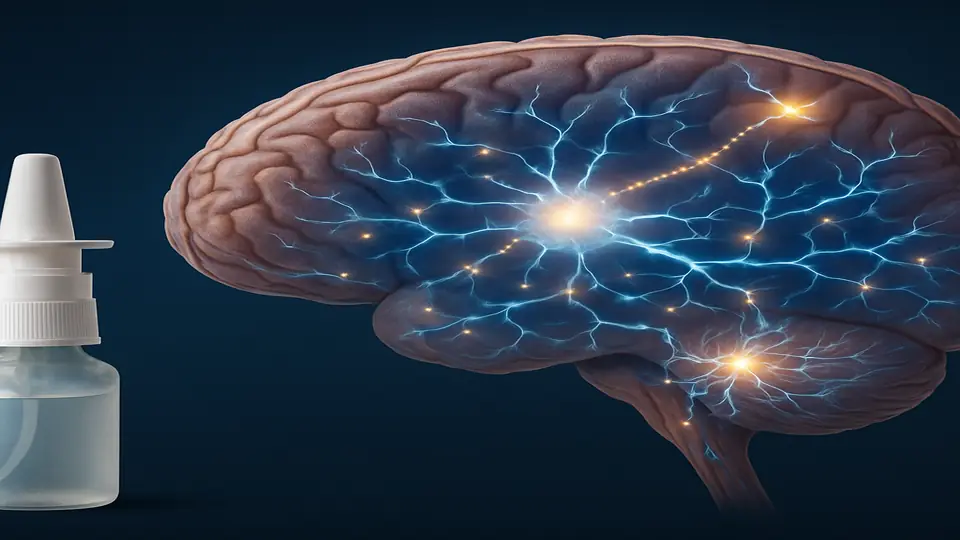
The Russian pharmaceutical formulation ships as a 0.1% nasal spray solution (1 mg/mL). Three drops per nostril delivers approximately 100 mcg, making dosing straightforward and titration simple. The intranasal route exploits olfactory neuron transport pathways to bypass the blood-brain barrier, with peak CSF concentrations appearing within 20–30 minutes.
Mechanism of Action: BDNF, Dopamine, and the Glial Response
Semax’s most clinically important mechanism is its upregulation of brain-derived neurotrophic factor (BDNF) and its high-affinity receptor TrkB. BDNF is the primary survival and plasticity signal for neurons in the hippocampus, prefrontal cortex, and brainstem. Chronically low BDNF is associated with depression, cognitive decline, treatment-resistant fatigue, and accelerated neurodegeneration.
Dolotov et al. (2006) demonstrated that a single intranasal dose of Semax in rats produced a significant and sustained increase in hippocampal BDNF mRNA, with effects observable within one hour and persisting for 24 hours. TrkB receptor expression increased in parallel, suggesting that Semax does not merely spike BDNF transiently but sensitizes the downstream signaling pathway.
Beyond BDNF, Semax influences several other neurochemical systems:
Dopaminergic tone. Semax has been shown to increase dopamine turnover in the striatum and prefrontal cortex — relevant for motivation, executive function, and working memory. Patients frequently describe improved mental drive rather than simple stimulation. The effect is qualitatively different from caffeine or amphetamine-class compounds.
Serotonergic modulation. Semax appears to modulate 5-HT levels in limbic regions, which may partly explain the anxiolytic and mood-stabilizing effects reported anecdotally and in some small clinical series. In patients with chronic infections and significant neuroinflammation, mood dysregulation often tracks BDNF; Semax seems to address both simultaneously.
Glial activation pattern. Unlike neuroinflammatory insults — which trigger pro-inflammatory M1 microglial activation — Semax stimulates an anti-inflammatory glial response. Eremin et al. showed increased expression of GFAP and S100B (markers of activated but not reactive astrocytosis) alongside downregulation of IL-6 and TNF-alpha in an ischemia model. This anti-neuroinflammatory signature makes Semax particularly relevant for post-infectious brain states.
Clinical Evidence: Stroke, TBI, and Cognitive Impairment
The strongest clinical evidence for Semax comes from Russian academic centers studying acute ischemic stroke and its aftermath. In a controlled trial conducted at the Research Institute of Neurology in Moscow, Semax administered within the first 24 hours of ischemic stroke significantly reduced the volume of neurological deficit at 7 and 30 days compared to placebo. Functional recovery scores were also meaningfully improved.
A similar pattern holds for traumatic brain injury. Gusev and colleagues published data showing accelerated return of cognitive function in TBI patients treated with intranasal Semax as an adjunct to standard care. Crucially, patients receiving Semax showed better preservation of working memory at 90 days — the period when secondary neurodegeneration would otherwise be progressing.
For cognitive impairment not caused by acute events — the more common scenario in integrative medicine — the evidence is thinner but directionally consistent. Open-label series from neurological clinics in St. Petersburg and Moscow document improvements in processing speed, verbal memory, and subjective cognitive clarity in patients with age-related cognitive decline and post-encephalitic syndromes.
What the trial literature does not offer, in most cases, is large randomized placebo-controlled data by Western regulatory standards. This is the honest caveat. The mechanistic rationale is solid, the human safety data is reassuring, and the Russian clinical experience is extensive — but Semax has not undergone Phase III RCTs by EMA or FDA criteria.
Semax Variants: Standard, NA-Semax, and the Amidate Form
Three versions circulate among research suppliers, and they are not equivalent:
Semax (standard): The original 0.1% pharmaceutical formulation. Most clinical data comes from this variant. Appropriate for most patients as a starting point.
NA-Semax (N-Acetyl Semax): The acetylated form is reported to have a longer half-life and a somewhat more potent BDNF effect in preclinical models. The trade-off is that it is more stimulating — patients sensitive to dopaminergic activation may find it anxiety-inducing at standard doses. I start patients at half the standard dose when switching to this variant.
NA-Semax Amidate: Both acetylated and C-terminally amidated, which theoretically further extends metabolic stability and potency. The least amount of human data exists for this form. I reserve it for patients who have already established tolerability with standard Semax and are seeking incremental gains — not as a first choice.
For clinical purposes, standard Semax at 300–600 mcg/day intranasally is where I begin and where most patients remain.
Dosing Protocol and Cycling
Intranasal (standard clinical approach):
- Start: 100–200 mcg once daily (1–2 drops per nostril), typically in the morning
- Titrate to 300–600 mcg/day over 5–7 days if tolerated
- Some patients benefit from a second dose before cognitively demanding work, not after 2pm (to avoid sleep disruption)
- Cycle 2–4 weeks, then 2–4 weeks off before repeating
For a detailed breakdown of drop-to-microgram conversions, variant-specific starting doses for NA-Semax and NA-Semax Amidate, and step-by-step nasal technique, see the Semax Dosage and Nasal Protocol guide.
Subcutaneous injection:
- Used when precise dosing is required or nasal tolerance is an issue (chronic rhinitis, deviated septum)
- Typical dose mirrors intranasal: 300–500 mcg per injection
- Bioavailability via injection is higher; some patients require dose reduction
Timing considerations: Semax’s stimulating dopaminergic effects mean afternoon or evening dosing frequently disturbs sleep onset. In patients already dealing with poor sleep — common in post-Lyme and post-COVID presentations — I consistently advise morning-only administration.
Who should not use Semax: Patients with active seizure disorders should avoid Semax without neurologist oversight. Patients on MAOIs or serotonergic medications require caution. Pregnancy and breastfeeding are contraindications by convention, as no safety data exists in these populations.
Semax in the Context of Post-Infectious Brain Fog
In my clinical experience managing post-Lyme and post-COVID patients, neuroinflammation-driven cognitive impairment is one of the most treatment-resistant symptoms. Patients describe it consistently: the words won’t come, thoughts take effort, and the mental fatigue compounds by afternoon. Standard antidepressants and stimulants tend to either miss the mechanism or create tolerance issues.
Semax addresses the problem at a more fundamental level. When neuroinflammation suppresses BDNF — as occurs chronically in these conditions — synaptic pruning accelerates and hippocampal neurogenesis slows. Restoring BDNF signaling through Semax provides the biological substrate for symptomatic recovery to occur, while the anti-inflammatory glial modulation addresses the upstream driver.
I typically combine Semax with BPC-157 (for gut-brain axis support and peripheral inflammation), low-dose naltrexone (for microglial regulation), and targeted mitochondrial support in this patient population. Semax is rarely a standalone intervention in complex post-infectious cases — it works best as part of a coordinated neurological recovery protocol.
Side Effects and Safety Profile
Semax has a favorable safety profile from both clinical trial data and its long-term pharmaceutical use in Russia. The most commonly reported side effects are:
- Nasal irritation: Mild and transient, usually resolving within the first week. Occurs in approximately 10–15% of users with standard 0.1% solution.
- Increased vivid dreaming: Related to BDNF upregulation affecting REM sleep architecture. Not pathological; reduces with dose adjustment.
- Mood activation or mild restlessness: Dopaminergic effect; typically dose-dependent and manageable by reducing dose or shifting entirely to morning administration.
- Appetite changes: Some patients note reduced appetite, particularly in the first 1–2 weeks.
Serious adverse events have not been reported in clinical trial data. There are no documented cases of neurotoxicity, organ damage, or endocrine disruption in the published literature. This is consistent with the non-adrenocorticotropic mechanism — Semax does not perturb the HPA axis in the way that ACTH or corticosteroid therapies do.
The absence of long-term (>3 months continuous) human safety data is a real limitation. I address this through cycling protocols rather than continuous administration, which also helps prevent tachyphylaxis.
Related Articles
- Selank vs Semax: Which Nootropic Peptide Is Right for You?
- Dihexa: The Peptide for Memory and Cognitive Regeneration
- Post-COVID Brain Fog: A Functional Medicine Approach
- Photobiomodulation for Depression and Brain Fog
- BDNF and the Brain-Gut Axis: How Peptides Support Neural Recovery
- Nootropic Peptides: A Physician’s Guide to Cognitive Enhancement
References
-
Dolotov OV, Karpenko EA, Inozemtseva LS, et al. Semax, an analog of ACTH(4-7) with cognitive effects, regulates BDNF and TrkB expression in the rat hippocampus. Brain Res. 2006;1117(1):54–60. PMID: 16949557
-
Gusev EI, Skvortsova VI, Miasoedov NF, et al. Neuroprotective effects of Semax in patients with ischemic stroke. Cerebrovasc Dis. 2005;20(4):239–247.
-
Eremin KO, Kudrin VS, Saransaari P, et al. Semax, an ACTH(4-10) analogue with nootropic properties, activates dopaminergic and serotoninergic brain systems in rodents. Neurochem Res. 2005;30(12):1493–1500. PMID: 16362768
-
Shadrina MI, Dolotov OV, Grivennikov IA, et al. Neuroprotective effects of Semax in a rat model of olfactory epithelium impairment. J Neurochem. 2001;78(Suppl 1):53.
-
Menshanov PN, Bannova AV, Dygalo NN. Semax modifies BDNF expression in a structure-specific manner in rat brain. Pharmacol Biochem Behav. 2016;144:27–32. PMID: 27000710
-
Inozemtseva LS, Dolotov OV, Dobryakova YV, et al. Intranasal administration of the ACTH(4-7)PGP peptide (Semax) affects amnesia and increases neuronal activity in rats. Behav Brain Res. 2008;193(1):86–93. PMID: 18554726
-
Agapova TY, Agniullin YV, Silachev DN, et al. Comparative evaluation of N-acetylated and C-terminally amidated analogs of Semax on neuroprotective activity. J Pept Sci. 2007;13(5):318–325.