At a Glance
| Question | Short answer |
|---|---|
| What it is | Ultrashort (about 3 µs) acoustic pressure pulses, delivered with a handheld applicator and MRI-based neuronavigation |
| What it is not | Not TMS (magnetic); not low-intensity focused ultrasound (LIFU) |
| Regulatory | CE-marked for Alzheimer’s disease in the EU since 2018 (NEUROLITH); not FDA-cleared |
| First sham-controlled RCT | Matt 2025, n=60: primary endpoint not met; signals in patients ≤70 and in mood |
| Systematic reviews | Safe and promising; small, heterogeneous, often uncontrolled studies |
| Evidence grade | Emerging (CE-marked for Alzheimer’s in the EU; RCT evidence mixed) |
| Best fit today | Add-on to standard Alzheimer’s care, after informed consent about the evidence, ideally with outcome tracking |
The question patients bring
Families find TPS after a diagnosis of Alzheimer’s disease or mild cognitive impairment, usually with a direct question: does it work, and is it worth the travel and the cost?
I want to answer that properly, and I have to declare an interest first. TPS is offered at the Douwes Brain Center, the brain-health service of St. George Hospital, where I work, and I believe in neuromodulation as a field. That is exactly why this page sticks to the published trials, including the result that did not go our way.
How TPS works
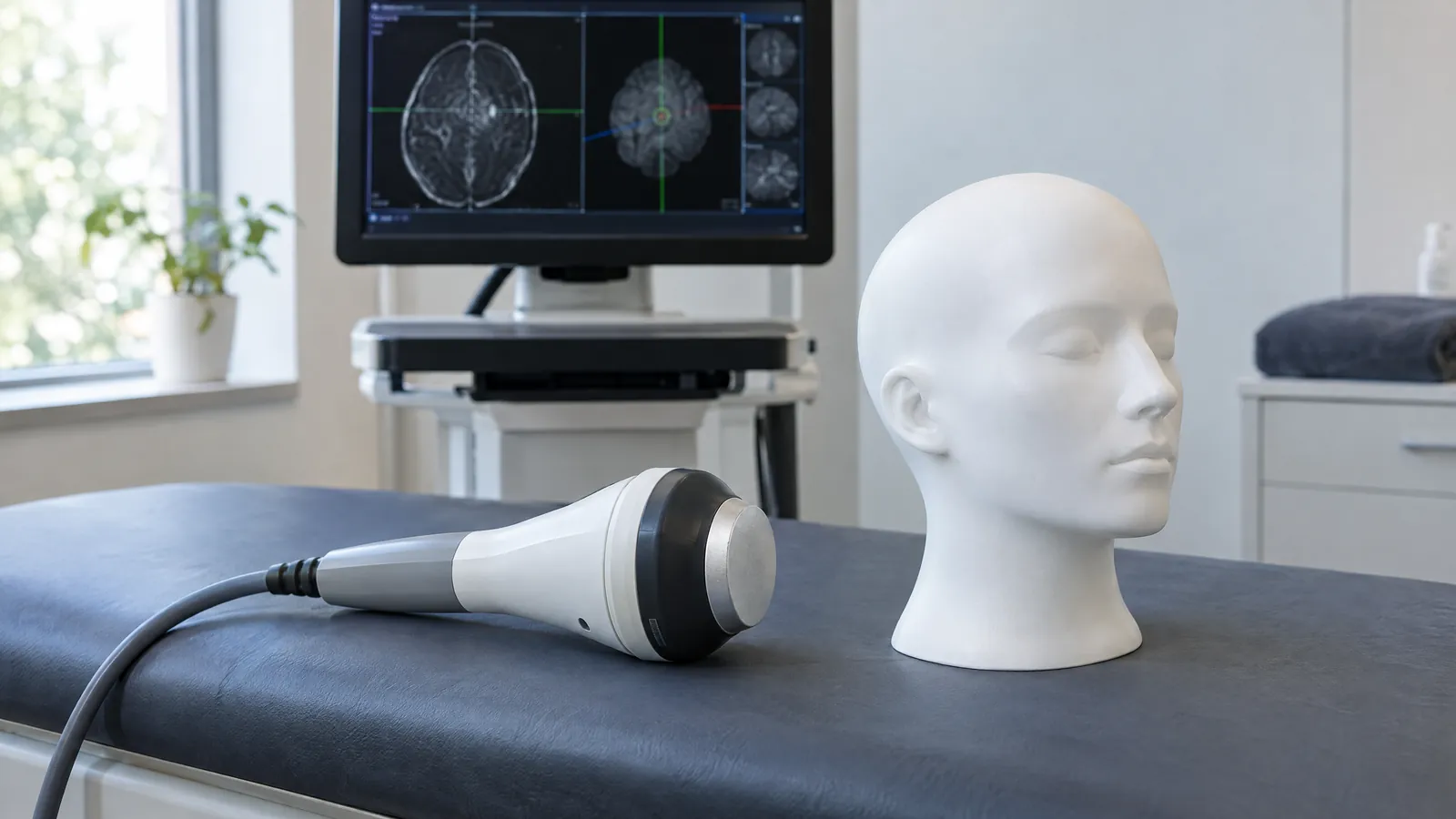
TPS uses a handheld applicator that emits single, very short pressure pulses, each lasting about three microseconds. The pulses are physically related to the shock waves used in urology and orthopaedics, at much lower energy. Each pulse is delivered at a low repetition rate while the applicator is moved over the scalp. A navigation system, built on the patient’s own MRI, shows which brain regions have received pulses (Beisteiner 2020).
Three distinctions are often blurred online:
- TPS vs TMS. TMS induces electrical currents with a magnetic field. TPS applies mechanical pressure pulses. The TMS guide covers magnetic stimulation.
- TPS vs focused ultrasound (LIFU). Low-intensity focused ultrasound uses longer trains of ultrasound waves. TPS uses single ultrashort pulses. Meta-analyses that pool “transcranial ultrasound” should be read with that difference in mind.
- TPS vs high-intensity focused ultrasound. HIFU destroys tissue (for example in essential tremor). TPS is not ablative.
How mechanical pulses change brain function is not settled. Proposed mechanisms include mechanotransduction in neurons and glia, changes in blood flow and growth-factor release. These come mostly from laboratory work and imaging correlates, not from proof in patients.
The evidence
The first human study: an uncontrolled pilot
The 2020 study that launched clinical TPS treated 35 people with Alzheimer’s disease and measured them before and after, with no sham group (Beisteiner 2020). Cognitive scores improved and functional MRI showed changes in memory networks. It established feasibility and safety. Without a control group, it cannot separate a treatment effect from practice effects, expectation and natural fluctuation. It was a pilot, not a pivotal trial.
The first sham-controlled RCT (2025)
Matt and colleagues randomised 60 people with Alzheimer’s disease, aged 51 to 82, to two weeks of real or sham TPS in a crossover design, all on top of standard treatment (Matt 2025).
- Primary outcome. The CERAD total score rose by 2.2 points after real TPS and 1.0 point after sham. The primary analysis was not statistically significant (P = .68).
- Age. There was a significant interaction with age. Patients aged 70 or younger improved more with real TPS than with sham in post-hoc analyses; some older patients also benefited.
- Mood and imaging. Depressive symptoms improved, and functional brain activation and connectivity changed.
- Safety. No safety concerns emerged.
The authors concluded that TPS “may be a safe and promising add-on therapy”. That is a reasonable reading as long as one adds the other half: the trial was designed to show a cognitive benefit across the whole group, and it did not. The age finding is a hypothesis for the next trial.
What reviews say
| Review | Scope | Conclusion |
|---|---|---|
| Polte 2025 | 15 studies (5 RCTs, 10 single-arm) across Alzheimer’s, MCI, Parkinson’s, depression, autism, ADHD | Mostly positive effects and good safety, but small samples, missing control groups and heterogeneous protocols; larger sham-controlled trials needed |
| Abdellatif 2026 | 3 RCTs (n=84) of transcranial ultrasound in Alzheimer’s | No significant pooled improvement in global cognition vs sham; TPS effect smaller than unfocused ultrasound; benefit under age 70; TPS improved depressive symptoms |
| Liu 2026 | Network meta-analysis of neuromodulation RCTs in Alzheimer’s | TPS ranked highest for global cognition, with rTMS strongest on ADAS-Cog; small samples and heterogeneous protocols limit confidence |
The pattern is consistent: safe, biologically active, encouraging signals, and too few well-controlled patients to be sure.
How TPS compares with other brain-stimulation options in Alzheimer’s
The most convincing single randomised trial of neuromodulation in Alzheimer’s so far is not TPS. In a 24-week sham-controlled trial of 50 patients, rTMS over the precuneus slowed cognitive and functional decline (Koch 2022). It too is a single-centre phase 2 study. The wider modality comparison sits in brain aging and cognitive reserve.
Who TPS may suit, and who it doesn’t
TPS is not a treatment for healthy aging or for “brain optimisation” in people without a diagnosis. There are no trials in that group.
It may be reasonable to discuss TPS when:
- there is a confirmed diagnosis of Alzheimer’s disease or a closely related condition;
- standard care is in place (diagnosis, approved medication where appropriate, vascular risk treatment, hearing and sleep);
- the person and family understand the evidence above, the cost, and that benefit is uncertain;
- outcomes will be measured before and after, so a non-response is recognised.
Contraindications are set by the manufacturer and the treating centre. Typical screening questions concern metal implants or skull defects in the treatment path, bleeding disorders or anticoagulation, brain tumours and pregnancy. Ask the centre for its full exclusion list in writing.
The Douwes Brain Center explains the procedure step by step in how TPS works Douwes Brain Center ↗, and its TPS for Alzheimer’s page Douwes Brain Center ↗ covers the clinical side.
Safety
Across the published studies, TPS has been well tolerated; a 2025 systematic review described a high safety profile in most included studies (Polte 2025). Long-term safety data beyond months are limited, and safety monitoring in routine practice is less systematic than in trials.
Regulatory status
| Authority | Status (October 2026) |
|---|---|
| EU | NEUROLITH TPS system CE-marked for Alzheimer’s disease since 2018. A CE mark for a medical device confirms conformity with safety and performance requirements; it is not the same as proof of efficacy from large RCTs. |
| US | Not FDA-cleared; use is investigational. |
My reading
TPS sits in the “Emerging” tier. The physics is distinctive, the safety record is good, and the field is moving quickly. The one sham-controlled trial missed its primary endpoint while pointing to a subgroup that might benefit. If we offer TPS, we owe patients that sentence word for word, a measured baseline and an honest follow-up. A properly powered multicentre trial in patients aged 70 and under is the study this field needs next.
Limitations of this review
- Most TPS studies come from a small number of centres.
- Crossover designs in a progressive disease complicate interpretation.
- Meta-analyses mix TPS with other ultrasound techniques and include very few patients.
Related reading
- Brain aging and cognitive reserve: what is established, what is emerging
- TMS: a physician’s guide
- Transcranial photobiomodulation
- Neuromodulation hub
Frequently asked questions
Is TPS approved for Alzheimer's disease?
The NEUROLITH TPS system has carried a CE mark for the treatment of Alzheimer's disease in the EU since 2018. A CE mark for a device is not the same as proof of efficacy from large trials, and the device is not FDA-cleared in the US.
Did the 2025 TPS randomised trial work?
Its primary analysis was not statistically significant (P = .68). Further analyses showed benefit in patients aged 70 or younger and improvement in depressive symptoms, which need confirmation in a new trial.
Is TPS the same as focused ultrasound?
No. TPS uses single shock-wave-type pressure pulses of about 3 microseconds. Low-intensity focused ultrasound (LIFU) uses longer trains of ultrasound waves. They are different physical stimuli with different evidence bases.
References
- Beisteiner R, et al. Transcranial pulse stimulation with ultrasound in Alzheimer’s disease: a new navigated focal brain therapy. Adv Sci (Weinh). 2020. PMID: 32042569
- Matt E, et al. Ultrasound neuromodulation with transcranial pulse stimulation in Alzheimer disease: a randomized clinical trial. JAMA Netw Open. 2025. PMID: 40009384
- Polte S, et al. Neuromodulatory effects of transcranial pulse stimulation (TPS) in neurological and psychiatric disorders: a systematic review and meta-analysis. Neurol Int. 2025. PMID: 41295447
- Abdellatif AI, et al. Focused and unfocused transcranial ultrasound stimulation in Alzheimer’s disease: a systematic review and meta-analysis of randomized controlled trials. Neurol Sci. 2026. PMID: 41981348
- Liu Y, et al. Comparative efficacy of neuromodulation techniques for Alzheimer’s disease: a systematic review and network meta-analysis of randomized controlled trials. Front Neurosci. 2026. PMID: 42798437
- Koch G, et al. Precuneus magnetic stimulation for Alzheimer’s disease: a randomized, sham-controlled trial. Brain. 2022. PMID: 36281767