At a Glance
| Parameter | Detail |
|---|---|
| Combination | Dasatinib 100 mg + Quercetin 1,000 mg (D+Q) |
| Dosing pattern | 2–3 consecutive days per cycle |
| Cycle interval | Every 3–6 months (most studied: 3-month intervals) |
| Route | Oral (both agents) |
| Primary target | Senescent adipocyte-lineage cells; senescent endothelial cells |
| Key evidence | Mayo Clinic open-label trials, UPitt WHEL extension |
| Monitoring | CBC, CMP, uric acid, p21, p16 (optional), IL-6, hsCRP |
| Who benefits most | Accelerated aging phenotypes, frailty, post-COVID fibrosis, diabetic kidney disease |
| Contraindications | QTc prolongation, severe hepatic impairment, anticoagulants (caution), active malignancy (relative) |
The single most replicated human senolytic intervention is not a supplement stack or a lifestyle hack — it is a short-course combination of two repurposed pharmaceutical agents: dasatinib, a tyrosine kinase inhibitor originally approved for chronic myeloid leukemia, and quercetin, a broadly available flavonoid. Together, they dismantle the pro-survival pathways that allow senescent cells to persist in tissues long past their physiological usefulness.
I started incorporating D+Q discussions into longevity consultations after the first Mayo Clinic open-label trial showed clinically meaningful reductions in senescent cell burden in patients with idiopathic pulmonary fibrosis — a condition with almost no effective conventional options. What struck me was the intermittent dosing strategy: just three days on drug, then nothing for months. This is not how we typically think about medication. It reflects the biology of senolytics — cells that have been eliminated do not return quickly, so continuous dosing is not only unnecessary but potentially counterproductive.
What Senescent Cells Actually Do
Cellular senescence is a normal, protective response. When a cell sustains genotoxic stress, telomere erosion, or oncogenic signaling, it can exit the cell cycle permanently rather than divide uncontrollably. In younger, healthier tissue this is a temporary state: the immune system — particularly NK cells and T cells — rapidly clears senescent cells. The cleared space is repopulated with functional progeny.
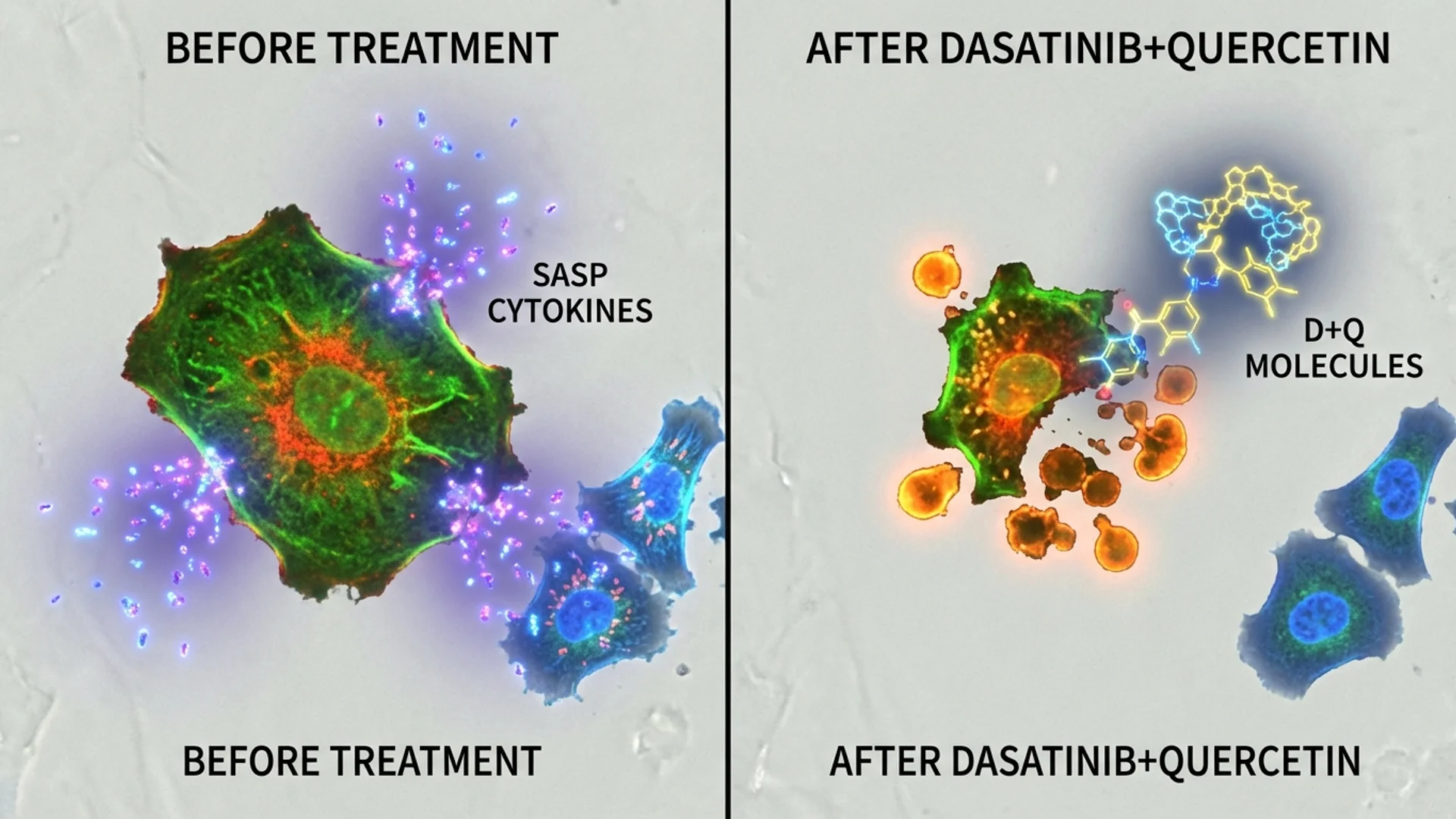
The problem emerges when clearance slows. This happens with age, chronic infection, metabolic stress, and following some chemotherapy regimens. Persistent senescent cells adopt a secretory phenotype called the senescence-associated secretory phenotype (SASP): they release IL-6, IL-8, MMP-3, MMP-9, PAI-1, and dozens of other mediators that damage adjacent healthy cells, promote local fibrosis, impair stem cell niches, and sustain chronic low-grade inflammation.
SASP is increasingly recognized as a driver of inflammaging — the chronic, sterile, low-grade inflammatory state that accelerates virtually every age-related disease, from cardiovascular disease to neurodegeneration. Removing the senescent cells removes the source of SASP. That is the therapeutic rationale.
Why Dasatinib and Quercetin Together
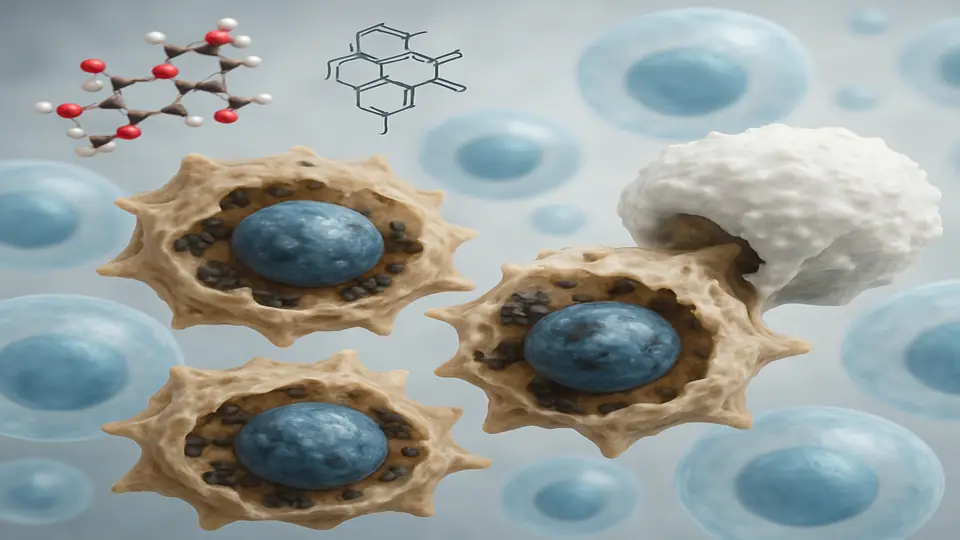
Zhu et al. (2015) at Mayo Clinic screened 46 compounds in silico against senescent human preadipocytes and identified dasatinib and quercetin as top candidates based on their predicted interactions with pro-survival networks — specifically the Bcl-2 family, PI3K/AKT, and p21/p53 pathways. Senescent cells upregulate these anti-apoptotic networks as a survival mechanism; D+Q collectively suppress them.
Dasatinib is more potent against senescent adipocyte-lineage cells and senescent endothelial cells. It inhibits Src, Abl, and multiple receptor tyrosine kinases that converge on AKT survival signaling. Its high tissue penetrance (it crosses the blood-brain barrier) makes it relevant for CNS applications.
Quercetin complements dasatinib in macrophage-lineage senescent cells and is broadly synergistic. It inhibits PI3K, Bcl-xL, and HSP90 — pathways dasatinib hits less effectively. Quercetin also has direct anti-SASP activity through NF-κB suppression, reducing inflammatory output from cells not yet pushed into apoptosis.
The combination achieves broader tissue coverage than either agent alone. In mouse models, D+Q eliminated approximately 25–50% of p16INK4a-expressing cells in various tissues within 3 days, with measurable phenotypic improvements persisting for weeks after the drug was cleared.
Human Clinical Evidence
Idiopathic Pulmonary Fibrosis (IPF)
The first human D+Q trial (Kirkland et al., Mayo Clinic, 2019) enrolled 14 patients with IPF — a disease characterized by progressive senescent-cell-driven fibrosis. After three weeks of intermittent D+Q (2 days on, 5 days off × 3 weeks), the treated group showed:
- Significant reductions in circulating senescent cells (p16+, p21+)
- Reduced SASP factors (MMP-3, IL-6, IL-8, eotaxin-1)
- Trends toward improved 6-minute walk distance
- Improved chair-stand speed
This was open-label and small, but the biological signal was clear. IPF has no mechanism-targeting treatment; the senescent cell burden in fibrotic lung tissue is among the highest measured in any human disease.
Diabetic Kidney Disease
A subsequent Mayo trial by Hickson et al. (2019) randomized 9 patients with type 2 diabetes and CKD to D+Q (100 mg dasatinib / 1,000 mg quercetin × 3 days) or placebo. Active treatment reduced adipose tissue and skin senescent cell abundance, as well as circulating SASP factors (IL-6, leptin). Kidney function was not significantly improved in this small sample, but the biological target engagement was demonstrated.
Physical Function and Frailty
The CORCEPT trial and subsequent work have examined D+Q in older adults with frailty phenotypes. Improvements in physical function tests — particularly gait speed and grip strength — have been observed, consistent with the known role of senescent cells in muscle stem cell niche impairment.
Ongoing Trials
Multiple Phase 2 trials are active as of 2025, including applications in:
- Alzheimer’s disease (Mayo Clinic ALSENLYT)
- Radiation-induced senescence in cancer survivors
- Long COVID fibrosis and fatigue
- Osteoporosis
- Macular degeneration (SToMP-AD)
The Protocol in Practice
Standard Dosing
The protocol used across Mayo Clinic and collaborating trials is consistent:
- Dasatinib: 100 mg orally, taken with food
- Quercetin: 1,000 mg orally, split as 500 mg twice daily or as a single dose
- Duration: 2 to 3 consecutive days per cycle
- Cycle frequency: Every 3 months is the most studied interval; some protocols extend to every 6 months after the first two cycles
There is no established maintenance dose. The intermittent design is intentional: dasatinib has a half-life of 3–5 hours, but its senolytic effect persists after clearance because the dead cells do not immediately repopulate. Continuing the drug beyond 3 days does not appear to increase benefit and raises toxicity risk.
Fasting and Timing Considerations
Some practitioners have their patients fast (16–18 hours) before the first dasatinib dose to reduce absorption variability and amplify the metabolic stress signal that may prime senescent cells for apoptosis. This is empirical rather than trial-tested, and I approach it case-by-case.
Quercetin should be taken with a fat-containing food to improve absorption. Quercetin phytosome forms (e.g., Quercefit) have significantly higher bioavailability than standard quercetin aglycone — approximately 20× in some head-to-head studies — and 500 mg phytosome may be functionally equivalent to 1,000 mg standard quercetin.
Scheduling Relative to Other Longevity Agents
D+Q is typically separated from rapamycin dosing by at least 2 weeks. There is theoretical concern that mTOR inhibition may reduce the apoptotic clearance of cells pushed into senescence by the senolytic protocol; in practice the two regimens tend to be alternated rather than stacked simultaneously.
NAD+ precursors (NMN, NR) and senolytics may be complementary — NAD+ supports the DNA damage response and mitochondrial quality control pathways that underlie healthy cell maintenance. I often continue NAD+ supplementation throughout a D+Q cycle.
Patient Selection
D+Q is not appropriate as a general wellness protocol for healthy young adults. The evidence, and the biological rationale, support use in individuals with demonstrable senescent cell burden or accelerated aging phenotypes.
Most appropriate candidates:
- Adults ≥55 with frailty, functional decline, or high biological age
- Post-chemotherapy or radiation patients (treatment accelerates senescence)
- Patients with IPF, diabetic nephropathy, or fibrotic conditions
- Long COVID patients with persistent fatigue and elevated inflammatory markers
- Patients with documented accelerated biological aging on epigenetic clocks (GrimAge, PhenoAge)
Relative contraindications and cautions:
- QTc prolongation: Dasatinib can prolong the QT interval. Obtain ECG before initiation and avoid in patients on other QTc-prolonging agents
- Hepatic impairment: Dasatinib is extensively hepatically metabolized; dose adjustment or avoidance required in Child-Pugh B/C
- Bleeding risk: Dasatinib inhibits platelet aggregation and should be used with caution in patients on anticoagulants or with thrombocytopenia
- Drug-drug interactions: Dasatinib is a CYP3A4 substrate; strong inhibitors (azole antifungals, certain macrolides) significantly raise plasma levels
- Active malignancy: Relative contraindication; oncological review required before proceeding in patients with current or recent cancer (dasatinib is itself used as a cancer treatment, but dosing context matters)
Lab Monitoring
Before the first cycle and before each subsequent cycle:
| Test | Rationale |
|---|---|
| CBC with differential | Dasatinib can cause thrombocytopenia and neutropenia (less common at 100 mg × 3 days than at oncology doses) |
| CMP (creatinine, LFTs) | Baseline renal/hepatic function; dasatinib is hepatically cleared |
| Uric acid | Rapid cell lysis can transiently raise uric acid |
| ECG (12-lead) | QTc before initiation |
| hsCRP, IL-6 | Baseline inflammatory burden; can serve as response tracking |
| p21, p16 (optional) | Circulating senescence markers; increasingly available through specialty labs |
Response monitoring at 6–8 weeks post-cycle: repeat hsCRP, IL-6, and functional assessments. In patients where epigenetic age guided the decision, recheck at 6 months.
What to Realistically Expect
Based on the clinical trial data and my own practice experience, I set the following expectations with patients:
- Noticeable effects within 4–8 weeks: Reduced joint stiffness, improved energy, clearer cognition are the most commonly reported subjective changes. These are plausibly mediated by reduced SASP and lower-grade neuroinflammation.
- Physical performance: Gait speed and grip strength improvements have been documented in trial settings at 2–3 months
- Biomarker shifts: CRP and IL-6 reductions are the most consistent; magnitude is modest in healthier individuals and more pronounced in those with high baseline burden
- Fibrosis-related conditions: Objective improvement in IPF (6-minute walk, diffusing capacity) takes 3–6 months and is most notable in those with higher baseline senescent cell burden
It is worth being direct with patients: the acute experience of a D+Q cycle is generally unremarkable. There is no “senolytic feeling.” The value is biological, measurable in markers and function over time, not immediately experiential.
Related Articles
- Senolytics: The Science of Clearing Senescent Cells
- Fisetin vs Quercetin as Senolytics: What the Evidence Says
- Quercetin as a Senolytic: Mechanisms and Dosing
- Rapamycin for Longevity: Dosing, Evidence, and Clinical Use
- Inflammaging: The Root of Age-Related Disease
References
-
Zhu Y, Tchkonia T, Pirtskhalava T, et al. The Achilles’ heel of senescent cells: from transcriptome to senolytic drugs. Aging Cell. 2015;14(4):644-658. PMID 25754370
-
Justice JN, Nambiar AM, Tchkonia T, et al. Senolytics in idiopathic pulmonary fibrosis: Results from a first-in-human, open-label, pilot study. EBioMedicine. 2019;40:554-563. PMID 30616998
-
Hickson LJ, Langhi Prata LGP, Bobart SA, et al. Senolytics decrease senescent cells in humans: Preliminary report from a clinical trial of Dasatinib plus Quercetin in individuals with diabetic kidney disease. EBioMedicine. 2019;47:446-456. PMID 31327715
-
Yousefzadeh MJ, Zhu Y, McGowan SJ, et al. Fisetin is a senotherapeutic that extends health and lifespan. EBioMedicine. 2018;36:18-28. PMID 30279143
-
Kirkland JL, Tchkonia T. Senolytic drugs: from discovery to translation. J Intern Med. 2020;288(5):518-536. PMID 32686219
-
Ogrodnik M, Miwa S, Tchkonia T, et al. Cellular senescence drives age-dependent hepatic steatosis. Nat Commun. 2017;8:15691. PMID 28593994
-
Mylonas KJ, O’Sullivan ED, Humphries D, et al. Cellular senescence inhibits renal regeneration after injury in mice, with senolytic treatment promoting repair. Sci Transl Med. 2021;13(594):eabb0203. PMID 34011625