At a Glance
| Variable | Effect | Evidence Level |
|---|---|---|
| Norepinephrine | +200–300% (dose-dependent) | High (RCT) |
| Core temperature drop | 0.5–2 °C depending on protocol | High |
| Brown adipose activation | Significant UCP1 upregulation | Moderate |
| Post-exercise inflammation | Reduced IL-6, TNF-α acutely | Moderate |
| Muscle hypertrophy (if used immediately post-lifting) | Potentially blunted | Moderate |
| Dopamine | Sustained +250% over 2–3 hours | Moderate (single study) |
| Insulin sensitivity | Improved with repeated sessions | Low–Moderate |
| Cold shock proteins | Upregulated (RBM3, CIRBP) | Low–Moderate |
When patients ask me about cold plunges, they usually arrive with one of two framings: either they’ve watched an influencer turn a garden tub of ice into a near-religious experience, or they’ve read a headline claiming cold exposure “extends lifespan.” Neither framing serves them well clinically. What the physiology actually shows is more nuanced — and more actionable — than either camp admits.
Cold water immersion (CWI) is a genuine hormetic stressor — meaning it triggers adaptive responses precisely because of, not despite, the physiological challenge it imposes. The dose-dependent activation of the sympathetic nervous system, metabolic shifts in thermogenesis, and downstream anti-inflammatory signalling are real biological events, supported by peer-reviewed research. Used incorrectly — or at the wrong time relative to training — the same intervention can blunt the adaptations you’re working toward.
This guide is what I walk patients through before we design any cold exposure protocol together.
The Norepinephrine Effect: More Than a Mood Trick
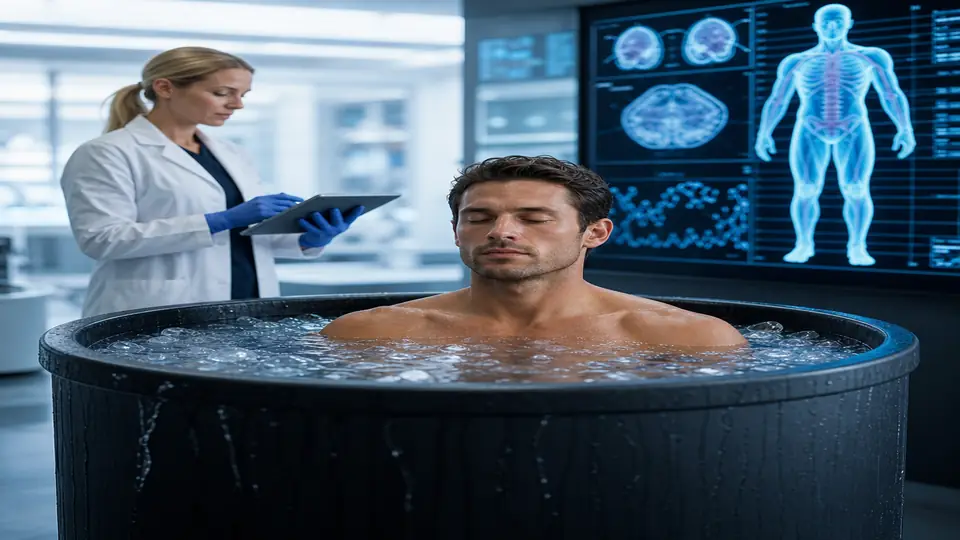
The most replicated finding in CWI research is the acute sympathetic response. Immersion in water at 14 °C for two minutes produces a 200–300% increase in plasma norepinephrine (NE) and roughly a 250% increase in dopamine that persists for two to three hours after the session — far longer than the immersion itself.
Why does this matter clinically?
Norepinephrine is both a neurotransmitter and a hormone. Centrally, elevated NE correlates with improved focus, reduced pain perception, and mood elevation — the mechanism behind the “post-plunge clarity” patients reliably report. Peripherally, NE triggers vasoconstriction, heart rate adaptation, and — critically — activates thermogenic pathways in brown adipose tissue.
Dopamine’s prolonged elevation is particularly interesting from a mental health perspective. Unlike the transient spike from acute stressors, the sustained increase post-CWI suggests a distinct mechanism, possibly linked to cold-shock protein signalling rather than pure sympathetic activation. Susanna Søberg’s 2021 data from the University of Copenhagen showed this dopamine profile is unique to cold and does not replicate with forced exercise at equivalent cardiovascular intensity.
Practical implication: Patients with low-grade depression, brain fog, or ADHD often respond well to morning cold exposure precisely because of this dopaminergic effect. I typically recommend morning protocols for mood-related goals rather than evening sessions, which can interfere with sleep onset in NE-sensitive individuals.
Brown Adipose Tissue: Your Metabolic Furnace
Brown adipose tissue (BAT) is thermogenic fat — it burns calories to generate heat rather than storing energy. Adults retain meaningful BAT deposits around the clavicles, neck, and perirenal region, but this tissue is highly activity-dependent: use it or lose it.
Cold exposure is the primary physiological activator of BAT. The mechanism runs through beta-3 adrenergic receptors stimulated by NE, which upregulate uncoupling protein 1 (UCP1) — the enzyme that allows proton leak across the mitochondrial inner membrane, dissipating the electrochemical gradient as heat rather than ATP.
Repeated cold exposure (4–8 weeks of regular CWI) leads to BAT hypertrophy and increased oxidative capacity. A 2022 study published in Cell Reports Medicine found that regular cold exposure in healthy adults increased BAT volume by ~37% and resting metabolic rate by ~3–5%. While 3–5% sounds modest, over a year that represents a meaningful metabolic contribution — equivalent to one additional moderate cardio session per week, without the session.
What this means for metabolic health: In patients with insulin resistance or early metabolic syndrome, BAT activation represents an adjunctive — not standalone — intervention. The insulin-sensitising effect of repeated CWI appears partly mediated through BAT-driven glucose uptake and partly through skeletal muscle GLUT4 translocation post-shivering. I use CWI as part of a broader metabolic protocol that typically includes time-restricted eating and zone-2 training, never in isolation.
Cold Shock Proteins and Cellular Resilience
Less discussed in popular media but arguably the most interesting longevity mechanism of CWI is cold shock protein upregulation.
RNA-binding motif protein 3 (RBM3) is a cold-inducible protein with neuroprotective properties. In rodent models, RBM3 upregulation preserves synaptic density during neurodegeneration and can reverse synapse loss when induced before injury. Cold-inducible RNA-binding protein (CIRBP) has parallel roles in cellular stress resilience, acting as a broad-spectrum regulator of RNA stability under sub-physiological temperatures.
These proteins represent a parallel pathway to heat shock proteins (HSPs) — together they form what researchers are beginning to call the “proteostatic hormesis network”: the body’s capacity to maintain protein quality control under both hot and cold stressors. The heat-driven side of this system — HSP70, HSP90, HSF1 activation, and sauna dosing — is explored in depth in Heat Shock Proteins: Cellular Repair Through Hormesis. This is part of the biological rationale for contrast therapy (alternating sauna and cold plunge), which I cover in a separate guide on contrast therapy protocols.
The clinical caveat: The human data on cold shock proteins is largely observational or derived from ex vivo studies. I include it in patient education as a plausible mechanism, not an established clinical endpoint. The neuroscience is compelling, but we don’t yet have RCTs showing that routine cold plunging preserves cognitive function at 10-year follow-up.
Anti-Inflammatory Signalling: Real, But Nuanced
Cold water immersion acutely reduces circulating levels of interleukin-6 (IL-6) and tumour necrosis factor-alpha (TNF-α) in the hours following a session. This has been confirmed in multiple sport science studies and is the physiological basis for athletic ice bath recovery.
However, the inflammation story is more complex than “cold = anti-inflammatory.”
Acute IL-6 from exercise is anabolic. IL-6 released from contracting muscle during exercise acts as a myokine — it stimulates AMPK, promotes fat oxidation, and signals muscle repair. Blocking this acute IL-6 spike by immediately immersing in cold water after strength training appears to blunt hypertrophic signalling. A landmark 2015 study by Roberts et al. in The Journal of Physiology showed that men who used CWI immediately after resistance training had significantly smaller strength and muscle mass gains over 12 weeks compared to those who used active recovery.
For chronically elevated inflammatory load — as seen in post-COVID patients, Lyme disease, or metabolic syndrome — CWI appears beneficial as a repeated stressor that downregulates baseline NF-κB activity and increases regulatory T-cell function. This is a different context from post-lifting recovery, and the intervention logic is different.
My protocol guidance based on goal:
- Strength/hypertrophy goal: No CWI within 4–6 hours post-resistance training
- Endurance/cardiovascular recovery: CWI within 1 hour post-session is fine (endurance adaptations are less sensitive to this acute IL-6 blunting)
- Chronic inflammatory conditions: Morning CWI, separate from exercise, 3–5x/week
- Mental health/neurological: Morning CWI, daily if tolerated
Vagus Nerve Activation and the Parasympathetic Rebound
One mechanism that receives less attention in mainstream cold plunge content is the vagal activation pattern during and after CWI.
During immersion, the initial cold shock response is sympathetic: sharp inhalation, heart rate spike, peripheral vasoconstriction. Within 60–90 seconds, as the body habituates, there is a progressive shift toward parasympathetic dominance mediated partly through the diving reflex and partly through direct cold-receptor input to the vagus nerve via the face and neck.
Repeated cold exposure trains this sympathetic-to-parasympathetic transition. Over time, habituated cold-plungers show:
- Faster heart rate recovery post-immersion (improved HRV)
- Lower baseline resting heart rate
- More resilient stress response in non-cold contexts (cross-stressor adaptation)
Tracking heart rate variability (HRV) is one of the most practical ways to quantify these autonomic adaptations — a rising morning HRV trend over 6–8 weeks of regular cold plunge practice is a reliable signal that the nervous system is adapting.
For patients I’m treating with vagus nerve dysfunction — common in post-Lyme, post-COVID, and dysautonomia presentations — facial cold water immersion (submerging the face in cold water for 30–60 seconds) can be a gentler entry point that still engages the diving reflex without the cardiovascular demand of full-body immersion. You can read more about vagal exercises and their role in inflammation regulation in our vagus nerve and inflammation guide.
How to Actually Dose Cold Immersion
The research converges on a few consistent parameters:
Temperature: ≤15 °C (59 °F) appears to be the minimum threshold for meaningful NE response. 10–14 °C is the sweet spot for most protocols in the literature. Below 6 °C increases hypothermia risk with diminishing neurochemical returns.
Duration: 2–5 minutes per session covers most studied protocols. The Susanna Søberg “minimum effective dose” paper suggested 11 minutes total per week across sessions as sufficient for meaningful BAT activation and NE response. More is not always better — prolonged sessions increase peripheral vasoconstriction to a degree that may reduce, not enhance, metabolite clearance from muscle.
Frequency: 3–5 sessions/week appears sufficient for physiological adaptation. Daily sessions are feasible if duration is kept short (2–3 minutes). Daily cold plunging over 90+ days produces measurable BAT volume change; shorter protocols are adequate for acute neurochemical and recovery benefits.
Entry protocol (for naive patients):
- Week 1–2: Cold shower finish, last 30–60 seconds at cold (around 18–20 °C)
- Week 3–4: Cold shower finish extended to 90–120 seconds, gradually cooler
- Week 5+: Full CWI at 15 °C for 2 minutes, extending to 3–4 minutes over subsequent weeks
Contraindications: Raynaud’s disease, uncontrolled hypertension, recent cardiac event, open wounds, or cryoglobulinemia. I always review cardiovascular history before recommending CWI to patients over 55 or with any cardiovascular risk factors.
What Cold Plunging Cannot Do
I find it clinically important to be explicit about what CWI does not reliably do at accessible doses:
- Extend lifespan directly — the longevity data is mechanistic and animal-model-based, not human RCT
- Replace sleep — no evidence CWI compensates for sleep debt; it may transiently mask fatigue through NE but does not restore slow-wave sleep architecture
- Eliminate chronic inflammation — CWI is an adjunct to treating root causes, not a standalone anti-inflammatory therapy
- Accelerate fat loss significantly — the metabolic effect is real but modest; a 3–5% RMR increase does not overcome a poor diet
Managing patient expectations here is part of good practice. CWI is a powerful hormetic tool in a well-designed longevity or recovery protocol — it is not a panacea.
Related Articles
- Contrast Therapy: The Science of Hot-Cold Alternation — How combining sauna and cold plunge amplifies vascular and neuroendocrine adaptations
- Vagus Nerve and Inflammation: What the Research Shows — Deep dive into vagal tone, HRV, and inflammatory regulation
- Cold Shower vs Ice Bath: Which Is Clinically Superior? — A head-to-head comparison of accessible cold protocols
- Sleep Optimization Protocol — Why cold timing relative to sleep matters for cortisol and melatonin
- Zone 2 Training: The Longevity Case — How to pair cold exposure with aerobic base-building for maximum metabolic effect
References
- Søberg S, et al. Altered brown fat thermoregulation and enhanced cold-induced thermogenesis in young, healthy, winter-swimming men. Cell Reports Medicine. 2021;2(10):100408.
- Roberts LA, et al. Post-exercise cold water immersion attenuates acute anabolic signalling and long-term adaptations in muscle to strength training. J Physiol. 2015;573(14):4285–4301.
- Tipton MJ, et al. Cold water immersion: kill or cure? Exp Physiol. 2017;102(11):1335–1355.
- Brazaitis M, Skurvydas A. Heat acclimation does not reduce the impact of cold on performance. Eur J Appl Physiol. 2010;109(4):707–716.
- Espeland D, de Weerd L, Mercer JB. Health effects of voluntary exposure to cold water — a continuing subject of debate. Int J Circumpolar Health. 2022;81(1):2111789.
- Mäkinen TM, et al. Autonomic nervous function during whole-body cold exposure before and after cold acclimation. Aviat Space Environ Med. 2008;79(9):875–882.
- van Marken Lichtenbelt WD, et al. Cold-activated brown adipose tissue in healthy men. N Engl J Med. 2009;360(15):1500–1508.