At a Glance
| Property | Value |
|---|---|
| Evidence Level | Moderate (PET-CT studies of BAT activation; controlled thermogenesis trials) |
| Primary Use | Brown fat activation, metabolic conditioning, norepinephrine-mediated benefits |
| Key Mechanism | Cold-induced thermogenesis via UCP1 in brown adipose tissue; sympathetic nervous system activation |
Cold Showers vs. Ice Baths for Brown Fat: The Honest Comparison
If you are researching cold exposure for fat loss or metabolic health, you have likely encountered bold claims about “activating your brown fat to burn hundreds of extra calories.” Let me be direct about what the science actually supports — and where the hype outpaces the evidence.
Brown adipose tissue (BAT) is real. Its activation by cold exposure is real. The metabolic implications are interesting and potentially meaningful. But the magnitude of the effect matters enormously, and the difference between a cold shower and a full ice bath is not trivial.
Here is what the research actually says.
Brown Fat: What It Is and Why It Matters
Brown adipose tissue is metabolically active fat that burns energy to produce heat — the opposite of white adipose tissue, which stores energy. Brown fat achieves this through uncoupling protein 1 (UCP1), a mitochondrial membrane protein that short-circuits the normal ATP production process and generates heat directly.
For decades, scientists believed brown fat was only present in infants and disappeared with age. PET-CT imaging studies in the mid-2000s overturned this assumption. van Marken Lichtenbelt et al. demonstrated in 2009 that functional BAT is present in adult humans, primarily in the supraclavicular, paravertebral, and perirenal regions, and that its activity is directly stimulated by cold exposure (1).
Why This Matters for Longevity
Brown fat activation is not just about burning calories. Active BAT is associated with:
- Improved glucose homeostasis. Brown fat takes up glucose from the bloodstream at rates comparable to active muscle. In observational studies, individuals with more active BAT have better insulin sensitivity and lower fasting glucose.
- Lipid clearance. Active BAT clears triglycerides from the bloodstream, improving lipid profiles.
- Reduced body fat. People with detectable BAT on PET-CT scans have lower BMIs and less visceral fat, even after controlling for age and physical activity.
- Potential longevity signaling. BAT activation engages several pathways implicated in longevity, including AMPK activation, mitochondrial biogenesis, and FGF21 secretion.
The question is not whether brown fat matters. The question is how effectively cold showers and ice baths activate it.
The Thermal Stimulus: Showers vs. Immersion
The fundamental difference between a cold shower and an ice bath comes down to three variables: total surface area exposed, water temperature, and rate of heat extraction.
Cold Showers
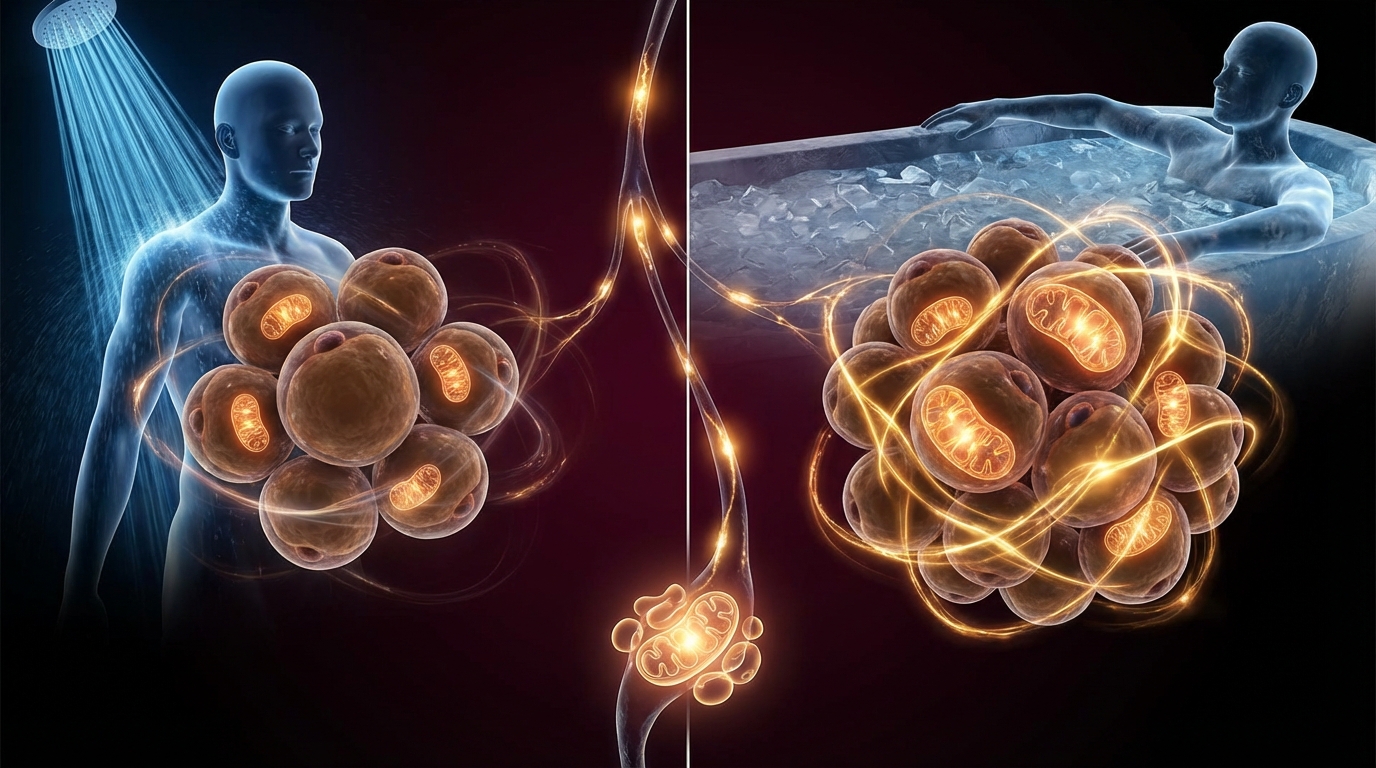
A typical cold shower delivers water at 10-20°C (50-68°F) depending on your geographic location and plumbing. The water contacts roughly 30-50% of your body surface at any given moment — the rest is exposed to ambient air. The rate of heat extraction is moderate because shower water runs off the body rather than surrounding it.
What the data shows: Cold showers produce a meaningful norepinephrine response — Shevchuk proposed a protocol of 2-3 minutes at 20°C as an adjunctive treatment for depression based on sympathetic nervous system activation (2). However, the skin cooling is uneven and the core temperature reduction is minimal. Most cold shower studies measure subjective outcomes (mood, alertness, sick days) rather than BAT activation directly.
Ice Baths / Cold Water Immersion
A cold plunge or ice bath at 3-10°C (37-50°F) surrounds approximately 80-90% of the body surface with water that extracts heat 25 times more efficiently than air at the same temperature. Core body temperature drops measurably within 5-10 minutes. The thermal challenge is categorically different from a shower.
What the data shows: Blondin et al. used PET-CT imaging to quantify BAT activity during cold water exposure and demonstrated significant increases in BAT glucose uptake — a direct proxy for thermogenic activity — at temperatures below 10°C (3). The caloric expenditure attributable to BAT activation during full immersion ranges from 100-200 kcal per session, with substantial individual variation based on BAT volume and adaptation status.
The Head-to-Head Comparison
| Parameter | Cold Shower | Ice Bath |
|---|---|---|
| Water temperature | 10-20°C (varies by region) | 3-10°C (controlled) |
| Body surface contact | 30-50% | 80-90% |
| Heat extraction rate | Moderate | High (25x vs air) |
| Core temp reduction | Minimal | Measurable (0.5-1.5°C) |
| Norepinephrine increase | ~150-200% | ~200-300% |
| BAT activation | Mild to moderate | Significant |
| Estimated caloric cost | 30-50 kcal/session | 100-200 kcal/session |
| Practical barrier | Low (daily habit) | Higher (equipment, willpower) |
Let me be honest: the caloric difference, while real, is not transformative for fat loss on its own. An additional 100-200 kcal from a 5-minute ice bath is meaningful as part of a comprehensive metabolic strategy, but it is not going to compensate for a poor diet or sedentary lifestyle. What I tell my patients is that the metabolic benefits of cold exposure are best understood as a signal — you are telling your body to upregulate metabolic machinery (mitochondria, BAT, norepinephrine) that has downstream effects on energy expenditure, insulin sensitivity, and substrate utilization over months of consistent practice.
The Norepinephrine Factor
Beyond brown fat, the most well-documented acute effect of cold exposure is norepinephrine release. This catecholamine is responsible for the alertness, focus, and mood elevation that cold exposure practitioners consistently report.
Srámek et al. measured plasma norepinephrine levels during water immersion at different temperatures. At 14°C, norepinephrine increased by 530% — a massive sympathetic response (4). Colder temperatures produce even greater responses, though the dose-response curve flattens above certain intensities.
Cold showers produce norepinephrine increases in the range of 150-200%, which is still pharmacologically significant — comparable to some antidepressant medications. But the magnitude and consistency of the response is substantially greater with full immersion.
This matters because norepinephrine is not just a feel-good molecule. It is:
- A key regulator of BAT thermogenesis (it directly activates UCP1 via beta-3 adrenergic receptor signaling)
- An immune modulator that shifts cytokine profiles toward anti-inflammatory states
- A driver of attention, working memory, and executive function
Building a Practical Protocol
Based on the evidence, here is how I advise patients to incorporate both modalities:
Daily Practice: Cold Showers
Protocol: End every shower with 1-3 minutes of the coldest water your tap produces. This is your daily maintenance dose. It is not maximal BAT stimulation, but it maintains the norepinephrine response, keeps adaptation primed, and is sustainable as a lifelong habit.
Progression: Start with 30 seconds. Add 15 seconds per week until you reach 2-3 minutes. Focus on controlled breathing — nasal inhale, mouth exhale.
Dedicated Sessions: Ice Bath (2-4x/week)
Protocol: Full immersion to the shoulders in water at 3-10°C for 2-5 minutes. This is your primary BAT activation stimulus.
Temperature: If you are new, start at 10-15°C. Work down to 3-7°C over 4-6 weeks. The physiological response increases substantially below 10°C.
Duration: 2 minutes is sufficient for a meaningful norepinephrine response. 5 minutes is the practical ceiling for most people. Going beyond 10 minutes at temperatures below 5°C significantly increases the risk of hypothermia without proportional benefit.
Timing: Morning sessions appear to be better tolerated and may enhance daytime alertness through sustained norepinephrine elevation. Avoid cold immersion within 4 hours of bedtime — the sympathetic activation can impair sleep onset.
Combining with Heat: The Contrast Approach
For the maximal vascular and metabolic stimulus, combine ice baths with sauna sessions in a contrast therapy protocol. The repeated cycling between vasodilation and vasoconstriction provides benefits beyond either modality alone.
The Fat Loss Reality Check
Here is what the evidence shows, stated plainly:
- Brown fat activation from cold exposure is real and measurable.
- The caloric expenditure is modest — roughly 100-200 kcal per dedicated cold immersion session.
- Over 52 weeks, 3 sessions per week at 150 kcal per session equals approximately 23,400 additional calories burned — roughly 3 kg (6.6 lbs) of fat. This is meaningful but not dramatic.
- The metabolic remodeling effects may be more important than the acute calorie burn. Improved insulin sensitivity, better lipid clearance, enhanced mitochondrial density, and increased metabolic flexibility are cumulative benefits that change how your body processes energy at baseline.
- Cold showers alone will not produce significant fat loss. They are a useful tool for mood, alertness, and habit formation, but the thermal stimulus is insufficient for substantial BAT activation.
The nuance matters. Cold exposure is part of a metabolic toolkit that includes sleep optimization, nutritional strategy, exercise, and — where appropriate — pharmacological or nutraceutical support. It is not a standalone solution, and anyone selling it as one is not being honest with you.
Safety and Considerations
Cold Shock Response
The first 30 seconds of cold water immersion triggers the cold shock response: involuntary gasping, hyperventilation, and a spike in heart rate and blood pressure. This is the highest-risk window. Control it with deliberate breathing: inhale through the nose for 4 counts before immersing, exhale slowly through the mouth upon entry. The response diminishes significantly with regular practice.
Contraindications
- Raynaud’s disease: Cold exposure can trigger severe vasospasm in affected individuals.
- Uncontrolled cardiovascular disease: The blood pressure and heart rate spikes during cold immersion are a significant cardiovascular stressor.
- Cold urticaria: Some individuals develop hives and potentially anaphylaxis with cold exposure.
- Hypothyroidism: Impaired thermoregulation may increase hypothermia risk.
Post-Strength Training Caution
Emerging evidence suggests that cold water immersion immediately after resistance training may attenuate the mTOR pathway and longevity signaling cascade responsible for muscle protein synthesis. If hypertrophy is a primary goal, separate cold immersion from strength training by at least 4 hours.
The Bottom Line
Ice baths are a more potent stimulus for brown fat activation, norepinephrine release, and cold-induced thermogenesis than cold showers — by a significant margin. Cold showers are a useful daily practice for mood, alertness, and metabolic maintenance, but they should not be confused with dedicated cold immersion for BAT activation. In my clinical experience, the patients who benefit most are those who use cold showers daily and ice baths 2-4 times per week, as part of a comprehensive longevity strategy.
References
-
van Marken Lichtenbelt WD, Vanhommerig JW, Smulders NM, et al. Cold-activated brown adipose tissue in healthy men. New England Journal of Medicine. 2009;360(15):1500-1508. doi:10.1056/NEJMoa0808718
-
Shevchuk NA. Adapted cold shower as a potential treatment for depression. Medical Hypotheses. 2008;70(5):995-1001. doi:10.1016/j.mehy.2007.04.052
-
Blondin DP, Labbé SM, Tingelstad HC, et al. Increased brown adipose tissue oxidative capacity in cold-acclimated humans. Journal of Clinical Endocrinology & Metabolism. 2014;99(3):E438-E446. doi:10.1210/jc.2013-3901
-
Srámek P, Simecková M, Janský L, Savlíková J, Vybíral S. Human physiological responses to immersion into water of different temperatures. European Journal of Applied Physiology. 2000;81(5):436-442. doi:10.1007/s004210050065