If you are in acute danger, contact emergency services immediately or call your national crisis line.
At a Glance
| Property | Detail |
|---|---|
| Key biomarker | High-sensitivity CRP (hs-CRP) |
| Inflamed subtype prevalence | Up to 27% of patients with major depressive disorder |
| TRD association | CRP significantly elevated in treatment-resistant vs. treatment-responsive depression after BMI correction |
| TMS implication | Not established. In one sham-controlled trial, hs-CRP rose during active rTMS and did not track improvement (PMID 35722555) |
| CRP threshold for action | hs-CRP ≥ 3 mg/L: look for the cause |
| Priority | Rule out occult infections before attributing high CRP to lifestyle alone |
| Testing sequence | hs-CRP first; full cytokine panel if elevated; infection screen if CRP > 3 mg/L |
The question is not only whether to start TMS. It is whether something else, such as systemic inflammation, is keeping the depression going and needs treatment too.
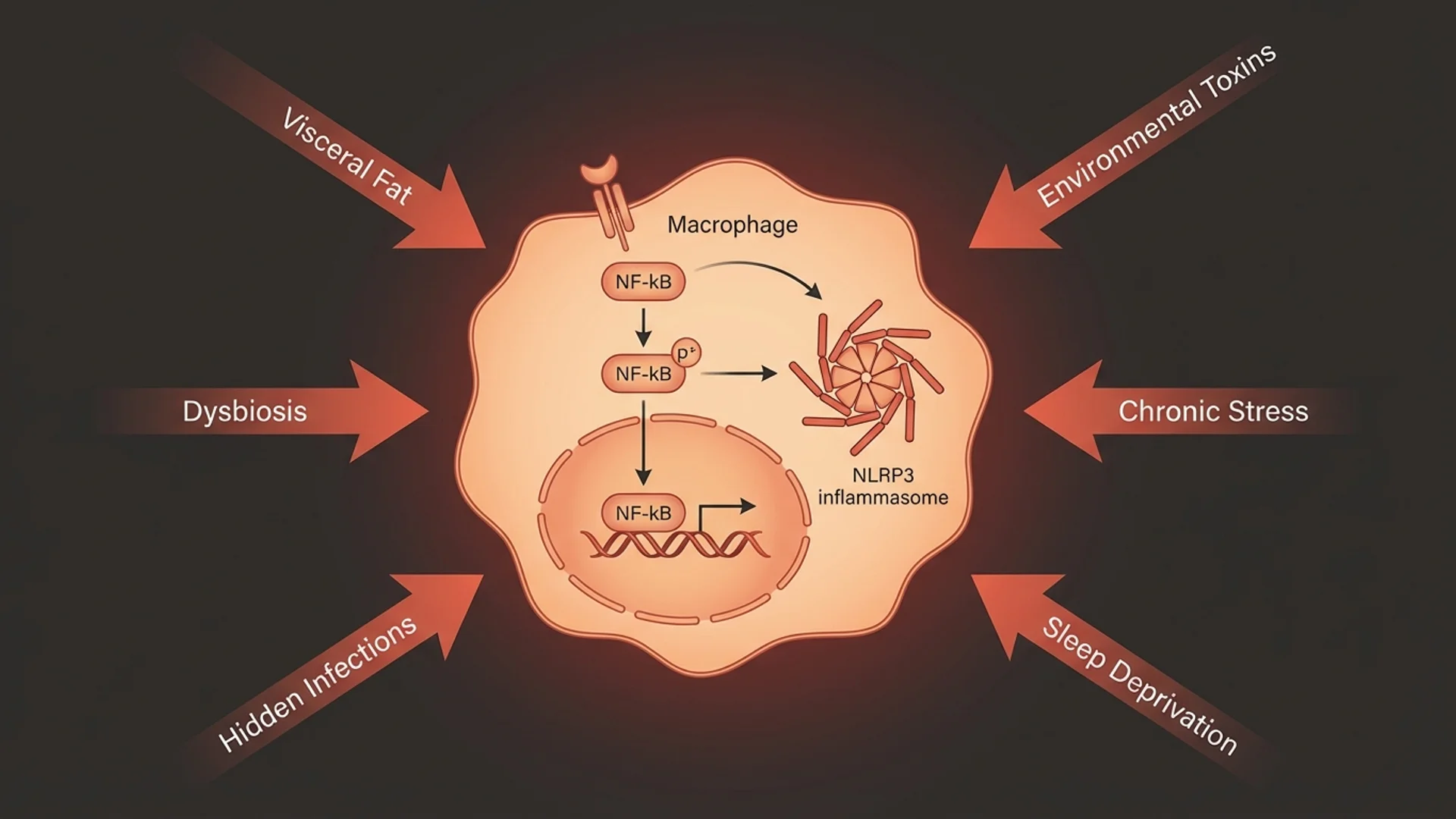
Up to one in four patients with major depressive disorder has detectable systemic inflammation, most readily measured by peripheral high-sensitivity C-reactive protein. For those patients, antidepressants tend to work somewhat less well, and inflammation is more common in depression that has not responded to treatment. In my practice the sequence is to test first, look for the cause and treat the inflammation where needed, alongside brain stimulation.
Who Has the Inflamed Subtype — and What It Looks Like
One review puts neuroinflammation at up to 27% of patients with major depressive disorder, and links it with a more severe, chronic and treatment-resistant course (Hassamal, 2023, PMID 37252156). That is a large enough group to make inflammation testing worth doing in a thorough workup.
The critical study here is Chamberlain et al. (2019, PMID 29764522), published in the British Journal of Psychiatry. It compared CRP levels in four groups: 102 patients with treatment-resistant MDD, 48 with treatment-responsive MDD, 48 with untreated MDD, and 54 healthy volunteers. After correcting for BMI — the most important confounder — CRP was significantly elevated only in the treatment-resistant group (Cohen’s d = 0.47). The treatment-responsive and untreated groups were not significantly different from healthy controls.
In this one-time measurement, CRP was most clearly raised in the group whose depression had not responded to treatment. It shows a link, not that inflammation causes treatment to fail.
Clinically, the inflamed subtype does not always look like the textbook depressed patient. Fellows et al. (2024, PMID 39359158) analysed adults with treatment-resistant depression in Pakistan, taken from two randomised trials. 87% had CRP of 3 mg/L or more. High CRP was linked with early-night insomnia, early-morning waking and psychic anxiety. The authors say this needs replicating in other samples. When a patient describes their depression as primarily driven by anxious agitation, sleep-onset and sleep-maintenance problems, and a sense that something biological is wrong, inflammation belongs on the differential.
The Testing Panel: What to Order and What the Numbers Mean
High-sensitivity CRP is the first-line test, for the same reason it has entered cardiovascular medicine: it is inexpensive, widely available, stable under standard laboratory handling, and peripheral CRP levels correlate closely with cerebrospinal fluid CRP (Hassamal, 2023). Ordering the standard CRP is insufficient for this purpose — only the hs-CRP assay has the sensitivity to detect the low-grade elevations that are clinically meaningful in depression.
hs-CRP thresholds in clinical context:
| hs-CRP level | Interpretation | Clinical implication |
|---|---|---|
| < 1.0 mg/L | Low-risk | Inflammation unlikely to be a primary driver |
| 1.0–3.0 mg/L | Moderate elevation | Low-grade inflammation; lifestyle factors likely; test for occult causes if TRD |
| 3.0–5.0 mg/L | High | Inflammation may contribute; investigate the cause (see the decision tree) |
| > 5.0 mg/L | Elevated (“hot”) | Group with an exploratory (non-significant) infliximab signal in one small trial; infection/autoimmune screen |
Beyond hs-CRP, the full inflammatory picture adds meaningful resolution. A practical first-tier extension panel includes:
- Interleukin-6 (IL-6): One of the inflammatory cytokines most consistently raised in depression; higher levels go with more severe symptoms (Hassamal, 2023, PMID 37252156).
- TNF-alpha: In a 57-patient sham-controlled rTMS trial, changes in TNF-alpha over the first two weeks correlated with changes in depression scores, with the active and sham groups analysed together (Wang et al., 2022, PMID 35722555). This was a correlation of change scores. It did not test TNF-alpha at baseline as a predictor.
- Neutrophil-to-lymphocyte ratio (NLR): An accessible whole-blood calculation that tracks systemic immune activation.
- Ferritin: Elevated ferritin is both a marker of acute-phase inflammation and, separately, a marker of iron overload. It is worth drawing when CRP is elevated to distinguish inflammatory ferritin from primary iron excess.
- Erythrocyte sedimentation rate (ESR): Slower to change than CRP and less specific, but adds value when temporal trends are needed or when vasculitis or autoimmune disease is suspected.
How Elevated CRP Undermines Antidepressant and TMS Response
Several mechanisms have been proposed for how inflammation affects depression and its treatment:
The IDO pathway (mechanistic hypothesis). Inflammatory cytokines activate the enzyme indoleamine-2,3-dioxygenase (IDO), which breaks down tryptophan, the building block of serotonin, into kynurenine, leaving less available for serotonin (Hassamal, 2023, PMID 37252156).
Direct meta-analytic evidence. Gasparini et al. (2022, PMID 35342200) reviewed 31 studies on inflammatory markers and antidepressant response in MDD and pooled 19 of them. In the CRP analysis (seven studies, 1,493 patients), baseline CRP was higher in people who did not respond to antidepressants than in those who did, a small effect (effect size −0.18, 95% CI −0.28 to −0.08; p = 0.0006; I² = 0%). IL-8 was also higher in non-responders. The authors say more research is needed before these markers can be used to predict response.
At the extreme end. Raison et al. (2013, PMID 22945416) tested infliximab, a TNF-alpha blocker, against placebo in treatment-resistant depression. Across the full sample, infliximab had no advantage. But in the subgroup with baseline hs-CRP above 5 mg/L — the actively inflamed patients — response rates were 62% (8 of 13) with infliximab versus 33% (3 of 9) with placebo. This difference was not statistically significant (P = .19), and in patients with hs-CRP of 5 mg/L or less the trend favoured placebo. The authors call it a proof-of-concept result: blocking TNF did not help treatment-resistant depression in general, but may help patients with high baseline inflammation.
For TMS specifically, Wang et al. (2022, PMID 35722555) randomised 57 patients to active or sham rTMS; patients also started antidepressant medication. In the active group, IL-2 and hs-CRP rose after 2 and 12 weeks (week 12 was 8 weeks after the last session). Symptom change was linked with changes in TNF-α at 2 weeks and IL-2 at 12 weeks, but not with hs-CRP. No trial has tested whether lowering inflammation before TMS improves the response.
The Decision Tree: What to Do with the CRP Result
None of this delays treatment for severe depression or suicidal thoughts. If you are in acute danger, contact emergency services immediately or call your national crisis line. These thresholds and steps are my clinical working practice, decided with each patient. The < 1, 1–3 and > 3 mg/L bands come from cardiovascular risk assessment and have not been validated as treatment thresholds in depression.
hs-CRP < 1.0 mg/L: Inflammation is unlikely to be a meaningful driver. Proceed with the standard workup for depression (qEEG brain mapping, infection screen if clinically indicated) and initiate TMS according to the network pattern identified on mapping.
hs-CRP 1.0–3.0 mg/L: Low-grade chronic inflammation. Address lifestyle factors (sleep, exercise, diet, stress) alongside TMS rather than waiting. In patients with TRD, chronic interpersonal stress from a coercive or narcissistically abusive relationship is a biologically significant source of persistent HPA activation and should be screened for systematically — the mechanism and clinical approach are covered in narcissistic abuse as an overlooked driver of treatment-resistant depression. This level should be followed up at the end of the stimulation course.
hs-CRP 3.0–5.0 mg/L: Clinically meaningful elevation. Complete a targeted cause investigation: Lyme disease and co-infections (Bartonella, Babesia, Ehrlichia), reactivated viruses (EBV, HHV-6), autoimmune screening (ANA, anti-dsDNA, thyroid antibodies), and gut integrity markers (zonulin, calprotectin). If an infectious or autoimmune cause is found, I treat it alongside TMS. If no discrete cause is identified, I start a structured anti-inflammatory protocol alongside TMS. hs-CRP is rechecked after eight to twelve weeks.
hs-CRP > 5.0 mg/L: At this level I do a full infection and autoimmune workup before deciding on further treatment. This is the threshold above which Raison et al. (2013) saw an exploratory, non-significant signal for infliximab.
Treating Inflammation Alongside TMS: The Protocol
I start the anti-inflammatory protocol alongside brain stimulation. The long-term goal is to bring inflammation markers such as hs-CRP down; the protocol usually runs for eight to twelve weeks.
Step 1 — Rule out infections first. Lyme disease, Bartonella, reactivated EBV, and HHV-6 are under-recognized causes of persistent high CRP and neuropsychiatric symptoms that look identical to treatment-resistant depression. In my experience, standard antibody tests can miss Lyme disease in long-standing or atypical illness, so a clinical specialist with experience in tick-borne illness and atypical presentations should be part of the workup when CRP stays high and standard causes are absent.
Step 2 — Dietary foundation. The base is a Mediterranean-pattern diet, with ultra-processed foods, refined carbohydrate and seed oils removed.
Step 3 — Targeted supplementation. In my protocol: omega-3 fatty acids (EPA + DHA, at least 2–3 grams per day combined), with curcumin plus piperine, berberine and high-dose vitamin D3 (with K2) added where indicated. Berberine slows the liver enzymes that break down many medicines, including several antidepressants (CYP2D6, CYP2C9 and CYP3A4 in a human study; Guo 2012, PMID 21870106), so it is only added after a medication review. These are not substitutes for identifying and removing the inflammatory cause.
Step 4 — Sleep and exercise. Both independently reduce IL-6 and CRP. Seven to nine hours of consolidated sleep is not a lifestyle preference in this context — it is part of the treatment protocol.
Step 5 — Retest and decide. After eight to twelve weeks, recheck hs-CRP and the extended cytokine panel. If the level remains elevated despite the protocol, escalate the infection/autoimmune investigation.
Related Articles
- Treatment-Resistant Depression: The Cause-First Workup Before TMS — The full four-domain protocol: brain networks, inflammation, infections, and relationships.
- TMS for Depression: What 20 Years of Evidence Shows — The clinical evidence base for rTMS in depression and how to interpret response rates.
- Chronic Inflammation: The Root of Disease — Mechanisms of systemic low-grade inflammation and evidence-based strategies for reducing it.
- Brain Fog and Neuroinflammation: The PET Scan Evidence — Microglial activation and central nervous system inflammation documented in Lyme and post-infectious states.
- ECT Side Effects and Alternatives — Why ECT should not be the escalation step for treatment-resistant depression, and what the evidence shows.
References
-
Chamberlain SR, Cavanagh J, de Boer P, et al. Treatment-resistant depression and peripheral C-reactive protein. Br J Psychiatry. 2019;214(1):11–19. doi:10.1192/bjp.2018.66. PMID: 29764522
-
Gasparini A, Callegari C, Lucca G, et al. Inflammatory Biomarker and Response to Antidepressant in Major Depressive Disorder: a Systematic Review and Meta-Analysis. Psychopharmacol Bull. 2022;52(1):36–52. doi:10.64719/pb.4425. PMID: 35342200
-
Wang Q, Zeng L, Hong W, et al. Inflammatory Cytokines Changed in Patients With Depression Before and After Repetitive Transcranial Magnetic Stimulation Treatment. Front Psychiatry. 2022;13:925007. doi:10.3389/fpsyt.2022.925007. PMID: 35722555
-
Raison CL, Rutherford RE, Woolwine BJ, et al. A randomized controlled trial of the tumor necrosis factor antagonist infliximab for treatment-resistant depression: the role of baseline inflammatory biomarkers. JAMA Psychiatry. 2013;70(1):31–41. doi:10.1001/2013.jamapsychiatry.4. PMID: 22945416
-
Fellows E, Jones BDM, Hodsoll J, et al. Associations between C-reactive protein and individual symptoms of depression in a lower-middle income country. BJPsych Open. 2024;10(5):e169. doi:10.1192/bjo.2024.735. PMID: 39359158
-
Hassamal S. Chronic stress, neuroinflammation, and depression: an overview of pathophysiological mechanisms and emerging anti-inflammatories. Front Psychiatry. 2023;14:1130989. doi:10.3389/fpsyt.2023.1130989. PMID: 37252156
-
Guo Y, Chen Y, Tan ZR, et al. Repeated administration of berberine inhibits cytochromes P450 in humans. Eur J Clin Pharmacol. 2012;68(2):213–217. doi:10.1007/s00228-011-1108-2. PMID: 21870106