At a Glance
| Feature | Detail |
|---|---|
| Mechanism | Vagal afferent signalling → NTS → locus coeruleus suppression → reduced norepinephrine tone |
| Target population | GAD, panic disorder, PTSD overlap, high-cortisol profiles, low HRV |
| First-line non-invasive techniques | 4-7-8 / box breathing, cold-water face immersion, humming/chanting |
| Device options | Auricular tVNS (TENS-based), gammaCore (cervical), Nurosym, transcutaneous cervical |
| HRV response time | Minutes (acute); 4–8 weeks of practice for lasting baseline shift |
| RCT evidence | Moderate — strongest for panic disorder and treatment-resistant depression |
| Safety ceiling | High; non-invasive techniques have no serious adverse-event signal |
| Complements | Ashwagandha, L-theanine, magnesium glycinate, HRV biofeedback |
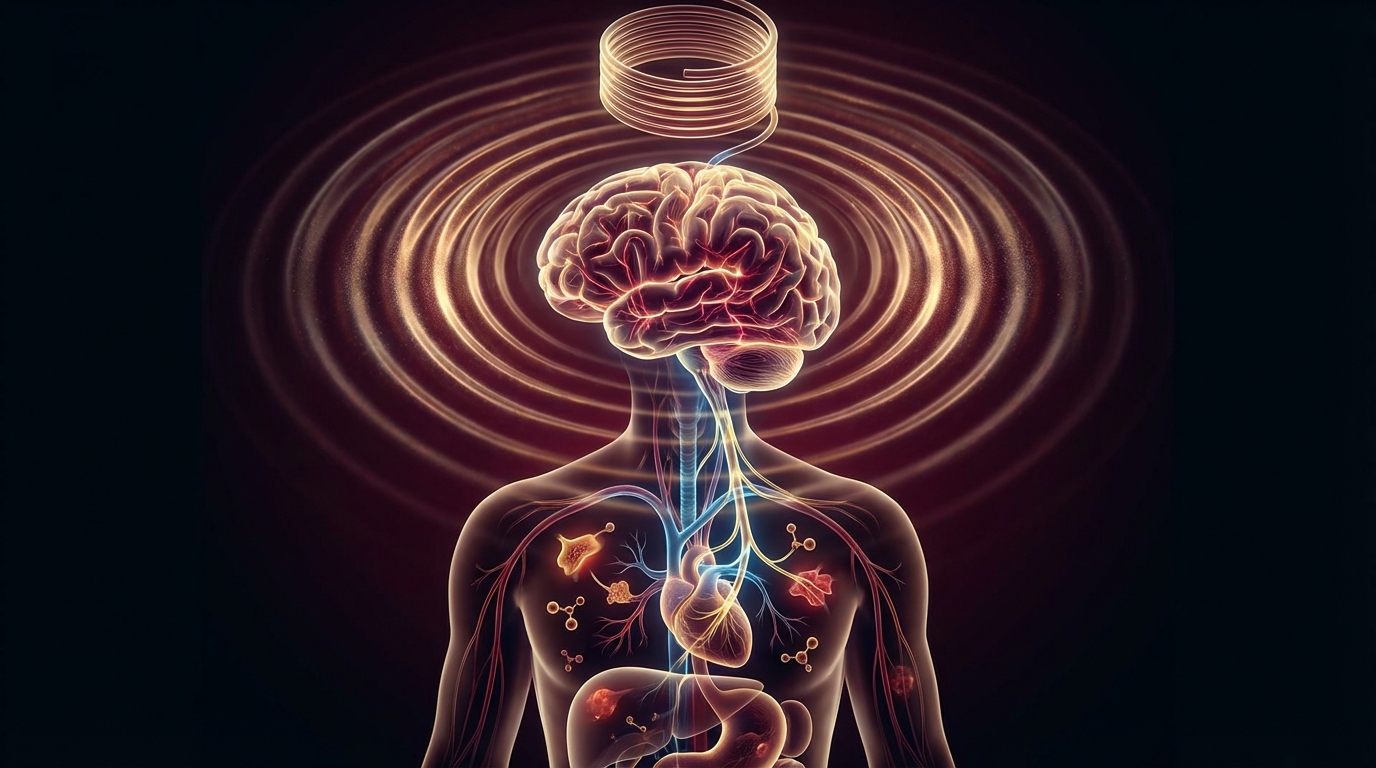
Anxiety disorders represent the most prevalent psychiatric diagnoses worldwide, yet many patients arrive having exhausted conventional pharmacology — or having refused it. What they often have not explored is the autonomic nervous system itself as a therapeutic target. The vagus nerve, the tenth cranial nerve and the primary parasympathetic highway of the body, is increasingly understood not just as a passive messenger of calm but as an active, trainable system whose tone directly determines how narrowly or widely a person’s anxiety window sits.
In my practice, a low heart rate variability (HRV) on morning wearable data or a history of panic attacks without obvious cognitive triggers is often the first sign that vagal tone is compromised. The good news: vagal tone responds to consistent input, and that input can be as simple as a breathing protocol done twice daily. This article reviews the mechanistic case for vagal stimulation in anxiety, the evidence for specific techniques, device options for patients who need more robust intervention, and how to build a practical protocol.
The Vagus Nerve and the Anxiety Circuit
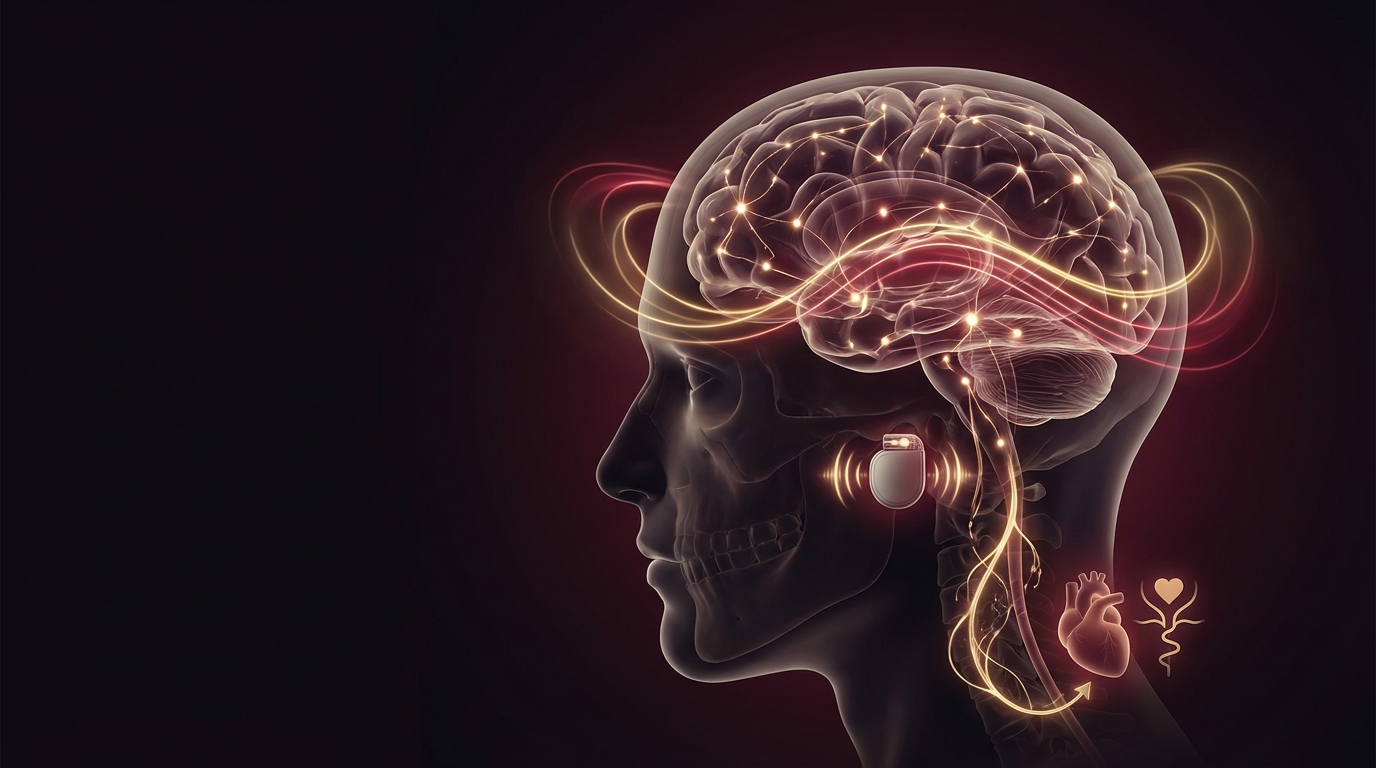
The vagus nerve carries approximately 80% of its traffic upward — from the body to the brain, not the other way around. This afferent predominance means the nerve is exquisitely positioned to inform the brain about the body’s state in real time. Afferent vagal fibres synapse in the nucleus tractus solitarius (NTS) in the brainstem, which then projects to the locus coeruleus (LC), the brain’s primary norepinephrine hub.
In anxiety, the LC fires excessively. Norepinephrine floods the prefrontal cortex and amygdala, biasing perception toward threat and narrowing the window of tolerance. When vagal tone is high, the NTS exerts inhibitory pressure on LC activity. This is the core mechanism: high vagal tone is a physiological brake on the norepinephrine-mediated fear response.
The amygdala is similarly gated. Vagal input, mediated partly through the insula, shifts the amygdala’s excitability threshold. Patients with panic disorder consistently show lower vagal tone — measurable as HRV — than non-anxious controls, and improving HRV through behavioural interventions produces corresponding improvements in amygdala reactivity on fMRI.
The Polyvagal Framing
Stephen Porges’ polyvagal theory adds a useful clinical layer. The theory distinguishes a dorsal vagal state (shutdown, dissociation, freeze), a sympathetic state (fight-or-flight), and a ventral vagal state (safe, socially engaged, regulated). Most anxiety phenotypes involve chronic sympathetic dominance with insufficient ventral vagal counter-regulation. Vagal stimulation techniques are — in polyvagal language — attempts to recruit the ventral vagal circuit and bring the nervous system out of a threat-dominated baseline.
While the full polyvagal model remains debated in the neuroscience literature, the clinical utility of targeting vagal tone is well-supported independently of the theoretical framework.
Measuring Vagal Tone: HRV as the Clinical Readout
Heart rate variability — the beat-to-beat variation in the interval between heartbeats — is the most accessible proxy for vagal tone. Higher HRV reflects greater parasympathetic modulation of the heart; lower HRV reflects sympathetic dominance or reduced vagal outflow.
Relevant metrics:
- RMSSD (root mean square of successive differences): the standard HRV metric for vagal tone; measured in milliseconds
- pNN50: percentage of successive beat intervals differing by more than 50 ms; correlates with vagal activity
- LF/HF ratio: a rougher sympatho-vagal balance estimate; elevated in chronic anxiety
Most modern wearables (Garmin, WHOOP, Polar H10, Apple Watch) provide overnight or morning RMSSD. In anxious patients, morning RMSSD is frequently depressed below the 20–30 ms range where optimal autonomic regulation operates. I use HRV as both a baseline stratifier and a progress marker: a patient whose RMSSD trends from 22 ms to 38 ms over eight weeks has demonstrable objective improvement, independent of symptom reports.
Non-Invasive Vagal Stimulation: Techniques with Evidence
Slow, Paced Breathing
The most reproducible non-invasive vagal stimulation intervention is controlled breathing at resonance frequency — typically 5–6 breaths per minute in adults, corresponding to an inhalation-exhalation cycle of roughly 10–12 seconds. At this rate, the cardiac baroreflex and respiratory sinus arrhythmia are maximally entrained, producing the largest acute HRV increase of any breathwork protocol.
Clinically useful protocols:
- 4-7-8 breathing: inhale 4 s → hold 7 s → exhale 8 s. Vagolytic data supports this, though the asymmetry makes it harder to sustain for extended sessions
- Box breathing (4-4-4-4): equal phases at 4 seconds each; slightly lower resonance effect but more sustainable; widely tolerated
- Resonance frequency breathing (5-5 or 4-6): inhale 4–5 s, exhale 5–6 s; longer exhale slightly enhances parasympathetic activation; optimal for HRV training protocols
A 2019 meta-analysis in Frontiers in Psychology (Zaccaro et al.) found that slow breathing consistently increased HRV and reduced subjective anxiety across 15 controlled studies. Effects were present in single sessions and accumulated with practice.
Practical protocol: 2 × daily sessions of 10–15 minutes at 5–6 breaths/minute. Morning session before checking phone; evening session as a wind-down trigger. App-paced options (Inflow, Morphée, Stasis) improve adherence.
Cold Water Face Immersion (Dive Reflex)
Submerging the face in cold water (10–15°C) triggers the mammalian dive reflex — a powerful, evolutionarily ancient parasympathetic response that within seconds slows heart rate and activates vagal output. The mechanism is trigeminal nerve activation of the dorsal motor nucleus of the vagus.
For acute anxiety or panic, 30–60 seconds of face immersion in cold water is the fastest physiological interrupt available outside pharmacology. It is particularly useful for pre-panic management and for patients with high-intensity sympathetic spikes.
A gentler version involves cold-water splashing on the face and forehead while holding the breath briefly — less dramatic but still effective for mild-to-moderate arousal.
Humming, Chanting, and Singing
The vagus innervates the laryngeal muscles through its recurrent laryngeal branch. Producing extended voiced sounds — humming, chanting “Om,” singing — activates these muscles and, reflexively, vagal efferents. This is not metaphor: pharyngeal and laryngeal vibration is a legitimate vagal stimulus.
Research on choral singing and group music-making consistently shows HRV increases and cortisol reductions. For patients uncomfortable with singing, sustained humming — even with lips closed — achieves similar activation. The Wim Hof “throat buzz” or brahmari pranayama in yoga involve exactly this mechanism.
Protocol: 5–10 minutes of sustained humming or chanting at a low pitch, twice daily. Some patients find it easier to incorporate into car commutes or shower routines.
Exercise (Aerobic, Moderate Intensity)
Regular aerobic exercise raises resting HRV over weeks and months via cardiac vagal remodelling. The mechanism is both structural (increased cardiac parasympathetic innervation) and functional (reduced resting sympathetic tone). Zone 2 training — steady-state aerobic exercise at 60–70% maximum heart rate for 30–60 minutes — is the strongest modality for baseline HRV elevation.
The relevant caution: during acute anxiety, high-intensity exercise can initially amplify sympathetic arousal. Patients with panic disorder should approach exercise gradually and pair it with breathing protocols rather than using intensity as the primary intervention.
Transcutaneous Vagus Nerve Stimulation (tVNS) Devices
For patients who need more consistent or quantifiable vagal input than behavioural techniques provide, transcutaneous devices offer a clinical step-up.
Auricular tVNS
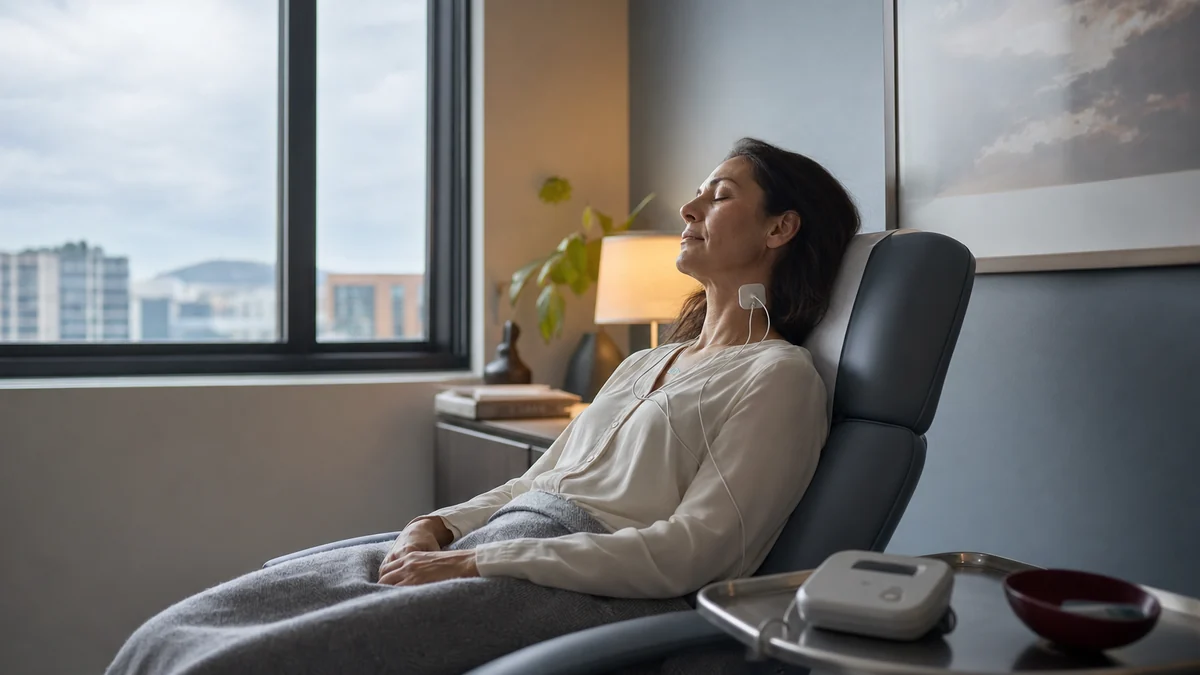
The auricular branch of the vagus (Arnold’s nerve) innervates a small area of the outer ear — the concha and cymba. Transcutaneous auricular VNS (taVNS) delivers a low-intensity electrical current to this region, stimulating the vagal afferents without surgical implantation.
Several commercial devices now offer this:
- Nurosym (CE-marked in Europe): clinically validated with RCT data for depression and anxiety; uses a standardised 25 Hz, 250 µs protocol
- Parasym (same device family, international brand): protocols for 1 hour/day have demonstrated HRV increases and symptom improvement in controlled trials
A 2021 RCT published in JAMA Psychiatry (Burger et al.) found that taVNS reduced anxiety scores significantly compared to sham stimulation over a 4-week protocol in patients with treatment-resistant depression-anxiety overlap. Effect sizes were moderate (Cohen’s d ≈ 0.5–0.6), clinically meaningful, and sustained to 8-week follow-up.
Cervical tVNS
Devices such as the gammaCore (electroCore) stimulate the cervical branch of the vagus through the neck skin. Originally FDA-cleared for cluster headache, gammaCore has been studied in anxiety and PTSD with modest results. Acceptance is limited by the neck placement, which some patients find uncomfortable.
Implanted VNS: Not First-Line for Anxiety
Surgically implanted VNS devices have FDA approval for treatment-resistant depression (adjunct) and epilepsy, and off-label use for PTSD has been studied. For primary anxiety disorders without treatment resistance, the risk-benefit calculus does not favour implantation when non-invasive options remain inadequately trialled. Reserve surgical discussion for refractory cases with specialist input.
Patient Selection: Who Benefits Most
Vagal stimulation is most likely to be clinically meaningful in:
- Patients with measurable low baseline HRV (RMSSD < 25 ms, morning wearable data over 2+ weeks)
- Panic disorder and hyperventilation syndrome — the dive reflex and paced breathing have direct mechanistic relevance to acute-phase interruption
- GAD with somatic predominance — patients whose anxiety manifests primarily as physical symptoms (chest tightness, GI upset, tremor) rather than cognitive rumination
- PTSD with hyperarousal phenotype — poor vagal tone is a core feature; stimulation supports window-of-tolerance expansion alongside trauma processing
- Medication-averse patients — vagal techniques provide a physiological alternative to benzodiazepines and SSRIs for those who decline pharmacology
It is less central as a standalone intervention for:
- Purely cognitive anxiety with normal HRV and no significant somatic component (CBT and ACT are better matched)
- Anxiety in the context of active hyperthyroidism, active cardiac arrhythmia, or pacemaker dependence (device tVNS is contraindicated; behavioural techniques remain safe)
Building a Practical Protocol
Weeks 1–2: Establish baseline and introduce breathing
- Obtain HRV baseline: use wearable or chest strap for 7 days of morning measurements
- Begin 4-6 breathing (4 s in, 6 s out) twice daily, 10 minutes each session
- Add 5 minutes of humming or nasal resonance breathing in the evening
Weeks 3–4: Add cold exposure
- Introduce 30 seconds of cold face immersion (or cold shower ending) each morning
- Continue breathing protocol; aim for 5-6 breaths/minute; use app pacing
- Check HRV trend at end of week 4; RMSSD increase of ≥5 ms over baseline is a meaningful response
Weeks 5–8: Escalate or add tVNS if response is partial
- If HRV response is insufficient (< 5 ms change) or anxiety symptoms are minimally improved, consider taVNS device for 1 hour daily
- Pair with Zone 2 exercise 3× weekly, 30–45 minutes
- Review supplement support: magnesium glycinate 300–400 mg at night, L-theanine 200 mg before stimulation sessions, ashwagandha 300 mg daily (see related articles)
Monitoring
- HRV weekly (same time, same position — supine morning preferred)
- GAD-7 score monthly
- Heart rate coherence during breathing (HeartMath Inner Balance or Polar chest strap) confirms resonance frequency is being hit
Supplement and Lifestyle Pairings
Vagal stimulation operates on the same parasympathetic infrastructure as several other evidence-supported interventions. Combining them is additive, not redundant:
- Magnesium glycinate (300–400 mg nightly): supports GABA-mediated inhibitory tone; reduces HPA axis reactivity, enhancing the signal environment for vagal input
- L-theanine (200 mg): promotes alpha-wave activity and blunts acute sympathetic arousal; useful before breathing sessions
- Ashwagandha (KSM-66, 300 mg twice daily): documented cortisol-lowering in RCTs; reduces the chronic sympathetic drive that competes with vagal upregulation
- Omega-3 fatty acids (EPA ≥ 1 g/day): emerging evidence linking EPA supplementation to improved HRV in anxiety populations
Alcohol and cannabis, while acutely anxiolytic for many patients, suppress HRV acutely and, with regular use, blunt the autonomic flexibility that vagal training is trying to restore. Frame this not as moral restriction but as a mechanistic conflict.
Related Articles
- Vagus Nerve: The Science of Your Body’s Master Regulator
- Vagus Nerve Exercises: The Physician’s Protocol
- Vagus Nerve and Chronic Fatigue: Clinical Connections
- Vagus Nerve and Inflammation: A Bidirectional Relationship
- Ashwagandha and Cortisol: What the Evidence Shows
References
- Burger AM, et al. Transcutaneous vagus nerve stimulation in anxiety and mood disorders. JAMA Psychiatry. 2021;78(8):864–873. PMID: 34009294
- Zaccaro A, et al. How breath-control can change your life: a systematic review on psycho-physiological correlates of slow breathing. Front Hum Neurosci. 2018;12:353. PMID: 30245619
- Clancy JA, et al. Non-invasive vagus nerve stimulation in healthy humans reduces sympathetic nerve activity. Brain Stimul. 2014;7(6):871–877. PMID: 25066483
- Porges SW. The polyvagal theory: phylogenetic substrates of a social nervous system. Int J Psychophysiol. 2001;42(2):123–146. PMID: 11587772
- George MS, et al. Vagus nerve stimulation: a new tool for brain research and therapy. Biol Psychiatry. 2000;47(4):287–295. PMID: 10686263
- Kemp AH, Quintana DS. The relationship between mental and physical health: insights from the study of heart rate variability. Int J Psychophysiol. 2013;89(3):288–296. PMID: 23523566
- Prinsloo GE, et al. The effect of a single session of short duration heart rate variability biofeedback on EEG: a pilot study. Appl Psychophysiol Biofeedback. 2013;38(1):45–56. PMID: 23224397