At a Glance
| Parameter | Detail |
|---|---|
| Indication | Obsessive-compulsive disorder (OCD), all severities; treatment-resistant preferred |
| FDA clearance | August 2018 — BrainsWay H7 deep TMS coil for OCD |
| Primary target | Medial prefrontal cortex (mPFC) + anterior cingulate cortex (ACC) |
| Alternative target | Supplementary motor area (SMA) — bilateral 1 Hz rTMS |
| Protocol (deep TMS) | 20 Hz, 100% rMT, 20 pulses/train, 60 trains/session, 29 sessions over 6 weeks |
| Symptom provocation | Mandatory 3–5 min individualized provocation before each session (distress 4–7/10) |
| Response rate | ~45% active vs ~18% sham (Y-BOCS ≥35% improvement) at 4-week follow-up |
| Safety | Headache most common; seizure risk <0.1%; no cognitive adverse effects documented |
| Best combination | Concurrent or sequential CBT/ERP augments and consolidates TMS gains |
Obsessive-compulsive disorder is one of the most disabling psychiatric conditions worldwide, yet fewer than half of patients achieve adequate relief from first-line treatments — serotonin reuptake inhibitors and exposure and response prevention therapy (ERP). For the other half, TMS offers a non-invasive path that bypasses the bloodstream, works directly on the dysfunctional circuit, and can be delivered in an outpatient chair without anaesthesia or the irreversible memory risks of ECT. For a full discussion of why ECT should not be a treatment option in neuropsychiatric conditions, see ECT side effects and alternatives.
This article covers the neurobiology of OCD that makes TMS mechanistically rational, the two main stimulation targets, the protocol details that separate effective from ineffective treatment, and what patients should realistically expect.
Why OCD Responds to TMS: The Circuit Basis
OCD is not a vague “chemical imbalance.” It has an identifiable, repeatedly replicated neural substrate: hyperactivity in the cortico-striato-thalamo-cortical (CSTC) loop, specifically the direct pathway connecting the orbitofrontal cortex (OFC), anterior cingulate cortex (ACC), caudate nucleus, and thalamus. When this loop runs too fast, the brain’s error-detection alarm fires continuously — triggering intrusive thoughts and compulsive acts that temporarily reduce but never permanently resolve the signal.
Neuroimaging confirms that effective OCD treatment — whether SSRI, CBT, or deep brain stimulation — tends to normalize OFC and ACC hyperactivity. TMS can modulate cortical excitability non-invasively: high-frequency protocols (≥10 Hz) increase synaptic potentiation; low-frequency protocols (≤1 Hz) suppress hyperactive nodes. Applied to the right target, either approach can interrupt the runaway loop.
The critical insight driving modern deep TMS for OCD is that activating the dysfunctional circuit just before stimulation dramatically improves precision. A resting brain doesn’t direct the effect where it matters. A brain currently running an OCD loop does.
Two Validated Targets — Different Coils, Different Mechanisms
Deep TMS: Medial Prefrontal Cortex and Anterior Cingulate Cortex
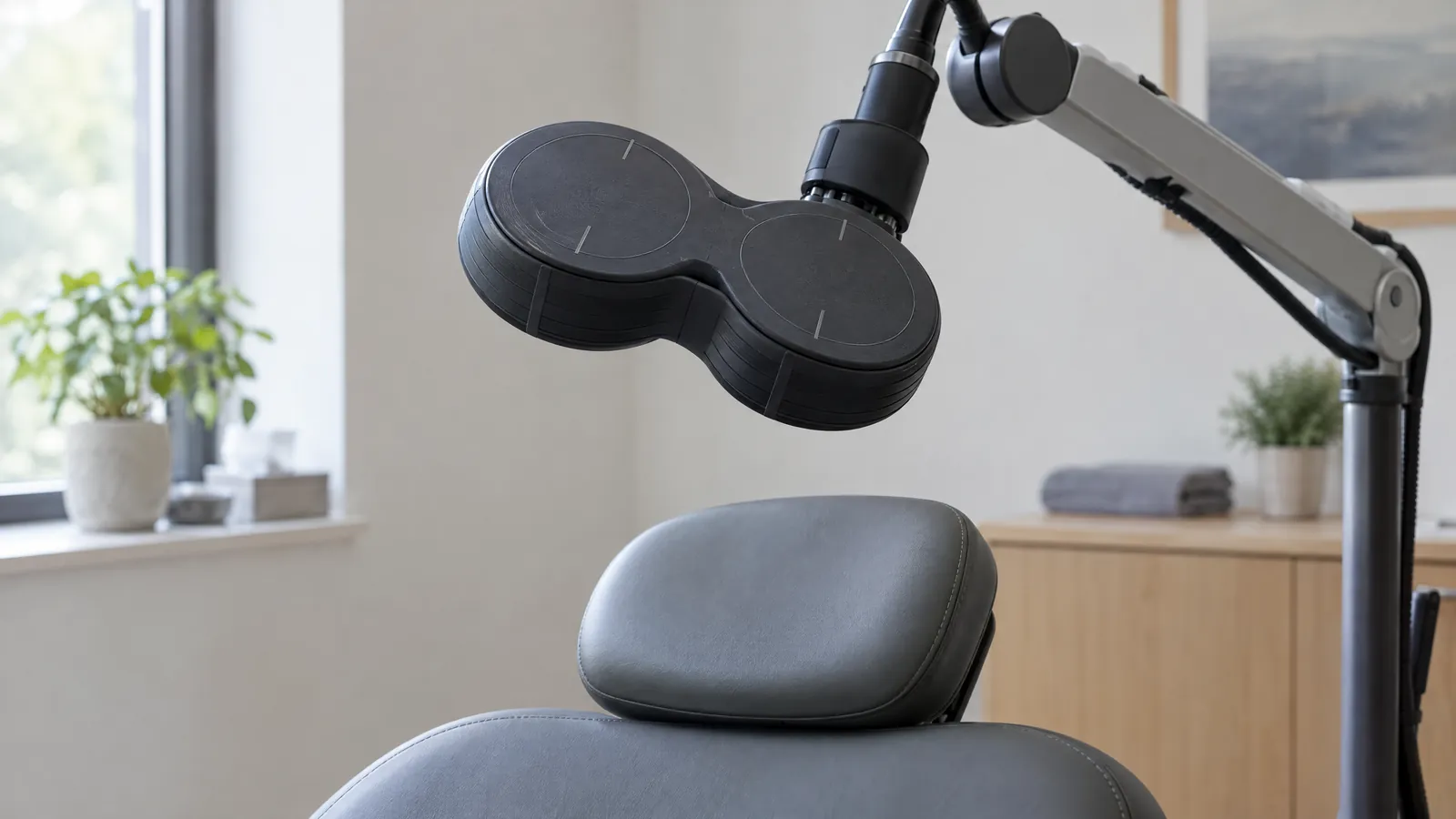
The BrainsWay H7 coil was engineered specifically to reach the mPFC and ACC — both deep midline structures that conventional figure-8 coils cannot reliably engage. The H7 delivers magnetic flux 3–4 cm below the scalp surface, covering roughly 20 cm³ of cortical volume compared to 3–4 cm³ for a figure-8 coil.
The protocol is high-frequency (20 Hz) to drive LTP-like potentiation in the medial prefrontal network, with the goal of enhancing top-down inhibitory control over the hyper-reactive CSTC loop. Because the mPFC normally suppresses amygdala and OFC hyperactivity, strengthening this pathway reduces the drive that feeds compulsive behaviour.
Conventional rTMS: Supplementary Motor Area
Before the H7 coil was available, researchers noted that the supplementary motor area — a node linking the prefrontal cortex with motor striatum — is implicated in the tic-like compulsive motor acts of OCD. Low-frequency (1 Hz) rTMS over the bilateral SMA suppresses cortical hyper-excitability in that region. Mantovani et al. showed that 4 weeks of bilateral SMA rTMS at 1 Hz, 100% motor threshold, 1200 stimuli/day produced significant Y-BOCS improvement in medication-resistant OCD, normalizing cortical excitability measured by TMS-evoked cortical silent periods (PMID 19691873).
The SMA target remains clinically useful, particularly in patients with prominent motor rituals or in clinics that do not have access to deep TMS hardware. It requires a standard figure-8 coil and no specialised helmet.
The Deep TMS Protocol — Step by Step
Symptom Provocation: The Clinical Key
This is the detail most often missed in centres attempting TMS for OCD without specialised training. Before each session, the therapist presents the patient with personalised OCD-triggering material — a contamination-feared object, a symmetry trigger, an intrusive-thought script — for 3–5 minutes, aiming for a subjective distress score of 4–7 on a 10-point scale. The purpose is not distress for its own sake: it is to activate the CSTC loop immediately before stimulation so that the magnetic pulses land on a circuit that is currently firing, not at rest.
Carmi et al. (2019) used this provocation approach in the pivotal registration trial and demonstrated that it was associated with the efficacy signal (DOI: 10.1176/appi.ajp.2019.18101180). Retrospective analyses suggest that patients with higher provocation distress scores show greater Y-BOCS reductions. Without provocation, the evidence for deep TMS efficacy weakens substantially.
Session Parameters
| Parameter | Standard (FDA-cleared) |
|---|---|
| Frequency | 20 Hz |
| Intensity | 100% resting motor threshold |
| Pulses per train | 20 |
| Trains per session | 60 |
| Inter-train interval | 20 s |
| Total pulses/session | 1,200 |
| Session duration | ~20 minutes (excluding provocation) |
| Course | 29 sessions over 6 weeks (5 days/week × 6 weeks minus 1) |
After the initial 6-week course, symptom-based maintenance at monthly intervals has been used in clinical practice, though no large maintenance trial exists yet.
What Happens to Y-BOCS Scores
The Yale-Brown Obsessive Compulsive Scale (Y-BOCS) is the standard outcome measure. A response is defined as ≥35% reduction from baseline; remission as a final score <12. In the Carmi 2019 trial (n=99, multicenter, double-blind, sham-controlled):
- End of treatment (week 6): Active group Y-BOCS mean decrease ~6 points vs ~3.3 points sham (p=0.009)
- One-month follow-up: Response rate 45% active vs 18% sham
- Dropout due to adverse effects: 2 of 99 patients
The 2021 network meta-analysis of rTMS for OCD in adults (PMC: 8163761, Translational Psychiatry) ranked several protocols as significantly superior to sham; low-frequency over the DLPFC and high-frequency deep TMS both showed consistent effects, though evidence quality was rated low to moderate given trial heterogeneity.
Patient Selection: Who Benefits and Who Does Not
Good Candidates
- Primary OCD, any severity — the FDA indication does not restrict to severe or treatment-resistant disease, though real-world use skews toward inadequate responders to SRIs
- Failed one or more adequate SRI trials — Carmi et al. enrolled predominantly this population; prior SRI failure did not predict non-response to deep TMS
- Active symptoms at time of treatment — provocation works best when OCD is clinically present; stable remission on SRI is not an indication
- Willing to engage with provocation — patients who resist the provocation component show diminished outcomes
- Comorbid depression — OCD frequently co-occurs with major depression; TMS can target depression circuitry if scheduling is managed carefully
Contraindications and Cautions
- Metallic implants in or near the head — cochlear implants, aneurysm clips, stents above the clavicle are hard contraindications
- History of seizures or epilepsy — relative contraindication; individual risk-benefit applies
- Cardiac pacemakers or implanted defibrillators — contraindicated
- Pregnancy — insufficient data; standard clinical caution applies
- Active substance dependence — unstable substance use is a relative contraindication; the brain’s excitability is altered in unpredictable ways
What Not to Expect
TMS for OCD is not a cure and does not eliminate the need for cognitive-behavioural work. Response is defined as ≥35% symptom reduction — most responders will still have residual symptoms. The optimal use is as an augmentation to CBT/ERP: TMS reduces the intensity of the OCD signal, which makes the exposure exercises more tolerable and more effective. Patients who complete a full ERP course concurrently with or immediately after TMS show better consolidation of gains.
TMS vs. SRI and CBT — Where It Fits in the Algorithm
| Stage | First Choice | Add-on Options |
|---|---|---|
| Mild-moderate OCD | CBT/ERP ± SSRI | — |
| Moderate-severe, partial SRI response | SSRI dose optimisation + CBT intensification | TMS augmentation |
| SRI-resistant (≥2 adequate trials failed) | Clomipramine trial or augmentation | Deep TMS, referral for DBS evaluation |
| Co-morbid depression | SSRI + CBT | Deep TMS (may treat both circuits) |
Deep TMS is particularly valuable at stages 3 and 4, where medication burden is already high and further pharmacological escalation carries significant adverse effect risk.
Safety Profile
The safety record of TMS for OCD mirrors that of TMS for depression: the most common adverse effect is transient, mild-to-moderate headache or scalp discomfort at the stimulation site, typically resolving within 30–60 minutes and diminishing over the first week of treatment. Serious adverse events are rare:
- Seizure risk: Estimated <0.1% per treatment course with standard protocols; no seizures were reported in the Carmi 2019 trial
- Cognitive effects: No evidence of impaired memory, attention, or processing speed — in direct contrast to ECT, where permanent autobiographical memory loss is a documented outcome (Mathiassen 2026, Br J Psychiatry, PMID 40357797)
- Mood shift: A small minority of patients report transient mood lowering in the first week; this resolves spontaneously
- Hearing: Standard foam earplugs are worn to protect against the clicking sound; no long-term auditory effects documented
What to Expect as a Patient
A typical deep TMS course for OCD involves daily visits (Monday through Friday) for six weeks. Each visit takes roughly 30–40 minutes:
- Provocation (5 minutes): A trained therapist presents your personalised trigger material. You notice the OCD response — do not perform any compulsion.
- Stimulation (20 minutes): The H7 helmet is fitted and calibrated to your motor threshold. You sit comfortably while the coil delivers trains of pulses. Most patients describe a tapping or buzzing sensation on the scalp.
- Brief rating (5 minutes): Y-BOCS items or a brief distress rating help track progress.
Improvement typically appears gradually from week 3 or 4. Some patients notice a sudden shift; others see steady incremental gains. Plan for at least the full 6-week course before evaluating outcome — early responders exist but early non-response does not predict final outcome.
If you are in an acute crisis, please contact emergency services or a crisis line immediately.
Related Articles
- ECT Side Effects and Why Alternatives Exist — the case against ECT and what non-invasive neuromodulation offers instead
- TMS for Depression: Protocols, Evidence, and What to Expect — the full depression TMS guide, including protocol comparison and insurance context
- TMS for PTSD: Neural Targets, Protocols, and Clinical Outcomes — PTSD-specific TMS, amygdala modulation, and exposure-augmented protocols
- TMS for Anxiety: Evidence, Targets, and Clinical Application — generalized and social anxiety TMS protocols with direct comparison to OCD approach
- Neurofeedback for ADHD: Brain-Guided Training and Clinical Outcomes — the qEEG-guided approach to attention dysregulation
References
-
Carmi L, Tendler A, Bystritsky A, et al. Efficacy and Safety of Deep Transcranial Magnetic Stimulation for Obsessive-Compulsive Disorder: A Prospective Multicenter Randomized Double-Blind Placebo-Controlled Trial. Am J Psychiatry. 2019;176(11):931-938. DOI: 10.1176/appi.ajp.2019.18101180
-
Mantovani A, Westin G, Hirsch J, Lisanby SH. Modulation of motor cortex excitability in obsessive-compulsive disorder: an exploratory study on three single cases. Int J Neuropsychopharmacol. 2010;13(2):217-227. PMID: 19691873
-
Fitzsimmons OJ, Mellor C, Mulligan S, et al. Repetitive transcranial magnetic stimulation in obsessive-compulsive disorder: a pairwise and network meta-analysis. J Affect Disord. 2022. PMID: 35917621
-
Hazari N, Narayanaswamy JC, Venkatasubramanian G. Neuroimaging findings in obsessive-compulsive disorder: a narrative review to understand the neural correlates and neurobiological underpinnings. Indian J Psychiatry. 2019;61(Suppl 1):S9-S29. PMID: 30745673
-
Rodrigues PA, Zaninotto AL, Neville IS, et al. Efficacy and tolerability of repetitive transcranial magnetic stimulation for the treatment of obsessive-compulsive disorder in adults: a systematic review and network meta-analysis. Transl Psychiatry. 2021;11(1):254. PMCID: PMC8163761
-
Ahmari SE, Rauch SL. The prefrontal cortex and OCD. Neuropsychopharmacology. 2022;47(1):211-224. DOI: 10.1038/s41386-021-01130-2