
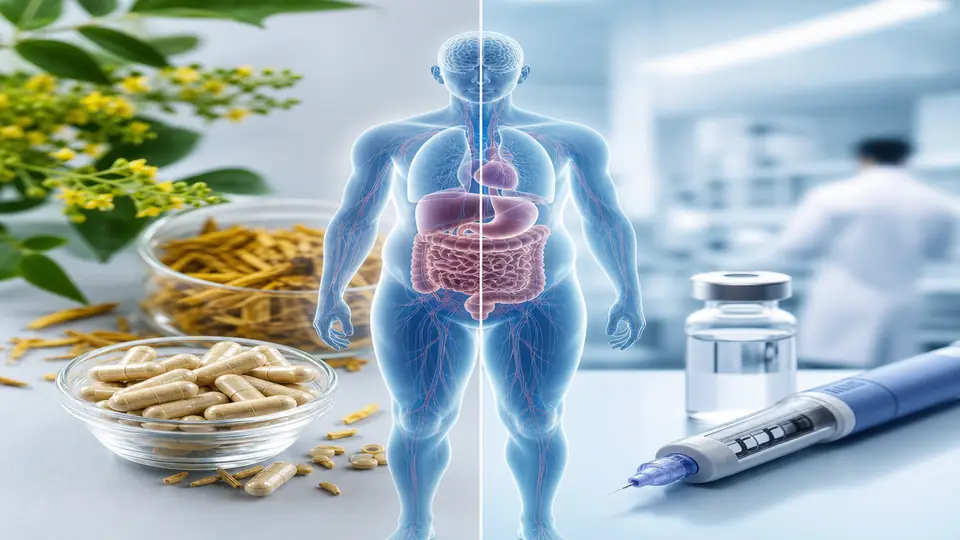
At a Glance
| Berberine | Semaglutide | |
|---|---|---|
| Drug class | Plant alkaloid / AMPK activator | GLP-1 receptor agonist |
| HbA1c reduction | ~0.9–1.5% | ~1.5–2.1% |
| Weight loss | 2–5 lb (modest) | 10–15% body weight |
| CV mortality benefit | Not established | Proven (SUSTAIN-6, SELECT) |
| Delivery | Oral capsule | Weekly injection or daily pill |
| Prescription required | No | Yes |
| Monthly cost | $20–50 | $800–1,200+ (brand) |
| Main side effects | GI upset, cramping | Nausea, vomiting, rare pancreatitis risk |
| Best for | Early insulin resistance, lipid support | Obesity with metabolic syndrome or high CV risk |
When a plant supplement gets nicknamed “nature’s Ozempic,” it signals both genuine interest and genuine confusion. Berberine has earned that nickname through a cluster of small but real metabolic effects — and semaglutide has earned its blockbuster status through some of the most compelling obesity trial data ever published. The problem is that collapsing both into “things that lower blood sugar” obscures everything clinically important about them.
This article is not a ranking of which compound is better. It is a clinical map: what each one actually does, where the evidence is strong versus thin, and how I think about patient selection in integrative practice.
Mechanism: Fundamentally Different Targets
How Berberine Works
Berberine is an isoquinoline alkaloid extracted from plants including Berberis vulgaris (barberry) and Coptis chinensis. Its dominant mechanism is activation of AMP-activated protein kinase (AMPK), the cellular energy sensor that responds to falling ATP-to-AMP ratios — the same pathway targeted by metformin and exercise.
AMPK activation by berberine drives:
- Glucose uptake into skeletal muscle via GLUT4 translocation
- Inhibition of hepatic gluconeogenesis (less de-novo glucose production)
- Reduced triglyceride synthesis through SREBP-1c suppression
- Modest thermogenic effects in white and brown adipose tissue
Berberine also modulates the gut microbiome — specifically enriching Akkermansia muciniphila and short-chain fatty acid producers — which may amplify its metabolic effects independently of direct AMPK signaling. This dual peripheral-and-gut action partly explains why it produces broader lipid improvements than metformin alone in some studies.
How Semaglutide Works
Semaglutide is a synthetic analogue of glucagon-like peptide-1 (GLP-1), a 30-amino-acid incretin hormone secreted by intestinal L-cells after meals. Native GLP-1 has a half-life of roughly 2 minutes; semaglutide’s structural modifications (C-18 fatty acid chain, Aib substitution at position 8) extend it to approximately 7 days, enabling once-weekly dosing.
Its metabolic effects are mediated through GLP-1 receptors distributed across the pancreas, brain, heart, and gut:
- Pancreatic β cells: glucose-dependent insulin secretion (no hypoglycemia risk when euglycemic)
- Hypothalamus and brainstem: appetite suppression via arcuate nucleus GLP-1R signaling; patients consistently report reduced food preoccupation and earlier satiety
- Gastric motility: delayed emptying, which blunts post-meal glucose spikes and prolongs satiety
- Myocardium and vasculature: direct anti-inflammatory and anti-atherosclerotic effects independent of weight loss
These are not overlapping pathways. Berberine does not meaningfully activate GLP-1 receptors; semaglutide does not activate AMPK. Any claim that one “does what the other does” should be treated with suspicion.
Efficacy: What the Clinical Trials Show
Berberine
The evidence base is dominated by small Chinese RCTs, mostly 8–24 weeks, with heterogeneous patient populations and formulations. The 2012 systematic review by Dong et al. (27 RCTs, n=2,569) found berberine reduced fasting glucose by approximately 1.3 mmol/L and HbA1c by 0.9–1.5% in type 2 diabetes patients — comparable to metformin 1,500 mg/day in head-to-head trials, with an added benefit of modest LDL and triglyceride reduction.
Key limitations:
- Most trials used Chinese herbal preparations, not standardized commercial capsules
- Very few trials exceed 12 months
- No large outcome trials tracking MI, stroke, or all-cause mortality
- No regulatory-grade GMP manufacturing standards
In clinical practice, berberine delivers consistent but modest glycaemic benefit. Weight loss in these trials was roughly 2–5 pounds — real, but dwarfed by GLP-1 agonist data.
Semaglutide
The STEP 1 trial (Wilding et al., NEJM 2021, n=1,961 non-diabetic adults with BMI ≥30) showed 2.4 mg weekly semaglutide produced mean 14.9% body weight reduction vs. 2.4% placebo over 68 weeks. Approximately one-third of patients lost more than 20% of body weight — numbers previously seen only with bariatric surgery.
For cardiovascular outcomes:
- SUSTAIN-6 (Marso et al., NEJM 2016): Semaglutide reduced major adverse cardiovascular events (MACE) by 26% vs. placebo in high-risk T2DM patients
- SELECT (Lincoff et al., NEJM 2023): In 17,604 non-diabetic obese adults with established cardiovascular disease, semaglutide reduced MACE by 20% — the first GLP-1 trial to demonstrate CV mortality benefit in a non-diabetic cohort
This cardiovascular data is the reason I view berberine and semaglutide as categorically different tools, not interchangeable options on a spectrum.
Safety and Side Effects
Berberine
Berberine’s side-effect profile is dominated by gastrointestinal effects: cramping, bloating, loose stools, and constipation occur in 30–40% of users, especially early in treatment. These are dose-dependent and usually manageable by starting at 500 mg once daily and titrating up over 2–3 weeks.
More important under-discussed risks:
- Drug interactions: Berberine inhibits CYP3A4 and P-glycoprotein. Concurrent use with cyclosporine, warfarin, macrolide antibiotics, or statin doses exceeding moderate intensity requires monitoring
- Neonatal toxicity: Berberine crosses the placenta and is contraindicated in pregnancy
- Hypoglycemia: Rare but possible when combined with sulfonylureas or insulin
- Long-term data: Studies beyond 24 months are essentially absent in Western populations
Semaglutide
Nausea affects 40–50% of initiating patients; vomiting affects approximately 25%. These effects are largely transient and mitigated by slow dose escalation (starting at 0.25 mg/week for 4 weeks before titrating). Severe pancreatitis is a rare but documented adverse event; personal or family history of pancreatitis is a contraindication.
The concern I take most seriously clinically: lean muscle mass loss. The STEP trials showed that roughly 40% of total weight lost was lean mass — notably higher than bariatric surgery outcomes. For patients with pre-existing sarcopenia, low bone density, or chronic illness-related deconditioning, this deserves explicit discussion and mitigation (resistance training, adequate protein, periodic DEXA monitoring).
Thyroid C-cell tumors: Black-box warning based on rodent pharmacology. No human signal in post-market surveillance to date, but medullary thyroid carcinoma history or MEN2 remains an absolute contraindication.
Patient Selection: How I Think About It in Practice
Consider berberine when:
- Early insulin resistance (pre-diabetes, mildly elevated HOMA-IR) without established CVD
- Patient declines or cannot access prescription medications
- Lipid optimization alongside statin or as monotherapy in mild dyslipidemia
- Metabolic support in the context of chronic illness where drug burden already exists
- Adjunct to lifestyle modification with realistic, modest expectations for weight
Consider semaglutide when:
- BMI ≥30, or ≥27 with metabolic comorbidity (T2DM, hypertension, dyslipidemia, sleep apnea)
- Established cardiovascular disease or high 10-year ASCVD risk
- Patient has attempted lifestyle modification and diet optimization without sufficient response
- HbA1c >7.5% requiring more aggressive glycaemic control
- Food reward dysregulation is a dominant clinical feature
Not either/or: There is no biological reason berberine and semaglutide cannot be used together. AMPK activation and GLP-1R agonism work on non-competing pathways. The combination has not been studied in RCTs, but the theoretical synergy is plausible. I have used this combination in patients who are on semaglutide and want additional lipid support or who tolerate semaglutide at low doses and want metabolic complementation.
The “Nature’s Ozempic” Claim — Where It Goes Wrong
The comparison that spawned a thousand TikTok videos rests on one surface-level similarity: both lower blood glucose. That is where the resemblance ends.
Berberine will not produce 15% body weight loss. No published trial comes close. The appetite-suppressing CNS mechanism that makes semaglutide transformative for obesity does not exist with berberine. Patients who choose berberine over semaglutide based on social media advice and who carry significant metabolic risk — elevated cardiovascular risk, severe obesity, poorly controlled diabetes — are making a meaningful downgrade, not a natural equivalent choice.
Equally important in the opposite direction: berberine offers real benefits that semaglutide does not address — microbiome modulation, LDL reduction, broad anti-inflammatory activity, and accessibility to patients who cannot afford or access GLP-1 therapy. In a world where GLP-1 agonists remain prohibitively expensive for most uninsured or underinsured patients, dismissing berberine entirely is also wrong.
The clinical question is never “which is better.” It is: what does this specific patient need, and what will they actually be able to access and sustain?
Related Articles
- Berberine for Blood Sugar: Dosing, Timing, and Clinical Evidence
- Berberine vs Metformin: How They Compare
- Semaglutide in Clinical Practice: Beyond Weight Loss
- Berberine Dosage Guide: How to Use It Effectively
- Metformin vs Berberine for Longevity
References
- Dong H, et al. Berberine in the treatment of type 2 diabetes mellitus: a systematic review and meta-analysis. Evidence-Based Complementary and Alternative Medicine. 2012;2012:591654. PMID: 23118704
- Yin J, et al. Efficacy of berberine in patients with type 2 diabetes mellitus. Metabolism. 2008;57(5):712–717. PMID: 18442638
- Zhang Y, et al. Treatment of type 2 diabetes and dyslipidemia with the natural plant alkaloid berberine. J Clin Endocrinol Metab. 2008;93(7):2559–2565. PMID: 18397984
- Müller TD, et al. Glucagon-like peptide 1 (GLP-1). Mol Metab. 2019;30:72–130. PMID: 31767182
- Wilding JPH, et al. Once-weekly semaglutide in adults with overweight or obesity (STEP 1). N Engl J Med. 2021;384(11):989–1002. PMID: 33567185
- Marso SP, et al. Semaglutide and cardiovascular outcomes in patients with type 2 diabetes (SUSTAIN-6). N Engl J Med. 2016;375(19):1834–1844. PMID: 27633186
- Lincoff AM, et al. Semaglutide and cardiovascular outcomes in obesity without diabetes (SELECT). N Engl J Med. 2023;389(24):2221–2232. PMID: 37952131