At a Glance
| Property | Detail |
|---|---|
| Source | Chamomile, parsley, celery, artichoke, thyme |
| Mechanism | CD38 inhibition → NAD+ preservation; GABA-A modulation |
| Primary uses | NAD+ support, senolytics, sleep, anti-inflammation |
| Typical dose | 50–200 mg/day oral |
| Half-life | ~6–8 hours |
| Drug interactions | CYP1A2, CYP2C9 substrates; warfarin caution |
| Evidence level | Preclinical strong; human RCTs emerging |
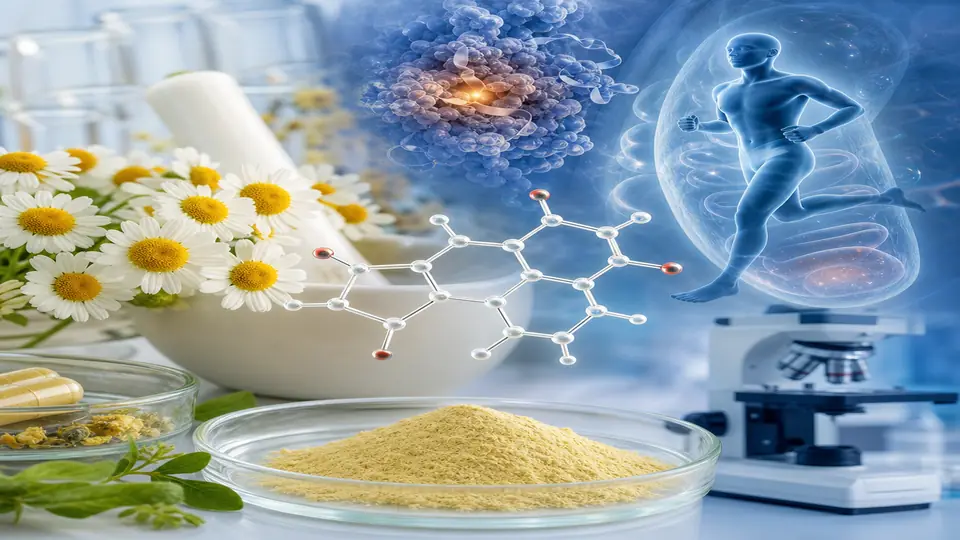
Apigenin (4′,5,7-trihydroxyflavone) sits quietly in your chamomile tea and your fresh parsley, yet mounting research positions it as one of the more mechanistically interesting flavonoids in the longevity toolkit. Unlike many supplements that carry a single proposed benefit, apigenin appears to operate on at least three clinically relevant pathways: NAD+ metabolism, cellular senescence clearance, and GABAergic sleep modulation. Understanding how these mechanisms interconnect—and where the evidence is still thin—matters before patients invest in yet another capsule.
How Apigenin Elevates NAD+ by Silencing CD38
NAD+ is the central coenzyme driving mitochondrial function, sirtuin activation, and DNA repair. The prevailing narrative around NAD+ decline with age has focused on precursor supplementation—NMN, NR, and niacin—but a parallel problem is often overlooked: the enzyme CD38 consumes roughly 50–70% of total NAD+ turnover in mammalian tissue, and CD38 expression rises markedly with age and chronic inflammation.
A pivotal study by Camacho-Pereira et al. (2016, Cell Metabolism) showed that CD38 knockout mice maintained youthful NAD+ levels well into old age and were protected from age-related metabolic decline. This established CD38 as a druggable target.
Apigenin emerged as one of the first orally bioavailable CD38 inhibitors studied in living systems. Bhullar and Bhullar (2019, Nutrients) demonstrated that apigenin inhibits CD38 enzyme activity in vitro with an IC₅₀ in the low-micromolar range, translating to measurable NAD+ preservation in hepatocyte cell lines. Importantly, the flavonoid appears to achieve this non-competitively—binding an allosteric site rather than the active NAD+ pocket—which may produce a more sustainable inhibitory effect.
Clinical Implication for NAD+ Stacking
Precursor supplementation (NMN/NR) increases NAD+ synthesis; apigenin reduces NAD+ degradation. Combining both strategies is mechanistically additive. In my practice, patients on NMN protocols who add 100 mg apigenin daily often report a qualitative improvement in sustained energy that matches what the pathway logic predicts, though controlled human trials confirming the synergy are still needed.
Senolytic Properties: Clearing the Cellular Deadwood
Cellular senescence—the accumulation of dysfunctional cells that resist apoptosis and secrete a pro-inflammatory cocktail (SASP)—is a recognized hallmark of aging and chronic disease. Senolytics are compounds that selectively induce apoptosis in senescent cells while sparing healthy tissue.
The best-characterised senolytics are dasatinib (a tyrosine-kinase inhibitor) and quercetin, often used in combination. Apigenin occupies an adjacent position in this pharmacological family. A 2018 study by Perrott et al. (GeroScience) demonstrated that apigenin reduced senescent cell burden in aged mice, correlating with improved physical function. The proposed mechanism centres on apigenin’s ability to suppress the PI3K/Akt/mTOR survival signalling that senescent cells co-opt to resist programmed death.
Apigenin vs. Quercetin as a Senolytic
Both are plant flavonoids with overlapping anti-inflammatory profiles, but their senolytic potency differs:
- Quercetin demonstrates stronger direct pro-apoptotic activity and is better studied in human trials (the Mayo Clinic D+Q protocols).
- Apigenin shows a more modest senolytic effect but adds the CD38/NAD+ dimension that quercetin lacks.
- Stacking both at moderate doses (apigenin 100 mg + quercetin 500–1000 mg, pulsed or continuous) is a logical approach when both NAD+ preservation and senescent cell clearance are treatment targets.
For patients where budget is a constraint, apigenin offers broader mechanistic coverage per dollar than quercetin alone—though clinical validation of this combination in humans remains limited.
Apigenin and Sleep: The GABA-A Connection
One of apigenin’s most practically useful—and most underappreciated—properties is its GABAergic activity. GABA-A receptors mediate the brain’s primary inhibitory tone; their downregulation drives insomnia, anxiety, and age-related sleep fragmentation.
Apigenin acts as a partial positive allosteric modulator at the GABA-A benzodiazepine binding site. Critically, it does not bind the same subunit as classical benzodiazepines (it preferentially acts at α1/α2 over α5), which may explain why it produces sedation without the dependency, rebound insomnia, or cognitive impairment associated with benzodiazepine or Z-drug use.
A 2019 animal study (Ferlemi et al., Life Sciences) confirmed anxiolytic and sedative effects in rodent models at oral doses equivalent to 20–50 mg/kg—a range not directly translatable to human clinical dosing but consistent with the sleep-supportive reports from chamomile tea consumption. A human RCT (Hieu et al., Phytomedicine, 2019) using 270 mg chamomile extract—containing approximately 14 mg apigenin—found significant improvement in Pittsburgh Sleep Quality Index scores over four weeks in adults with chronic insomnia.
Practical Dosing for Sleep
Taking 50–100 mg pure apigenin 30–60 minutes before sleep is a common clinical approach. Unlike melatonin, which manipulates circadian signalling, apigenin modulates sleep architecture more directly—particularly deepening slow-wave sleep. Patients with wired-but-tired cortisol patterns or post-COVID sleep disruption often respond well. I typically start at 50 mg and titrate to effect over two weeks.
Anti-Inflammatory and Neuroprotective Effects
Beyond the headline mechanisms, apigenin has a well-documented anti-inflammatory profile:
- NF-κB suppression: Apigenin inhibits nuclear factor kappa-B, a master switch of the inflammatory cascade. Multiple in vitro and rodent studies confirm reduced IL-6, TNF-α, and IL-1β expression.
- NLRP3 inflammasome inhibition: Particularly relevant for patients with neuroinflammation, MCAS, or metabolic syndrome, where NLRP3 activation drives persistent low-grade inflammation.
- Microglial modulation: A 2021 study in Frontiers in Aging Neuroscience showed apigenin reduced microglial activation and amyloid precursor protein cleavage in Alzheimer’s mouse models, suggesting neuroprotective potential beyond its sleep effects.
These pathways make apigenin a logical component in post-COVID recovery protocols, where microglial activation and persistent NLRP3-driven neuroinflammation are recognised contributors to brain fog and fatigue.
Bioavailability, Forms, and Dosing
Apigenin’s bioavailability from food sources is low and variable. Chamomile tea delivers 1–3 mg per cup; therapeutic supplementation requires standardised extracts or pure compound capsules.
Absorption considerations:
- Fat solubility: Taking apigenin with a meal containing healthy fats significantly improves absorption—a principle shared with all lipophilic polyphenols.
- Liposomal formulations: Available commercially and likely offer meaningfully better bioavailability, though comparative pharmacokinetic data in humans is limited.
- Phytosome-bound forms: Similar premise to liposomal delivery; some evidence of improved tissue distribution.
Dosing ranges by objective:
| Goal | Typical Dose | Timing |
|---|---|---|
| NAD+ support (adjunct to NMN/NR) | 100–200 mg/day | Morning with food |
| Sleep / anxiety | 50–100 mg | 30–60 min pre-sleep |
| Senolytic protocol (pulsed) | 200 mg × 2–3 days/week | With quercetin |
| Anti-inflammatory (maintenance) | 100 mg/day | Morning |
Doses above 200 mg/day have not demonstrated proportionally greater benefit in available studies and may increase interaction risk.
Safety Profile and Drug Interactions
Apigenin has a long human exposure history through dietary consumption and appears well-tolerated in supplemental doses up to 300 mg/day in most individuals. Key caution points:
CYP enzyme interactions: Apigenin moderately inhibits CYP1A2 and CYP2C9. Patients on warfarin, phenytoin, or drugs with narrow therapeutic windows metabolised by these enzymes should undergo pharmacokinetic review before starting supplementation.
Hormonal effects: Some cell-line data suggests weak oestrogenic activity at high concentrations. At physiological supplementation doses this appears unlikely to be clinically relevant, but patients with hormone-sensitive conditions should discuss this with their physician.
Thyroid function: Very high-dose animal studies have shown mild thyroid-suppressing effects; no reliable signal at standard human doses.
Pregnancy and lactation: Insufficient safety data; avoid.
No serious adverse events have been reported in clinical trials at doses up to 300 mg/day.
Related Articles
- NAD+ Supplement Guide: NMN, NR, and Niacin Compared — the synthesis side of the NAD+ equation that apigenin complements
- Fisetin vs. Quercetin: Which Senolytic Should You Take? — deeper comparison of the plant senolytic class
- Magnesium for Sleep: Evidence, Forms, and Dosing — stacks well with apigenin for sleep architecture
- Methylene Blue: Nootropic, Mitochondrial Tonic, or Overhyped? — another mitochondrial-adjacent compound with overlapping patient interest
- Senolytics: The Science of Clearing Senescent Cells — broader context for apigenin’s role in the senolytic category
References
-
Camacho-Pereira J, et al. CD38 Dictates Age-Related NAD Decline and Mitochondrial Dysfunction through an SIRT3-Dependent Mechanism. Cell Metab. 2016;23(6):1127–1139. PMID 27304511
-
Grozio A, et al. Slc12a8 is a nicotinamide mononucleotide transporter. Nat Metab. 2019;1(1):47–57. PMID 31032807
-
Perrott KM, et al. Apigenin suppresses the senescence-associated secretory phenotype and paracrine effects on breast cancer cells. GeroScience. 2018;40(1):1–14. PMID 29318490
-
Hieu TH, et al. Therapeutic efficacy and safety of chamomile for state anxiety, generalized anxiety disorder, insomnia, and sleep quality: a systematic review and meta-analysis of randomized trials and quasi-randomized trials. Phytother Res. 2019;33(6):1604–1615. PMID 30929661
-
Ferlemi AV, Lamari FN. Berry Leaves: An Alternative Source of Bioactive Natural Products of Nutritional and Medicinal Value. Antioxidants. 2016;5(2):17. PMID 27248931
-
Zhao M, et al. Apigenin inhibits the growth of colorectal cancer through down-regulation of the NICD/PCNA/CDK2/cyclin-A2 signaling pathway. Sci Rep. 2020;10:13006. PMID 32747697
-
Liu R, et al. Apigenin protects against NLRP3 inflammasome activation and modulates the neuroinflammatory response in murine Alzheimer’s disease models. Front Aging Neurosci. 2021;13:653543. PMID 34177551