At a Glance
| Property | Value |
|---|---|
| Evidence Level | Strong (curcuminoid content and bioavailability well-characterized; clinical evidence for supplemental curcumin in inflammation and pain) |
| Primary Use | Anti-inflammatory, antioxidant, joint health, metabolic support |
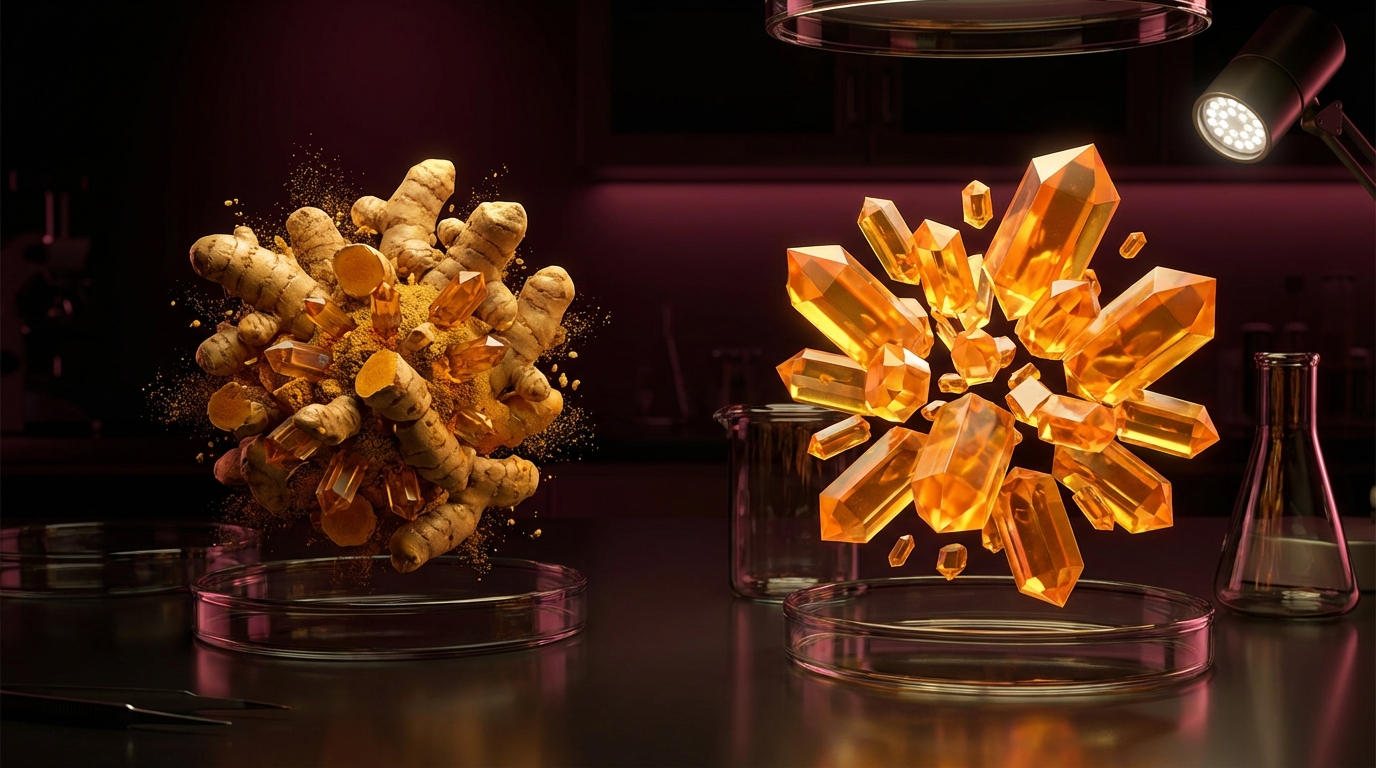
| Key Distinction | Turmeric = food/spice (2-5% curcuminoids). Curcumin supplement = concentrated extract (95% curcuminoids) with absorption enhancement |
Curcumin vs. Turmeric: The Fundamental Confusion
The question I encounter most often about curcumin is not about dosing or formulation — it is the more basic confusion between turmeric and curcumin. Patients tell me they take “turmeric” for inflammation, and when I ask the dose of curcuminoids, they do not know — because their product is turmeric powder, not a curcumin extract.
This distinction matters enormously. Let me explain why, and then we can discuss what actually works.
What Turmeric Is (and Is Not)
Turmeric (Curcuma longa) is a rhizome in the ginger family, cultivated primarily in India and Southeast Asia. When dried and ground, it produces the yellow-orange powder used in curry, golden milk, and countless “anti-inflammatory” food products.
The active compounds in turmeric — curcuminoids — include curcumin (the primary and most studied), demethoxycurcumin, and bisdemethoxycurcumin. Together, these constitute approximately 2-5% of turmeric powder by weight.
The Math
If you take a “turmeric” supplement containing 500 mg of turmeric root powder, you are getting approximately 10-25 mg of curcuminoids. The therapeutic dose of curcumin used in clinical trials is typically 500-1,500 mg of curcuminoids per day.
To get 1,000 mg of curcuminoids from turmeric powder alone, you would need to consume approximately 20-50 grams (about 2-4 tablespoons) daily. That is not a seasoning — that is a stomach-churning amount of spice.
The bottom line on turmeric powder: It is a wonderful culinary spice with modest health benefits from regular dietary use. It is not a therapeutic anti-inflammatory supplement. The golden latte you enjoy at the cafe contains perhaps 5-15 mg of curcuminoids — a trace amount with no measurable clinical effect.
The Bioavailability Problem
Even if you take a concentrated curcumin extract (95% curcuminoids), you face a second problem: curcumin is notoriously poorly absorbed.
Why Curcumin Disappears
After oral ingestion, curcumin encounters a gauntlet of metabolic barriers:
- Intestinal glucuronidation: The gut wall rapidly conjugates curcumin with glucuronic acid, converting it to inactive metabolites before it even reaches the bloodstream.
- Hepatic first-pass metabolism: Whatever curcumin makes it past the intestinal wall is further metabolized by the liver, primarily through reduction and conjugation.
- Rapid clearance: The plasma half-life of unconjugated curcumin is approximately 1-2 hours.
- Poor water solubility: Curcumin is highly lipophilic, which limits its dissolution in the aqueous environment of the gut.
The net result: standard curcumin has a bioavailability of less than 1%. Shoba et al. measured plasma curcumin levels after 2g oral curcumin and found essentially undetectable concentrations (1).
The Bioavailability Solutions
The supplement industry has developed several strategies to overcome this problem. These are not gimmicks — they represent genuine pharmaceutical science applied to a natural compound. For a detailed comparison of formulations, see my best curcumin supplement for absorption guide.
Piperine (BioPerine): Black pepper extract containing 95% piperine. Piperine inhibits intestinal glucuronidation and hepatic CYP3A4, preventing curcumin’s premature metabolism. Shoba et al. demonstrated a 2,000% (20x) increase in curcumin bioavailability with 20 mg piperine co-administration (1).
Phospholipid complexes (Meriva/Phytosome): Curcumin bound to phosphatidylcholine, improving absorption through lipid-phase transport across the intestinal membrane. Studies show 29x higher plasma curcumin levels compared to standard curcumin.
Nanoparticle/micellar technology (Theracurmin, NovaSOL): Reduces curcumin particle size to nanometer scale, dramatically increasing water solubility and surface area. Theracurmin showed 27x higher bioavailability in pharmacokinetic studies. NovaSOL claims 185x improvement.
BCM-95/CurcuGreen: Combines curcumin with turmeric essential oils (turmerones), which inhibit intestinal metabolism. Approximately 7-8x improved bioavailability.
Comparing Products
| Form | Bioavailability Increase | Dose for ~500 mg Equivalent | Cost | Notes |
|---|---|---|---|---|
| Standard curcumin (95%) | 1x (baseline) | ~50,000 mg (impractical) | $ | Requires piperine at minimum |
| Curcumin + piperine | 20x | 1,000-1,500 mg | $ | Most affordable enhanced option |
| Meriva (phospholipid) | 29x | 500-1,000 mg | $$ | Good joint health data |
| BCM-95 | 7-8x | 500-1,000 mg | $$ | Includes turmeric oils |
| Theracurmin | 27x | 180-360 mg | $$$ | Best pharmacokinetic data |
| NovaSOL (micellar) | 185x | 80-100 mg | $$$ | Highest claimed absorption |
What About “Whole Turmeric” Claims?
Some supplement brands market “whole turmeric” or “full-spectrum turmeric” products, arguing that the non-curcuminoid compounds (turmerones, polysaccharides) have synergistic health benefits that curcumin extracts miss.
Here is what the evidence shows:
- Turmerones do have independent biological activity (anti-inflammatory, neuroprotective in preclinical studies).
- The synergy argument has some preclinical support but is not well-validated in human trials.
- The curcuminoid content of “whole turmeric” products is typically far lower than standardized extracts.
- Most of the clinical evidence — joint pain, inflammation, metabolic health — comes from curcumin extracts, not whole turmeric.
My position: If a product provides a defined, therapeutic dose of curcuminoids (500-1,500 mg) AND includes turmeric co-factors (BCM-95 does this), that is the best of both worlds. But a product that provides 500 mg of “whole turmeric root” with 10-25 mg of curcuminoids is functionally useless for therapeutic purposes, regardless of what other compounds it contains.
Practical Recommendations
If You Want Anti-Inflammatory Benefits:
- Choose a curcumin extract standardized to 95% curcuminoids, not a turmeric powder.
- Choose an enhanced formulation: At minimum, curcumin with piperine. Ideally, a phospholipid (Meriva) or nanotechnology (Theracurmin) formulation.
- Therapeutic dose: 500-1,500 mg curcuminoids per day, depending on the formulation’s bioavailability enhancement.
- Take with fat. Curcumin is fat-soluble. Taking with a fat-containing meal improves absorption even for enhanced formulations.
- For joint pain specifically, see my curcumin for joint pain dosing guide.
If You Enjoy Turmeric as a Food:
Continue enjoying it. Add black pepper (piperine) when cooking with turmeric to modestly improve curcuminoid absorption. Cook with fat (coconut oil, ghee) for the same reason. But do not confuse dietary turmeric with therapeutic curcumin supplementation — they are categorically different in their clinical potential.
Safety Note: Curcumin and the Liver
There is an emerging safety signal worth mentioning. Several case reports of hepatotoxicity (liver injury) have been associated with highly bioavailable curcumin formulations. The European Food Safety Authority (EFSA) and several national drug agencies have issued alerts.
The hypothesis: standard curcumin’s poor bioavailability may have been protective — the liver was never exposed to high concentrations. Enhanced bioavailability formulations achieve plasma levels that standard curcumin never could, and these higher concentrations may be hepatotoxic in susceptible individuals.
My recommendation: Monitor liver enzymes (ALT, AST) at baseline and 3 months when starting high-bioavailability curcumin formulations. If liver enzymes rise above 2x the upper limit of normal, discontinue. This is a precautionary measure, not evidence that curcumin is inherently dangerous — the absolute risk appears to be very low.
The Bottom Line
Turmeric is a spice. Curcumin is the active pharmaceutical compound within that spice. Therapeutic anti-inflammatory effects require curcumin at 500-1,500 mg/day in a bioavailability-enhanced formulation — something turmeric powder and golden lattes cannot deliver. The nuance matters: choose a standardized extract, pair it with an absorption enhancer, take it with fat, and monitor liver function with high-bioavailability formulations. This is what the evidence shows.
References
-
Shoba G, Joy D, Joseph T, et al. Influence of piperine on the pharmacokinetics of curcumin in animals and human volunteers. Planta Medica. 1998;64(4):353-356. doi:10.1055/s-2006-957450
-
Cuomo J, Appendino G, Dern AS, et al. Comparative absorption of a standardized curcuminoid mixture and its lecithin formulation. Journal of Natural Products. 2011;74(4):664-669. doi:10.1021/np1007262
-
Sasaki H, Sunagawa Y, Takahashi K, et al. Innovative preparation of curcumin for improved oral bioavailability. Biological and Pharmaceutical Bulletin. 2011;34(5):660-665. doi:10.1248/bpb.34.660