At a Glance
| Property | Berberine | Metformin |
|---|---|---|
| Evidence Level | Moderate (glucose/lipids); Limited (longevity) | Strong (glucose); Moderate (longevity) |
| Availability | OTC supplement | Prescription only |
| Primary Mechanism | AMPK activation, gut microbiome modulation | AMPK activation, hepatic glucose suppression |
| Typical Dose | 500 mg 2-3x/day | 500-2,000 mg/day |
| Safety Data | ~30 years, primarily Asian clinical trials | 60+ years, massive global dataset |
| Cost | $15-30/month | $4-10/month (generic) |
Two Compounds, One Master Switch
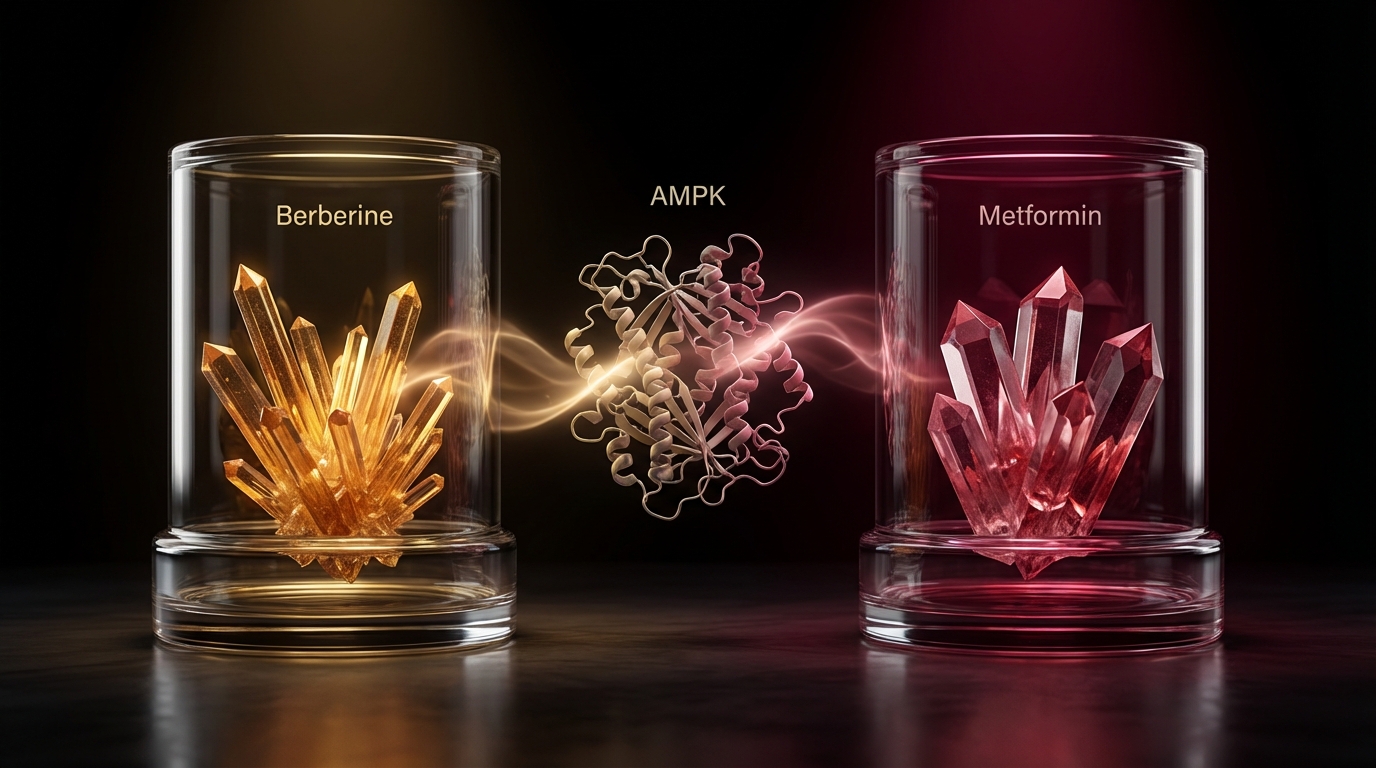
If you have spent any time in the longevity or metabolic health space, you have encountered the claim that berberine is “nature’s metformin.” This comparison is not entirely wrong — both compounds activate AMPK (AMP-activated protein kinase), the cellular energy sensor that coordinates metabolic responses to low energy states. But the comparison deserves more precision than a marketing slogan allows.
Here’s what the research actually says.
AMPK is activated when the cellular AMP-to-ATP ratio rises — essentially, when cells are running low on energy. This happens during exercise, fasting, and caloric restriction. When AMPK is switched on, it triggers a cascade of metabolically favorable events: increased glucose uptake, fatty acid oxidation, mitochondrial biogenesis, and autophagy. Simultaneously, it inhibits energy-consuming processes like lipid synthesis and gluconeogenesis.
Both berberine and metformin activate AMPK, but through partially overlapping and partially distinct mechanisms. Understanding these differences matters clinically.
Mechanism: Where They Overlap and Diverge
Metformin
Metformin’s primary action is inhibition of mitochondrial complex I in the electron transport chain, which mildly impairs mitochondrial ATP production. This raises the AMP-to-ATP ratio, activating AMPK. Additionally, metformin:
- Suppresses hepatic gluconeogenesis (the liver’s production of new glucose) — this is the dominant clinical effect
- Reduces intestinal glucose absorption
- Improves insulin sensitivity in peripheral tissues
- Modulates the gut microbiome (increasing Akkermansia muciniphila and short-chain fatty acid producers)
- Inhibits mTOR signaling downstream of AMPK
Berberine
Berberine, an isoquinoline alkaloid found in goldenseal, Oregon grape, and Chinese goldthread (Coptis chinensis), also inhibits mitochondrial complex I, activating AMPK through the same energetic stress mechanism [1]. However, berberine has additional pharmacological actions:
- Upregulates insulin receptor expression, improving insulin signaling independently of AMPK
- Inhibits DPP-4 (the same enzyme targeted by drugs like sitagliptin), increasing GLP-1 levels
- Directly stimulates glucose transporter GLUT4 translocation to the cell membrane
- Has antimicrobial activity against various gut pathogens (historically used in traditional Chinese medicine for GI infections)
- Modulates the gut microbiome differently from metformin — berberine significantly increases Faecalibacterium prausnitzii and reduces Fusobacterium species

The nuance matters here. Berberine is not simply an herbal copy of metformin — it has a broader pharmacological profile with distinct GI, antimicrobial, and lipid-modulating effects.
Head-to-Head Clinical Evidence
Glucose Control
The most cited head-to-head trial is Yin et al. (2008), which randomized 116 newly diagnosed type 2 diabetics to either berberine 500 mg three times daily or metformin 500 mg three times daily for 13 weeks [2]. The results:
- HbA1c reduction: Berberine -2.0% vs. Metformin -1.8% (not statistically different)
- Fasting glucose reduction: Berberine -3.8 mmol/L vs. Metformin -3.6 mmol/L (comparable)
- Post-meal glucose: Both groups showed similar reductions
A subsequent larger trial by Zhang et al. (2010) confirmed comparable glucose-lowering effects and added that berberine significantly improved lipid parameters where metformin showed minimal lipid effects [3].
In my clinical experience, berberine performs credibly for mild-to-moderate insulin resistance and prediabetic patients. For established type 2 diabetes requiring aggressive glucose management, metformin has the stronger evidence base and regulatory framework.
Lipid Profile
This is where berberine consistently outperforms metformin. Multiple trials and meta-analyses show berberine reduces:
- Total cholesterol: 15-20% reduction
- LDL cholesterol: 20-25% reduction
- Triglycerides: 25-35% reduction
- Increases HDL: modest 2-5% improvement
A 2012 meta-analysis of 27 RCTs (N=2,569) confirmed these lipid-lowering effects, with berberine performing comparably to some statin therapy for LDL reduction in mild hyperlipidemia [4]. Metformin, by contrast, has minimal direct lipid-lowering effects.
The mechanism appears to involve upregulation of LDL receptors on hepatocytes (through PCSK9 reduction and LDLR mRNA stabilization) — a mechanism distinct from statins but with a similar functional outcome.
GI Side Effects
Both compounds cause GI side effects, but the profile differs:
- Metformin: Nausea, diarrhea, metallic taste, abdominal cramping (affects 20-30% of patients; extended-release formulations reduce this significantly)
- Berberine: Constipation, abdominal discomfort, diarrhea (affects 10-15% of patients; antimicrobial activity may cause initial GI disruption)
In practice, I find that patients who cannot tolerate metformin’s GI effects often do fine on berberine, and vice versa. The side effect profiles are sufficiently different that one is not predictive of the other.
The Longevity Question
Metformin’s Longevity Evidence
Metformin has the stronger longevity story. The Bannister et al. (2014) epidemiological study showing diabetics on metformin outliving non-diabetic controls is widely cited [5]. The TAME (Targeting Aging with Metformin) trial is the first FDA-approved trial testing a drug specifically for slowing biological aging. Metformin’s effects on AMPK, mTOR inhibition, autophagy stimulation, and inflammation reduction align with all major theories of aging biology.
I discuss metformin’s longevity evidence in detail in my metformin article.
Berberine’s Longevity Evidence
Berberine’s longevity evidence is far more limited. Animal studies show lifespan extension in C. elegans and Drosophila through AMPK and DAF-16/FOXO pathways. Rodent studies show improved healthspan markers. But there are no large-scale human epidemiological studies comparable to the metformin dataset, and there is no equivalent of the TAME trial.
The theoretical rationale is plausible — AMPK activation, mTOR suppression, and anti-inflammatory effects should, in principle, promote healthspan. But “should” is not “does,” and the data gap is real.
Let me be direct: if your primary goal is pharmacological longevity intervention with the strongest available evidence, metformin is the more defensible choice. If you want AMPK activation without a prescription and with additional lipid benefits, berberine is a reasonable alternative — with the understanding that the evidence base is thinner.
Can You Combine Them?
This is one of the most common questions I receive, and the answer requires care.
Yes, berberine and metformin can be combined. Both activate AMPK through complex I inhibition, so there is a theoretical risk of additive hypoglycemia and lactic acidosis (metformin’s rare but serious adverse effect). In practice, the risk is low in patients with normal renal function, but it requires monitoring.
What I tell my patients who combine both:
- Start one at a time. Establish tolerability and glucose response with one compound before adding the other.
- Monitor fasting glucose and postprandial glucose for the first 2-4 weeks after combining.
- Use lower doses of each rather than maximum doses of both. A common regimen: metformin 500-1,000 mg/day + berberine 500-1,000 mg/day (split doses).
- Monitor renal function (creatinine, eGFR) at baseline and every 6 months.
- Do not combine if you have renal impairment (eGFR < 45) — this increases metformin’s lactic acidosis risk, and adding another complex I inhibitor compounds it.
- Separate dosing times. Take metformin with breakfast/lunch and berberine with dinner, or vice versa, to reduce GI overlap and smooth glucose response throughout the day.

Berberine’s Bioavailability Problem
Like curcumin, berberine has a bioavailability challenge. Standard berberine hydrochloride has approximately 5% oral absorption [6]. The gut microbiome converts a significant portion of ingested berberine to dihydroberberine, which is better absorbed but may have different pharmacological activity.
Several enhanced berberine formulations have emerged:
- Dihydroberberine (DHB / GlucoVantage): Approximately 5x better absorption than berberine HCl, allowing lower dosing (200-300 mg vs. 500 mg)
- Berberine phytosome: Lipid-complexed for improved absorption
- Berberine with cyclodextrin: Enhanced solubility
The clinical trial evidence is overwhelmingly based on standard berberine HCl at 500 mg three times daily. Enhanced formulations may allow lower dosing, but head-to-head comparisons with standard berberine in clinical outcomes are still limited.
Safety and Considerations
Berberine
- Drug interactions: Berberine inhibits CYP3A4, CYP2D6, and CYP2C9 — major drug-metabolizing enzymes. It can increase blood levels of statins (particularly simvastatin and atorvastatin), cyclosporine, anticoagulants, and many other medications. Always review drug interactions before adding berberine.
- Hypoglycemia risk: In combination with diabetes medications or insulin, berberine can cause excessive glucose lowering. Monitor carefully.
- Pregnancy and breastfeeding: Contraindicated. Berberine crosses the placenta and can cause kernicterus in neonates.
- Thyroid function: Some evidence suggests berberine may lower thyroid hormone levels (T3, T4). Monitor thyroid function in patients with hypothyroidism.
- Antimicrobial effects: Long-term high-dose berberine may alter gut flora in unpredictable ways. Periodic microbiome assessment is reasonable in long-term users.
Metformin
- Lactic acidosis: Rare but serious (estimated 3-10 per 100,000 patient-years). Risk increases with renal impairment, liver disease, excessive alcohol, and acute illness.
- B12 depletion: Long-term metformin use reduces vitamin B12 absorption by 10-30%. Monitor B12 annually and supplement if deficient.
- Exercise interaction: Metformin may blunt aerobic exercise adaptations (mitochondrial biogenesis, insulin sensitivity improvements). Some patients skip metformin on intensive training days.
- GI intolerance: Use extended-release formulation to minimize.
Practical Decision Framework
| Your Situation | Recommended Approach |
|---|---|
| Prediabetic, no prescription access | Berberine 500 mg 2-3x/day |
| Type 2 diabetic, physician-managed | Metformin first-line (stronger evidence, regulatory framework) |
| Primary concern is lipids + glucose | Berberine may be superior (lipid effects) |
| Primary concern is longevity | Metformin (TAME trial, larger evidence base) |
| Cannot tolerate metformin GI effects | Berberine as alternative |
| Want maximum AMPK activation | Cautious combination at moderate doses |
| On multiple medications | Metformin (fewer drug interactions) |
| Healthy, lean, metabolically normal | Neither may be necessary — exercise and diet first |
The Bottom Line
Berberine and metformin are genuinely comparable compounds for glucose management, and the head-to-head clinical trial data supports this. Berberine has a meaningful advantage for lipid management. Metformin has a massive advantage in depth and breadth of safety data, regulatory support, and longevity research.
Neither is a miracle drug. Both are tools — useful, evidence-based tools — that work best as part of a comprehensive metabolic health strategy built on diet, exercise, sleep, and stress management. The supplement industry’s marketing of berberine as “nature’s metformin” is not entirely wrong, but it understates metformin’s vastly larger evidence base and overstates berberine’s longevity credentials.
In my clinical experience, both have a role. The right choice depends on the patient sitting in front of me, their metabolic profile, their medication list, and their goals.
References
- Turner N, Li JY, Gosby A, et al. Berberine and its more biologically available derivative, dihydroberberine, inhibit mitochondrial respiratory complex I: a mechanism for the action of berberine to activate AMP-activated protein kinase and improve insulin action. Diabetes. 2008;57(5):1414-1418. PMID: 18285556
- Yin J, Xing H, Ye J. Efficacy of berberine in patients with type 2 diabetes mellitus. Metabolism. 2008;57(5):712-717. PMID: 18442638
- Zhang Y, Li X, Zou D, et al. Treatment of type 2 diabetes and dyslipidemia with the natural plant alkaloid berberine. J Clin Endocrinol Metab. 2008;93(7):2559-2565. PMID: 18397984
- Dong H, Wang N, Zhao L, Lu F. Berberine in the treatment of type 2 diabetes mellitus: a systemic review and meta-analysis. Evid Based Complement Alternat Med. 2012;2012:591654. PMID: 23118793
- Bannister CA, Holden SE, Jenkins-Jones S, et al. Can people with type 2 diabetes live longer than those without? A comparison of mortality in people initiated with metformin or sulphonylurea monotherapy and matched, non-diabetic controls. Diabetes Obes Metab. 2014;16(11):1165-1173. PMID: 25041462
- Liu CS, Zheng YR, Zhang YF, Long XY. Research progress on berberine with a special focus on its oral bioavailability. Fitoterapia. 2016;109:274-282. PMID: 26851175