At a Glance
| Property | Value |
|---|---|
| Evidence Level | Moderate (34 RCTs, mostly small; consistent glucose-lowering effect; limited long-term data) |
| Primary Use | Blood sugar regulation, insulin sensitization, lipid improvement |
| Key Mechanism | AMPK activation, hepatic gluconeogenesis inhibition, gut microbiome modulation |
Berberine Dosage for Blood Sugar: The Physician’s Protocol
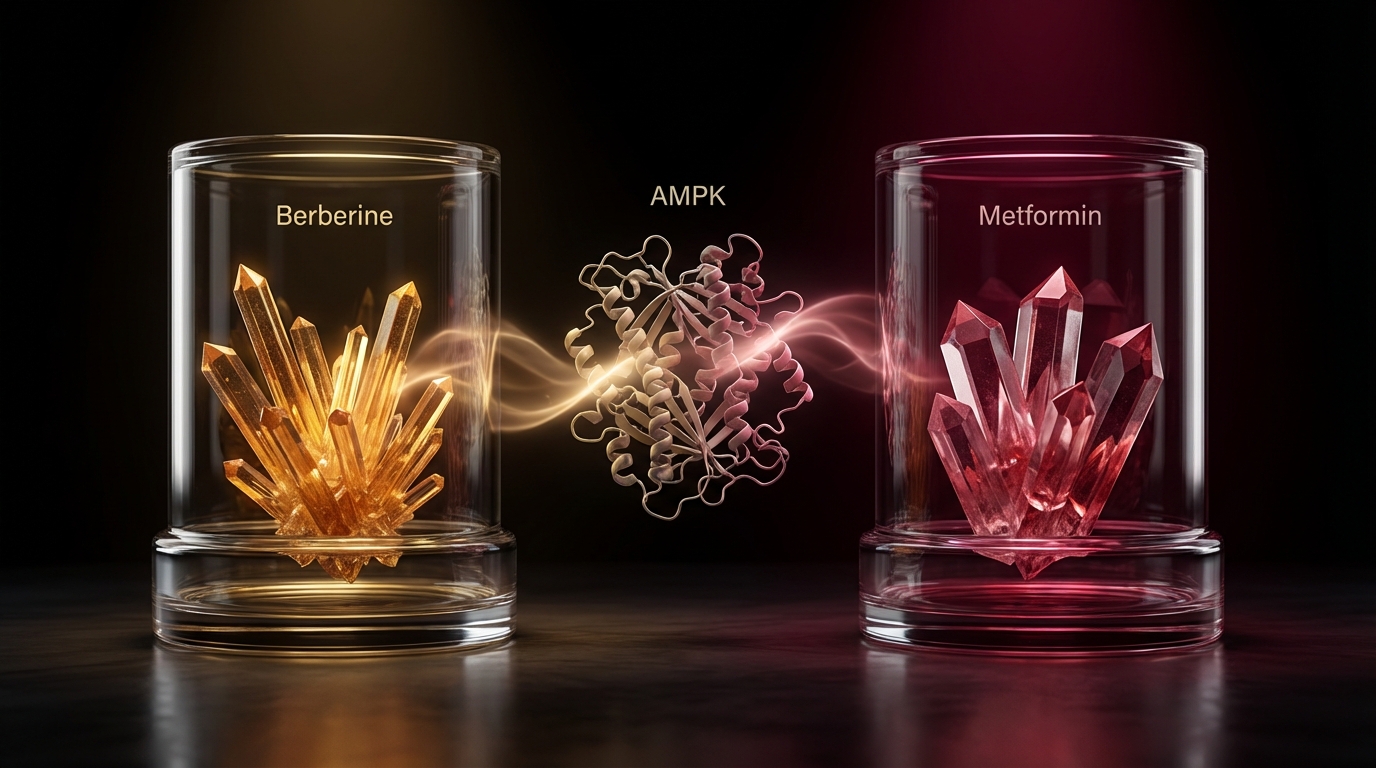
Berberine has become one of the most popular natural supplements for blood sugar management, often marketed as “nature’s metformin.” There is legitimate science behind this comparison — berberine activates the same AMPK pathway as metformin, and head-to-head trials show comparable glucose-lowering effects. But berberine is not metformin, the evidence base is much smaller, and the dosing strategy requires attention to bioavailability, GI tolerance, and drug interactions that most supplement guides ignore.
Here is what the clinical evidence supports for dosing.
The Clinical Evidence for Blood Sugar
The Key Trials
Yin et al. (2008): The most-cited berberine-glucose trial. 36 newly diagnosed type 2 diabetics received berberine 500 mg 3x/day for 3 months. Results: HbA1c decreased from 9.5% to 7.5% (a 2.0% reduction), fasting glucose decreased by 56 mg/dL, and post-meal glucose decreased by 97 mg/dL (1). In a separate arm, these results were comparable to metformin 500 mg 3x/day.
Zhang et al. (2008): 116 type 2 diabetics received berberine 500 mg 2x/day for 3 months. HbA1c decreased by 0.9%, fasting glucose by 25 mg/dL, and triglycerides by 36 mg/dL. Notably, LDL cholesterol also decreased by 21 mg/dL — a lipid benefit that metformin does not reliably provide (2).
Lan et al. (2015) meta-analysis: Pooled data from 27 RCTs (2,569 participants) confirmed that berberine significantly reduces fasting glucose (-15.5 mg/dL), HbA1c (-0.72%), triglycerides (-44.3 mg/dL), and LDL cholesterol (-25.1 mg/dL) compared to placebo. When compared to conventional hypoglycemic drugs, berberine was non-inferior for glucose outcomes (3).
Honest Context
These trials are promising but have limitations:
- Most were conducted in Chinese populations with newly diagnosed or mild type 2 diabetes
- Sample sizes were small (20-116 participants per group)
- Follow-up was short (3 months, rarely longer)
- There are no large, long-term outcome trials (cardiovascular events, mortality)
- Quality control of berberine products varied between studies
Compare this to metformin: 1,600+ clinical trials, 60+ years of human safety data, hundreds of millions of patient-years of exposure, and the ongoing TAME longevity trial. The evidence depth is not in the same category.
For a detailed comparison, see my metformin vs. berberine guide.
Dosing Protocol
Standard Blood Sugar Protocol
| Phase | Dose | Duration | Notes |
|---|---|---|---|
| Week 1 | 500 mg once daily with dinner | 7 days | Assess GI tolerance |
| Week 2 | 500 mg twice daily with meals | 7 days | Add breakfast dose |
| Week 3+ | 500 mg three times daily with meals | Ongoing | Full therapeutic dose |
Total daily dose: 1,500 mg/day (500 mg 3x/day) Always with meals: This is non-negotiable. Taking berberine with food reduces GI side effects and modestly improves the already-poor absorption.
Why Three Doses Per Day?
Berberine has a short half-life (approximately 2-4 hours) and very poor oral bioavailability (~5%). A single daily dose produces a brief spike followed by undetectable levels for most of the day. Splitting into 3 doses maintains more consistent blood levels and provides coverage around the three main glucose-spiking events (meals).
For Prediabetes / Insulin Sensitivity
A lower dose may be appropriate if your goal is metabolic optimization rather than managing diagnosed diabetes:
- Dose: 500 mg twice daily with meals (1,000 mg/day)
- Duration: 3+ months minimum to assess effect
- Monitor: Fasting glucose, fasting insulin, HOMA-IR at baseline and 3 months
Enhanced Bioavailability Formulations
Standard berberine has approximately 5% oral bioavailability. Some newer formulations aim to improve this:
Berberine phytosome (Berbevis): Phospholipid complex similar to the Meriva technology for curcumin. Claims 10-15x improved absorption, allowing lower doses (500-1,000 mg/day).
Dihydroberberine (DHB/GlucoVantage): A reduced metabolite of berberine that is 5x better absorbed and then converted back to berberine in the intestinal wall. Dose: 100-200 mg 2-3x/day.
These formulations are interesting but have far less clinical trial data than standard berberine. I mention them because they may be the future of berberine supplementation, but the current evidence supports standard berberine at 1,500 mg/day as the reference protocol.
The Lipid Bonus
One of berberine’s genuine advantages over metformin is its lipid-lowering effect. Berberine upregulates hepatic LDL receptor expression through the PCSK9 pathway — the same mechanism targeted by expensive PCSK9 inhibitor drugs (evolocumab, alirocumab).
Typical lipid improvements with berberine 1,500 mg/day:
- LDL cholesterol: -20-25 mg/dL
- Triglycerides: -35-45 mg/dL
- Total cholesterol: -15-25 mg/dL
This combined glucose + lipid effect makes berberine particularly attractive for metabolic syndrome, where both glucose and lipid parameters are abnormal.
Drug Interactions: The Critical Warning
This section is essential and under-discussed. Berberine is a potent inhibitor of CYP2D6, CYP3A4, and CYP2C9 — three of the most important drug-metabolizing enzyme systems.
Medications That Require Caution
| Drug Category | Examples | Risk |
|---|---|---|
| Statins | Atorvastatin, simvastatin | Increased statin levels → myopathy/rhabdomyolysis risk |
| Blood thinners | Warfarin | Increased bleeding risk (CYP2C9 inhibition) |
| Antiarrhythmics | Amiodarone, digoxin | Increased drug levels → cardiac toxicity |
| Immunosuppressants | Cyclosporine, tacrolimus | Increased immunosuppressant levels → toxicity |
| SSRIs/antidepressants | Fluoxetine, paroxetine | Increased SSRI levels (CYP2D6 inhibition) |
| Blood pressure meds | Some calcium channel blockers | Variable effects |
| Antifungals | Ketoconazole, itraconazole | Additive CYP3A4 inhibition |
My clinical rule: If you take any prescription medication metabolized by CYP2D6, CYP3A4, or CYP2C9, consult with your physician or pharmacist before starting berberine. This is not optional. The interaction potential is significant and under-recognized.
Side Effects and Management
Common Side Effects
- GI disturbance (10-25%): Diarrhea, constipation, bloating, abdominal cramping. The GI effects are dose-dependent and typically resolve with slow titration and consistent food co-administration.
- Flatulence: Berberine alters gut microbiome composition, which can initially increase gas production.
- Constipation: Some users experience constipation rather than diarrhea — berberine can slow intestinal motility at higher doses.
Rare but Notable
- Hypoglycemia: Possible if combined with insulin, sulfonylureas, or in the setting of fasting. Monitor blood glucose closely if combining with hypoglycemic medications.
- Liver enzyme elevation: Rare reports of transaminase increases. Monitor ALT/AST at baseline and 3 months.
- Jaundice in newborns: Berberine can displace bilirubin from albumin. Absolutely contraindicated in pregnancy and nursing.
Monitoring Protocol
| Test | Timing | Target |
|---|---|---|
| Fasting glucose | Baseline, 1 month, 3 months | <100 mg/dL (prediabetes); <126 (diabetes) |
| HbA1c | Baseline, 3 months | <5.7% (optimal); <6.5% (diabetes management) |
| Fasting insulin | Baseline, 3 months | <10 mIU/L |
| Lipid panel | Baseline, 3 months | LDL, TG improvements expected |
| ALT/AST | Baseline, 3 months | Monitor for elevation |
| Complete metabolic panel | Baseline, 3 months | Overall metabolic status |
Quality Control: The Supplement Reality
Berberine is sold as a dietary supplement, not a pharmaceutical. This means no standardized manufacturing requirements, no pre-market testing for potency or purity, and no guarantee that the label reflects the product contents.
What to look for:
- Berberine HCl (hydrochloride) — the most common and well-studied salt form
- Third-party testing (USP, NSF, ConsumerLab verification)
- At least 97% berberine HCl purity
- Individual capsule potency verified (not just batch average)
- No “proprietary blend” — you need to know the exact berberine dose per capsule
The Bottom Line
Berberine at 500 mg three times daily with meals is a well-supported protocol for blood sugar management, with consistent evidence showing HbA1c reductions of 0.7-1.2% and fasting glucose reductions of 15-30 mg/dL. The lipid-lowering bonus (LDL -20-25 mg/dL, TG -35-45 mg/dL) adds clinically meaningful cardiovascular value. However, the drug interaction profile is significant, the long-term safety data is limited compared to metformin, and product quality varies. What I tell my patients: berberine is a real pharmacological agent sold in a supplement wrapper — treat it with the same respect you would give a prescription medication, including proper monitoring and drug interaction checks.
References
-
Yin J, Xing H, Ye J. Efficacy of berberine in patients with type 2 diabetes mellitus. Metabolism. 2008;57(5):712-717. doi:10.1016/j.metabol.2008.01.013
-
Zhang Y, Li X, Zou D, et al. Treatment of type 2 diabetes and dyslipidemia with the natural plant alkaloid berberine. Journal of Clinical Endocrinology & Metabolism. 2008;93(7):2559-2565. doi:10.1210/jc.2007-2404
-
Lan J, Zhao Y, Dong F, et al. Meta-analysis of the effect and safety of berberine in the treatment of type 2 diabetes mellitus, hyperlipemia and hypertension. Journal of Ethnopharmacology. 2015;161:69-81. doi:10.1016/j.jep.2014.09.049