
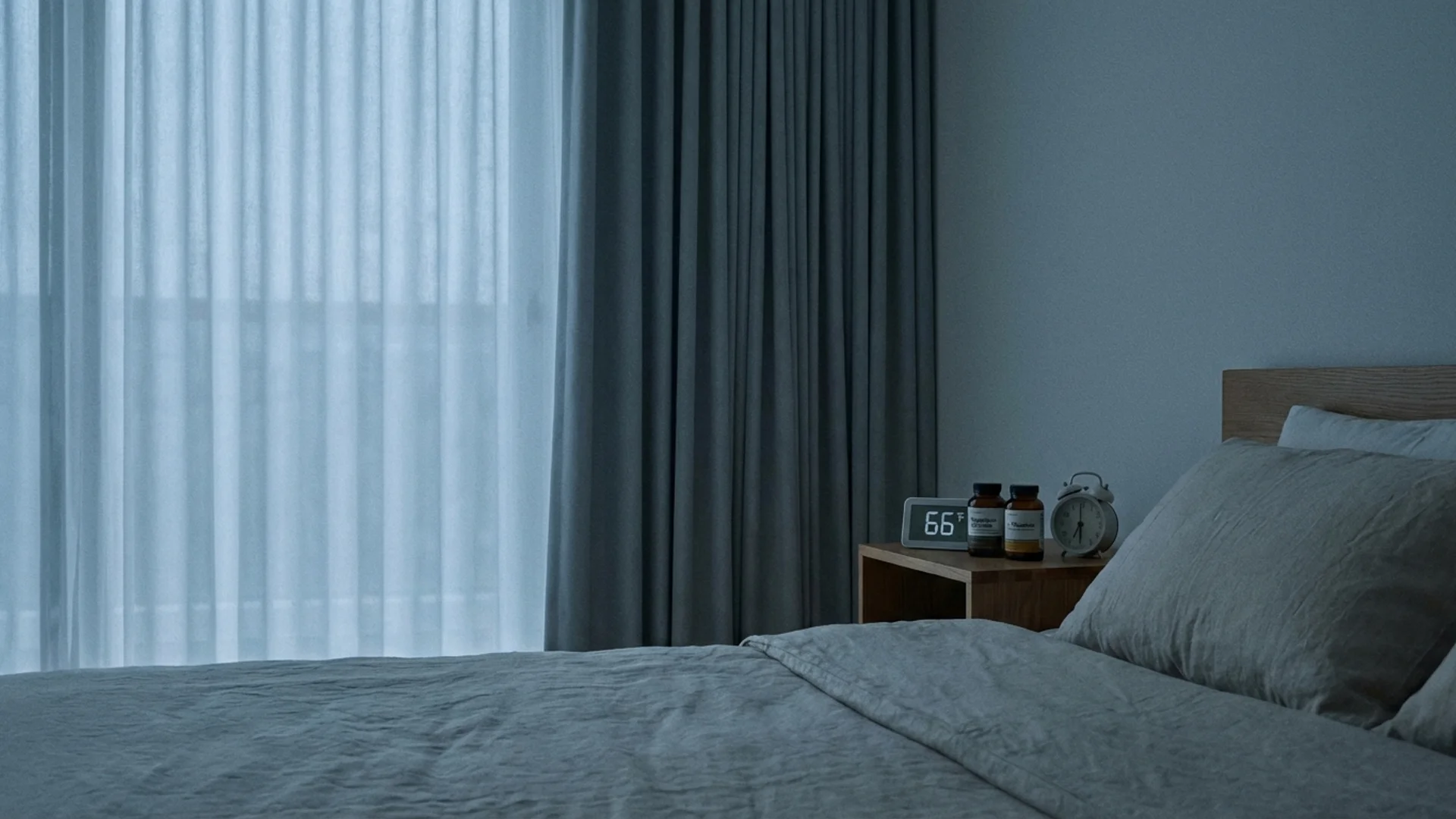
Sleep is not a luxury. It is the single most important health behavior, and compromising it undermines virtually every other intervention — supplements, exercise, diet, and clinical treatments. If you do nothing else from this site, prioritize sleep.
The data is unambiguous. A single night of sleep deprivation reduces NK cell activity by approximately 70% (Irwin et al.). Chronic short sleep (less than six hours) is associated with increased all-cause mortality, cardiovascular disease, obesity, type 2 diabetes, depression, and cognitive decline. The evidence is Level 1 across multiple outcomes.
This protocol addresses sleep through three domains: environment, behavior, and targeted supplementation.
Domain 1: Sleep Environment
Your bedroom should be optimized for one function: sleep. The following environmental modifications have documented effects on sleep quality.
Temperature
Recommendation: Bedroom temperature of 18-19 degrees Celsius (65-67 degrees Fahrenheit).
Core body temperature drops by approximately 1 degree Celsius during the transition to sleep. A cool sleeping environment facilitates this drop. Room temperatures above 24 degrees Celsius significantly disrupt sleep architecture. Evidence level: controlled studies.
If you tend to sleep hot, consider a cooling mattress pad or breathable bedding materials. These are practical interventions that can meaningfully improve sleep quality.
Light
Recommendation: Complete darkness or as close to it as possible.
Even dim light during sleep suppresses melatonin production and disrupts circadian rhythm. A study published in PNAS (Cho et al., 2022) demonstrated that sleeping with a dim light (100 lux — approximately a night light) increased heart rate, reduced heart rate variability, and impaired glucose metabolism compared to sleeping in complete darkness.
- Use blackout curtains or a sleep mask
- Cover or remove all electronics with LED indicators
- If a night light is needed (safety reasons), use a red or amber light (wavelengths above 600 nm do not significantly suppress melatonin)
Evidence level: strong (controlled studies and RCTs).
Sound
Recommendation: Quiet or consistent background sound (white noise, brown noise).
Intermittent noise (traffic, household sounds) fragments sleep more than consistent noise. White noise machines or brown noise generators can mask intermittent sounds and improve sleep continuity. Evidence level: moderate (controlled studies showing improved sleep with consistent background sound in noisy environments).
Air Quality
Recommendation: Ventilate the bedroom. Consider an air purifier if in an urban environment.
Higher CO2 levels from poor ventilation impair sleep quality. Opening a window or using a fan to circulate air reduces CO2 buildup. Evidence level: controlled studies (Strom-Tejsen et al., Indoor Air 2016 — improved cognitive performance and reduced next-day fatigue with better bedroom ventilation).
Domain 2: Sleep Behavior
Consistent Timing
Recommendation: Same bedtime and wake time every day, including weekends. Variation of no more than 30 minutes.
Social jet lag — the shift in sleep timing between workdays and weekends — disrupts circadian rhythm and is independently associated with metabolic and cardiovascular risk. The consistency of your sleep schedule is as important as the duration. Evidence level: strong (epidemiological studies, controlled studies).
Light Management
Evening (2-3 hours before bed):
- Dim overhead lights
- Use blue-light blocking glasses or switch devices to night mode (although blue-light blocking alone is insufficient if overall light intensity is high)
- Avoid screens within 60 minutes of bed (or at minimum, use aggressive blue-light filtering)
Morning:
- Bright light exposure within 30 minutes of waking (see Morning Protocol)
- This sets the circadian clock and determines the timing of evening melatonin onset 14-16 hours later
Caffeine
Recommendation: No caffeine after 12:00-14:00 (noon to 2:00 PM).
Caffeine has a half-life of five to six hours, but the quarter-life (time to reduce to 25% of peak) is approximately 10-12 hours. An afternoon coffee at 3:00 PM still has 25% of its caffeine active at 1:00-3:00 AM. Individual variation in caffeine metabolism (CYP1A2 polymorphisms) means some people clear caffeine faster than others, but the conservative approach is to limit caffeine to the first half of the day.
Evidence level: strong (controlled studies demonstrating dose-dependent sleep disruption).
Alcohol
Recommendation: Minimize or eliminate alcohol, particularly within three hours of bedtime.
Alcohol is a sedative, not a sleep aid. It reduces sleep latency (you fall asleep faster) but fragments sleep architecture in the second half of the night, suppresses REM sleep, and worsens sleep apnea. Even moderate consumption (two drinks) measurably impairs sleep quality. Evidence level: strong (RCTs and controlled studies).
Meal Timing
Recommendation: Last meal at least two to three hours before bed. Avoid heavy meals in the evening.
Late eating raises core body temperature (thermogenesis from digestion) and can trigger reflux, both of which impair sleep. A light evening meal or an earlier dinner supports the natural temperature drop that facilitates sleep onset.
Domain 3: Targeted Supplementation
Supplements are a support, not a substitute for the behavioral and environmental interventions above. If your sleep environment is wrong and your habits are poor, supplements will not compensate.
Tier 1: Strong Evidence
Supplement Dose Evidence Level Mechanism
Melatonin 0.3-1.0 mg, 30 min before bed Strong (RCTs, Cochrane review) Circadian signal; lower doses are often more effective than higher doses
On melatonin dosing: Most commercial melatonin products are drastically overdosed. Physiological melatonin production is approximately 0.1-0.3 mg. Doses of 5-10 mg (common in supplements) produce supraphysiological blood levels that can cause morning grogginess, disrupt the dose-response curve, and potentially desensitize melatonin receptors. Start with 0.3-0.5 mg. Increase only if needed.
Tier 2: Moderate Evidence
Supplement Dose Evidence Level Mechanism
Glycine 3 g before bed Moderate (RCTs) Lowers core body temperature, improves subjective sleep quality
Tart cherry extract 500 mg or 8 oz tart cherry juice Moderate (controlled studies) Contains melatonin precursors and anti-inflammatory compounds
Phosphatidylserine 100 mg before bed Moderate (controlled studies) Blunts cortisol response, helpful for stress-related insomnia
Tier 3: Traditional/Emerging
Supplement Dose Evidence Level Mechanism
Passionflower 500 mg before bed Traditional (limited controlled data) GABAergic activity, anxiolytic
Apigenin (from chamomile) 50 mg before bed Emerging GABAa receptor modulation
When to Seek Medical Help
- Persistent insomnia (more than three nights per week for more than three months) despite implementing behavioral and environmental changes
- Suspected sleep apnea (snoring, witnessed apneas, daytime sleepiness, morning headaches)
- Restless legs or periodic limb movements during sleep
- Sleep that is long enough (7+ hours) but unrefreshing — this may indicate a sleep architecture disorder or underlying medical condition
- Significant daytime impairment (driving safety, occupational performance)
Sleep disorders are medical conditions that require proper diagnosis and treatment. Supplements are not appropriate treatment for sleep apnea, narcolepsy, or severe insomnia.
Disclaimer: This protocol is provided for educational purposes and reflects one physician’s clinical approach. It is not a substitute for individualized medical care. Consult a qualified physician if you have persistent sleep difficulties or suspect a sleep disorder.