
At a Glance
| Property | Value |
|---|---|
| Protocol | Cognitive Performance Protocol |
| Evidence Level | Strong |
| Duration | 7-9 hours |
| Key Components | Phase 1: Foundation (Ongoing); Phase 2: Core Supplements; Phase 3: Targeted Support; Phase 4: Advanced (Physician-Supervised) |
| Who It’s For | individuals experiencing mild to moderate cognitive complaints: difficulty concentrating, mental… |
| Key Takeaway | A cognitive performance protocol prioritizing foundational factors (sleep, cerebral blood flow, inflammation reduction) over nootropics. |
Key Takeaways:
- Cognitive decline often has identifiable, treatable causes
- Foundation matters more than nootropics: sleep, blood flow, inflammation
- Targeted supplementation can support — but not replace — foundational health
- If brain fog is persistent, investigate underlying causes (infections, hormones, toxins)
Who This Protocol Is For
This protocol is designed for individuals experiencing mild to moderate cognitive complaints: difficulty concentrating, mental fatigue, word-finding problems, or reduced mental stamina. It is not a replacement for medical evaluation of persistent brain fog — see the section on when to seek help.

Phase 1: Foundation (Ongoing)
Before adding any supplement, address these fundamentals:
- Sleep: 7-9 hours, consistent schedule, dark/cool room. Poor sleep is the most common cause of cognitive complaints I see in practice.
- Blood flow: Regular cardiovascular exercise (150 min/week minimum). The brain receives 20% of cardiac output — anything that improves circulation improves cognition.
- Blood sugar: Stable glucose prevents the cognitive crashes that many people mistake for brain fog. Consider a CGM for 2 weeks to identify patterns.
- Hydration: Even mild dehydration (2%) measurably impairs cognitive function.
Phase 2: Core Supplements
Supplement Dose Evidence Mechanism
Creatine 5g daily Strong Brain energy metabolism (ATP), neuroprotection
Magnesium L-Threonate 2g daily Moderate Crosses BBB, synaptic plasticity (Magtein research)
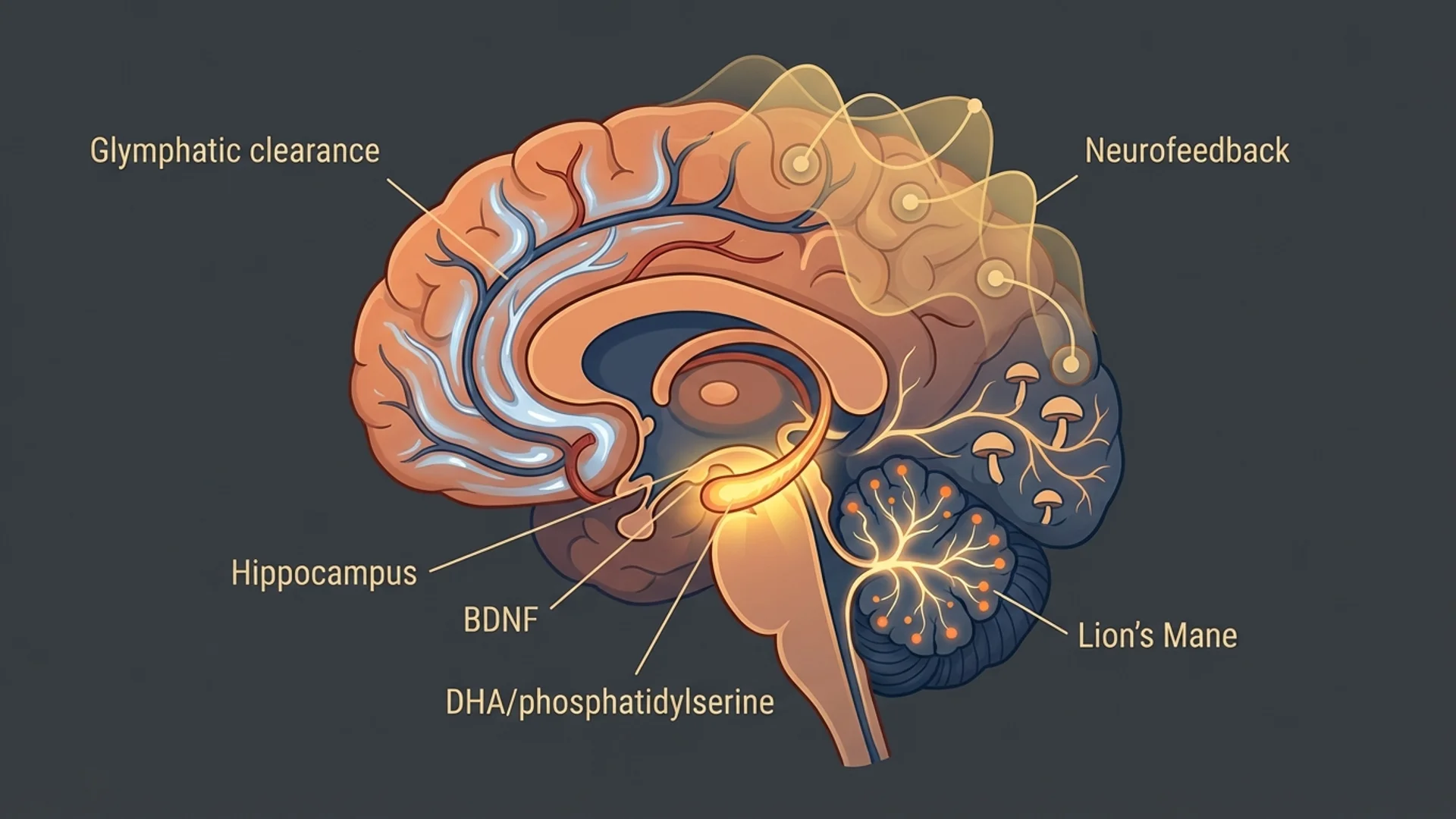
lion’s mane for neuroprotection 1g daily Moderate NGF stimulation, neurogenesis (Hericium erinaceus)
Phase 3: Targeted Support
Add based on specific symptoms:
For focus/attention:
- Alpha-GPC (600mg) — acetylcholine precursor
- L-Tyrosine (500-1000mg) — dopamine precursor, especially under stress
For mental fatigue:
- CoQ10 (200mg) — mitochondrial electron transport
- PQQ (20mg) — mitochondrial biogenesis
For memory:
- Bacopa Monnieri (300mg, standardized) — evidence for long-term memory, takes 8-12 weeks
- Phosphatidylserine (100mg) — membrane phospholipid
Phase 4: Advanced (Physician-Supervised)
These require medical oversight:
- NAD+ IV therapy — mitochondrial energy, cellular repair
- Selank (nasal spray) — anxiolytic peptide with cognitive benefits
- Low-dose methylene blue for mitochondrial support — mitochondrial electron carrier (investigational)
- IHHT — intermittent hypoxia-hyperoxia for mitochondrial resilience
When to Seek Medical Help
Persistent brain fog warrants investigation, not just supplementation. Common treatable causes include:
- Chronic infections (Lyme, EBV, co-infections)
- Post-COVID neuroinflammation
- Thyroid dysfunction
- Hormonal imbalances (testosterone, estrogen, cortisol)
- Heavy metal exposure
- Mold illness (CIRS)
- Sleep apnea
Clinical Perspective
In my clinical experience, the most common mistake I see is treating brain fog as a supplement deficiency when it is actually a symptom of something deeper. The patients who come to me with cognitive complaints almost always have an underlying cause — whether it is a chronic infection, hormonal imbalance, or toxic exposure. Supplements can support recovery, but identifying and treating the root cause is what actually restores cognitive function.
Related Reading
- Selank: Anxiolytic Peptide
- NAD+ IV Therapy
- Post-COVID Brain Fog
- Brain Fog: Neuromodulation Approaches
- sleep optimization protocol
References
-
Avgerinos KI, et al. “Effects of Creatine Supplementation on Cognitive Function of Healthy Individuals: A Systematic Review of Randomized Controlled Trials.” Experimental Gerontology, 108, 166-173 (2018). PMID: 29704637.
-
Slutsky I, et al. “Enhancement of Learning and Memory by Elevating Brain Magnesium.” Neuron, 65(2), 165-177 (2010). PMID: 20152124.
-
Mori K, et al. “Improving Effects of the Mushroom Yamabushitake (Hericium erinaceus) on Mild Cognitive Impairment.” Phytotherapy Research, 23(3), 367-372 (2009). PMID: 18844328.
-
Pase MP, et al. “The Cognitive-Enhancing Effects of Bacopa monnieri: A Systematic Review of Randomized, Controlled Human Clinical Trials.” Journal of Alternative and Complementary Medicine, 18(7), 647-652 (2012). PMID: 22747190.
-
Walker MP. “The Role of Sleep in Cognition and Emotion.” Annals of the New York Academy of Sciences, 1156, 168-197 (2009). PMID: 19338508.
This protocol is for educational purposes only and does not constitute medical advice. Consult a qualified healthcare provider before starting any supplement regimen.