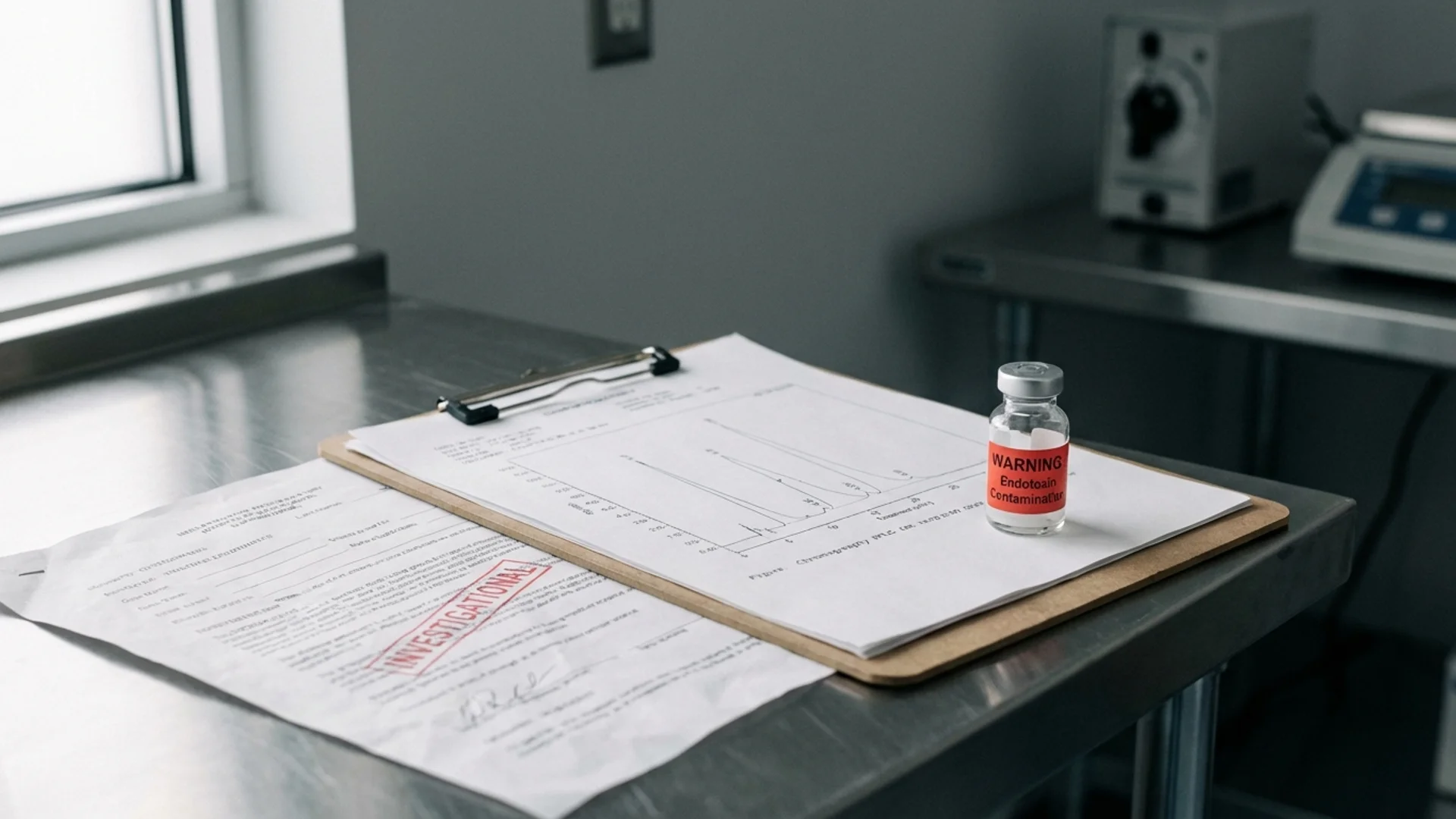
At a Glance
| Topic | Details |
|---|---|
| Governing body | World Anti-Doping Agency (WADA) — updated Prohibited List each January |
| Most relevant WADA class | S2 (Peptide Hormones, Growth Factors, Related Substances and Mimetics) |
| Key banned peptides | All GHRPs (GHRP-2, GHRP-6, Ipamorelin), all GHRFs (CJC-1295, Sermorelin, Tesamorelin), IGF-1 analogues, Thymosin beta-4 (TB-500) |
| Monitoring-only (not yet banned) | BPC-157 — on WADA monitoring program; no sanctioned cases yet in 2026 |
| Likely safe for athletes | GHK-Cu (topical), KPV, select FDA-approved peptides with a TUE |
| Detection window | GHRPs: 24–72 hours in urine; longer in dried blood spots |
| TUE process | Submit before use; approval not guaranteed; typically requires diagnosis + physician letter |
| Stakes | First violation: typically 4-year ban; reduced to 2 years if no significant fault |
The overlap between functional medicine’s growing peptide toolkit and elite sport’s anti-doping framework creates a genuine clinical dilemma. Athletes at every level — Olympic competitors, triathletes, professional team sport players, and masters athletes who compete under anti-doping rules — increasingly consult integrative physicians about peptides for injury recovery, hormonal support, and performance optimisation. Many are unaware that several of the most commonly discussed therapeutic peptides carry significant anti-doping risk.
This article is written for athletes who compete under WADA-aligned rules, for coaches and team physicians navigating that landscape, and for patients who want to understand why a peptide their non-competing peers use freely is off-limits for them.
How WADA Classifies Peptides
WADA’s Prohibited List, updated annually on 1 January, organises prohibited substances into classes. Peptides appear primarily in two:
S2 — Peptide Hormones, Growth Factors, Related Substances and Mimetics
This is the broadest and most relevant class. It covers:
- Erythropoiesis-stimulating agents (EPO and analogues)
- Peptide hormones and analogues (growth hormone, chorionic gonadotrophin, luteinising hormone, corticotrophins)
- Growth hormone releasing factors (GHRFs) — including all GHRH analogues
- Growth hormone releasing peptides (GHRPs) — including all secretagogues
- Insulin-like growth factor-1 (IGF-1) and analogues
- Vascular endothelial growth factor (VEGF) and related compounds
A critical feature of S2: all members of these peptide families are banned — regardless of whether the specific compound has been clinically studied, FDA-approved, or is a novel research compound. WADA applies class-based prohibition, not compound-by-compound listing. This means a new GHRP synthesised next year would be banned the moment it existed, without appearing by name on the list.
S0 — Non-Approved Substances
S0 catches anything not approved for human therapeutic use by a regulatory authority and not in an active approved protocol. Many peptides currently sold as research chemicals fall here. If a peptide has no approved therapeutic indication and no TUE pathway, S0 applies by default.
Peptides That Are Definitively Banned
Growth Hormone Releasing Peptides (GHRPs)
Every compound in this class is prohibited in-competition and out-of-competition:
- GHRP-2 (Pralmorelin) — One of the original synthetic GHRPs; significantly increases GH pulse amplitude
- GHRP-6 — Stimulates ghrelin receptor; increases appetite alongside GH secretion
- Ipamorelin — Selective GH secretagogue without significant cortisol or prolactin elevation; among the cleanest GHRPs pharmacologically
- Hexarelin — Potent GHRP; also acts on cardiac tissue directly
- MK-677 (Ibutamoren) — Not technically a peptide (it is an orally active small molecule) but functions as a ghrelin mimetic/GH secretagogue and is prohibited under S2
The anti-doping rationale: GHRPs amplify endogenous GH pulses. This improves body composition, accelerates soft tissue repair, and can substantially augment recovery — the same properties that make them therapeutically attractive are precisely why WADA prohibits them.
Growth Hormone Releasing Factors (GHRFs)
Also banned in-competition and out-of-competition:
- CJC-1295 (with and without DAC)
- Sermorelin — The oldest GHRF analogue; sometimes presumed safe because of its long clinical history, but it is explicitly prohibited
- Tesamorelin (Egrifta) — FDA-approved for HIV-associated lipodystrophy; no TUE is granted for athletic performance enhancement
- Modified GRF 1-29 — Another GHRH analogue; same prohibition applies
Thymosin Beta-4 / TB-500
TB-500 is the synthetic fragment most commonly used in clinical settings. Thymosin beta-4 itself stimulates actin polymerisation, promotes wound healing, and modulates inflammation — making it highly appealing for musculoskeletal injury recovery.
WADA position in 2026: Thymosin beta-4 and its fragments are listed under S2 as growth factors with anabolic or tissue-repair activity. Multiple positive anti-doping tests involving TB-500 have been reported since 2021. This compound must be treated as prohibited until explicitly removed from the Prohibited List.
IGF-1 Analogues
Insulin-like growth factor-1 and any structural analogue (including Long R3 IGF-1 and des(1-3)IGF-1) are banned. Mechano Growth Factor (MGF), a splice variant of IGF-1 expressed in response to mechanical stress, is also explicitly prohibited.
Gonadotropins and Related Peptides
Human Chorionic Gonadotrophin (hCG), Luteinising Hormone (LH), and their analogues are banned for male athletes. This is relevant for physicians managing hypogonadism in male athletes: while hCG-based testosterone restoration protocols are used in functional medicine, they carry anti-doping consequences for competing males.
The Grey Zone: BPC-157
BPC-157 (Body Protection Compound-157) occupies a genuinely ambiguous position that creates clinical confusion.
Current WADA status: BPC-157 is on WADA’s monitoring program, not the Prohibited List. The monitoring program tracks substances that may warrant future prohibition but for which sufficient evidence has not yet been gathered. Being on the monitoring list means samples are tested and data is collected — but a positive test for BPC-157 alone does not constitute a doping violation in 2026.
Why this is not clearance: WADA can move a compound from monitoring to prohibited at the next annual List revision. The monitoring program is specifically designed to generate the pharmacokinetic and prevalence data needed to support future prohibition. Athletes who begin using BPC-157 now could be prohibited by the time their season begins next year.
My clinical position: I do not prescribe BPC-157 to athletes competing under WADA rules without discussing the monitoring status explicitly. The risk that it transitions to the Prohibited List before a competition cycle ends is real and non-trivial. Athletes whose careers depend on clean test results should not gamble on monitoring-only status.
Peptides Likely Safe Under WADA Rules
Not all peptides are prohibited. The following are generally considered permissible, though athletes should verify with their national anti-doping organisation before use:
GHK-Cu (Copper Peptide) — Used primarily as a topical for skin and wound repair. No systemic anabolic mechanism; not targeted by WADA as of 2026.
KPV — An anti-inflammatory tripeptide (Lys-Pro-Val) derived from MSH. Primarily gut-targeted. No current WADA classification as prohibited.
Collagen peptides — Hydrolysed collagen and gelatin-derived peptides used as nutritional supplements. Not prohibited.
Thymosin alpha-1 — Distinct from thymosin beta-4. Used for immune modulation in chronic infections and oncology support. Not currently listed under S2, though athletes should confirm its status as WADA periodically revisits immunomodulators.
BPC-157 (with caveats) — As discussed above: currently monitoring-only, not prohibited, but this status can change.
Therapeutic Use Exemptions (TUEs)
An athlete with a genuine medical condition requiring a prohibited substance can apply for a Therapeutic Use Exemption. The TUE process is managed by national anti-doping organisations (NADOs) and, for international events, by the international federation or WADA itself.
Criteria for TUE Approval
All four criteria must be met:
- Medical necessity — The prohibited substance is necessary to treat a diagnosed medical condition. The condition must be documented with appropriate diagnostic evidence.
- No alternative — No permitted therapeutic alternative with comparable clinical effect exists.
- No enhancement — The treatment will not restore health beyond the athlete’s normal state.
- Diagnosis not caused by prohibited use — The condition did not arise from prior use of prohibited substances.
Practical Considerations for Peptides
In practice, TUEs for GHRPs and GHRFs are rarely granted. The “no alternative” criterion is difficult to satisfy because conventional hormonal approaches (including recombinant human GH for documented GH deficiency) exist and are themselves handled under separate TUE frameworks.
For growth hormone deficiency — the clearest clinical scenario where GHRPs or GHRFs might be medically justified — WADA has specific guidance: recombinant human GH (somatropin) can receive a TUE if GH deficiency is documented by stimulation testing, but this is distinct from using peptide secretagogues as a workaround.
Timeline: TUE applications should be submitted at least 30 days before competition. Emergency TUEs are available but time-constrained and not appropriate for elective peptide therapy.
Detection Windows and Testing
Anti-doping science has advanced significantly in peptide detection since 2018. Key points for athletes and their physicians:
Urine testing (traditional): GHRPs have a relatively short detection window — typically 24 to 72 hours in urine, depending on the specific compound, dose, and individual pharmacokinetics. This led to a historical assumption that GHRPs were “undetectable.” That assumption is outdated.
Dried blood spots (DBS): WADA’s implementation of DBS testing has extended detection windows and enabled out-of-competition testing with less logistical burden. Several GHRP compounds are detectable in DBS for substantially longer than urine.
Longitudinal profiling: The Athlete Biological Passport (ABP) tracks biomarkers over time. Sustained or patterned changes in GH-axis parameters can flag anomalies even when no direct compound is detected.
A false negative is not a clean record: An athlete who uses prohibited peptides but happens not to be tested during the detection window is not “cleared” — they have simply not been caught yet. Anti-doping violations can be pursued retroactively if stored samples are re-analysed.
Clinical Protocol: What I Tell Athlete Patients
When an athlete presents asking about peptides — usually for injury recovery, and usually having read about GHRPs or BPC-157 online — I follow a consistent framework:
-
Establish competition status first. Does this athlete compete under an anti-doping code? At what level? Many masters athletes assume they are below the threshold for testing; this is incorrect for events affiliated with World Athletics, USADA, or national federations.
-
Check the current Prohibited List at wada-ama.org directly. Never rely on memory or third-party summaries — the list changes annually and my recollection of last year’s version could get a patient sanctioned.
-
For permitted peptides (GHK-Cu, KPV, collagen): prescribe without restriction.
-
For BPC-157: explain the monitoring status clearly. Document the conversation. If the athlete wants to use it, I recommend holding until after their competitive season and monitoring WADA announcements.
-
For GHRPs, GHRFs, TB-500: these are prohibited. I explain the mechanism, the prohibition rationale, and the detection risk. I then pivot to permitted injury recovery approaches: high-dose collagen peptides with vitamin C peri-workout, physiotherapy-led load management, PRP where appropriate, and optimised sleep and nutrition.
-
If there is a genuine medical indication: initiate a TUE application early — not a week before competition. Document thoroughly and be honest with the athlete about the likelihood of approval.
Related Articles
- Are Peptides Legal? A 2026 Regulatory Guide — FDA, EU, and grey market peptide access explained
- BPC-157: Oral vs Injection Compared — Routes of administration and bioavailability
- Peptide Therapy for Women: A Clinical Overview — Subgroup-specific dosing and indications
- TB-500 Dosage and Protocol Guide — Clinical dosing reference
- Peptide Safety: Long-Term Considerations — Risk-benefit framework for extended use
References
- World Anti-Doping Agency. 2026 Prohibited List International Standard. WADA; January 2026. https://www.wada-ama.org/en/prohibited-list
- Semenistaya EN, et al. “Detection of growth hormone releasing peptides GHRP-2 and GHRP-6 in human urine and blood serum.” Drug Test Anal. 2016;8(9):919-930. doi:10.1002/dta.1868
- Thomas A, et al. “Peptide hormone misuse in sport: current evidence and detection methods.” Br J Pharmacol. 2017;174(12):1753-1773. doi:10.1111/bph.13759
- Baume N, et al. “Dried blood spots as an alternative specimen in anti-doping analysis for detection of growth hormone peptides.” Drug Test Anal. 2021;13(2):387-396. doi:10.1002/dta.2964
- Vernec A, et al. “Glucocorticoids in sport: a critical review with recommendations.” Br J Sports Med. 2020;54(10):573-577. doi:10.1136/bjsports-2019-101123
- Chang MC, et al. “Thymosin beta-4 and its uses in musculoskeletal injury.” Ann N Y Acad Sci. 2021;1487(1):5-13. doi:10.1111/nyas.14512
- WADA. Therapeutic Use Exemption (TUE) Physician Guidelines — Growth Hormone Deficiency (Adult). WADA; 2023.