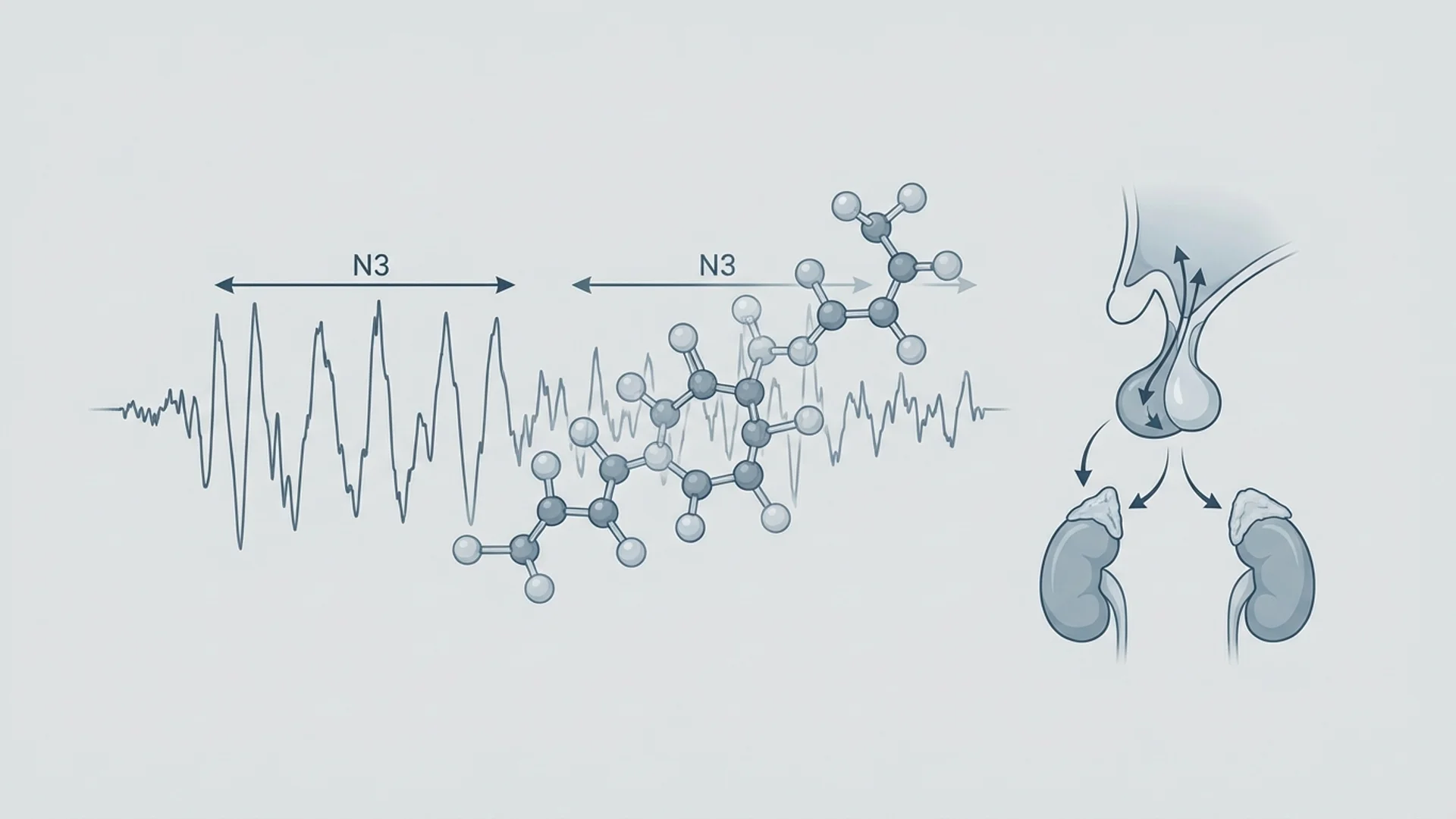
DSIP — delta sleep-inducing peptide — has one of the most misleading names in the peptide landscape. The name implies it will reliably induce deep sleep, and while there is evidence supporting its role in sleep regulation, the clinical reality is more nuanced than the name suggests. It was isolated from rabbit blood in 1977, and almost fifty years later nobody has found its gene, its receptor or a clear role in human sleep regulation [1].
If you are looking for DSIP dosing information, what I want you to understand first is this: DSIP is not a sedative. It does not produce unconsciousness. It modulates sleep architecture and neuroendocrine balance over time. This distinction is critical for setting realistic expectations and choosing the right dosing protocol.
At a Glance
| Property | Value |
|---|---|
| What it is | A 9-amino-acid peptide first isolated in 1977; its natural role in humans is still unclear [1] |
| Evidence Level | Mixed — encouraging open studies; the controlled studies found weak or clinically minor effects [2][3][4][5] |
| Standard Dose | 100-200 mcg subcutaneously; 250-500 mcg for severe sleep problems (practice protocols) |
| Timing | 30-60 minutes before intended sleep |
| Cycle Length | 2-4 weeks (practice protocols; some use 5-14 nights) |
| Onset | Gradual over 3-5 nights (not acute) |
| Route | Subcutaneous injection (preferred); IV (clinical research) |
| Mechanism | Sleep architecture modulation, HPA axis regulation (hypothesised; receptor unknown) |
| Approval status | Not approved as a medicine by the FDA, the EMA or Germany’s BfArM |
| Main risks | Unknown long-term safety; immunogenicity and impurities flagged by the FDA; contamination and infection risk with research-grade vials |
| Anti-doping (WADA 2026) | Not named; as a non-approved substance it falls under S0 (prohibited at all times) |
Protocol Table: Dose, Route, Timing and Basis
For informational purposes only — this summarises doses used in research and practice; it is not a prescription or individual medical advice.
One row per use case. Basis: Trial (published human study, PMID), Practice protocol (reported by at least two independent compilations), Anecdotal (community reports only).
| Goal | Dose | Route | Frequency / timing | Cycle length | Basis |
|---|---|---|---|---|---|
| Chronic insomnia, open sleep-lab study | 30 nmol/kg (about 25 mcg/kg) | IV | 6 doses over one week | 1 week | Trial (open study, no control group; PMID 3792404) |
| Chronic insomnia, controlled studies | 25 nmol/kg (about 21 mcg/kg) | IV | Single doses on study nights; in one study on the afternoons before nights 3-5 | Up to 1 week | Trial (effects weak or of little clinical significance; PMID 3583493, PMID 1299794) |
| Sleep quality, community standard | 100-200 mcg | SC | Nightly, 30-60 minutes before bed | 2-4 weeks (Peptide DB: 5-10 days) | Practice protocol (Peptide Protocol Wiki; Peptide DB) |
| Severe sleep problems, higher dose | 250-500 mcg (Peptide DB: 250-300 mcg) | SC | Nightly | 2-4 weeks | Practice protocol (Peptide Protocol Wiki; Peptide DB); next-day grogginess reported above about 300 mcg |
| Intermittent dosing to limit tolerance and rebound | 100-250 mcg | SC | 3 non-consecutive evenings per week | 4-6 weeks | Anecdotal (Peptide Protocol Wiki) |
| Stress rather than sleep | 50-150 mcg | SC | Evening | 2-4 weeks | Practice protocol (Peptide Protocol Wiki: 50-100 mcg; Peptide DB: 150 mcg) |
| Combined with CJC-1295/ipamorelin before bed | DSIP 100-200 mcg + the GH secretagogues at their usual doses | SC | Nightly | 2-4 weeks | Anecdotal (Peptide Protocol Wiki) |
The clinical studies gave DSIP intravenously at weight-based doses (about 1.6-1.9 mg for a 75 kg adult); the community injects a fraction of that under the skin, a route the published sleep studies did not use.
Technique, reconstitution and storage are in the peptide injection guide.
What DSIP is and what it does
DSIP is a nonapeptide (nine amino acids). Early animal work suggested it promoted slow-wave sleep and influenced several hormone systems, including luteinizing hormone, growth hormone and cortisol release. That picture never firmed up. A 2006 review in the Journal of Neurochemistry called DSIP “a still unresolved riddle”: the gene, the precursor protein and a specific receptor were never identified, and some of the sleep-promoting activity seen in animals came from synthetic analogues rather than DSIP itself [1].
That matters for anyone reading confident mechanism claims online. When a molecule’s receptor is unknown, statements about how it “resets sleep architecture” or “regulates the HPA axis” are hypotheses, not established pharmacology.
The Evidence for Sleep Effects
Preclinical
Rabbit, rat and cell studies from the 1970s and 1980s reported effects on sleep stages, stress hormones and neurotransmitter turnover [7]. In stressed animal models, DSIP appeared to act as a “sleep permitter” rather than a “sleep inducer” — facilitating natural sleep processes rather than overriding wakefulness. The results were inconsistent across labs, and the 2006 review concluded that the link between DSIP and sleep “has never been further characterized” [1].
Human
Every human sleep study I could verify used intravenous DSIP in a sleep laboratory, given by researchers at a weight-based dose. None used the subcutaneous injections that are used in practice today.
| Study | Design | n | What was studied | Finding | Certainty |
|---|---|---|---|---|---|
| Schneider-Helmert 1986 [2] | Open sleep-lab study, chronic insomnia | 18 | IV DSIP, 6 doses over one week | Sleep moved toward normal values, larger effect in older patients | Very low (no control group) |
| Schneider-Helmert 1987 [3] | Placebo-controlled, double-blind, 7 nights | 14 | IV DSIP | Sleep efficiency and daytime alertness improved | Low (very small, single centre) |
| Monti et al. 1987 [4] | Double-blind crossover, chronic insomnia | Small | IV DSIP, 25 nmol/kg dose studied, 4 nights | Some sleep measures changed, but similar differences already existed at baseline; the authors judged the improvement “of little clinical significance” | Low |
| Bes et al. 1992 [5] | Double-blind matched pairs, parallel groups | 16 | IV DSIP, 25 nmol/kg dose studied, 3 afternoons | Small, partly incidental effects; subjective sleep quality unchanged; “not likely to be of major therapeutic benefit” | Low |
The pattern is familiar from early-phase research. Open studies by the original research group looked encouraging. The more tightly controlled studies by other groups found weak effects that did not translate into patients feeling better. I found no modern randomized trial, no dose-finding study and no study of subcutaneous use.
What the mixed data tells us: DSIP may work best as a sleep neuromodulator in people whose insomnia is driven by stress, cortisol dysregulation, or HPA axis dysfunction — not as a universal sleep aid. People with primary insomnia without a clear stress/neuroendocrine component may not respond.
What I See When Coaching Patients
To be clear, DSIP is not a first-line sleep intervention. Here is where it seems most relevant:
Stress-driven insomnia. People who describe racing thoughts, difficulty “switching off,” and a clear correlation between daytime stress and nighttime sleep quality are the best candidates. Their HPA axis is likely dysregulated, and DSIP’s proposed cortisol-modulating properties may address the upstream problem.
Post-travel or shift-work disruption. People whose circadian rhythm has been disrupted by jet lag or irregular schedules sometimes respond well to a short DSIP course to reset sleep architecture.
People who have tried everything. For those who have failed melatonin, magnesium, sleep hygiene optimization, and conventional sleep medications, DSIP represents a mechanistically different approach. Some of them respond, which makes sense if their insomnia is driven by neuroendocrine factors that other interventions do not address.
Where DSIP does not work well: People with sleep apnea (a structural problem DSIP cannot address), insomnia secondary to chronic pain without stress components, and anyone expecting an acute sedative effect.
DSIP Dosage: What the Research Used
For informational purposes only — this summarises doses used in research and practice; it is not a prescription or individual medical advice.
The dosing of DSIP is derived from a combination of early clinical research, pharmacokinetic data, and the clinical protocols that have developed in the peptide therapy community. Let me walk through each source.
Human Clinical Trial Doses
The human sleep studies that form the evidence base for DSIP gave it intravenously at weight-based doses of about 25 nmol/kg body weight [4][5] — roughly 21 mcg/kg, or about 1.6 mg for a 75 kg individual. These were IV doses used in sleep-laboratory research settings, over a few nights to one week [2][3][4][5].
Modern Subcutaneous Protocols
The shift from IV to subcutaneous administration reflects practical clinical reality — patients cannot self-administer IV peptides at home. Modern protocols use significantly lower doses:
| Protocol | Dose | Route | Frequency | Duration |
|---|---|---|---|---|
| Standard | 100 mcg | Subcutaneous | Nightly | 2-4 weeks |
| Moderate | 200 mcg | Subcutaneous | Nightly | 2-4 weeks |
| Higher-end | 250-500 mcg | Subcutaneous | Nightly | 2-4 weeks |
The subcutaneous doses are lower than the early IV research doses for several reasons:
- Absorption kinetics. Subcutaneous injection provides slower, more sustained absorption compared to IV bolus, potentially increasing the duration of effect.
- Clinical pragmatism. Higher doses have not shown proportionally better results in practice.
- Cost. DSIP is relatively expensive as a peptide, and lower effective doses are preferred.
These subcutaneous schedules come from practice, not from a published trial (basis: Practice protocol, as in the protocol table above).
Pharmacokinetics
DSIP has a relatively short plasma half-life — approximately 15-20 minutes after IV administration. This initially puzzled researchers because the sleep effects persist far beyond the circulating peptide’s presence. The proposed explanation is that DSIP exerts its effects through downstream changes in neurotransmitter balance, receptor sensitivity, and neuroendocrine signaling, not through direct receptor occupation during sleep.
This has a critical dosing implication: DSIP does not need to be present in circulation during sleep. The timing of administration (30-60 minutes before sleep) reflects the window needed for initiating these downstream effects, not for maintaining circulating levels.
Practical Dosing Protocol
For informational purposes only — this summarises doses used in research and practice; it is not a prescription or individual medical advice.
Standard DSIP Sleep Protocol
| Parameter | Recommendation |
|---|---|
| Starting dose | 100 mcg subcutaneously |
| Escalation dose | 200 mcg if no response after 3-4 nights |
| Higher dose | 250-500 mcg for severe sleep problems (Practice protocol; next-day grogginess reported above about 300 mcg) |
| Timing | 30-60 minutes before intended sleep |
| Injection site | Abdominal subcutaneous tissue |
| Course duration | 2-4 weeks (Practice protocol) |
| Rest period | 2-4 weeks between courses |
| Assessment point | Night 5 (minimum time to evaluate response) |
Timing Is Critical
DSIP’s effects on sleep are not acute. What I tell patients I coach:
- Night 1-2: Do not expect a dramatic change. DSIP is initiating downstream neuroendocrine shifts.
- Night 3-5: Some people begin noticing easier sleep onset and slightly deeper sleep. Others notice nothing yet.
- Night 7-10: If you are going to respond, this is when the effect typically becomes clear. Sleep onset improves, nighttime awakenings decrease, and morning alertness increases.
- Night 14: The full course. Sleep improvements often persist for days to weeks after the course ends.
If there is no discernible effect by night 7 at the 200 mcg dose, DSIP is likely not the right intervention for that individual. Practice protocols run courses for 2-4 weeks and go up to 250-500 mcg for severe sleep problems; users report next-day grogginess above about 300 mcg.
Reconstitution and Storage
DSIP is supplied as a lyophilized powder:
- Reconstitute with bacteriostatic water
- Store reconstituted DSIP refrigerated (2-8 degrees C)
- Use within 21 days of reconstitution
- Protect from light (DSIP is sensitive to oxidation)
- Do not freeze reconstituted solution
Combining DSIP with Other Sleep Interventions
DSIP + melatonin. These work through different mechanisms (see the DSIP vs Melatonin comparison for detailed analysis). Low-dose melatonin (0.3-1 mg) for circadian timing combined with DSIP for sleep architecture modulation is a rational combination that some people use, though no studies have evaluated the combination directly.
DSIP + magnesium glycinate. Magnesium supports GABAergic function and is a safe, well-evidenced sleep support. This combination is reasonable.
DSIP + sleep hygiene. This is not optional. No peptide compensates for blue light exposure at midnight, caffeine after 2 PM, or an irregular sleep schedule. Optimize sleep hygiene before adding DSIP.
DSIP + benzodiazepines/Z-drugs. This has not been studied. I do not recommend combining DSIP with sedative-hypnotics without medical supervision. The theoretical concern is not additive sedation (DSIP is not sedating), but unpredictable interactions with sleep architecture when two different modulators are active simultaneously.
Known and theoretical risks
In the published short-term data, DSIP was well tolerated: no next-day sedation, no documented dependence or withdrawal, no loss of efficacy within the one-week study periods, and mostly mild injection site reactions, occasional vivid dreams and transient warmth after injection. What that data cannot show:
- Unknown long-term safety. The published human exposure is a few dozen people for days, decades ago. That cannot detect uncommon or delayed harms.
- Immunogenicity and impurities. The FDA states that compounded drugs containing emideltide (DSIP) may pose a risk of immune reactions and peptide-related impurities, and that it has identified no safety information for the proposed route of administration [8].
- Research-grade product quality. Vials sold “for research use only” are not made or tested to pharmaceutical standards. When researchers bought semaglutide from illegal online sellers, measured purity was 7.7 to 14.4 percent against a 99 percent label claim, and endotoxin was found in every sample [6]. There is no reason to assume other grey-market peptides are better controlled.
- Injection-related harm. Self-injecting non-sterile material can cause abscesses, skin infections and, rarely, bloodstream infection.
- Masking a treatable cause. Persistent insomnia can come from sleep apnoea, depression, restless legs, thyroid disease, medication effects or pain. Self-treating with a peptide can delay the diagnosis that actually helps.
Contraindications:
- Pregnancy and lactation (no safety data)
- Active pituitary or hypothalamic disorders (DSIP influences neuroendocrine axes)
- Active malignancy (DSIP’s effects on growth hormone release warrant caution)
- Patients with epilepsy (DSIP modulates cortical excitability, though no seizure cases have been reported)
Regulatory status
- United States (FDA). DSIP is not an approved drug. On the FDA page “Certain Bulk Drug Substances for Use in Compounding that May Present Significant Safety Risks” (content current as of 22 April 2026), emideltide (DSIP) is listed among substances previously in category 2 whose nominations were withdrawn by the nominators. It is not on the 503A bulks list and not in category 1 (“under evaluation”) on the FDA list updated 14 May 2026 [8].
- EU and Germany. DSIP is not authorised as a medicinal product by the EMA or the BfArM. A “research use only” product has been through no approval process and no testing for human use.
- Sport (WADA 2026). DSIP is not named on the Prohibited List, but any pharmacological substance without current approval for human therapeutic use falls under S0 and is prohibited at all times [9].
When to talk to a physician
See a doctor if poor sleep has lasted more than about three months, if you snore loudly or wake gasping, if you feel sleepy while driving, or if low mood, pain or anxiety are part of the picture. Bring a two-week sleep diary and a list of everything you take, including supplements.
The treatment with the strongest evidence for chronic insomnia is cognitive behavioural therapy for insomnia (CBT-I).
The Bottom Line
DSIP is a neuromodulatory peptide that may improve sleep quality in a subset of people — particularly those whose insomnia is driven by stress and HPA axis dysregulation. It is not a sedative, it does not work acutely, and the evidence is genuinely mixed: its receptor is still unknown and the controlled trials found weak benefit. Standard practice dosing is 100-200 mcg subcutaneously, 30-60 minutes before sleep, for courses of 2-4 weeks, with 250-500 mcg used for severe sleep problems. If you are going to respond, you will typically know by night 7. This is what the research actually says — a promising mechanism with inconsistent clinical results, best suited for a specific profile rather than as a universal sleep solution.
Back to DSIP Overview | All Peptide Articles
References
- Kovalzon VM, et al. Delta sleep-inducing peptide (DSIP): a still unresolved riddle. J Neurochem. 2006. PMID: 16539679.
- Schneider-Helmert D. Efficacy of DSIP to normalize sleep in middle-aged and elderly chronic insomniacs. Eur Neurol. 1986. PMID: 3792404.
- Schneider-Helmert D. Effects of delta-sleep-inducing peptide on 24-hour sleep-wake behaviour in severe chronic insomnia. Eur Neurol. 1987. PMID: 3622582.
- Monti JM, et al. Study of delta sleep-inducing peptide efficacy in improving sleep on short-term administration to chronic insomniacs. Int J Clin Pharmacol Res. 1987. PMID: 3583493.
- Bes F, et al. Effects of delta sleep-inducing peptide on sleep of chronic insomniac patients. A double-blind study. Neuropsychobiology. 1992. PMID: 1299794.
- Ashraf AR, et al. Multifactor quality and safety analysis of semaglutide products sold by online sellers without a prescription. J Med Internet Res. 2024. PMID: 39509151.
- Graf MV, Kastin AJ. Delta-sleep-inducing peptide (DSIP): a review. Neurosci Biobehav Rev. 1984. PMID: 6145137.
- US Food and Drug Administration. Certain Bulk Drug Substances for Use in Compounding that May Present Significant Safety Risks (content current as of 22 April 2026); Bulk Drug Substances Nominated for Use in Compounding Under Section 503A (updated 14 May 2026).
- World Anti-Doping Agency. The 2026 Prohibited List (valid 1 January 2026), section S0.
Disclaimer: This article is for informational purposes only and is not a prescription or individual medical advice. It reflects one physician’s reading of the research and of practice. DSIP is not approved by the FDA, the EMA or the BfArM. Consult a qualified physician before beginning any peptide protocol, and about persistent sleep problems.