At a Glance
| Property | Value |
|---|---|
| Evidence Level | Strong (sleep architecture studies, randomized interventions for temperature, exercise timing, and supplements) |
| Primary Use | Increasing slow-wave sleep for physical recovery, immune function, and longevity |
| Key Mechanism | Core body temperature regulation, adenosine pressure, GABA-ergic modulation |
How to Increase Deep Sleep: What Actually Works
If you are tracking your sleep with an Oura Ring, Whoop, or Apple Watch and seeing embarrassingly low deep sleep numbers — 30 minutes when the target is 90 — you are not alone, and your concern is justified.
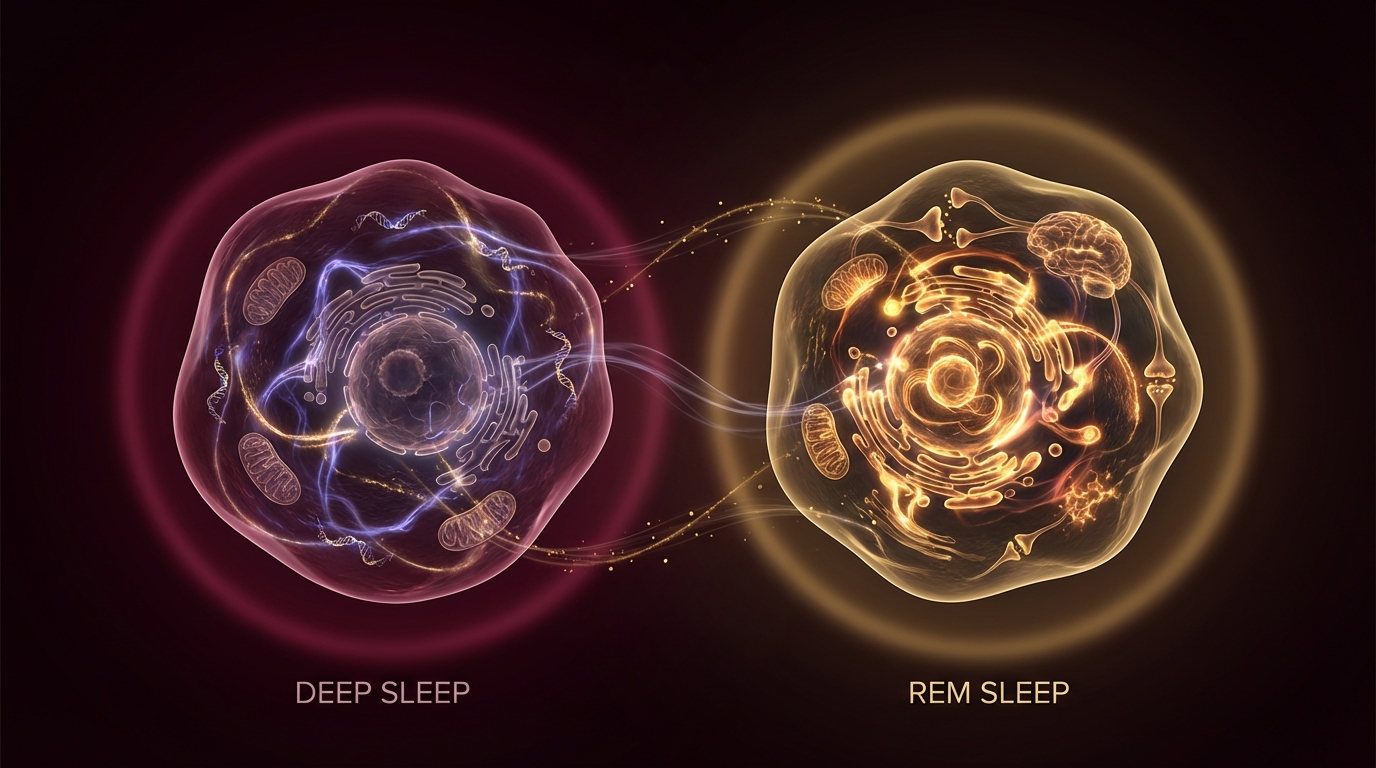
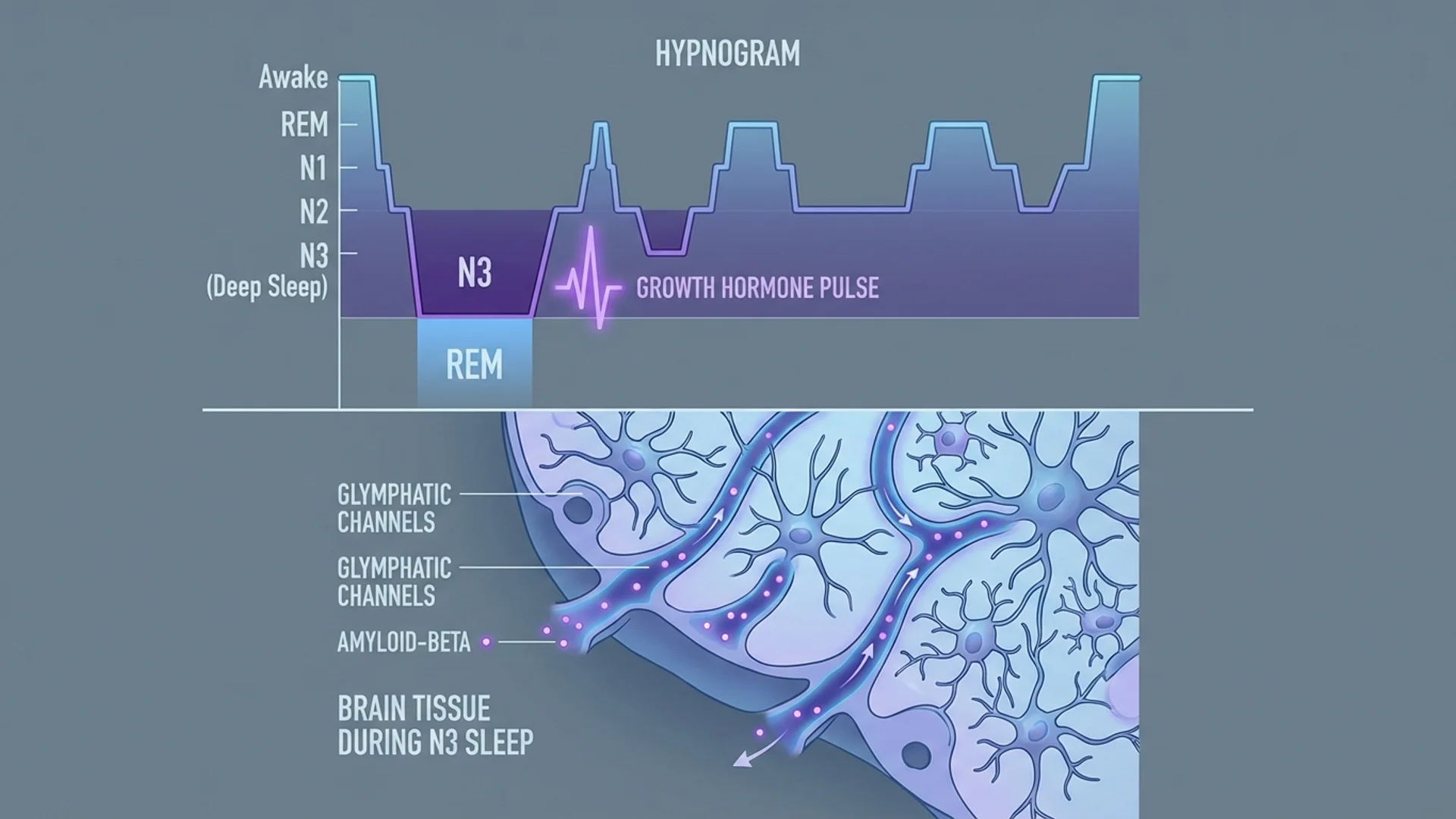
Deep sleep — technically stage N3 or slow-wave sleep (SWS) — is the most physically restorative phase of your sleep architecture. It is when growth hormone pulses peak, when glymphatic clearance removes metabolic waste from the brain (including amyloid-beta, the protein implicated in Alzheimer’s), when immune function consolidates, and when muscle tissue repairs.
And it declines dramatically with age. This decline is not benign. Reduced deep sleep is independently associated with a 29% increase in all-cause mortality in men over 40, even after adjusting for total sleep duration (1). You can sleep 8 hours and still be deep-sleep deprived.
Here is what the research actually says about increasing it.
Why Deep Sleep Declines With Age
The age-related decline in deep sleep is driven by several converging factors:
- Cortical thinning. The prefrontal cortex, which generates the slow oscillations (0.5-1 Hz) that define deep sleep, thins with age. Less cortical mass produces weaker slow waves.
- Reduced adenosine sensitivity. Adenosine — the molecule that builds “sleep pressure” during wakefulness — becomes less effective at triggering deep sleep onset as we age.
- Hormonal changes. Growth hormone, which is released primarily during deep sleep, declines with age in a self-reinforcing cycle: less GH means less deep sleep, which means even less GH.
- Increased nocturnal cortisol. Cortisol, which should be at its nadir during the first half of the night (when most deep sleep occurs), rises with age and disrupts slow-wave generation.
The practical consequence: a 25-year-old might spend 90-120 minutes per night in deep sleep. By age 60, this often drops to 20-40 minutes. This is one of the most consistent biomarkers of biological aging.
The Protocol: Evidence-Ranked Interventions
I am going to rank these from strongest evidence to weakest, so you know where to invest your effort first.
1. Temperature: The Single Most Impactful Variable
Evidence level: Strong
Core body temperature must drop by approximately 1-1.5°C from its daytime peak for deep sleep to initiate and sustain. This is not optional — it is a prerequisite of slow-wave sleep physiology.
Protocol:
- Set bedroom temperature to 18-19°C (65-67°F). This is consistently shown to maximize deep sleep in controlled studies.
- Take a warm shower or bath 60-90 minutes before bed. This seems counterintuitive, but the rapid post-bath cooling accelerates the core temperature drop. Haghayegh et al. meta-analyzed 13 studies and found that a warm bath 1-2 hours before bed reduced sleep latency by 36% and increased deep sleep duration (2).
- If you use sauna for longevity purposes, schedule it 2-3 hours before bed to leverage this temperature drop effect.
- Avoid heavy exercise within 2 hours of bedtime — it elevates core temperature and delays the necessary decline.
2. Consistent Wake Time
Evidence level: Strong
Your circadian rhythm anchors to your wake time, not your bedtime. An inconsistent wake time fragments your circadian oscillation and reduces the amplitude of slow-wave pressure in the first third of the night.
Protocol:
- Set the same wake time 7 days per week (±30 minutes maximum variance).
- Yes, including weekends. Social jetlag — the shift between weekday and weekend sleep timing — suppresses deep sleep on Sunday and Monday nights.
- If you must vary, shift bedtime rather than wake time.
3. Exercise: Timing Matters More Than Type
Evidence level: Strong
Regular exercise consistently increases deep sleep duration. The mechanism involves increased adenosine production, enhanced thermoregulatory capacity, and reduced evening cortisol. Kredlow et al. meta-analyzed 66 studies and confirmed that acute exercise increases deep sleep by approximately 10-15 minutes per night (3).
Protocol:
- Optimal timing: 4-6 hours before bed. This allows the post-exercise core temperature spike to resolve, creating a steeper temperature decline at bedtime.
- Morning exercise is second best — it anchors circadian rhythm through cortisol and light exposure.
- Late evening exercise (within 2 hours of bed) can impair deep sleep by elevating core temperature and sympathetic tone at the wrong time.
- Type: Both resistance training and aerobic exercise increase deep sleep. High-intensity exercise produces a larger effect than low-intensity.
4. Light Management
Evidence level: Strong
Light is the primary zeitgeber (time-giver) for your circadian clock. Mismanaged light exposure — particularly blue/green wavelengths in the evening — suppresses melatonin and delays the circadian processes that gate deep sleep.
Protocol:
- Morning: Get bright light exposure (>10,000 lux, or direct sunlight) within 30 minutes of waking. This sets the circadian clock and initiates the 14-16 hour countdown to melatonin onset.
- Evening: Dim lights and use blue-blocking glasses or warm-only lighting after sunset. Even modest room lighting (100-200 lux) suppresses melatonin by up to 50%.
- Screens: If screens are unavoidable, use Night Shift/blue light filters set to maximum warmth. Better yet, stop screens 60 minutes before bed.
5. Eliminate Deep Sleep Destroyers
Evidence level: Strong
Before adding supplements or devices, remove the things that are actively destroying your deep sleep:
Alcohol. Even moderate alcohol consumption (2 drinks) reduces deep sleep by 24-39%. Alcohol increases adenosine initially (making you feel sleepy) but then disrupts sleep architecture in the second half of the night as it is metabolized. This is the single biggest deep sleep destroyer I see in clinical practice.
Late caffeine. Caffeine blocks adenosine receptors. Its half-life is 5-7 hours, meaning a 2 PM coffee still has 25% of its stimulant effect at 10 PM. For deep sleep optimization, caffeine cutoff should be 12-14 hours before bed (meaning by noon for a 10 PM bedtime). If you are a slow CYP1A2 metabolizer, even earlier.
Late large meals. Digestion elevates core temperature and metabolic rate, directly opposing the temperature decline needed for deep sleep. Finish eating 3+ hours before bed.
6. Supplements: What the Evidence Supports
Evidence level: Moderate
Supplements are the last layer — they enhance an already-good sleep environment, they do not fix a bad one. For a detailed ranking, see my best supplements for deep sleep guide.
The evidence-supported stack:
- Magnesium glycinate (400 mg), 30-60 minutes before bed. Magnesium is a GABA receptor co-agonist and a natural muscle relaxant. The glycinate form specifically binds GABA-A receptors, enhancing inhibitory neurotransmission. See my comparison of magnesium glycinate vs. L-threonate for choosing the right form.
- Glycine (3g), 30-60 minutes before bed. Glycine lowers core body temperature by vasodilating peripheral blood vessels, which enhances the radiative heat loss needed for deep sleep onset. Bannai et al. demonstrated improved subjective sleep quality and reduced sleep latency with 3g glycine before bed (4).
- L-theanine (200 mg). An amino acid from green tea that increases alpha brain wave activity and promotes relaxation without sedation. It does not directly increase deep sleep but reduces the anxiety and racing thoughts that prevent sleep onset.
What I do NOT recommend for deep sleep:
- Melatonin for deep sleep specifically. Melatonin is a circadian signal, not a deep sleep enhancer. It helps with sleep timing (jet lag, shift work) but does not increase slow-wave sleep.
- Benzodiazepines and Z-drugs (Ambien, Lunesta). These actually reduce deep sleep while increasing total sleep time. They are sedatives, not sleep optimizers.
- CBD. The evidence for deep sleep enhancement is weak and inconsistent. Most reported benefits are likely due to anxiety reduction.
7. Advanced Strategies
Evidence level: Emerging
- Acoustic stimulation. Timed pink noise pulses synchronized to slow-wave oscillations can enhance deep sleep by 10-20% in laboratory settings. Commercial devices are emerging but not yet reliable.
- Brain-wave entrainment. Binaural beats at 0.5-4 Hz (delta range) have shown modest effects in small trials.
- Continuous glucose monitoring. Blood sugar spikes and crashes during the night fragment deep sleep. Using a CGM to identify and eliminate nocturnal glycemic instability is an underappreciated strategy.
How Much Deep Sleep Do You Need?
For detailed guidance on sleep architecture targets by age, see my article on how much deep sleep and REM you need. The short answer:
- Age 20-30: 90-120 minutes (20-25% of total sleep)
- Age 30-50: 60-90 minutes (15-20%)
- Age 50-70: 45-60 minutes (10-15%)
- Age 70+: 30-45 minutes (8-12%)
These are population averages. Individual variation exists, but if your deep sleep is consistently below these ranges, the interventions above are worth pursuing systematically.
The Implementation Order
Do not try everything at once. Here is the order I recommend:
Week 1: Temperature (set bedroom to 18-19°C) + consistent wake time Week 2: Add light management (morning sunlight, evening dimming) Week 3: Eliminate alcohol for 2 weeks and observe the effect on your tracker data Week 4: Add magnesium glycinate 400 mg before bed Week 5: Add glycine 3g before bed Week 6: Optimize exercise timing (move to morning or early afternoon if currently evening)
Track your deep sleep metrics throughout. The temperature and alcohol elimination steps typically produce the most dramatic immediate improvements.
The Bottom Line
Deep sleep is not a luxury — it is a biological necessity that declines with age and predicts mortality. The interventions to increase it are mostly behavioral, not pharmaceutical: cool bedroom, consistent schedule, well-timed exercise, managed light exposure, and elimination of alcohol and late caffeine. Supplements like magnesium glycinate and glycine can add incremental benefit on top of a solid foundation. In my clinical experience, most patients can increase their deep sleep by 30-50% within 4-6 weeks by implementing these changes systematically.
References
-
Djonlagic I, Mariani S, Fitzpatrick AL, et al. Macro and micro sleep architecture and cognitive performance in older adults. Nature Human Behaviour. 2021;5(1):123-145. doi:10.1038/s41562-020-00964-y
-
Haghayegh S, Khoshnevis S, Smolensky MH, et al. Before-bedtime passive body heating by warm shower or bath to improve sleep: a systematic review and meta-analysis. Sleep Medicine Reviews. 2019;46:124-135. doi:10.1016/j.smrv.2019.04.008
-
Kredlow MA, Capozzoli MC, Hearon BA, et al. The effects of physical activity on sleep: a meta-analytic review. Journal of Behavioral Medicine. 2015;38(3):427-449. doi:10.1007/s10865-015-9617-6
-
Bannai M, Kawai N, Ono K, et al. The effects of glycine on subjective daytime performance in partially sleep-restricted healthy volunteers. Frontiers in Neurology. 2012;3:61. doi:10.3389/fneur.2012.00061