If you are a man over 40 and you are reading this, there is a reasonable chance you have noticed something: less energy, less drive, more belly fat, worse sleep, reduced libido, or a general sense that the engine is running on fewer cylinders than it used to.
You may have Googled “low testosterone” and landed in one of two worlds. The first is the testosterone clinic world — inject first, ask questions later, chase a number on a lab report. The second is the mainstream medical world — “your levels are normal for your age,” here is an antidepressant.
Both are wrong. Here is what the evidence actually shows about testosterone after 40, and what I tell my patients.
At a Glance
| Property | Value |
|---|---|
| Evidence Level | Strong (decline and physiology); Moderate (optimization strategies); Moderate (TRT outcomes) |
| Primary Use | Testosterone assessment, optimization, and replacement when indicated |
| Key Mechanism | Hypothalamic-pituitary-gonadal axis regulation and peripheral conversion |
| Testing Required | Total testosterone, free testosterone, SHBG, LH, FSH, estradiol, prolactin, hematocrit |
The Natural Decline: What Is Actually Normal
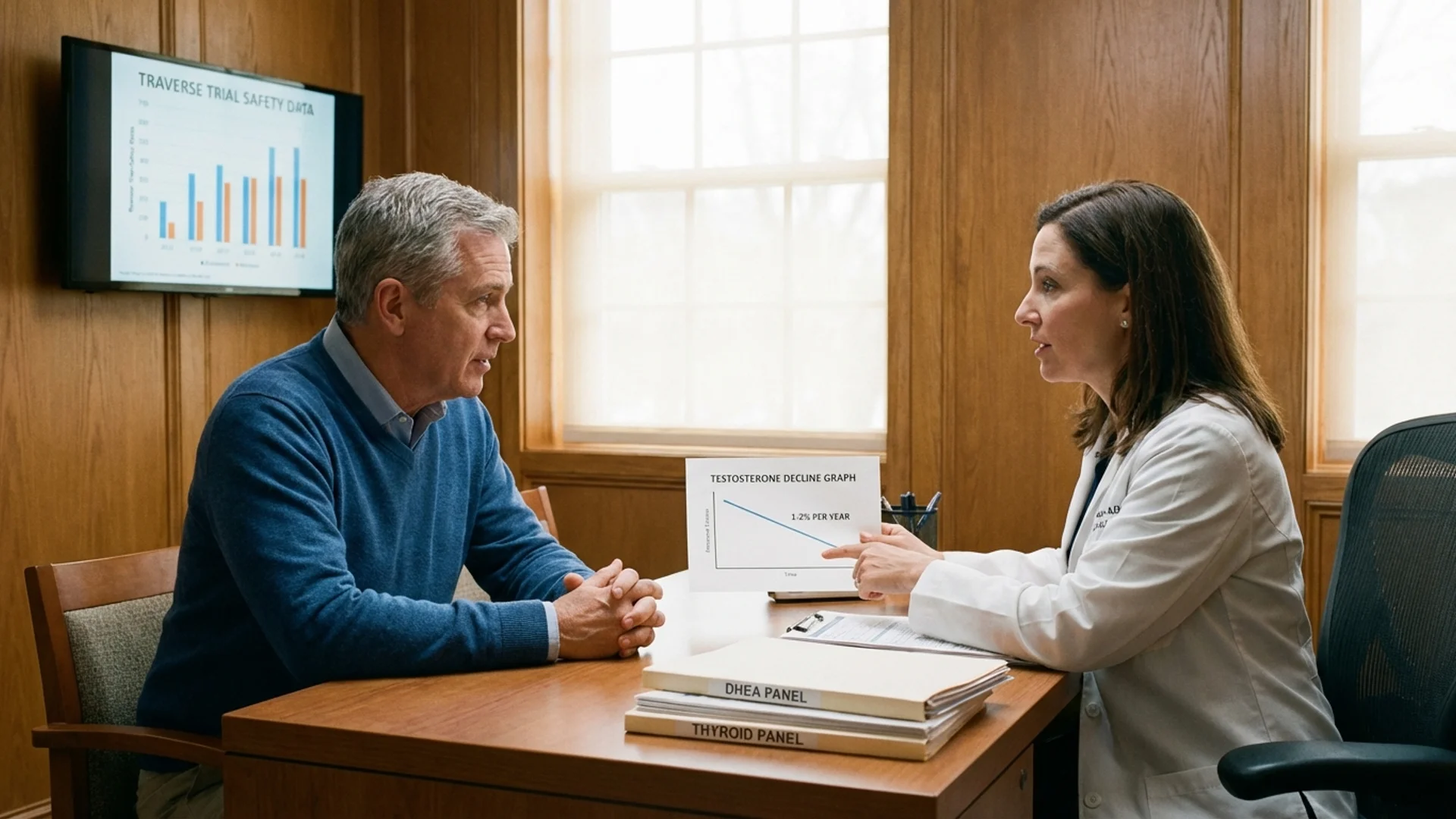
Testosterone production peaks in the late teens to early 20s, then begins a gradual decline — approximately 1-2% per year after age 30 [1]. By age 50, a man’s testosterone is roughly 20-40% lower than his peak. By 70, it may be 50% lower or more.
But here is the nuance that matters: this decline is not uniform. It is heavily modified by:
- Body composition: Visceral fat actively converts testosterone to estradiol via aromatase enzyme activity. The more visceral fat, the faster the decline.
- Sleep quality: Testosterone production is pulsatile and predominantly nocturnal. Poor sleep directly suppresses the hypothalamic-pituitary-gonadal (HPG) axis. One week of restricted sleep (5 hours/night) reduces testosterone by 10-15% in young men [2].
- Metabolic health: Insulin resistance, type 2 diabetes, and metabolic syndrome are independently associated with lower testosterone levels. The relationship is bidirectional — low testosterone worsens metabolic health, and poor metabolic health lowers testosterone.
- Chronic stress: Cortisol and testosterone compete for precursor molecules and receptor activity. Chronic stress, whether psychological, physical, or inflammatory, suppresses the HPG axis.
- Environmental factors: Endocrine-disrupting chemicals (phthalates, BPA, certain pesticides) have measurable effects on testosterone production, though quantifying individual exposure impact remains difficult.
What I tell my patients: a significant portion of the testosterone decline attributed to “normal aging” is actually the accumulation of modifiable factors. A 50-year-old man with optimal sleep, low visceral fat, regular resistance training, and well-managed stress will typically have substantially higher testosterone than a same-age man without those factors — even accounting for genetics.
This is not an argument that decline is imaginary. It is real. But the rate and severity are far more modifiable than most men — and many doctors — realize.
Testing: What to Measure and What the Numbers Mean
This is where I see the most errors, from both testosterone clinics and conventional physicians.
The Complete Panel
A single “testosterone level” is insufficient. Here is what a proper evaluation requires:
Total Testosterone: The headline number, but misleading in isolation. Reference ranges are typically 300-1000 ng/dL, but these ranges include 95% of the male population — including men with obesity, chronic illness, and sleep disorders. An “in-range” result of 320 ng/dL in a 42-year-old is technically normal but may be clinically significant.
Free Testosterone: Only 2-3% of testosterone circulates in its free, biologically active form. The rest is bound to SHBG (tightly) or albumin (loosely). A man with total testosterone of 500 ng/dL but high SHBG may have less bioavailable testosterone than a man at 400 ng/dL with normal SHBG. Free testosterone is essential for clinical interpretation.
Sex Hormone-Binding Globulin (SHBG): The transport protein that binds testosterone. SHBG increases with age, hyperthyroidism, liver disease, and certain medications. It decreases with obesity, insulin resistance, and hypothyroidism. SHBG context is required to interpret total testosterone accurately.
Luteinizing Hormone (LH) and Follicle-Stimulating Hormone (FSH): These pituitary hormones stimulate testosterone production. They distinguish between primary hypogonadism (testicular failure — high LH, low testosterone) and secondary hypogonadism (pituitary or hypothalamic dysfunction — low or inappropriately normal LH, low testosterone). This distinction matters for treatment selection.
Estradiol (E2): Testosterone converts to estradiol via aromatase. Elevated estradiol relative to testosterone produces symptoms that mimic low testosterone — gynecomastia, water retention, mood changes, reduced libido. It also provides feedback that suppresses further testosterone production. Measuring estradiol is non-negotiable.
Prolactin: Elevated prolactin suppresses LH and thereby testosterone. A prolactinoma (benign pituitary tumor) is a treatable cause of hypogonadism that is missed if prolactin is not checked.
Hematocrit and Hemoglobin: Baseline values are essential before considering TRT, as testosterone stimulates erythropoiesis. Pre-existing polycythemia is a relative contraindication.
Thyroid function (TSH, free T3, free T4): Thyroid and testosterone are interdependent. Hypothyroidism increases SHBG and can produce symptoms that overlap with low testosterone.
Testing Conditions
Testosterone has a diurnal rhythm — it peaks in the early morning and declines throughout the day. A sample drawn at 2pm may be 20-30% lower than one drawn at 8am. Testing protocol matters:
- Draw blood between 7-10am
- Fasting (insulin and glucose affect SHBG)
- After a normal night of sleep (not after a poor night or night shift)
- Repeat abnormal results — a single low reading is not diagnostic
- At least two low readings on separate occasions before diagnosing hypogonadism
The Optimization Ladder: Before TRT
Here is what the evidence shows about non-pharmacological testosterone optimization. In my clinical experience, these interventions — taken seriously and implemented consistently — can raise testosterone by 20-40% in men who start from a suboptimal baseline.
Step 1: Sleep
This is not optional. It is the single highest-yield intervention for most men.
7-9 hours of quality sleep in a dark, cool room, with consistent timing, is the foundation. Sleep apnea must be screened for and treated — untreated sleep apnea is strongly associated with low testosterone, and CPAP treatment improves levels [3].
What I see in practice: when a 45-year-old man with a testosterone of 380 ng/dL starts sleeping 7.5 hours instead of 5.5 hours, his follow-up labs often show a 15-20% increase in total testosterone. Sleep alone.
Step 2: Body Composition
Visceral fat is a testosterone-destroying endocrine organ. Aromatase in adipose tissue converts testosterone to estradiol. The more visceral fat, the more conversion. This creates a vicious cycle: low testosterone promotes fat storage, which further lowers testosterone.
Losing visceral fat — through caloric management and resistance training — directly improves the testosterone-to-estradiol ratio. The evidence is strong: weight loss of 5-10% of body weight in overweight men produces measurable testosterone increases [4].
Step 3: Resistance Training
Compound resistance exercises — squats, deadlifts, presses, rows — stimulate acute testosterone release and, more importantly, improve insulin sensitivity, body composition, and sleep quality. The evidence supports heavy compound movements over isolation exercises or endurance training for testosterone optimization [5].
The caveat: overtraining suppresses testosterone. Marathon runners and ultra-endurance athletes frequently have lower testosterone than moderately training strength athletes. More is not always better.
Step 4: Stress Management and Cortisol Reduction
Chronic cortisol elevation directly suppresses the HPG axis. Whether the stress is psychological (work, relationships), physical (overtraining, chronic pain), or inflammatory (gut dysbiosis, chronic infection), the endocrine effect is the same.
This is the step most men skip because it seems “soft.” It is not. The biochemistry is clear: sustained cortisol elevation reduces LH pulsatility and directly inhibits Leydig cell testosterone production.
Step 5: Targeted Supplementation
A few supplements have genuine evidence for supporting testosterone — not the hundreds of products marketed to men with “BOOST YOUR T” labels on the bottle.
Vitamin D: Men with vitamin D levels below 30 ng/mL frequently have lower testosterone. Supplementation to achieve 40-60 ng/mL is associated with modest testosterone improvements [6]. This is not a testosterone booster — it is correcting a deficiency that suppresses the HPG axis.
Zinc: Essential for testosterone synthesis. Zinc deficiency (common in athletes and men with poor dietary quality) directly impairs Leydig cell function. Supplementation in zinc-deficient men raises testosterone. Supplementation in zinc-replete men does nothing.
Magnesium: Magnesium status correlates with testosterone levels, particularly in athletes. The mechanism likely involves SHBG binding — magnesium may reduce SHBG, increasing free testosterone.
Ashwagandha (Withania somnifera): Multiple RCTs show modest testosterone increases (15-20%) and improved sperm parameters. The mechanism appears to involve cortisol reduction and direct effects on the HPG axis [7]. The evidence is moderate and the effect size is modest, but real.
What I do not recommend: tribulus terrestris (no reliable human evidence for testosterone), DHEA (unless documented deficiency), or any supplement that promises dramatic testosterone increases. If a supplement could raise testosterone by 200%, it would be a drug.
When TRT Is Indicated
For some men, lifestyle optimization is insufficient. The decline is too severe, the hypogonadism is primary, or the contributing factors are not fully modifiable. In these cases, testosterone replacement therapy is indicated.
Indications
TRT is appropriate when:
- Symptoms consistent with hypogonadism are present
- Total testosterone is consistently below 300 ng/dL on at least two morning samples (or free testosterone is below the age-adjusted reference range)
- Lifestyle optimization has been genuinely attempted and is insufficient
- There are no contraindications (active prostate cancer, polycythemia, severe sleep apnea, fertility planning without concurrent hCG)
What TRT Can Do
The evidence from large clinical trials and systematic reviews shows TRT in hypogonadal men improves:
- Libido and sexual function (moderate-strong evidence)
- Body composition — increased lean mass, decreased fat mass (strong evidence)
- Bone mineral density (moderate evidence)
- Mood and energy (moderate evidence, though variable)
- Insulin sensitivity and metabolic parameters (moderate evidence)
What TRT Cannot Do
TRT is not a performance-enhancing drug at physiological replacement doses. It will not transform body composition without exercise. It will not fix a marriage, cure depression that has non-hormonal causes, or produce the energy and drive of a 25-year-old in a 55-year-old body. Expectations must be realistic.
Risks and Monitoring
TRT is not risk-free. Honest discussion of risks is essential:
Erythrocytosis (elevated hematocrit): The most common side effect. Testosterone stimulates red blood cell production. Hematocrit above 54% increases thrombotic risk and requires dose adjustment or therapeutic phlebotomy. This is why baseline hematocrit and regular monitoring are mandatory.
Fertility suppression: Exogenous testosterone suppresses LH and FSH, which suppresses spermatogenesis. Men who want future fertility should not start TRT without concurrent hCG or should consider alternatives like clomiphene citrate (off-label). This is the most important counseling point for younger men.
Prostate considerations: TRT does not cause prostate cancer — this is a myth that has been largely debunked [8]. However, TRT can accelerate growth of existing prostate cancer. PSA monitoring is required.
Cardiovascular risk: The data has evolved significantly. The TRAVERSE trial (2023) — a large, placebo-controlled cardiovascular safety trial — showed no increased cardiovascular event risk with TRT in hypogonadal men with cardiovascular risk factors [9]. This largely settled a decade-long debate, though individual risk assessment remains appropriate.
Skin and mood: Acne, oily skin, and — in some men — irritability or mood changes can occur, particularly at supraphysiological levels. Proper dosing minimizes these effects.
Monitoring Protocol
Patients on TRT at our facility are monitored with:
- Total and free testosterone, estradiol: every 6-8 weeks until stable, then every 6 months
- Hematocrit: every 3-6 months
- PSA: annually (every 6 months in the first year)
- Metabolic panel: annually
- Symptom assessment: every visit
The goal is to achieve total testosterone in the 500-800 ng/dL range with free testosterone in the upper-normal range, estradiol controlled, and hematocrit below 52%. Supraphysiological levels are not the target.
The Bottom Line
Testosterone optimization after 40 is a systematic process, not a single prescription. Start with sleep, body composition, resistance training, and stress management — these produce measurable results in most men. Test properly: total testosterone, free testosterone, SHBG, LH, FSH, estradiol, hematocrit, prolactin. When TRT is indicated, use it with proper monitoring, realistic expectations, and individualized dosing.
What I tell my patients: your testosterone level is a number that reflects your overall health. Optimize the health, and the number often follows. When it does not, we have effective tools — but those tools work best when the foundation is solid.
The nuance matters. The bro-science does not.

References
- Harman SM, et al. Longitudinal effects of aging on serum total and free testosterone levels in healthy men. Journal of Clinical Endocrinology & Metabolism. 2001;86(2):724-731. doi:10.1210/jcem.86.2.7219
- Leproult R, Van Cauter E. Effect of 1 week of sleep restriction on testosterone levels in young healthy men. JAMA. 2011;305(21):2173-2174. doi:10.1001/jama.2011.710
- Luboshitzky R, et al. Testosterone treatment in men with obstructive sleep apnoea. Respiratory Medicine. 2005;99(8):1049-1055. doi:10.1016/j.rmed.2004.12.008
- Corona G, et al. Body weight loss reverts obesity-associated hypogonadotropic hypogonadism: a systematic review and meta-analysis. European Journal of Endocrinology. 2013;168(6):829-843. doi:10.1530/EJE-12-0955
- Kraemer WJ, Ratamess NA. Hormonal responses and adaptations to resistance exercise and training. Sports Medicine. 2005;35(4):339-361. doi:10.2165/00007256-200535040-00004
- Pilz S, et al. Effect of vitamin D supplementation on testosterone levels in men. Hormone and Metabolic Research. 2011;43(3):223-225. doi:10.1055/s-0030-1269854
- Lopresti AL, et al. A Randomized, Double-Blind, Placebo-Controlled, Crossover Study Examining the Hormonal and Vitality Effects of Ashwagandha (Withania somnifera) in Aging, Overweight Males. American Journal of Men’s Health. 2019;13(2):1557988319835985. doi:10.1177/1557988319835985
- Morgentaler A, Traish AM. Shifting the paradigm of testosterone and prostate cancer: the saturation model and the limits of androgen-dependent growth. European Urology. 2009;55(2):310-320. doi:10.1016/j.eururo.2008.09.024
- Lincoff AM, et al. Cardiovascular Safety of Testosterone-Replacement Therapy. New England Journal of Medicine. 2023;389(2):107-117. doi:10.1056/NEJMoa2215025
This content is educational and does not constitute medical advice. Hormone optimization requires individualized medical evaluation.