
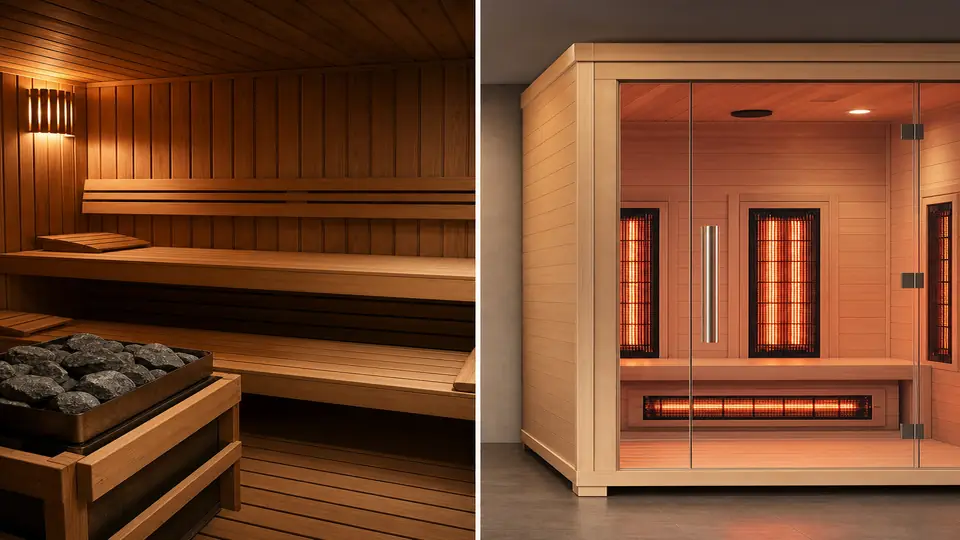
At a Glance
| Feature | Traditional Finnish Sauna | Infrared Sauna |
|---|---|---|
| Air temperature | 80–100°C (176–212°F) | 45–60°C (113–140°F) |
| Humidity | 10–20% dry, or steamed | Very low (< 10%) |
| Primary heat mechanism | Convection + radiation | Direct infrared tissue absorption |
| Core temperature rise | +1–2°C typical | +0.5–1.5°C typical |
| Session length | 10–20 min per round | 20–45 min continuous |
| HSP activation evidence | Well-documented | Plausible, less studied directly |
| Cardiovascular longevity data | Robust (large Finnish cohort studies) | Promising but smaller trials |
| Detox evidence | Weak (sweat ≈ 99% water) | Weak (similar sweat composition) |
| Ideal patient | Healthy adult seeking longevity, cardiovascular conditioning | Heat-sensitive individuals, chronic pain, accessibility |
For a deep dive into the cardiovascular evidence — including dose-response data and heart failure protocols — see Sauna and Cardiovascular Health: What the Evidence Shows.
Saunas have been central to Finnish culture for more than 2,000 years. The emergence of infrared sauna technology in the 1970s — and its explosion in consumer wellness markets since 2010 — has created a clinically relevant question: are these the same intervention delivered differently, or fundamentally distinct therapies with distinct indications?
After reviewing the mechanistic literature and clinical trial data, my position is: substantially overlapping in cardiovascular and stress-response outcomes, different in mechanism, tolerability, and the depth of supporting evidence. Here is what that means for clinical decision-making.
How Each Sauna Heats You: The Mechanism Matters
Traditional Finnish Sauna
A traditional sauna heats the surrounding air to 80–100°C. Your body then gains heat through convection (hot air contacting skin) and radiation (infrared emission from hot walls and stones). Throwing water on heated rocks — the Finnish löyly — briefly raises perceived humidity and heat intensity without dramatically increasing air temperature.
The critical physiological point: heat stress proceeds from outside in. Skin surface temperature rises first, triggering peripheral vasodilation and sweating. Core temperature elevation of 1–2°C follows over a 15–20 minute session. This core temperature rise is what drives most of the systemic benefits — cardiovascular conditioning, heat shock protein (HSP) induction, and autonomic nervous system modulation.
Infrared Sauna
Infrared saunas emit electromagnetic radiation across near (NIR: 0.8–1.5 μm), mid (MIR: 1.5–5.6 μm), and far (FIR: 5.6–1000 μm) infrared spectra. Biological tissue absorbs this radiation directly, and different wavelengths penetrate to different depths: NIR reaches 5–10 mm below skin, FIR primarily affects the superficial dermis.
Marketing often claims infrared saunas heat “from the inside out.” This is partially accurate: infrared energy does bypass surface air-heating and deposit energy directly in tissue. However, the physiological endpoints are similar — core temperature rises, sweating begins, cardiovascular stress occurs — just at a lower ambient air temperature (45–60°C rather than 80–100°C). This is the key practical distinction.
Clinical takeaway: For patients who find traditional sauna intolerable due to claustrophobia, orthostatic sensitivity, or respiratory discomfort in very hot air, infrared sauna delivers meaningful heat exposure in a substantially more accessible format. This is not a compromise — it is an appropriate modification.
Cardiovascular Benefits: Where the Evidence Is Most Compelling
The strongest longevity data is unambiguously from traditional sauna, owing to the size and duration of Finnish epidemiological cohorts.
The landmark Kuopio Ischemic Heart Disease Risk Factor Study (Laukkanen et al., JAMA Intern Med, 2015) followed 2,315 Finnish men over 20 years. Men who used the sauna 4–7 times per week showed:
- 40% lower all-cause mortality versus once-weekly users
- 63% reduction in sudden cardiac death
- Dose-dependent reductions in fatal coronary heart disease events
These associations persisted after adjusting for established cardiovascular risk factors, physical activity, and alcohol consumption. No other passive thermal intervention has population data of this magnitude.
The mechanistic explanation is well-established:
- Cardiac output increases 50–70% during a traditional sauna session — comparable to moderate aerobic exercise
- Heart rate typically reaches 100–150 bpm
- Systemic vascular resistance falls transiently
- Endothelial nitric oxide synthase (eNOS) is upregulated with repeated exposures
- Flow-mediated dilation of the brachial artery improves measurably with regular use
For infrared sauna, smaller trials show directionally consistent results. Kihara et al. demonstrated that repeated far-infrared sauna sessions (15 minutes daily for 3 weeks) improved left ventricular ejection fraction, exercise tolerance, and 6-minute walk distance in patients with chronic heart failure (J Am Coll Cardiol, 2002). Beever’s 2009 systematic review identified blood pressure reductions and improved arterial compliance in regular FIR sauna users.
My clinical position: Both modalities improve cardiovascular function through similar mechanisms. If a patient can comfortably use a traditional sauna, I recommend it based on the Laukkanen cohort data. If they cannot, far-infrared sauna is a reasonable clinical substitute — not an inferior alternative.
Heat Shock Proteins: The Central Anti-Aging Mechanism
Heat shock proteins — particularly HSP70, HSP90, and HSP27 — are among the most important longevity-relevant molecules activated by sauna use. These molecular chaperones:
- Refold misfolded and damaged proteins before they aggregate
- Protect cells from oxidative stress-induced apoptosis
- Suppress inflammatory cytokine cascades, particularly NF-κB and IL-6 signaling
- Support autophagy, the cellular recycling process that declines with aging
HSP induction requires a meaningful core temperature elevation — typically ≥ 38.5°C sustained for at least 15–30 minutes. Traditional sauna reliably and repeatably achieves this. Infrared sauna, operating at lower ambient temperatures, produces a smaller and slower core temperature rise. Whether a standard 30-minute infrared session at 50°C produces equivalent HSP induction to a Finnish sauna round at 85°C remains unresolved in direct head-to-head trials.
However, infrared sauna carries a mechanistically distinct additional pathway not present in traditional sauna: photobiomodulation. Near-infrared radiation (particularly 810–1100 nm wavelengths) directly stimulates mitochondrial cytochrome c oxidase, increasing ATP synthesis and reducing mitochondrial reactive oxygen species. This photobiomodulation effect is independent of thermal stress and may provide additive benefits — particularly relevant for patients with mitochondrial dysfunction, chronic fatigue, or neurological conditions.
The Detoxification Question: Separating Evidence from Marketing
Both sauna types are heavily marketed for detoxification. The implication — that sweating removes heavy metals, endocrine disruptors, and other toxins in clinically meaningful quantities — deserves careful scrutiny.
What the evidence shows:
Sweat does contain trace quantities of heavy metals (cadmium, lead, arsenic, nickel) and some lipophilic compounds including bisphenol A. Several published analyses have detected these in sauna sweat above plasma concentrations. Crinnion’s 2011 review in Alternative Medicine Review summarizes evidence supporting sauna as an adjunct in reducing persistent organic pollutant body burden.
Why the “detox” framing is misleading:
-
Sweat is approximately 99% water. Even 1–2 liters of sweat per session contains toxin quantities that are minor relative to hepatic and renal excretion routes, which process toxins continuously throughout the day.
-
Studies showing metals in sweat often lack rigorous plasma controls, making it unclear whether sweating is mobilizing stored toxins or simply excreting already-circulating trace minerals.
-
Methodological quality varies substantially across detox-sauna studies. The effect sizes for toxin reduction, when reported, are modest.
-
No direct comparison of traditional vs. infrared sweat composition shows one modality to be superior for toxin excretion.
My clinical position: Sauna is a legitimate adjunct to structured heavy metal and toxin reduction protocols — I use it alongside DMSA/EDTA chelation in appropriate patients. As a standalone “detox” intervention, it is oversold. I do not present sauna to patients primarily through the detox lens; cardiovascular conditioning, autonomic regulation, sleep improvement, and musculoskeletal pain reduction are better-supported primary indications.
Specific Clinical Applications
Chronic Pain and Fibromyalgia
Far-infrared sauna has the most consistent published evidence in musculoskeletal pain conditions. Japanese trials have demonstrated meaningful reductions in pain VAS scores in fibromyalgia patients using FIR sauna. Proposed mechanisms include endorphin and dynorphin release, reduction in muscle spindle activity, peripheral vasodilation improving tissue oxygenation, and direct anti-inflammatory effects on pain-sensitized nociceptors.
For patients with inflammatory arthritis, infrared sauna’s lower ambient temperature often permits meaningful heat exposure without triggering the orthostatic symptoms, palpitations, or dyspnea that can occur in 90°C traditional sauna environments.
Neurological and Cognitive Health
Laukkanen et al. reported in 2017 (Age and Ageing) that frequent traditional sauna use was associated with a 66% lower risk of dementia and 65% lower risk of Alzheimer’s disease in middle-aged Finnish men, with dose-dependent effects. Plausible mechanisms include increased brain-derived neurotrophic factor (BDNF), heat-mediated reduction of neuroinflammation, improved cerebrovascular endothelial function, and sleep quality enhancement.
Infrared sauna’s photobiomodulation component — particularly when incorporating near-infrared panels positioned near the head — has independent mechanistic support for cognitive benefit through mitochondrial stimulation and neuroprotection. The two mechanisms may be genuinely complementary, though head-to-head comparison data in neurological endpoints does not yet exist.
Lyme Disease and Post-Infectious Syndromes
At our clinic, whole-body hyperthermia at 40.5–41.6°C core temperature is used as a primary intervention in chronic Lyme and co-infection protocols. Sauna serves as a lower-intensity adjunct between formal hyperthermia sessions. The mechanistic rationale: Borrelia burgdorferi and many co-infecting organisms have a narrower thermal tolerance range than human somatic cells, and repetitive mild hyperthermia may reduce microbial persistence and support immune activation.
I present sauna as part of a structured protocol — not as treatment for active infection. Antimicrobial therapy, immune modulation (including thymosin alpha-1 and LL-37 where appropriate), and detoxification support remain the primary pillars.
Post-COVID and Chronic Fatigue
Masuda et al. documented symptomatic improvement in chronic fatigue syndrome patients using repeated thermal therapy. Post-COVID patients with dysautonomia and fatigue represent a particularly relevant population: regular FIR sauna use at moderate intensity can provide cardiovascular conditioning without the exertional post-malaise that follows conventional aerobic exercise. Infrared’s lower heat burden is often better tolerated by post-COVID patients with autonomic instability.
Safety Considerations and Contraindications
Both sauna types share a broadly similar safety profile. Key clinical considerations:
Absolute contraindications for either modality:
- Unstable angina or myocardial infarction within the preceding 30 days
- Severe aortic stenosis or hypertrophic obstructive cardiomyopathy
- Uncontrolled hypertension (> 180/110 mmHg consistently)
- Active febrile illness (core temperature already elevated)
- Pregnancy — insufficient safety data for either modality; avoid until delivery
Relative contraindications requiring physician clearance:
- Compensated heart failure (FIR sauna has specific evidence here but requires supervision)
- Significant orthostatic hypotension
- Active autoimmune flare
- Medications with narrow therapeutic windows or heat-altered pharmacokinetics (lithium, anticoagulants)
Practical safety protocol for all patients:
- Hydrate 400–600 mL before each session; replace losses afterward
- Exit immediately for dizziness, chest discomfort, or severe palpitations
- Avoid alcohol for at least 2 hours before sauna use
- Cool down gradually after sessions — avoid immediate cold plunge if cardiovascular status is uncertain
- Start with shorter sessions (10–15 minutes) and build tolerance over 2–3 weeks
Clinical Decision Framework
| Patient Profile | Recommendation |
|---|---|
| Healthy adult, primary longevity goal | Traditional Finnish sauna, 4+ times/week, per Laukkanen protocol |
| Heat-sensitive, orthostatic, or claustrophobic | Infrared sauna as primary modality |
| Chronic pain or fibromyalgia | Far-infrared sauna — better tolerance, stronger pain-specific evidence |
| Between hyperthermia sessions (Lyme protocol) | Either; infrared more practical for home use |
| Compensated heart failure, physician-supervised | FIR sauna — Kihara et al. evidence supports this application |
| Cognitive health priority | Traditional sauna (Laukkanen dementia data); NIR component as adjunct |
| Post-COVID or ME/CFS | Infrared preferred — lower heat burden, better tolerated in dysautonomia |
| Budget or access limited | Traditional sauna at gym or facility (lower cost, no equipment needed) |
Related Articles
- Whole-Body Hyperthermia for Lyme Disease — for patients seeking clinical-grade heat therapy within a structured protocol
- Cold Plunge Science: What the Evidence Shows — the mechanistic data behind cold immersion and contrast therapy
- Contrast Therapy: Heat and Cold Cycling — clinical protocols for alternating sauna and cold plunge
- Heat Shock Proteins and Longevity — a deeper dive into the molecular biology of hormetic heat stress
- How Often Should You Use the Sauna? — frequency, duration, and timing guidance for different goals
References
- Laukkanen JA et al. Association Between Sauna Bathing and Fatal Cardiovascular and All-Cause Mortality Events. JAMA Intern Med. 2015;175(4):542–548. PMID: 25705824
- Laukkanen T et al. Sauna bathing is inversely associated with dementia and Alzheimer’s disease in middle-aged Finnish men. Age Ageing. 2017;46(2):245–249. PMID: 27613825
- Kihara T et al. Repeated sauna treatment improves vascular endothelial and cardiac function in patients with chronic heart failure. J Am Coll Cardiol. 2002;39(5):754–759. PMID: 11893039
- Beever R. Far-infrared saunas for treatment of cardiovascular risk factors: summary of published evidence. Can Fam Physician. 2009;55(7):691–696. PMID: 19608740
- Crinnion WJ. Sauna as a valuable clinical tool for cardiovascular, autoimmune, toxicant-induced and other chronic health problems. Altern Med Rev. 2011;16(3):215–225. PMID: 21951023
- Hussain J, Cohen M. Clinical Effects of Regular Dry Sauna Bathing: A Systematic Review. Evid Based Complement Alternat Med. 2018;2018:1857413. PMID: 29849692
- Masuda A et al. The effects of repeated thermal therapy for two patients with chronic fatigue syndrome. J Psychosom Res. 2005;58(4):383–387. PMID: 15992574