
At a Glance
Lipoprotein(a) [Lp(a)] is another atherogenic particle that standard lipid panels miss entirely — patients with optimal ApoB can still carry significantly elevated cardiovascular risk if their Lp(a) is high. See Lipoprotein(a): The Cardiovascular Risk Factor Your Doctor May Be Missing for a clinical guide on testing and management.
| Feature | LDL-C | ApoB |
|---|---|---|
| What it measures | Estimated cholesterol mass in LDL particles | Number of atherogenic lipoprotein particles |
| Includes | LDL fraction only | LDL, VLDL, IDL, chylomicron remnants |
| Lp(a) captured | No | Yes (partial — Lp(a) carries one ApoB) |
| Accuracy in metabolic syndrome | Poor (often falsely low) | High |
| Accuracy with hypertriglyceridemia | Unreliable (Friedewald formula fails) | Reliable |
| Optimal target (primary prevention) | <100 mg/dL | <90 mg/dL |
| Optimal target (high-risk patients) | <70 mg/dL | <70 mg/dL |
| Cost | Included in standard panel | Typically add-on (~$25–60 USD) |
| Availability in Germany | Routine | Available on request |
Standard lipid panels have been the cornerstone of cardiovascular risk assessment for five decades. Yet cardiovascular disease remains the leading cause of death worldwide — and a significant proportion of patients who suffer myocardial infarctions present with “normal” LDL cholesterol. That discrepancy is not a coincidence. It reflects a fundamental flaw in how most clinicians — and patients — interpret cholesterol results.
Apolipoprotein B, or ApoB, offers a more direct, particle-level view of cardiovascular risk. In the functional and longevity medicine context, understanding the ApoB vs LDL-C distinction is not academic — it changes who gets treated, how aggressively, and what the actual treatment target should be.
What LDL-C Actually Measures — And Why It Is Often Misleading
LDL-C is not a direct measurement. In most standard laboratory panels, it is calculated using the Friedewald equation:
LDL-C = Total Cholesterol − HDL-C − (Triglycerides ÷ 5)
This formula was derived in 1972 from a small population sample and assumes a fixed ratio between triglycerides and VLDL cholesterol. It fails in several common clinical scenarios:
- Elevated triglycerides (>400 mg/dL): The formula becomes unreliable; VLDL cholesterol is systematically underestimated, leading LDL-C to appear falsely low.
- Metabolic syndrome and insulin resistance: Patients often have a predominance of small, dense LDL particles. These particles carry less cholesterol per particle but are far more atherogenic. LDL-C may appear normal or even low while ApoB is elevated.
- Low-fat or ketogenic diets: Some individuals experience a dramatic rise in LDL particle number on high-fat diets even when LDL-C seems acceptable.
- Statin therapy: Statins reduce LDL-C substantially, but particle number reduction does not always match cholesterol mass reduction. Residual particle burden can persist despite an apparently “treated” LDL-C.
The most clinically dangerous scenario is what is sometimes called the LDL-discordance pattern: low or normal LDL-C combined with elevated ApoB and elevated LDL particle number. Studies have consistently shown that in discordant cases, cardiovascular event rates track with ApoB — not LDL-C.
What ApoB Measures
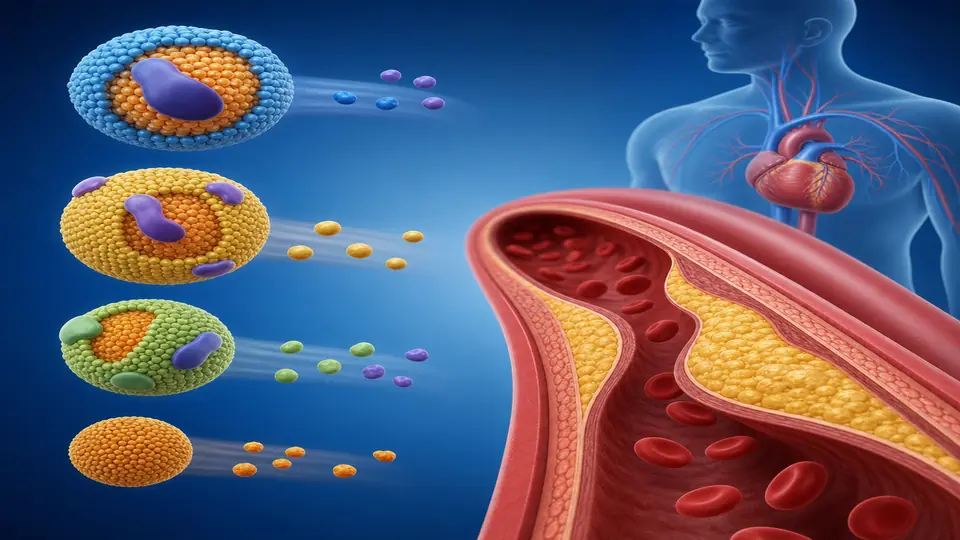
Every atherogenic lipoprotein particle — LDL, VLDL, IDL, and lipoprotein(a) — carries exactly one molecule of apolipoprotein B-100 on its surface. This one-to-one ratio makes ApoB a direct, unambiguous count of the total number of atherogenic particles circulating in the blood.
The mechanism of atherosclerosis requires a lipoprotein particle to penetrate the arterial endothelium. Once inside the subendothelial space, it can become oxidized and trigger the inflammatory cascade that leads to foam cell formation, plaque development, and ultimately plaque rupture. Each individual particle represents one opportunity for this process to occur. More particles means more opportunities — regardless of how much cholesterol each particle carries.
This is the fundamental insight that makes ApoB superior to LDL-C as a risk predictor: it captures the actual atherogenic exposure of the arterial wall.
ApoB and Lp(a)
Lipoprotein(a) — Lp(a) — is a genetically determined, highly atherogenic lipoprotein that standard lipid panels do not measure. It carries one ApoB-100 molecule, meaning elevated Lp(a) contributes to the total ApoB count. This is a partial advantage: ApoB captures Lp(a)‘s particle-level risk contribution, though if Lp(a) elevation is suspected, direct Lp(a) testing remains essential. For any patient with a family history of premature cardiovascular disease, checking Lp(a) separately alongside ApoB is standard of care in progressive preventive medicine practices.
The Evidence: ApoB as a Superior Risk Predictor
Multiple large prospective trials and meta-analyses have established ApoB’s advantage over LDL-C for cardiovascular risk prediction:
The INTERHEART Study — examining risk factors for myocardial infarction in 52 countries — found ApoB/ApoA-1 ratio to be the single strongest lipid-associated risk factor globally, outperforming LDL-C, total cholesterol, and HDL-C.
The Women’s Health Study demonstrated that non-HDL cholesterol and ApoB predicted cardiovascular events more accurately than LDL-C, particularly in women.
Mendelian randomization studies — which use genetic variants as natural experiments to establish causality — have provided unambiguous evidence that ApoB-containing lipoproteins are causally involved in atherosclerosis. Genetic variants that lower ApoB by any mechanism (LDL-C reduction, VLDL reduction, or Lp(a) reduction) proportionally reduce cardiovascular risk.
A 2021 analysis in the European Heart Journal by Sniderman et al. examined matched LDL-C and ApoB values across a large population sample and found that in approximately 25% of cases, risk classification differed between the two biomarkers — with ApoB consistently identifying higher-risk individuals that LDL-C missed.
Who Should Request an ApoB Test?
In integrative and longevity medicine practice, ApoB should be part of the baseline cardiovascular risk assessment for essentially all adult patients. It is particularly important in:
Patients with metabolic syndrome or insulin resistance: The combination of elevated triglycerides, low HDL, central obesity, and elevated fasting glucose is associated with a predominance of small dense LDL particles and frequent LDL-discordance. LDL-C routinely underestimates risk in this population.
Patients with “normal” lipids who have cardiovascular disease or family history: If a parent had a heart attack at 50 with “normal cholesterol,” ApoB and Lp(a) should have been measured. They almost certainly were not.
Patients on statin therapy whose LDL-C is at goal: Achieving an LDL-C of 70 mg/dL does not guarantee adequate particle reduction. Checking ApoB confirms whether particle burden has actually normalized.
Type 2 diabetes and prediabetes: Diabetic dyslipidemia is characterized by elevated VLDL and IDL particles, not just elevated LDL. ApoB captures the full atherogenic burden; LDL-C does not.
Patients pursuing longevity optimization: If extending healthspan is a clinical goal, understanding true cardiovascular risk decades before events occur is foundational. ApoB testing enables aggressive risk stratification and personalized intervention well before LDL-C would trigger concern.
Interpreting ApoB Results: What Are the Targets?
Target values vary by clinical context and risk level:
| Patient Category | ApoB Target |
|---|---|
| Primary prevention (low-moderate risk) | <90 mg/dL |
| Primary prevention (elevated risk — diabetes, hypertension, family history) | <80 mg/dL |
| Secondary prevention (established ASCVD) | <70 mg/dL |
| Very high risk (recent ACS, polyvascular disease) | <60 mg/dL |
| Longevity optimization (proactive) | <70 mg/dL (many longevity physicians target <60) |
The most aggressive targets come from the longevity medicine community, where the goal is not simply to avoid a first cardiovascular event but to minimize cumulative atherosclerotic burden over decades. Emerging evidence from statin and PCSK9 inhibitor trials suggests that lower ApoB is better across the entire range studied, with no lower threshold of benefit identified.
ApoB vs Non-HDL Cholesterol
Non-HDL cholesterol — total cholesterol minus HDL — also captures VLDL and IDL in addition to LDL. It is a reasonable intermediate step between LDL-C and ApoB, and it can be calculated from a standard lipid panel. However, non-HDL still measures cholesterol mass rather than particle number and retains some of LDL-C’s limitations in discordant patients. ApoB remains the more precise tool.
How to Test and What to Ask Your Doctor
ApoB is a single add-on blood test, typically run alongside a standard fasting lipid panel. No special preparation is required beyond the standard overnight fast.
In Germany, ApoB is available through major reference laboratories (LADR, Synlab, Labor Berlin) and can be requested directly. It is not yet part of the standard German health insurance panel (GKV) for primary prevention, but the cost is modest and the clinical information is substantial.
A comprehensive cardiovascular biomarker panel in a functional medicine context might include:
- Standard fasting lipid panel (total cholesterol, LDL-C, HDL-C, triglycerides)
- ApoB (particle count)
- Lp(a) — run once; it is largely genetically fixed
- hsCRP (inflammatory component of cardiovascular risk)
- Fasting insulin and HbA1c (insulin resistance assessment)
- Homocysteine (independent vascular risk factor, addressable with B vitamins)
- Oxidized LDL (when available — reflects actual plaque-forming LDL fraction)
This panel provides a far more complete picture of cardiovascular risk than the standard four-item lipid panel, and it identifies actionable intervention targets across multiple pathways.
What to Do if ApoB Is Elevated
The intervention hierarchy depends on the mechanism driving elevated ApoB:
Dietary and metabolic optimization: Reducing refined carbohydrate and ultra-processed food intake lowers VLDL and triglycerides, which reduces ApoB. Time-restricted eating and ketogenic approaches can lower ApoB meaningfully in insulin-resistant patients. Aerobic exercise — particularly Zone 2 training — improves insulin sensitivity and shifts lipoprotein production toward less atherogenic species.
Statin therapy: Statins remain the most evidence-dense intervention for ApoB reduction. They work primarily by upregulating LDL receptors, increasing hepatic clearance of ApoB-containing particles. The ApoB reduction with high-intensity statins typically ranges from 35–50%.
Ezetimibe: Adds approximately 15–20% ApoB reduction when combined with a statin, or can be used as monotherapy in statin-intolerant patients.
PCSK9 inhibitors: The most powerful ApoB-lowering agents available. Monoclonal antibodies (evolocumab, alirocumab) or the newer small interfering RNA agent inclisiran can reduce ApoB by 50–60% on top of statin therapy. These are increasingly used in high-risk patients who cannot achieve targets with conventional therapy.
Bempedoic acid: A newer lipid-lowering agent that inhibits ATP-citrate lyase, reducing hepatic cholesterol synthesis without direct mitochondrial involvement. Useful in patients with statin-associated muscle symptoms.
Omega-3 fatty acids: At high doses (4 g/day of EPA-only formulations such as icosapentaenoic acid), clinically significant reductions in VLDL-derived ApoB particles and triglycerides have been demonstrated. Icosapent ethyl (Vascepa) reduced cardiovascular events in the REDUCE-IT trial in patients with elevated triglycerides despite statin therapy.
Related Articles
- Understanding Your Blood Panel: What Your Numbers Actually Mean
- Homocysteine: The Overlooked Cardiovascular Biomarker
- Functional Medicine Lab Testing: What to Order and Why
- Metformin for Longevity: Evidence and Clinical Considerations
- Omega-3 Fatty Acids: Dose, Form, and the Evidence for Inflammation
References
- Sniderman AD, et al. “Concordance/discordance between plasma apolipoprotein B and LDL-cholesterol in type 2 diabetes.” European Heart Journal. 2021;42(24):2346–2355. PMID: 33367485
- Yusuf S, et al. “Effect of potentially modifiable risk factors associated with myocardial infarction in 52 countries (the INTERHEART study).” Lancet. 2004;364(9438):937–952. PMID: 15364185
- Ridker PM, et al. “Non-HDL Cholesterol, Apolipoproteins A-I and B100, Standard Lipid Measures, Lipid Ratios, and CRP as Risk Factors for Cardiovascular Disease in Women.” JAMA. 2005;294(3):326–333. PMID: 16030278
- Borén J, et al. “Low-density lipoproteins cause atherosclerotic cardiovascular disease: pathophysiological, genetic, and therapeutic insights.” European Heart Journal. 2020;41(24):2313–2330. PMID: 32052833
- Bhatt DL, et al. “Cardiovascular Risk Reduction with Icosapentaenoic Acid for Hypertriglyceridemia.” NEJM. 2019;380(1):11–22. PMID: 30415628
- Pencina MJ, et al. “Application of New Cholesterol Guidelines to a Population-Based Sample.” NEJM. 2014;370(15):1422–1431. PMID: 24645942
- Hoogeveen RC, Ballantyne CM. “Residual Cardiovascular Risk at Low LDL: Remnants, Lipoprotein(a), and Inflammation.” Clinical Chemistry. 2021;67(1):143–153. PMID: 33418588