| At a Glance | Details |
|---|---|
| Metabolic pathway | CYP3A4 substrate; P-glycoprotein (P-gp) substrate |
| Interaction risk level | Narrow therapeutic index at therapeutic doses; moderate at longevity microdoses |
| Highest-risk inhibitors | Ketoconazole, fluconazole, clarithromycin, verapamil, grapefruit juice |
| Highest-risk inducers | Rifampin, St. John’s Wort, carbamazepine, phenytoin |
| Additive immunosuppression | Cyclosporine, tacrolimus, corticosteroids, other immunosuppressants |
| Supplement caution | Berberine (moderate CYP3A4 inhibition), curcumin, milk thistle (silymarin) |
| Other notable risks | ACE inhibitors (↑ angioedema), live vaccines (↓ response), NSAIDs (↑ nephrotoxicity) |
| Monitoring frequency | CBC, lipid panel, fasting glucose, creatinine/BUN every 3–6 months |
Rapamycin’s renaissance as a longevity agent has placed it in the hands of people who were never studied in its original transplant trials. Those trials generated an extensive pharmacology dossier — one that longevity prescribers and patients need to understand before combining rapamycin with the typical stack of supplements, antibiotics, and common medications.
The core problem is straightforward: rapamycin is almost entirely metabolized by cytochrome P450 3A4 (CYP3A4) in the gut wall and liver, and it is also a substrate of the efflux transporter P-glycoprotein (P-gp). Anything that slows CYP3A4 or blocks P-gp raises systemic rapamycin exposure; anything that accelerates CYP3A4 lowers it. In transplant doses these swings cause rejection or toxicity. At weekly longevity doses the absolute blood-level shifts are smaller, but the interaction mechanisms are identical and the margins are not infinite.
CYP3A4 Inhibitors: Drugs That Raise Rapamycin Levels
When CYP3A4 is inhibited, rapamycin is not broken down at its normal rate. Blood levels rise — sometimes dramatically. The magnitude depends on how potent the inhibitor is and how long it is taken.
Strong inhibitors — avoid or hold rapamycin
Azithromycin (Z-pack): One of the most commonly overlooked interactions in longevity patients. Azithromycin is a moderate-to-strong CYP3A4 inhibitor and P-gp inhibitor. A single 5-day course can increase rapamycin area under the curve (AUC) by 80–150%. Since azithromycin is the most-prescribed antibiotic in outpatient settings, this needs to be on every patient’s interaction card.
Fluconazole and other azole antifungals: Fluconazole is a potent CYP3A4 and CYP2C9 inhibitor. A single-dose fluconazole for a yeast infection (150 mg) can still raise rapamycin trough levels substantially due to its long half-life. Ketoconazole (rarely used now) raises rapamycin AUC by roughly 900%. Itraconazole and voriconazole carry similar warnings. Topical azoles (vaginal, skin) present minimal systemic risk.
Clarithromycin and erythromycin: Macrolide antibiotics. Clarithromycin is a powerful CYP3A4 inhibitor; erythromycin is moderate. Both are commonly used for respiratory infections, H. pylori eradication, and in integrative medicine for biofilm protocols. If either is prescribed during rapamycin use, either pause rapamycin for the course duration plus one week or monitor blood levels and reduce the rapamycin dose.
Verapamil and diltiazem (non-dihydropyridine calcium channel blockers): Both are CYP3A4 and P-gp inhibitors. Patients taking these for hypertension or arrhythmia who start rapamycin need level monitoring. Amlodipine and other dihydropyridines do not carry the same interaction risk.
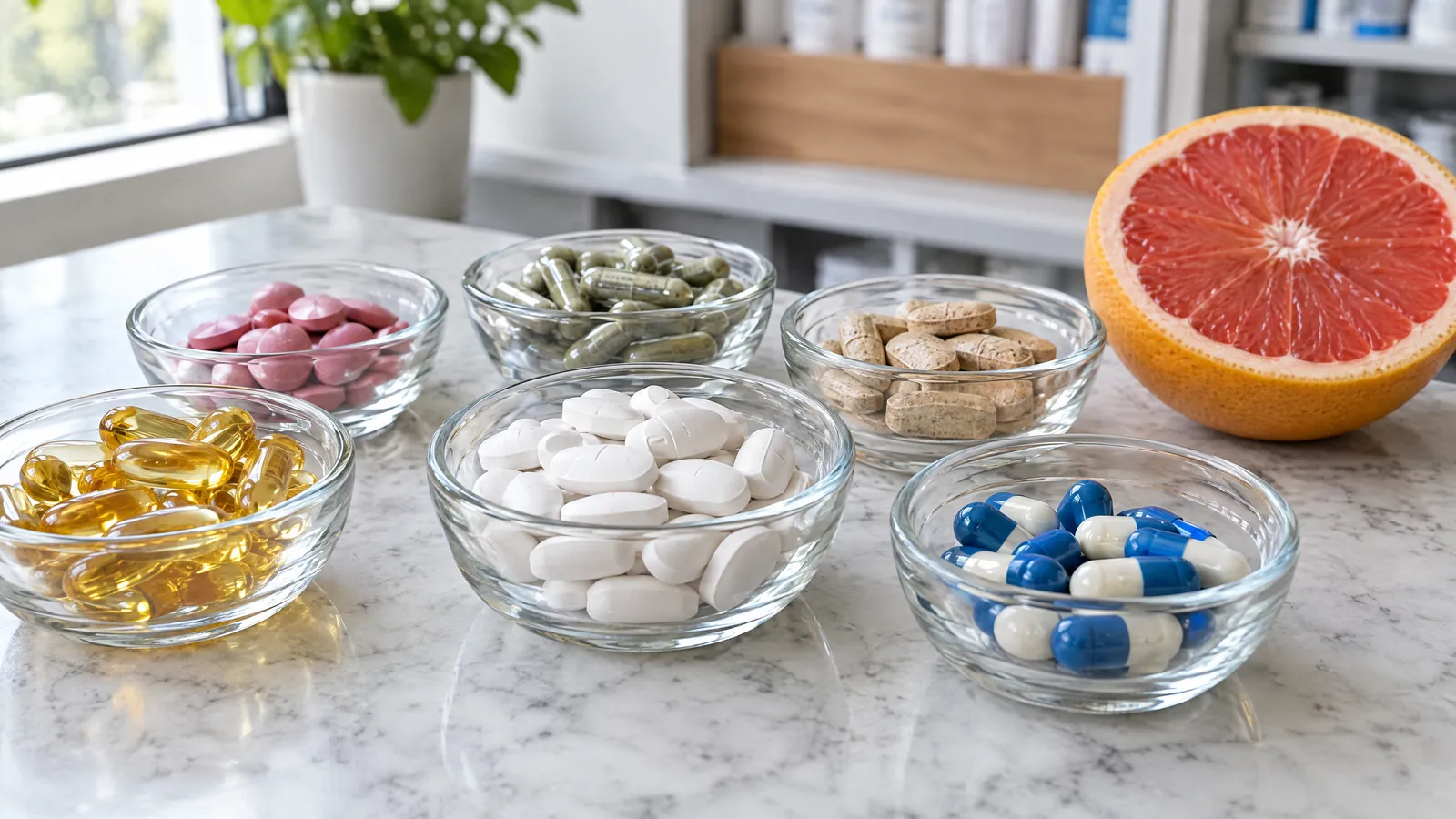
Grapefruit and Seville oranges: Furanocoumarins in grapefruit irreversibly inhibit CYP3A4 in the intestinal wall. The effect lasts up to 24–72 hours per glass. This is not a minor consideration — studies with cyclosporine (a CYP3A4 substrate with similar pharmacokinetics to rapamycin) show 2–3× AUC increases from regular grapefruit consumption.
Moderate inhibitors — use with awareness
- Fluoxetine, fluvoxamine (antidepressants): fluvoxamine is among the stronger inhibitors in clinical practice; fluoxetine is moderate
- Amiodarone: strong combined CYP3A4/2C8 inhibitor; must monitor closely
- Cimetidine (H2 blocker, OTC): moderate inhibitor: ranitidine and famotidine are safer alternatives
- Oral contraceptives containing ethinylestradiol: moderate inhibitory effect in some individuals
CYP3A4 Inducers: Drugs That Lower Rapamycin Levels
Inducers reduce rapamycin blood levels, which matters less for safety but more for efficacy. In transplant settings this leads to rejection; in longevity use it means the weekly dose may not achieve target mTOR inhibition.
Rifampin (rifampicin): The prototypical strong inducer. A 10-day rifampin course drops rapamycin AUC by 60–90%. It is sometimes used in integrative infectiology for Bartonella or biofilm disruption. If used concurrently, rapamycin dosing would need to be substantially increased — a scenario best managed with trough level monitoring.
St. John’s Wort (Hypericum perforatum): A potent inducer of both CYP3A4 and P-gp via pregnane X receptor activation. Widely used for mood support. Studies show 50–70% reductions in immunosuppressant levels. Patients on rapamycin for longevity who also take St. John’s Wort are likely not achieving therapeutic mTOR inhibition.
Carbamazepine, phenytoin, phenobarbital: Anticonvulsants that strongly induce CYP3A4. These are less common in the typical longevity patient demographic but important in anyone with an epilepsy history.
Dexamethasone: Used in Lyme protocols, cancer care, and inflammation. At pharmacological doses it induces CYP3A4 significantly; short bursts are less clinically relevant than sustained courses.
Additive Immunosuppression: Compounding the Risk
Rapamycin inhibits mTORC1, which blunts T-cell proliferation and cytokine signaling. Combining it with other immunosuppressive agents amplifies this effect beyond what either drug achieves alone.
Cyclosporine: Used in organ transplant, psoriasis, and some autoimmune diseases. The interaction is bidirectional: cyclosporine inhibits CYP3A4/P-gp and raises rapamycin levels, while both drugs together increase nephrotoxicity. In transplant settings their combination is carefully timed (12-hour separation) precisely because of mutual level inflation.
Corticosteroids (prednisone, prednisolone, dexamethasone): Additive immunosuppression. Patients on chronic steroids for autoimmune conditions should have this interaction explicitly discussed before rapamycin is started.
Biological immunosuppressants (TNF inhibitors, JAK inhibitors): Not a PK interaction, but a pharmacodynamic one. Adding rapamycin to someone already on biologics creates a degree of immune suppression that is poorly characterized for the longevity context.
Thymosin alpha-1 and low-dose naltrexone (LDN): Used in integrative immunology for immune modulation. The direction of these interactions with rapamycin is complex — thymosin alpha-1 is broadly immune-supportive while LDN upregulates endorphins and TLR signaling. Neither is contraindicated, but the net immune effect of combining them with rapamycin deserves consideration.
ACE Inhibitors and Angiotensin Receptor Blockers
One of the less publicized rapamycin interactions involves ACE inhibitors (lisinopril, ramipril, enalapril) and ARBs (losartan, valsartan). Both drug classes increase risk of angioedema individually; rapamycin has its own angioedema association via bradykinin pathway mechanisms. The combination can amplify this risk. Patients on an ACE inhibitor or ARB should be counseled about angioedema symptoms (throat/tongue/lip swelling) and should not start rapamycin without this conversation.
NSAIDs, Aspirin, and Renal Function
Rapamycin can impair renal tubular function, particularly at higher doses. Non-steroidal anti-inflammatory drugs (ibuprofen, naproxen, diclofenac) reduce prostaglandin-mediated renal blood flow. Their combination with rapamycin is not absolutely contraindicated at longevity doses, but chronic concurrent NSAID use should be avoided. Low-dose aspirin (81–100 mg) for cardiovascular prophylaxis is generally acceptable.
Supplement Interactions — The Gray Zone
Many longevity patients take substantial supplement stacks. Several common supplements interact with CYP3A4:
Berberine: A moderately potent CYP3A4 and CYP2D6 inhibitor, as well as a P-gp inhibitor. Increasingly used for blood sugar regulation, AMPK activation, and as a longevity compound. Combining berberine with rapamycin could raise rapamycin levels by 20–40% based on CYP3A4 inhibition data. The clinical significance at longevity doses is not well studied but warrants awareness.
Curcumin/turmeric (high-dose): At high doses (>1 g/day), curcumin inhibits CYP3A4 and P-gp. Standard supplement doses (200–500 mg turmeric powder) likely present minimal interaction. High-dose curcumin formulations (BCM-95, Meriva, Longvida at gram-level doses) may have a measurable effect.
Milk thistle (silymarin): A mild CYP3A4 inhibitor used for hepatoprotection. Clinically significant interaction is unlikely at standard doses but worth noting in anyone taking multiple CYP3A4-affecting supplements simultaneously.
Piperine (black pepper extract): Enhances bioavailability of many compounds by inhibiting CYP3A4 and P-gp. Often combined with curcumin. The synergy is marketed as a benefit for supplement absorption, but it also applies to rapamycin.
Ginseng (Panax ginseng): Some ginsenosides inhibit CYP3A4 moderately. Clinical significance at standard supplement doses is low but adds to cumulative burden.
Quercetin: At high doses, quercetin inhibits CYP3A4. As a senolytic agent it is taken in pulsed protocols (often 500–1000 mg for 3 days); single-dose pulsing likely creates transient interaction rather than sustained level elevation.
Vaccines and Infection Risk
mTOR inhibition reduces T-cell clonal expansion, which is the mechanism by which vaccines generate immune memory. Studies in transplant recipients (who take rapamycin at far higher doses) show attenuated antibody and T-cell responses to influenza and COVID vaccines. The magnitude of attenuation at weekly 1–5 mg longevity doses is not established but is being actively studied.
Current practical guidance:
- Hold rapamycin for 2–4 weeks before and 2–4 weeks after any vaccine to maximize immune response
- Avoid live attenuated vaccines (MMR, varicella, yellow fever, nasal-spray influenza) during rapamycin use; these are typically contraindicated in immunosuppressed patients
- Discuss timing with the prescribing physician before flu season and any travel immunization schedule
Monitoring Protocol for Rapamycin Users on Concurrent Medications
Patients combining rapamycin with other drugs should establish a monitoring baseline and then test at 3–6 month intervals:
| Parameter | Rationale |
|---|---|
| Complete blood count (CBC) | Rapamycin can cause leukopenia and thrombocytopenia; polypharmacy amplifies this risk |
| Comprehensive metabolic panel | Monitors creatinine (nephrotoxicity signal), glucose, and hepatic function |
| Fasting lipid panel | Rapamycin raises triglycerides and LDL in a dose-dependent manner |
| Rapamycin trough level | Not routinely done in longevity dosing but warranted when a strong CYP3A4 inhibitor or inducer is added |
In transplant medicine, trough rapamycin levels are maintained at 5–15 ng/mL. Longevity dosing protocols typically aim for troughs under 3 ng/mL. Any time a strong CYP3A4 inhibitor is added, checking a trough level within 1–2 weeks is prudent.
Practical Decision Framework for Prescribers
When a longevity patient on weekly rapamycin needs a new medication:
- Check CYP3A4/P-gp liability of the new drug (Lexicomp, Epocrates, or FDA label)
- Strong inhibitor → pause rapamycin for the duration of the course plus one additional week, OR obtain trough level before restart
- Moderate inhibitor for >7 days → reduce rapamycin dose by 25–50% and monitor for side effects
- Strong inducer → consider dose adjustment upward with trough monitoring
- Additive immunosuppression → assess absolute indication and whether rapamycin dose should be reduced or paused
- ACE inhibitor addition → counsel explicitly on angioedema symptoms and have a plan for emergent management
Related Articles
- Rapamycin Contraindications: Who Should Not Take Sirolimus
- Rapamycin Dosage: Pulsed vs Continuous Dosing for Longevity
- Rapamycin Side Effects: What to Expect at Low Doses
- Berberine Blood Sugar Guide: Dosage, Evidence, and Safety
- Rapamycin vs Metformin for Longevity: Mechanisms and Evidence Compared
References
- Zimmerman JJ, Kahan BD. “Pharmacokinetics of sirolimus in stable renal transplant patients after multiple oral dose administration.” J Clin Pharmacol. 1997;37(5):405-415. PMID: 9156373
- Campana C, et al. “Clinically significant drug interactions with cyclosporin. An update.” Clin Pharmacokinet. 1996;30(2):141-179. PMID: 8906896
- Huang W, et al. “Induction of bilirubin clearance by the constitutive androstane receptor (CAR).” Proc Natl Acad Sci USA. 2003;100(7):4156-4161. PMID: 12644704
- Halloran PF. “Immunosuppressive drugs for kidney transplantation.” N Engl J Med. 2004;351(26):2715-2729. PMID: 15616206
- Mannick JB, et al. “mTOR inhibition improves immune function in the elderly.” Sci Transl Med. 2014;6(268):268ra179. PMID: 25540326