

How you start the day influences the next 16 hours. This is not motivational rhetoric — it is physiology. The cortisol awakening response, circadian light exposure, and thermal regulation in the first 90 minutes after waking set the hormonal and neurological tone for the rest of the day.
This is my personal morning protocol. I follow it with approximately 90% consistency (perfection is neither achievable nor necessary). It has evolved over years of clinical practice, self-experimentation, and review of the relevant literature. I share it because patients ask, and because the underlying principles apply broadly.
      Duration
      45-60 min


      Phases
      5 phases


      Supplements
      7 daily
Phase 1: Wake and Light (First 10 Minutes)
What I do: Get outside within 10 minutes of waking. No sunglasses. Five to 15 minutes of natural light exposure, ideally direct sunlight.
Why: Morning light exposure is the most powerful circadian zeitgeber (time-setter). Melanopsin-containing retinal ganglion cells detect blue-spectrum light and signal the suprachiasmatic nucleus (SCN) to suppress melatonin and promote cortisol release. This sets the circadian clock for the next 24 hours, including the timing of evening melatonin onset 14-16 hours later.
The cortisol awakening response (CAR) — a natural 50-100% spike in cortisol within 30-45 minutes of waking — is essential for alertness, immune function, and metabolic activation. Light exposure supports and amplifies this response.
Evidence level: strong (RCTs demonstrate that morning light exposure improves sleep quality, mood, and cortisol rhythm; extensive human data from circadian biology research).
Practical note: In Bavaria, winter mornings are dark until 7:30 or later. When outdoor light is insufficient, I use a 10,000 lux light therapy lamp during breakfast. It is not as effective as sunlight, but it is meaningfully better than indoor lighting alone.
Phase 2: Cold Exposure (Minutes 10-15)
What I do: Two to three minutes of cold water at the end of my shower. Water temperature approximately 10-15 degrees Celsius.
Why: Cold water exposure triggers a significant norepinephrine release (200-300% increase above baseline, sustained for over an hour). Norepinephrine is an alertness neurotransmitter and an immune modulator — it mobilizes NK cells and promotes anti-inflammatory cytokine production.
The controlled study by Buijze et al. (PLoS ONE 2016) demonstrated a 29% reduction in sick days with routine cold showers. Shevchuk (Medical Hypotheses 2008) documented norepinephrine increases and proposed cold exposure as a treatment for depression based on the catecholamine response.
Evidence level: moderate (controlled human studies for norepinephrine response and sick-day reduction; clinical observation for mood and energy effects). The evidence is not at the level of large RCTs, but the risk-benefit profile is favorable — cold showers are free and carry minimal risk for healthy individuals.
What I do not do: Prolonged cold immersion every day. The evidence for extreme cold protocols (ice baths daily, extended cold exposure) is less clear, and there is some evidence that excessive cold exposure can blunt the adaptive response to exercise (Roberts et al., J Physiol 2015). Two to three minutes of cold water is sufficient for the norepinephrine response without the risks of extreme cold.
Phase 3: Hydration (Minutes 15-20)
What I do: 500 mL of water with a pinch of unprocessed salt and a squeeze of lemon, consumed before any food or coffee.
Why: After seven to nine hours of sleep, you are mildly dehydrated. Sodium supports adrenal function and blood pressure regulation in the morning. The lemon is modest — it provides some vitamin C and improves taste. The water itself is the important part.
Evidence level: strong for hydration affecting cognitive function and energy (controlled studies); traditional for salt and lemon additions. I include this not because the evidence for the lemon and salt is overwhelming but because the practice is harmless, low-cost, and my patients report that it helps with morning energy. Physician honesty requires acknowledging that this is partly clinical observation rather than RCT-driven.
Phase 4: Foundational Supplements (With Breakfast)
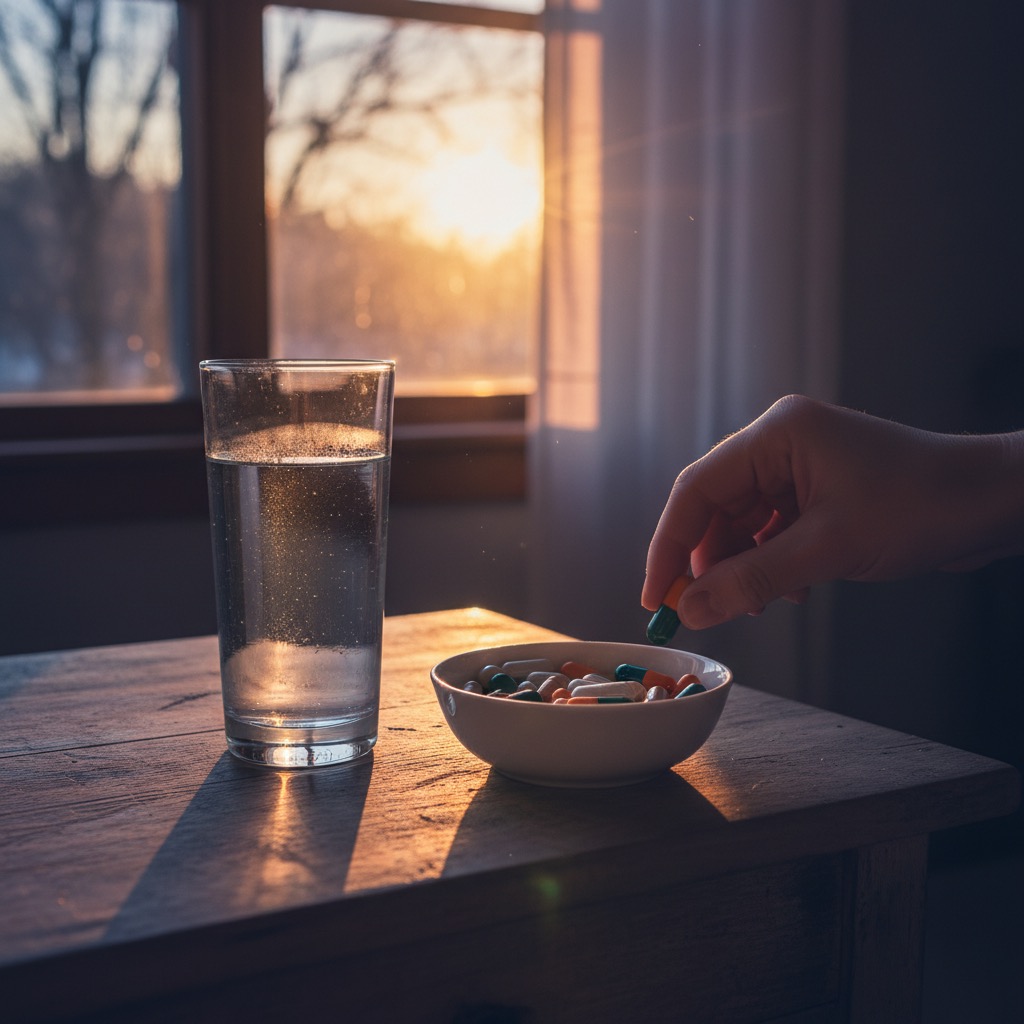
I take the following supplements with my first meal:
Supplement Dose Evidence Level Purpose
Omega-3 (EPA/DHA) 2 g combined EPA/DHA Strong (RCTs, meta-analyses) Anti-inflammatory, cardiovascular, cognitive
Magnesium (bisglycinate) 400 mg (elemental) Strong (RCTs) Muscle function, sleep quality, stress resilience. Taken split: 200 mg AM, 200 mg PM
Zinc (picolinate) 15 mg Strong (RCTs) Immune function, thymic health, enzyme cofactor
Vitamin C 1,000 mg Strong (RCTs) Antioxidant, immune support, collagen synthesis
B complex (methylated) 1 capsule Moderate Methylation support, energy metabolism, homocysteine management
Probiotics (multi-strain) 50 billion CFU Moderate (strain-specific RCTs) Gut-immune axis support
Notes on Specific Choices
Vitamin D with K2: K2 directs calcium to bone rather than soft tissue. The combination is supported by controlled studies showing that K2 prevents the vascular calcification that can accompany high-dose vitamin D supplementation.
Methylated B vitamins: Approximately 30-40% of the population carries MTHFR variants that impair methylation of folic acid and B12. Methylated forms (methylfolate, methylcobalamin) bypass this step. I take methylated forms as a reasonable default, not because I am certain I have an MTHFR variant.
Magnesium bisglycinate: Chosen for absorption and tolerability. Magnesium oxide has approximately 4% bioavailability. Bisglycinate has significantly better absorption and does not cause the gastrointestinal side effects common with citrate at higher doses.
Phase 5: Movement (Minutes 20-45)
What I do: 20-25 minutes of movement before my first clinical appointments. This varies — a walk in nature, bodyweight exercises, or a short gym session depending on the day.
Why: Morning exercise amplifies the cortisol awakening response, enhances cerebral blood flow, promotes BDNF release (supporting cognitive function throughout the day), and improves insulin sensitivity for the meals that follow. The evidence for morning exercise specifically (versus exercise at other times) is moderate but growing.
I do not do intense training every morning. Two to three days per week are higher intensity (resistance training or interval work). The other days are lower intensity (walking, mobility, light cycling). The consistency matters more than the intensity.
What I Do Not Include
Coffee before food. I delay coffee until after breakfast. Morning cortisol is already elevated, and caffeine on an empty stomach can exacerbate the cortisol spike and contribute to adrenal strain over time. The evidence for this specific practice is limited (primarily clinical observation and mechanistic reasoning), but the theoretical rationale is sound.
Elaborate supplement stacks. Many morning protocols I see online include 15-20 supplements. I take seven. Beyond a certain point, adding supplements produces diminishing returns and increases the likelihood of interactions and side effects. More is not better.
Rigid timing. I aim to complete this protocol within 45-60 minutes of waking, but I do not set alarms for each phase. The protocol should serve you, not the reverse.
Adapting This Protocol
This is my protocol, based on my clinical knowledge, my health status, and my goals. Your optimal morning protocol may differ. The principles that generalize well:
- Light exposure within the first hour of waking
- Hydration before caffeine
- A small number of well-chosen, evidence-based supplements
- Some form of movement
The specific supplements should be informed by your lab results and clinical needs. The cold exposure is optional — it is beneficial but not essential, and some patients with thyroid or adrenal dysfunction should approach it cautiously.
Disclaimer: This protocol reflects one physician’s personal practice and is provided for educational purposes. It is not a substitute for individualized medical care. Consult a qualified physician before beginning any new supplement or lifestyle protocol, particularly if you have existing medical conditions.