At a Glance
| Property | Value |
|---|---|
| Evidence Level | Varies by modality (TENS: strong for pain; PEMF: moderate; PBM: moderate and growing) |
| Primary Use | Comparing three distinct non-invasive energy therapies |
| Key Mechanism | Each operates through a fundamentally different biophysical mechanism |
Three Tools, Three Mechanisms, One Confusion
Patients frequently ask me: “Are PEMF, TENS, and red light therapy basically the same thing?” The answer is no — they are fundamentally different in how they work, what they treat, and when to use each one. The confusion is understandable because all three are non-invasive, use some form of energy, and are marketed for overlapping conditions like pain and inflammation.
Let me be direct about what each one actually does and when each is the right tool.
PEMF: Pulsed Electromagnetic Field Therapy
How It Works
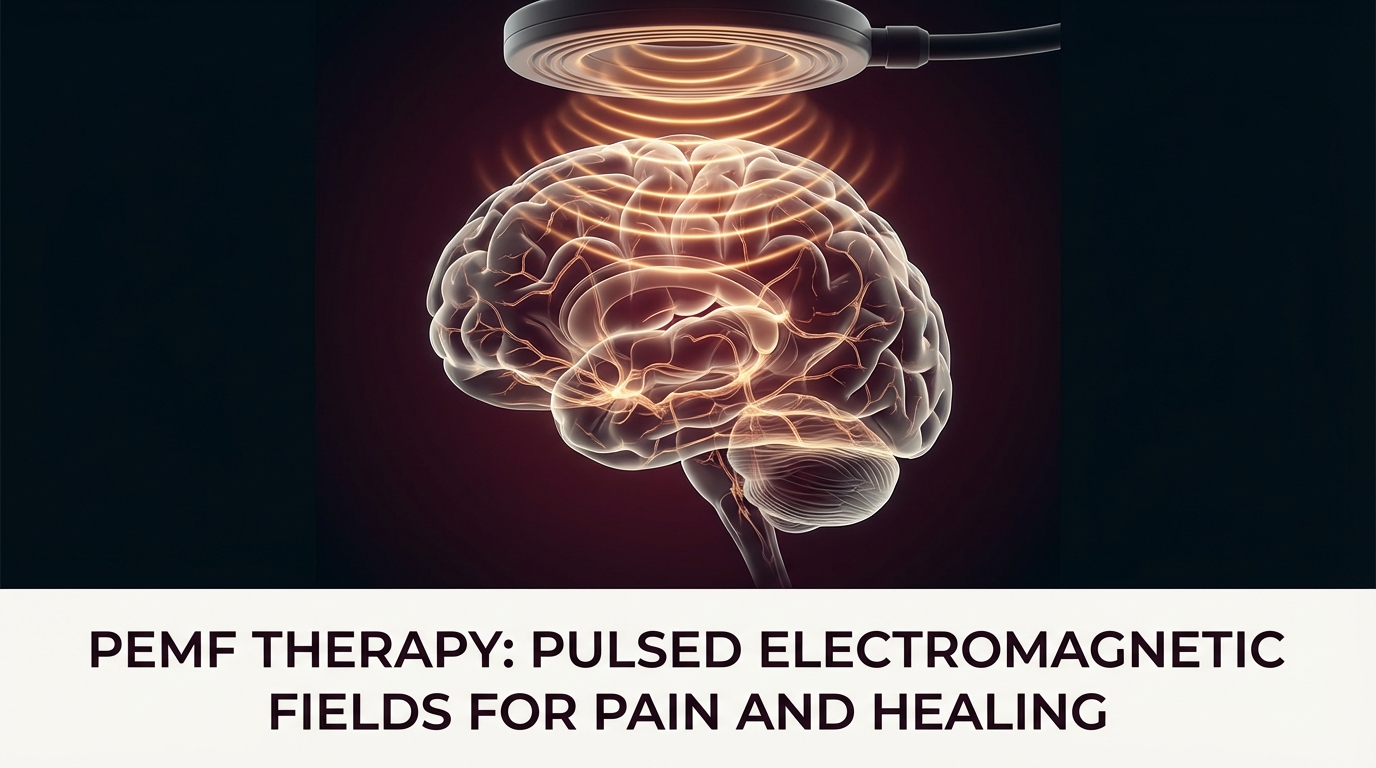
PEMF devices generate time-varying electromagnetic fields that pass through the body non-invasively. Unlike TENS, there is no electrical current through the skin. Unlike light therapy, there are no photons. The therapeutic agent is the electromagnetic field itself.
When a pulsed electromagnetic field passes through tissue, it induces microcurrents in cells through electromagnetic induction (Faraday’s law). These induced currents are far too small to stimulate nerves or cause muscle contraction — but they are sufficient to influence cell membrane potential, voltage-gated calcium channels, and intracellular signaling cascades [1].
The primary biological effects:
- Calcium signaling modulation: PEMF influences calcium channel activity, which regulates gene expression, cell proliferation, and inflammatory mediator production
- Nitric oxide pathway activation: PEMF stimulates endothelial nitric oxide synthase, improving circulation
- Osteoblast stimulation: PEMF promotes bone cell activity — this is the basis for its FDA-cleared indication in non-union fractures
- Inflammatory cytokine reduction: PEMF has been shown to reduce TNF-alpha, IL-1beta, and IL-6 in tissue inflammation models
- Deep tissue penetration: Electromagnetic fields pass through all tissue types, reaching bone, deep muscle, and visceral organs
Evidence Level
- FDA-cleared for bone healing (non-union fractures, post-surgical bone repair): Strong evidence
- Chronic pain: Moderate evidence from multiple RCTs showing benefit for osteoarthritis, fibromyalgia, and chronic low back pain
- Chronic Lyme and chronic fatigue: Emerging evidence; a clinical trial (NCT04577053) is evaluating PEMF for persistent Lyme symptoms
- Depression: One PEMF device (NeoSync) has been evaluated for treatment-resistant depression with promising results
Best For
- Deep tissue inflammation (joint, bone, visceral)
- Non-union fractures and bone healing
- Chronic pain syndromes
- Adjunctive use in chronic inflammatory conditions
- Conditions requiring systemic rather than localized effects
TENS: Transcutaneous Electrical Nerve Stimulation
How It Works
TENS delivers electrical current through electrodes placed on the skin. The mechanism is fundamentally different from PEMF — TENS works by direct electrical stimulation of sensory nerves.
Two primary mechanisms are recognized:
Gate control mechanism (conventional TENS, high frequency 50-120 Hz): Stimulation of large-diameter Abeta sensory fibers “closes the gate” in the spinal cord dorsal horn, preventing pain signals carried by smaller C-fibers and Adelta-fibers from reaching the brain. This is based on the gate control theory of pain proposed by Melzack and Wall in 1965 [2].
Endogenous opioid release (acupuncture-like TENS, low frequency 2-4 Hz): Lower frequency stimulation activates endorphin and enkephalin release in the spinal cord and brainstem, producing pain relief through the body’s own opioid system.
Key distinction: TENS does not heal tissue. It does not reduce inflammation. It does not stimulate cellular repair. It blocks or modulates pain signals. When you turn off the TENS unit, the pain-blocking effect gradually fades.
Evidence Level
- Acute pain management: Strong evidence. TENS is widely used in physiotherapy, post-operative pain management, and labor pain.
- Chronic pain: Moderate evidence. Meta-analyses show modest benefit for chronic musculoskeletal pain, with effect sizes generally smaller than for acute pain.
- Chronic conditions beyond pain: Limited evidence. TENS is not designed for inflammation, tissue repair, or systemic conditions.
Best For
- Acute and chronic pain management (localized)
- Post-surgical pain control
- Labor pain
- Musculoskeletal pain (back pain, knee pain, neck pain)
- Conditions where pain is the primary complaint and tissue healing is not the goal
Red Light Therapy / Photobiomodulation (PBM)
How It Works
Photobiomodulation uses light energy — specifically red (620-700nm) and near-infrared (700-1100nm) wavelengths — to stimulate cellular function through photochemical absorption by mitochondrial chromophores, primarily cytochrome c oxidase.
The mechanism is distinct from both PEMF and TENS:
- No electromagnetic field induction (unlike PEMF)
- No electrical current through tissue (unlike TENS)
- Direct photon absorption by a specific mitochondrial enzyme
- Increased ATP production through enhanced electron transport chain activity
- Reduced oxidative stress through improved mitochondrial efficiency
- Increased BDNF and growth factors through activation of transcription factors
Evidence Level
- Wound healing and skin: Strong evidence
- Musculoskeletal pain: Moderate evidence from multiple RCTs
- Transcranial brain applications: Moderate and growing (TBI, dementia, depression)
- Brain fog and mitochondrial dysfunction: Emerging evidence with strong mechanistic basis
Best For
- Tissue repair and wound healing
- Mitochondrial dysfunction and cellular energy deficits
- Brain fog and cognitive dysfunction (transcranial near-infrared)
- Inflammatory conditions with tissue damage
- Conditions requiring cellular-level repair, not just symptom management

Head-to-Head Comparison
| Feature | PEMF | TENS | Red Light / PBM |
|---|---|---|---|
| Energy type | Electromagnetic field | Electrical current | Photon energy (light) |
| Mechanism | Cell membrane potential, calcium signaling | Nerve stimulation, gate control | Mitochondrial cytochrome c oxidase |
| Tissue penetration | Deep (entire body) | Superficial (skin to nerve) | Moderate (red: 1-3mm; NIR: 3-5cm) |
| Pain relief | Indirect (via inflammation reduction) | Direct (nerve signal blocking) | Indirect (via tissue repair) |
| Tissue healing | Yes (bone, soft tissue) | No | Yes (cellular repair) |
| Anti-inflammatory | Yes (cytokine modulation) | No | Yes (mitochondrial, NF-kB) |
| Brain applications | Limited data | Not applicable | Growing evidence (transcranial) |
| FDA clearances | Bone healing, pain | Pain management | Wound healing, pain |
| Sensation during use | None to mild tingling | Definite tingling/buzzing | Warmth (if any) |
| Home device availability | Yes (variable quality) | Yes (widely available) | Yes (variable quality) |
| Effect duration | Hours to days | Minutes to hours | Cumulative with repeated use |
When to Use Each (and When to Combine)
Use PEMF When:
- Deep tissue is the target (bone, joint, visceral organs)
- Chronic inflammation is the primary problem
- You need whole-body or systemic effects
- Bone healing or soft tissue repair is the goal
- Pain is secondary to an inflammatory condition
Use TENS When:
- Pain management is the immediate priority
- You need rapid, on-demand pain relief
- The underlying tissue damage is being addressed by other means
- Post-surgical or post-procedural pain control
- Musculoskeletal pain without significant inflammation
Use PBM When:
- Mitochondrial dysfunction is suspected or documented
- Brain fog or cognitive symptoms are the primary complaint
- Tissue repair at the cellular level is the goal
- You want to combine anti-inflammatory and pro-repair effects
- Transcranial brain stimulation is indicated
Combining Modalities
In my clinical experience, these modalities are complementary, not competitive. A common combination for a chronic Lyme patient with pain and brain fog:
- PEMF for deep joint inflammation and systemic anti-inflammatory effects
- Transcranial PBM for brain fog and mitochondrial rescue in neurons
- TENS for acute pain management during flares or Herxheimer reactions
This combination addresses pain (TENS), deep inflammation (PEMF), and cognitive dysfunction (PBM) through three non-overlapping mechanisms. There are no known adverse interactions between these modalities when used appropriately.

What I Tell My Patients
Here is what the evidence shows and what I see clinically:
TENS is a pain management tool. It is effective, affordable, and accessible — but it does not heal anything. Think of it as a sophisticated aspirin: it manages the symptom while the body heals.
PEMF is a cellular stimulation tool. It influences cell behavior through electromagnetic fields, promotes healing, and reduces inflammation. The evidence is strongest for bone healing and growing for other applications.
PBM is a mitochondrial rescue tool. It delivers energy directly to the organelle that produces cellular energy. For conditions driven by mitochondrial dysfunction — which includes most post-infectious brain fog — this is the most mechanistically targeted approach.
The mistake I see most often: patients choosing one modality and expecting it to address all their symptoms. Each tool has a specific mechanism, a specific target, and specific strengths. Matching the tool to the problem is what makes the difference.
Safety and Considerations
All three modalities have excellent safety profiles when used appropriately.
PEMF contraindications: Active implanted devices (pacemaker, insulin pump), pregnancy (precautionary), active malignancy in treatment area.
TENS contraindications: Implanted cardiac devices, epilepsy (placement near head/neck), pregnancy (abdominal placement), over areas of impaired sensation.
PBM contraindications: Active malignancy in treatment area, photosensitizing medications, epilepsy (for transcranial pulsed PBM — precautionary).
For all three: start with conservative parameters and titrate up. More is not always better, and excessive stimulation can produce temporary symptom exacerbation.
The Bottom Line
PEMF, TENS, and photobiomodulation are three distinct therapies that work through completely different biophysical mechanisms. They are not interchangeable, and understanding their differences is essential for choosing the right tool. PEMF influences cells through electromagnetic fields — best for deep inflammation and tissue healing. TENS blocks pain signals through electrical nerve stimulation — best for immediate pain relief. PBM rescues mitochondrial function through photon energy — best for cellular repair and brain fog. For complex chronic illness patients, combining all three addresses complementary targets through non-overlapping mechanisms. The right question is not “which one should I use” but “which combination addresses my specific problems.”
References
- Markov MS. Pulsed electromagnetic field therapy: history, state of the art and future. The Environmentalist. 2007;27:465-475. DOI: 10.1007/s10669-007-9128-2.
- Melzack R, Wall PD. Pain mechanisms: a new theory. Science. 1965;150(3699):971-979. PMID: 5320816.
- Hamblin MR. Mechanisms and applications of the anti-inflammatory effects of photobiomodulation. AIMS Biophysics. 2017;4(3):337-361. PMC5523874.
- Johnson MI, et al. Transcutaneous Electrical Nerve Stimulation (TENS) for chronic pain — an overview of Cochrane Reviews. Cochrane Database of Systematic Reviews. 2019. DOI: 10.1002/14651858.CD011890.pub3.