
At a Glance
| Property | Value |
|---|---|
| Evidence Level | Strong (large prospective cohort, 20+ year follow-up, dose-response relationship) |
| Primary Use | Cardiovascular risk reduction, all-cause mortality reduction |
| Key Mechanism | Repeated hemodynamic stress, HSP activation, endothelial function improvement, autonomic conditioning |
Sauna Frequency for Longevity: What the Finnish Data Actually Shows
The question I hear most often about sauna practice is not whether it works — most people who use a sauna regularly already feel the benefits. The question is how often they should go, for how long, and at what temperature to maximize the long-term health effects.
We have unusually good data on this. The Finnish Kuopio Ischemic Heart Disease Risk Factor Study (KIHD) is one of the largest and longest-running studies on sauna use and mortality outcomes ever conducted. It gives us something rare in lifestyle medicine: a dose-response curve for a health practice, with hard endpoints like death — not just surrogate markers.
Here is what the research actually says.
The Landmark Study: Kuopio Ischemic Heart Disease Cohort
Laukkanen and colleagues followed 2,315 middle-aged Finnish men for a median of 20.7 years, tracking their sauna habits and health outcomes. The results, published in JAMA Internal Medicine in 2015, showed one of the clearest dose-response relationships in lifestyle medicine (1):
Frequency and Mortality
| Sauna Frequency | Sudden Cardiac Death Risk | Fatal CVD Risk | All-Cause Mortality Risk |
|---|---|---|---|
| 1x/week (reference) | 1.0 | 1.0 | 1.0 |
| 2-3x/week | 0.78 (22% reduction) | 0.77 (23% reduction) | 0.76 (24% reduction) |
| 4-7x/week | 0.37 (63% reduction) | 0.52 (48% reduction) | 0.60 (40% reduction) |
These numbers are striking. A 63% reduction in sudden cardiac death and a 40% reduction in all-cause mortality with 4-7 sauna sessions per week is a magnitude of effect that rivals some pharmaceutical interventions.
Duration Matters Too
The study also found that session duration was an independent predictor of outcomes. Men who spent more than 19 minutes per session had a 52% lower risk of sudden cardiac death compared to those who spent less than 11 minutes.
The temperature in this cohort was consistent with traditional Finnish sauna practice: 80-100°C dry heat.
Why Frequent Sauna Use Reduces Mortality
The mechanisms are well-characterized and operate through multiple pathways:
Cardiovascular Conditioning
A sauna session produces hemodynamic changes similar to moderate-intensity exercise. Heart rate increases to 100-150 bpm depending on temperature and duration. Cardiac output increases. Blood pressure drops acutely during the session and remains lower for hours afterward. Repeated exposure to this cardiovascular demand improves:
- Endothelial function. The repeated vasodilation trains the endothelium to produce nitric oxide more efficiently, improving vascular compliance.
- Arterial stiffness. Regular sauna use has been shown to reduce arterial stiffness, an independent predictor of cardiovascular events (2).
- Blood pressure regulation. A 2017 follow-up from the KIHD cohort showed that men with the highest sauna frequency had a 46% lower risk of developing hypertension over 24 years of follow-up (3).
Heat Shock Protein Activation
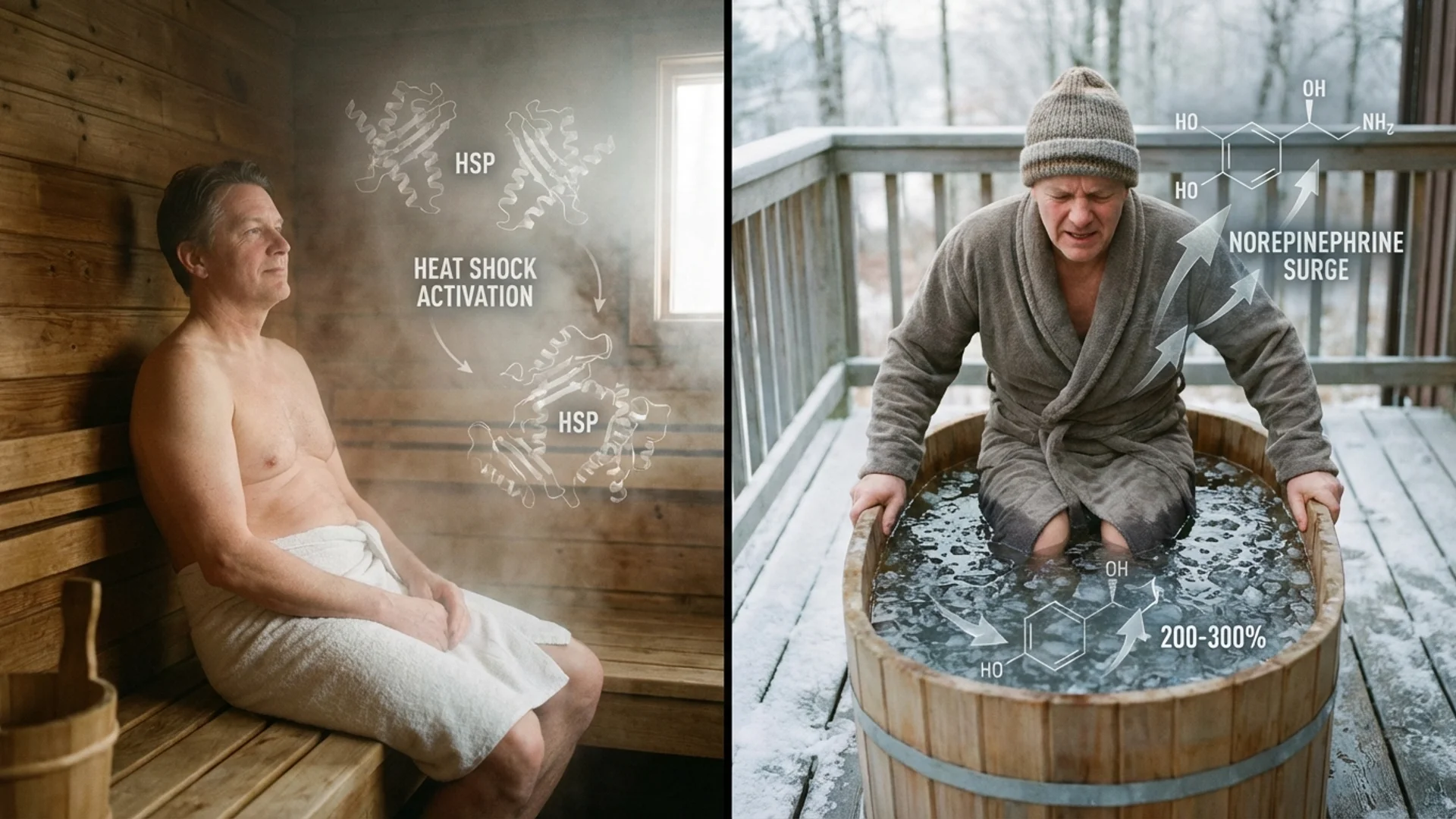
Heat shock proteins — particularly HSP70 and HSP90 — are upregulated in response to thermal stress. These molecular chaperones serve multiple protective functions:
- They protect cells from stress-induced damage by stabilizing protein folding.
- They enhance immune surveillance by presenting antigens to dendritic cells.
- They activate the FOXO3 longevity pathway, which regulates cellular stress resistance, autophagy, and DNA repair.
- They reduce systemic inflammation by suppressing NF-kB signaling.
The HSP response requires adequate thermal stimulus — both temperature and duration matter. A 10-minute session at 60°C does not produce the same HSP activation as a 20-minute session at 80°C.
Autonomic Nervous System Training
Sauna use shifts autonomic balance toward parasympathetic dominance over time. This is measurable as increased heart rate variability (HRV), a robust predictor of cardiovascular health and all-cause mortality. The repeated sympathetic stimulus during the sauna session, followed by parasympathetic recovery afterward, trains the autonomic nervous system in a manner analogous to interval exercise.
Inflammation Reduction
C-reactive protein (CRP), a systemic marker of inflammation, is lower in frequent sauna users. Given that chronic low-grade inflammation is implicated in virtually every age-related disease — cardiovascular disease, neurodegeneration, cancer, metabolic syndrome — this anti-inflammatory effect may be a unifying mechanism behind the broad mortality reduction observed in the Finnish data.
My Recommended Protocol
Based on the KIHD data, the broader sauna literature, and what I observe in clinical practice, here is what I recommend:
Minimum Effective Dose
Frequency: 3-4 sessions per week Temperature: 80°C (176°F) minimum — traditional Finnish sauna Duration: 15-20 minutes per session Hydration: 500 mL water before, 500 mL after each session
This is where the mortality curve bends most sharply in the Finnish data. Going from 1x/week to 4x/week captures the majority of the benefit.
Optimal Protocol (If Sustainable)
Frequency: 4-5 sessions per week Temperature: 80-100°C Duration: 15-25 minutes Post-sauna: Optional cold exposure for contrast therapy benefits
For Sleep Optimization
If you are using sauna specifically to improve sleep — and there is good evidence that it does — the timing matters. Sauna 2-3 hours before bedtime initiates a core body temperature drop that peaks at sleep onset, enhancing melatonin secretion and reducing sleep latency. See my full deep sleep optimization protocol for details.
What About Infrared Saunas?
This is a question I get constantly, and I want to be precise about it.
Traditional Finnish saunas operate at 80-100°C with very low humidity. They heat the air, which then heats your body. This is the modality studied in the KIHD cohort.
Infrared saunas operate at 45-65°C air temperature but deliver radiant heat that penetrates the skin more directly. They produce sweating and cardiovascular effects at lower air temperatures, which many people find more tolerable.
Here is what the evidence shows:
- Infrared saunas do elevate core temperature and produce cardiovascular effects. Beever et al. demonstrated improvements in endothelial function and blood pressure reduction with far-infrared sauna therapy in patients with coronary risk factors (4).
- There are no long-term mortality studies for infrared saunas. The 20-year, hard-endpoint data comes exclusively from traditional Finnish saunas.
- The thermal stimulus is lower. If HSP activation requires a minimum core temperature elevation, infrared saunas may not fully replicate the Finnish sauna effect.
My position: an infrared sauna is better than no sauna. If it is what you have access to, use it — 30-45 minutes, 4-5 times per week, at the highest temperature your unit achieves. But if you have a choice, a traditional sauna at 80°C+ for 15-20 minutes is the evidence-backed standard.
Safety and Who Should Be Cautious
Sauna Is Generally Safe
The Finnish data itself provides reassurance — in a country where sauna use is nearly universal, the mortality data shows benefit, not harm, even at very high frequencies. The risk of adverse events in a healthy adult is low.
Contraindications
- Unstable angina or recent MI. The hemodynamic stress can provoke ischemia.
- Severe aortic stenosis. Impaired ability to increase cardiac output makes the demand dangerous.
- Orthostatic hypotension. The vasodilation combined with standing after a session can cause syncope.
- Pregnancy. Core temperature elevation above 38.9°C during the first trimester is associated with neural tube defects.
- Active infection with fever. Additional thermal stress on an already-febrile body is counterproductive.
Common Mistakes
- Going too short. A 5-minute sauna session is a warmup, not a therapeutic intervention. The cardiovascular and HSP effects require at least 15 minutes.
- Dehydration. Sauna-induced sweating can reach 0.5-1 liter per session. Electrolyte depletion is a real concern with daily use — supplement with sodium, potassium, and magnesium.
- Alcohol. The combination of vasodilation, dehydration, and impaired thermoregulation from alcohol is a genuine safety risk. Finland — the country that knows sauna best — also knows that alcohol-related sauna deaths are preventable tragedies.
The Evidence Gap: Women
The largest limitation of the KIHD cohort is that it enrolled only men. This is a significant gap. Subsequent smaller studies have shown cardiovascular benefits of sauna use in women, and the physiological mechanisms should apply regardless of sex, but the magnitude of the dose-response relationship specifically in women remains less well-characterized.
A 2018 follow-up study from the same group included women and confirmed that the cardiovascular benefits extended to both sexes, though the sample size was smaller and follow-up duration shorter. More data is needed.
The Bottom Line
The Finnish sauna data is among the most compelling evidence for any single lifestyle intervention in longevity medicine. Four or more sauna sessions per week, at 80°C or above, for 15-20 minutes each, is associated with a 40% reduction in all-cause mortality and a 63% reduction in sudden cardiac death over 20 years. This is a practice with a long safety track record and a clear dose-response relationship. The evidence is strong — and it is the kind of evidence I pay attention to when advising patients.
References
-
Laukkanen T, Khan H, Zaccardi F, Laukkanen JA. Association between sauna bathing and fatal cardiovascular and all-cause mortality events. JAMA Internal Medicine. 2015;175(4):542-548. doi:10.1001/jamainternmed.2014.8187
-
Lee E, Laukkanen T, Kunutsor SK, et al. Sauna bathing and systemic inflammation markers: a prospective cohort study. European Journal of Epidemiology. 2019;34(6):599-606. doi:10.1007/s10654-019-00512-z
-
Zaccardi F, Laukkanen T, Willeit P, et al. Sauna bathing and incident hypertension: a prospective cohort study. American Journal of Hypertension. 2017;30(11):1120-1125. doi:10.1093/ajh/hpx102
-
Beever R. Far-infrared saunas for treatment of cardiovascular risk factors: summary of published evidence. Canadian Family Physician. 2009;55(7):691-696. PMID:19602651