At a Glance
| Property | Value |
|---|---|
| Evidence Level | Emerging |
| Primary Use | Identifying mold exposure source and body burden |
| Key Mechanism | Urine mycotoxins measure internal biotoxin load; ERMI measures environmental mold species diversity |
Which Mold Test Do You Actually Need?
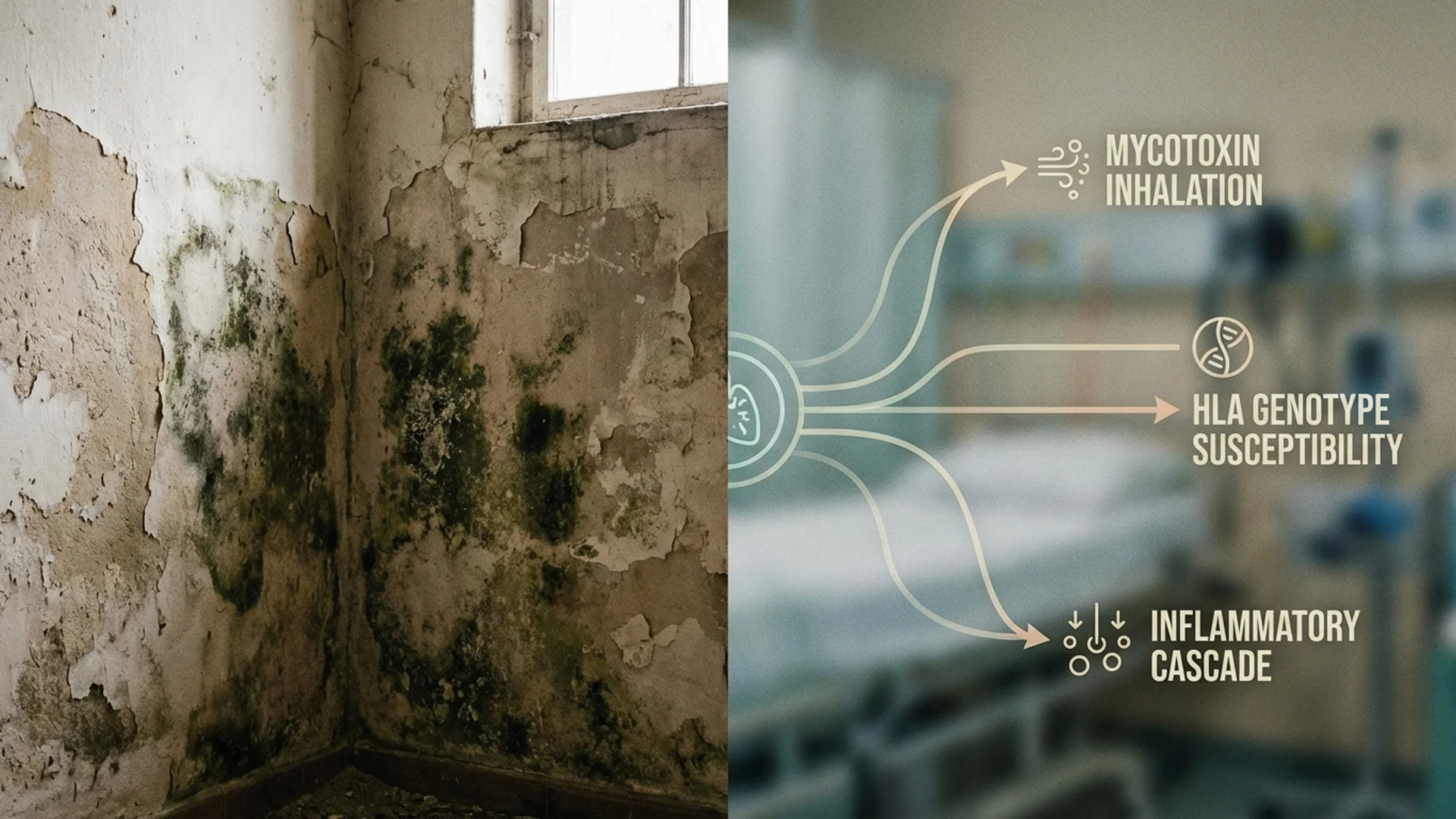
You suspect mold is making you sick. Maybe you have CIRS symptoms or your doctor has suggested biotoxin illness. Your next step is testing — but the options are confusing. Urine mycotoxin panels. ERMI dust testing. Air sampling. Each costs money and time, and not all of them answer the question you are actually asking.
Here is how I think about it: there are two fundamentally different questions in mold evaluation.
Question 1: Is there mold toxin in my body? (Body burden testing) Question 2: Is there mold in my environment? (Environmental testing)
The answer to one does not answer the other. A positive urine mycotoxin test does not tell you where the exposure is coming from. A positive ERMI does not tell you whether the mold in your building is actually making you sick. You often need both.
Body Burden Testing: Urine Mycotoxins
What It Measures
Urine mycotoxin panels detect specific mycotoxins (toxic metabolites produced by mold) that have been absorbed by your body and are being excreted in urine. The most commonly tested mycotoxins include:
- Ochratoxin A (OTA) — produced by Aspergillus and Penicillium species; nephrotoxic, immunosuppressive
- Aflatoxin — produced by Aspergillus flavus and A. parasiticus; hepatotoxic, carcinogenic
- Trichothecenes — produced by Stachybotrys (black mold), Fusarium; immunosuppressive, cytotoxic
- Gliotoxin — produced by Aspergillus fumigatus; immunosuppressive
- Mycophenolic acid — produced by Penicillium species; immunosuppressive
- Citrinin — produced by Penicillium citrinum; nephrotoxic
- Chaetoglobosin A — produced by Chaetomium species; cytotoxic
- Zearalenone — produced by Fusarium; estrogenic
The Major Laboratories
RealTime Laboratories (RTL):
- Uses ELISA (enzyme-linked immunosorbent assay)
- Tests for trichothecenes, aflatoxins, ochratoxin A, gliotoxin, zearalenone, chaetoglobosin A, mycophenolic acid
- Most widely used in the functional medicine community
Great Plains Laboratory (now Mosaic Diagnostics):
- Uses LC-MS/MS (liquid chromatography-tandem mass spectrometry)
- Generally considered more analytically precise than ELISA
- Tests for 11 mycotoxins
Vibrant Wellness:
- Uses LC-MS/MS
- Includes additional mycotoxins
- Newer entrant to the market
The Provocation Debate
Here is where the controversy begins. Mycotoxins are lipophilic — they are stored in fat tissue, not freely circulating in blood or urine. Some clinicians argue that a baseline (unprovoked) urine sample may show falsely low levels because the mycotoxins are sequestered in adipose tissue.
The provocation protocol involves:
- Glutathione (500-1000mg IV or liposomal) — mobilizes mycotoxins from storage
- Sauna session (20-30 minutes) — promotes toxin release through sweat and mobilization
- Collect urine within 4-12 hours of provocation
Proponents argue that provoked testing is more sensitive. Critics argue that it introduces variables and can produce false positives by detecting trivial amounts of mycotoxin from dietary sources (ochratoxin A is found in coffee, wine, and grains; aflatoxins in peanuts and corn).
What I tell my patients: I typically start with an unprovoked urine sample. If it is positive, we have our answer. If it is negative but clinical suspicion remains high (positive CIRS symptom checklist, susceptible HLA-DR genotype), a provoked retest may be warranted.
Limitations of Urine Mycotoxin Testing
Let me be honest about the limitations:
- Dietary mycotoxin contamination can produce positive results that do not reflect building exposure. OTA from coffee, aflatoxins from peanuts, and trichothecenes from grain products can be detected in urine.
- Timing sensitivity — mycotoxin excretion varies with recent exposure, detoxification activity, and kidney function
- No standardized reference ranges — laboratories set their own cutoffs
- ELISA vs. LC-MS/MS discrepancies — the two methodologies do not always agree
- A negative result does not exclude mold illness — some patients store mycotoxins efficiently and excrete poorly, particularly those with HLA-DR susceptibility and impaired detoxification

Environmental Testing: ERMI and Beyond
ERMI (Environmental Relative Moldiness Index)
What it is: A DNA-based test developed by the EPA that identifies 36 mold species in dust samples using MSQPCR (mold-specific quantitative PCR). It compares the relative abundance of 26 water-damage-indicator species against 10 common outdoor mold species to produce a single index score [1].
How it works:
- Dust sample collected from a Swiffer-type cloth rubbed across specified areas
- DNA extracted and analyzed for 36 target species
- ERMI score calculated: higher score = greater water-damage indicator species
Score interpretation:
- ERMI < -1: Low mold burden
- ERMI -1 to 5: Moderate
- ERMI > 5: High mold burden — strongly associated with water damage
- HERTSMI-2 (a subset scoring system using the 5 most clinically relevant species) < 11: Generally acceptable for CIRS patients
The EPA Warning: The EPA itself states that ERMI was developed as a research tool for large population studies and “was not designed to be used to assess the mold conditions in individual homes” [1]. This is important context. The ERMI is useful, but it was never intended as a definitive diagnostic for individual buildings. Interpreting an ERMI score requires clinical context — not just the number.
HERTSMI-2
A simplified version of ERMI developed by Shoemaker that scores only the five mold species most associated with CIRS:
- Aspergillus penicillioides
- Aspergillus versicolor
- Chaetomium globosum
- Stachybotrys chartarum
- Wallemia sebi
HERTSMI-2 score < 11 is the target for CIRS patients re-entering remediated buildings. This simplified metric is more clinically actionable than the full ERMI.
Air Sampling
Traditional air sampling (spore trap testing) involves drawing a measured volume of air through a collection device, then counting mold spores under a microscope.
Limitations of air sampling:
- Snapshot in time — mold spore release varies by hour, humidity, air movement, and disturbance
- Species identification is limited — many spores look similar under microscopy; Stachybotrys spores are often not airborne (they are heavy and sticky)
- Misses mycotoxins — air sampling counts spores, not toxins. A building can have low spore counts but high mycotoxin levels
- A normal air sample does not exclude mold — it may simply mean spores were not airborne at the moment of testing
In our clinical experience, air sampling alone is the least reliable mold assessment method. I have seen patients with clearly water-damaged buildings and severe CIRS symptoms whose air samples came back “normal” — because Stachybotrys was growing behind the wall and not releasing spores into the living space.
EMMA (Environmental Mold and Mycotoxin Assessment)
A newer option that combines dust DNA analysis (like ERMI) with direct mycotoxin measurement from dust samples. This bridges the gap between species identification and actual toxin production.
The Evidence
What We Know
The ERMI was validated through the EPA’s HUD American Healthy Homes Survey, which analyzed dust samples from over 1,000 homes across the United States [1]. This large-scale dataset established reference distributions for ERMI scores by region.
Urine mycotoxin testing methodology has been validated for specific mycotoxins using LC-MS/MS technology, though the clinical interpretation of results remains debated. A 2019 study found that 93% of patients with CIRS had detectable urinary mycotoxins compared to 30% of healthy controls — though the authors noted that dietary contribution could not be excluded [2].
What I See in Practice
In our clinical experience, the most informative approach is combined testing:
- ERMI or HERTSMI-2 from the home/workplace — establishes whether the environment is a plausible source
- Urine mycotoxin panel (unprovoked first) — establishes whether body burden is present
- If both are positive — the environmental source is confirmed and remediation is indicated
- If urine is positive but ERMI is low — consider workplace, car, school, or other environments as the exposure source
- If ERMI is high but urine is negative — consider provoked retesting, or recognize that some individuals clear mycotoxins efficiently (non-HLA susceptible)
Practical Application
Testing Strategy by Clinical Scenario
Scenario 1: Suspected mold illness, unknown source
- Start with ERMI/HERTSMI-2 of primary residence
- Simultaneously obtain urine mycotoxin panel
- If home ERMI is low, test workplace/office
Scenario 2: Known water damage history, symptoms present
- ERMI/HERTSMI-2 to quantify current mold burden
- Professional visual inspection of areas with known moisture history
- Urine mycotoxins to establish body burden
- CIRS biomarker panel to assess inflammatory status
Scenario 3: Post-remediation clearance testing
- HERTSMI-2 < 11 is the re-entry target for CIRS patients
- Repeat 2-4 weeks after remediation completion
- Include areas that were not directly remediated (mold can spread through HVAC systems)
Scenario 4: Monitoring treatment progress
- Urine mycotoxin retesting every 3-6 months during treatment
- Expect gradual decline in detectable mycotoxins during cholestyramine binding
- Persistent or rising levels suggest ongoing exposure despite remediation

Safety and Considerations
- Do not rely on air sampling alone to rule out mold. It is the least sensitive environmental testing method.
- ERMI results vary by sampling location within the home. Follow standardized collection protocols for reproducible results.
- Urine mycotoxin results can be influenced by recent diet. Consider a 48-hour low-mycotoxin diet before testing (avoid coffee, wine, peanuts, corn products, dried fruits).
- Environmental remediation should be performed by IICRC-certified professionals, not general contractors. Improper remediation can worsen exposure.
- Do not begin aggressive detoxification therapy (cholestyramine, sauna) while still living in a contaminated environment. You are binding toxins while being re-exposed — a futile cycle.
- Home mold test kits sold at hardware stores (settle plates) are essentially useless for clinical decision-making. They grow whatever lands on them and provide no quantification or species identification.
The Bottom Line
Mold testing requires answering two separate questions: is the toxin in your body, and is the source in your environment? Urine mycotoxin testing (body burden) and ERMI/HERTSMI-2 (environmental) are complementary, not interchangeable. Air sampling is the weakest tool in the kit. The best clinical strategy combines environmental DNA-based testing with urine mycotoxin analysis, interpreted in the context of CIRS symptom presentation, HLA-DR genotype, and biomarker findings. And remember the EPA’s own caveat: no single test is designed to be the definitive answer. Clinical judgment, combined with systematic testing, guides the diagnosis.
References
- United States Environmental Protection Agency. Mold: should I test or sample for mold in my home using the ERMI or similar tests? EPA.gov. Updated 2024.
- Hooper DG, Bolton VE, Guilford FT, Straus DC. Mycotoxin detection in human samples from patients exposed to environmental molds. Int J Mol Sci. 2009;10(4):1465-1475. PMID: 19468319
- Shoemaker RC, House D. Sick building syndrome (SBS) and exposure to water-damaged buildings: time series study, clinical trial and mechanisms. Neurotoxicol Teratol. 2006;28(5):573-588. PMID: 17010568
- Vesper SJ, McKinstry C, Haugland RA, et al. Development of an Environmental Relative Moldiness Index for US homes. J Occup Environ Med. 2007;49(8):829-833. PMID: 17693779