
At a Glance
| Property | Value |
|---|---|
| Evidence Level | Strong (decades of research, well-characterized sensitivity/specificity) |
| Primary Use | Comparing the two standard serological tests for Lyme disease |
| Key Mechanism | ELISA measures total antibody response; Western Blot identifies antibodies to specific Borrelia proteins |
How Each Test Works
ELISA (Enzyme-Linked Immunosorbent Assay)
The ELISA is the screening test — the first step in the two-tier algorithm. It works by coating a plate with Borrelia antigens (whole-cell lysate or the recombinant C6 peptide in newer versions), adding the patient’s serum, and detecting any antibodies that bind using an enzyme-linked color reaction.
What it tells you: A quantitative measure of total antibody reactivity to Borrelia. Results are reported as a value compared to a cutoff — positive, equivocal, or negative.
Strengths:
- Automated, high-throughput, fast (results in hours)
- Inexpensive
- Good specificity when used as a screening step (96-99%)
- The C6 ELISA (targeting the VlsE C6 peptide) has improved sensitivity over whole-cell lysate ELISAs
Weaknesses:
- Sensitivity is limited in early disease (35-50% in first 2 weeks)
- Cross-reactivity with other spirochetal infections (syphilis, relapsing fever Borrelia)
- Does not distinguish active from past infection
- Different ELISA manufacturers produce different results for the same sample
Western Blot (Immunoblot)
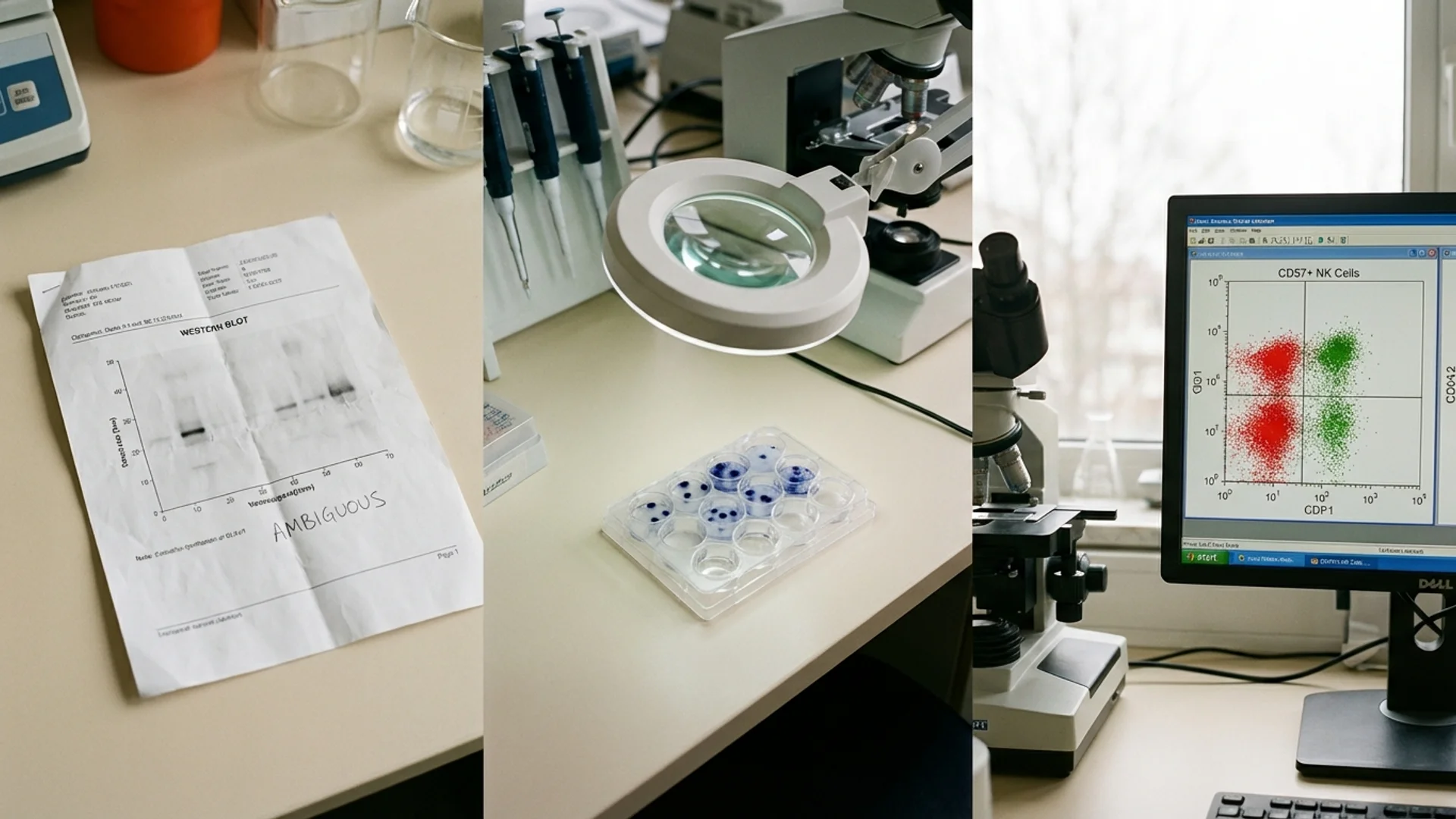
The Western Blot separates Borrelia proteins by molecular weight on a gel strip and then exposes the strip to the patient’s serum. Antibodies in the serum bind to specific protein bands, which are visualized. Each band corresponds to a specific Borrelia protein.
What it tells you: Which specific Borrelia proteins the patient’s immune system has generated antibodies against.
CDC interpretation criteria:
IgM Western Blot (useful in first 4 weeks):
- Positive if 2 of 3 bands are present: 23 kDa (OspC), 39 kDa (BmpA), 41 kDa (Fla)
- Only valid in first 4 weeks of illness (IgM alone after 4 weeks is not diagnostic)
IgG Western Blot (useful after 4 weeks):
- Positive if 5 of 10 bands are present: 18, 23, 28, 30, 39, 41, 45, 58, 66, 93 kDa
Strengths:
- Higher specificity than ELISA (identifies antibodies to specific Borrelia proteins)
- Provides more information than a single number — the specific band pattern can be informative
- Some bands are highly specific to Borrelia (23 kDa/OspC, 31 kDa/OspA, 34 kDa/OspB, 39 kDa/BmpA)
Weaknesses:
- Only performed if ELISA is positive (under standard algorithm)
- Subjective interpretation (band reading can vary between laboratories and readers)
- The 41 kDa band (flagellin) cross-reacts with other spirochetes and even other bacteria — it is sensitive but not specific
- The CDC criteria for “positive” are conservative — designed for surveillance, not clinical diagnosis
Sensitivity Comparison by Disease Stage
| Disease Stage | ELISA Sensitivity | Western Blot IgM | Western Blot IgG | Two-Tier Combined |
|---|---|---|---|---|
| Early localized (<2 weeks) | 30-40% | 25-40% | 10-20% | 29-40% |
| Early localized (2-4 weeks) | 50-70% | 50-70% | 30-50% | 40-60% |
| Early disseminated | 70-85% | 60-80% | 60-80% | 64-75% |
| Late Lyme | 85-95% | Variable | 80-95% | 87-97% |
Source: Compiled from multiple meta-analyses including Leeflang et al. (2016) and Waddell et al. (2016) [1, 2].
The key takeaway: in early disease, when treatment is most critical, the combined two-tier sensitivity is approximately 40-60%. That means 40-60% of early Lyme patients receive a correct positive result, and 40-60% receive a false negative.

The Band Controversy
Not all Western Blot bands are created equal. Some are highly specific to Borrelia burgdorferi:
- 23 kDa (OspC): Outer surface protein C — highly specific to Borrelia
- 31 kDa (OspA): Outer surface protein A — very specific, but may be absent in later stages (OspA is downregulated after tick transmission)
- 34 kDa (OspB): Highly specific to Borrelia
- 39 kDa (BmpA): Specific to Borrelia
And some are less specific:
- 41 kDa (Flagellin): Present in many flagellated bacteria — the least specific band
- 58 kDa, 66 kDa: Moderately specific
The clinical controversy: The CDC’s 5-of-10 criterion for IgG positivity was designed for high specificity in surveillance. Some Lyme-literate physicians argue that the presence of even 2-3 Borrelia-specific bands (such as 23, 31, and 39 kDa) in a clinically compatible patient should be considered significant — even if the strict 5-of-10 criterion is not met.
In my clinical experience, I have treated many patients with 3-4 Borrelia-specific bands on IgG Western Blot who did not meet the CDC 5-of-10 criterion but who had clear clinical Lyme disease and responded to appropriate treatment. The rigid application of surveillance criteria to individual clinical decisions is, in my view, a disservice to patients.
Modified Two-Tier Testing (MTTT)
In 2019, the FDA cleared a modified two-tier testing algorithm that replaces the Western Blot with a second ELISA. The MTTT uses:
- First tier: Standard ELISA (whole-cell lysate or C6)
- Second tier: A different ELISA targeting a different antigen set (typically VlsE/C6 combined with C10 peptide)
Advantages of MTTT:
- Faster (both tests are automated ELISAs — no manual Western Blot reading)
- Improved sensitivity in early infection (some studies show 10-15% improvement over traditional two-tier)
- Reduced subjectivity (no manual band reading)
- Lower cost
Limitations:
- Still antibody-dependent (same window period problem)
- Less information than Western Blot (no individual band data)
- Not yet universally adopted
The Evidence
What We Know (Human Data)
The limitations of standard two-tier testing are thoroughly documented:
- Wormser et al. documented that 10% of culture-confirmed Lyme cases were seronegative on both ELISA and Western Blot
- The meta-analysis by Leeflang et al. (2016) quantified the early sensitivity gap across European and American studies [1]
- The MTTT has been evaluated in multiple studies showing equivalent or improved performance compared to traditional two-tier, with the greatest gains in early disease detection
What I See in Practice
In our hospital, we use a multi-modal testing approach rather than relying solely on the standard two-tier algorithm:
- Standard ELISA and Western Blot (required for baseline documentation)
- C6 ELISA (improved sensitivity for early Lyme)
- iSpot Lyme / ELISpot (T-cell based — detects cellular immunity when antibodies are absent)
- Specialty laboratory panels (expanded Western Blot with additional bands including 31 and 34 kDa)
This multi-modal approach catches a significantly higher proportion of true Lyme cases than the standard two-tier algorithm alone.
What I tell my patients: the standard two-tier test is like a security system that only checks for one type of badge. If you have that badge, it lets you through. But if the infection has not produced that particular badge yet — or your immune system is not making badges efficiently — you get turned away even though you belong inside. We use additional tests that check for different kinds of badges.
Practical Application
Which Test to Request
| Clinical Scenario | Recommended Testing |
|---|---|
| Acute tick bite with EM rash (<2 weeks) | Clinical diagnosis. Test at 4-6 weeks for seroconversion documentation. |
| Suspected early Lyme (2-6 weeks) | C6 ELISA + IgM Western Blot. Consider ELISpot. |
| Suspected late/chronic Lyme | Standard two-tier (ELISA + IgG Western Blot) + expanded band WB + ELISpot |
| Previous negative testing, persistent symptoms | Repeat testing at 4-6 weeks. Add ELISpot. Consider specialty lab. |
| Post-treatment, monitoring | Clinical response is primary. Serology does not distinguish active vs. past. |
Reading Your Western Blot
If you have a Western Blot result, look for:
- The total number of positive bands (IgM and IgG separately)
- Which specific bands are positive — Borrelia-specific bands (23, 31, 34, 39 kDa) are more meaningful than non-specific bands (41 kDa)
- Whether the pattern is consistent with your clinical picture and exposure history

Safety and Considerations
Both tests require a standard blood draw. The risk is not physical but diagnostic: an incorrect test result (false negative or false positive) can have significant consequences for the patient’s treatment trajectory.
False negatives lead to delayed or absent treatment. False positives lead to unnecessary antibiotic courses. Neither is acceptable. The solution is not to abandon testing but to use it correctly — as one component of a comprehensive clinical evaluation that includes exposure history, symptom pattern, physical findings, and clinical judgment.
The Bottom Line
ELISA and Western Blot are complementary tools with different strengths and limitations. ELISA screens broadly but misses up to 50% of early cases. Western Blot confirms with higher specificity but is only performed when ELISA is positive — creating a bottleneck that systematically misses patients. The two-tier algorithm was designed for epidemiological surveillance, not individual clinical diagnosis. For patients with suspected Lyme disease, understanding these limitations is essential for advocating for appropriate testing and interpreting results in the context of the full clinical picture.
References
- Leeflang MM, et al. The diagnostic accuracy of serological tests for Lyme borreliosis in Europe: a systematic review and meta-analysis. BMC Infectious Diseases. 2016;16:140. PMC4818439.
- Waddell LA, et al. The Accuracy of Diagnostic Tests for Lyme Disease in Humans: A Systematic Review and Meta-Analysis of North American Research. PLoS One. 2016;11(12):e0168613. PMC5176313.
- Branda JA, et al. Advances in Serodiagnostic Testing for Lyme Disease Are at Hand. Clinical Infectious Diseases. 2018;66(7):1133-1139. PMID: 29228208.