A standard blood count tells you how many white blood cells you have. It does not tell you what kinds they are, whether they are functioning properly, or what state they are in. This is like knowing how many soldiers are in an army without knowing whether they are infantry, medics, or commanders — and whether any of them are actually capable of fighting.
Immune profiling fills this gap. It provides a detailed map of the immune system’s composition and, with functional assays, its operational capacity. For patients with chronic infections, autoimmune disease, recurrent illness, or unexplained fatigue, immune profiling frequently reveals abnormalities that explain the clinical picture and guide treatment.
Lymphocyte Subset Panel
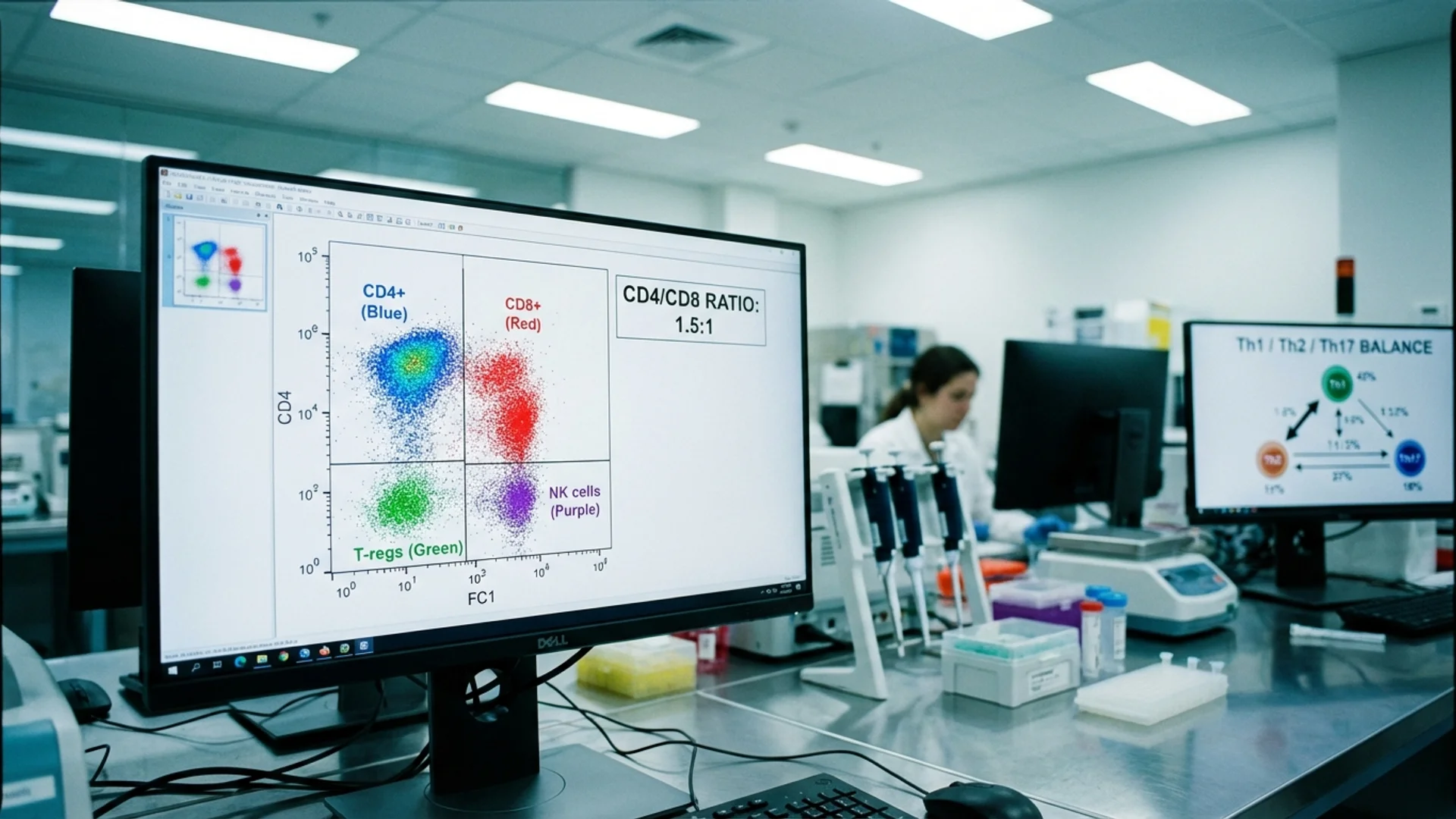
Flow cytometry allows precise identification and quantification of immune cell populations based on their surface markers. The standard lymphocyte subset panel includes:
T Cells (CD3+)
Helper T cells (CD3+CD4+) coordinate the immune response. Low CD4 counts indicate immune deficiency (as seen in HIV/AIDS, but also in chronic infections, malnutrition, and some autoimmune conditions). The normal range is approximately 500-1,500 cells/mcL.
Cytotoxic T cells (CD3+CD8+) directly kill infected or abnormal cells. Elevated CD8 counts may indicate active viral infection or chronic immune activation.
CD4/CD8 ratio is a key indicator of immune balance. Normal ratio is approximately 1.0-2.5. An inverted ratio (below 1.0) suggests chronic viral infection, immune exhaustion, or aging-related immune dysfunction. A markedly elevated ratio (above 3.0) may be seen in autoimmune conditions.
Regulatory T cells (CD4+CD25+FoxP3+) suppress excessive immune responses. Low Treg numbers or function are associated with autoimmune disease and chronic inflammation. Testing regulatory T cells is not universally available but is increasingly recognized as clinically important.
B Cells (CD19+ or CD20+)
B cells produce antibodies. Their numbers can be elevated in autoimmune conditions and chronic infections, or depleted in immunodeficiency states and after certain cancer treatments (rituximab).
NK Cells (CD3-CD56+)
Natural killer cells are critical for viral defense and cancer surveillance. Their numbers and, more importantly, their functional activity provide information about the immune system’s capacity for surveillance.
NK cell count — normal range approximately 100-400 cells/mcL. Low counts are associated with chronic infections and increased cancer risk.
NK cell cytotoxicity assay — measures actual killing capacity against target cells. This functional test is more clinically relevant than counts alone. A patient can have normal NK cell numbers but impaired cytotoxicity.
CD57+ NK cells — as discussed in the Lyme disease context, this subset is used by Lyme-literate physicians as a marker of chronic Lyme disease activity, though the evidence base consists primarily of clinical observation and case series.
Cytokine Panels
Cytokines are the signaling molecules of the immune system. Measuring them provides insight into the type and intensity of immune activation present.
TNF-alpha — a primary pro-inflammatory cytokine. Elevated levels indicate active inflammation and are seen in autoimmune disease, chronic infection, and obesity.
IL-6 — produced by macrophages and T cells. Elevated in chronic inflammation, sepsis, and some cancers. IL-6 is both a diagnostic and prognostic marker.
IL-10 — an anti-inflammatory cytokine produced by regulatory T cells and other immune cells. Low IL-10 relative to pro-inflammatory cytokines suggests impaired immune regulation.
IFN-gamma — the primary Th1 cytokine. Elevated in cell-mediated immune responses (intracellular infections, autoimmune Th1-dominant conditions). The ELISpot assay for IFN-gamma is the basis for several infection-specific tests.
IL-17 — the Th17 cytokine. Elevated in autoimmune conditions such as psoriasis, rheumatoid arthritis, and inflammatory bowel disease.
Interpreting Cytokine Patterns
Cytokine results are most informative when viewed as patterns rather than individual values:
- Th1 dominant (elevated IFN-gamma, IL-2, TNF-alpha) suggests cell-mediated immune activation — common in chronic intracellular infections and some autoimmune conditions
- Th2 dominant (elevated IL-4, IL-5, IL-13) suggests allergic or parasitic responses
- Th17 elevation suggests mucosal inflammation and autoimmune activity
- Low Treg markers (low IL-10, low TGF-beta) with elevated inflammatory cytokines suggests regulatory failure
Immunoglobulin Assessment
IgG (total and subclasses 1-4) — low IgG or specific subclass deficiencies can explain recurrent infections. IgG subclass 2 deficiency, for example, is associated with poor polysaccharide antibody responses and recurrent sinopulmonary infections.
IgA — low serum IgA occurs in approximately 1:500 people and is associated with increased infection susceptibility, autoimmune disease, and celiac disease.
IgM — elevated IgM may indicate acute infection or, when persistently elevated, certain lymphoproliferative conditions.
IgE — elevated in allergic disease, parasitic infection, and certain immunodeficiency states.
When I Order Immune Profiling
Not every patient needs comprehensive immune profiling. I recommend it for:
- Chronic Lyme disease — lymphocyte subsets, CD57+ NK cells, NK cell function, ELISpot
- Post-COVID syndrome — lymphocyte subsets (particularly T cell activation markers), cytokine panel, NK cell function
- Recurrent infections — immunoglobulin levels, lymphocyte subsets, NK cell function
- Autoimmune disease — lymphocyte subsets (particularly Tregs and activated T cells), cytokine panel, autoantibodies
- Cancer — NK cell function, lymphocyte subsets, cytokine balance
- Unexplained fatigue — particularly when infection-related causes are suspected
The results inform treatment decisions directly. A patient with depleted NK cell function and low CD57 may benefit from thymic peptide therapy and NK cell-supporting interventions. A patient with elevated Th17 cytokines and low Tregs may benefit from Treg-supporting strategies (vitamin D, butyrate, LDN). A patient with low IgG subclasses may need immunoglobulin replacement.
Practical Considerations
Sample handling matters. Lymphocyte subset analysis and NK cell functional assays require fresh blood (ideally processed within 24 hours). Results from improperly handled samples are unreliable. Work with a laboratory that specializes in immunological testing.
Timing matters. Acute illness, recent vaccination, intense exercise, sleep deprivation, and acute stress can all transiently alter immune cell populations. For baseline assessment, test when the patient is in their usual state of health, not during an acute flare.
Single values vs. trends. A single immune profile provides a snapshot. Repeated profiling (every three to six months during treatment) reveals trends that are often more informative than any individual measurement.
Disclaimer: This article is provided for educational purposes and reflects one physician’s clinical perspective. It is not a substitute for individualized medical care. Immune profiling should be ordered and interpreted by a qualified physician.