
Heavy metal exposure is a legitimate clinical concern that is simultaneously underappreciated by conventional medicine and overdiagnosed by some alternative practitioners. The truth, as usual, lies in the middle: heavy metal toxicity is real, can produce significant health effects, and can be accurately diagnosed — but the testing methodology matters, and not all testing approaches are equally valid.
Why Heavy Metals Matter
Heavy metals interfere with biological function through several mechanisms:

- Enzyme inhibition — lead inhibits delta-aminolevulinic acid dehydratase (affecting heme synthesis), mercury inhibits selenium-dependent enzymes (affecting thyroid function and antioxidant defense)
- Oxidative stress — heavy metals generate reactive oxygen species and deplete glutathione
- Immune dysregulation — mercury and other metals can trigger autoimmune responses in genetically susceptible individuals (documented in animal models and supported by human epidemiological data)
- Mitochondrial dysfunction — metals disrupt electron transport chain function
- Endocrine disruption — cadmium, lead, and arsenic have documented endocrine-disrupting effects
The clinical presentation of chronic low-level heavy metal exposure is nonspecific: fatigue, cognitive dysfunction, neurological symptoms, immune dysfunction, and hormonal imbalance. This overlap with many other conditions makes diagnosis challenging and testing essential.
Testing Modalities
Blood Testing
Best for: Recent or ongoing exposure. Lead and mercury in blood reflect exposure over the preceding weeks to months.
- Blood lead — the standard test for lead exposure. Above 5 mcg/dL in adults warrants attention. The CDC has acknowledged that there is no safe blood lead level.
- Blood mercury — reflects recent exposure, primarily to organic mercury (methylmercury from seafood). Normal is below 10 mcg/L; above 15 mcg/L suggests significant exposure.
Limitation: Blood levels reflect circulating metals, not stored body burden. A patient can have normal blood levels while harboring significant metal deposits in bone (lead), brain (mercury), or kidneys (cadmium).
Urine Testing (Unprovoked)
Best for: Assessing ongoing excretion. Unprovoked (baseline) urine testing measures what the body is currently excreting through normal metabolic pathways.
- Urine cadmium — the best biomarker for chronic cadmium exposure. Cadmium accumulates in the kidneys, and urine levels reflect renal cadmium burden. Above 1 mcg/g creatinine is elevated.
- Urine arsenic — important to differentiate organic arsenic (from seafood, benign) from inorganic arsenic (toxic). Speciated arsenic testing is necessary.
Provocation Testing
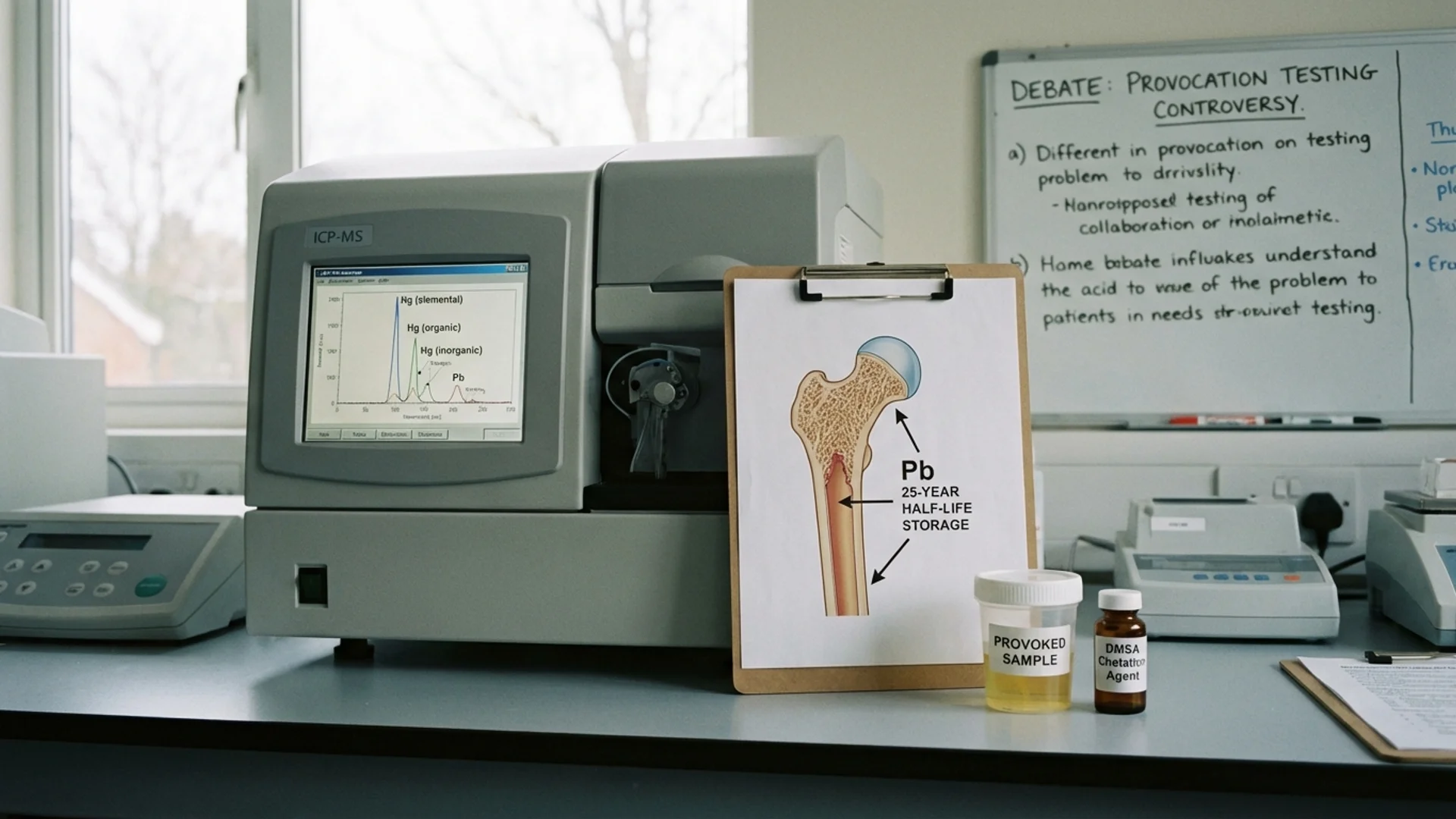
Provocation (or chelation challenge) testing involves administering a chelating agent (DMSA, DMPS, or EDTA) that mobilizes stored metals, followed by urine collection to measure the metals released.
This is an area of genuine controversy in medicine, and I want to be direct about it.
The argument for provocation testing: Baseline blood and urine levels may be normal even when significant metal stores exist in tissues. A chelating agent mobilizes these stores, revealing the body burden that unprovoked testing misses.
The argument against: Provocation testing results cannot be meaningfully compared to reference ranges derived from unprovoked samples. Everyone excretes more metal after chelation — the question is whether the amount excreted is pathologically significant, and we do not have universally accepted reference ranges for provoked urine. This can lead to overdiagnosis.
My clinical approach: I use provocation testing selectively, not routinely. When clinical history and baseline testing suggest possible metal burden (occupational exposure, dental amalgams, environmental contamination, symptoms consistent with metal toxicity), a provocation test can provide useful additional information. I interpret results in clinical context, not against unprovoked reference ranges, and I compare to published provocation reference ranges from chelation research.
Evidence level: the use of provocation testing is supported by clinical practice guidelines from integrative and environmental medicine organizations. It is not endorsed by mainstream toxicology societies. The disagreement is partly scientific and partly institutional.
Specific Metals
Mercury
Sources: dental amalgam fillings, seafood (methylmercury), occupational exposure, thimerosal (historical).
Mercury exists in three forms with different toxicological profiles:
- Elemental mercury — from amalgam fillings. Volatilizes and is inhaled, crosses the blood-brain barrier. Long half-life in the brain.
- Organic mercury (methylmercury) — from seafood. Well absorbed, crosses the blood-brain barrier, neurotoxic.
- Inorganic mercury — product of elemental and organic mercury metabolism. Accumulates in kidneys.
Symptoms of chronic mercury exposure: cognitive dysfunction, tremor, peripheral neuropathy, fatigue, immune dysregulation, and mood changes.
Lead
Sources: old paint, contaminated water, occupational exposure, some traditional medicines, firing ranges, and aviation fuel (100LL).
Lead accumulates in bone with a half-life of approximately 25 years. Blood lead reflects recent exposure; bone lead reflects lifetime accumulation. Even “low” blood lead levels (5-10 mcg/dL) are associated with cognitive impairment, hypertension, and kidney dysfunction in adults. Evidence level: robust epidemiological data.
Cadmium
Sources: cigarette smoke (the most significant source), contaminated food (rice, leafy vegetables grown in contaminated soil), occupational exposure.
Cadmium accumulates in the kidneys and has a biological half-life of 10-30 years. Chronic exposure is associated with kidney damage, osteoporosis, and increased cancer risk. Evidence level: strong (occupational health studies, epidemiological data).
Arsenic
Sources: contaminated groundwater (significant in parts of South Asia, Latin America, and some US states), rice, pressure-treated wood (historical), some herbicides.
Chronic arsenic exposure is associated with skin changes, peripheral neuropathy, cardiovascular disease, and multiple cancers. Speciated urine testing distinguishes toxic inorganic arsenic from benign organic arsenic.
When I Recommend Testing
I recommend heavy metal assessment for patients with:
- Occupational exposure history (dentistry, metalworking, mining, painting)
- Multiple dental amalgam fillings, particularly if symptomatic
- Chronic neurological symptoms without clear cause
- Unexplained immune dysfunction or autoimmunity
- Living in areas with known environmental contamination
- History of significant seafood consumption with neurological symptoms
Testing is not useful as a screening tool for the general population. It is useful as a targeted diagnostic tool when clinical history and presentation suggest possible metal contribution.
Disclaimer: This article is provided for educational purposes and reflects one physician’s clinical perspective. It is not a substitute for individualized medical care. Heavy metal testing and any subsequent treatment should be supervised by a physician experienced in environmental medicine.