
At a Glance
| Property | Value |
|---|---|
| Evidence Level | Moderate (well-established analytical methods, debated clinical protocols) |
| Primary Use | Assessing heavy metal exposure and body burden |
| Key Mechanism | Different matrices (blood, urine, provoked urine) capture different time windows and compartments of metal distribution |
The Testing Question Nobody Agrees On
Few topics in functional medicine generate more debate than heavy metal testing. Conventional toxicologists criticize provoked urine testing as producing artificially elevated results. Functional medicine practitioners argue that unprovoked testing misses tissue-stored metals. Patients end up confused, undertested, or overtested depending on which camp their doctor belongs to.
Here is what the evidence actually shows — and where legitimate scientific disagreement exists.
Blood (Serum or Whole Blood) Testing
What It Captures
Blood testing measures the concentration of metals currently circulating in the bloodstream. For most metals, blood levels reflect recent exposure — within the past days to weeks, depending on the metal’s half-life.
Best for:
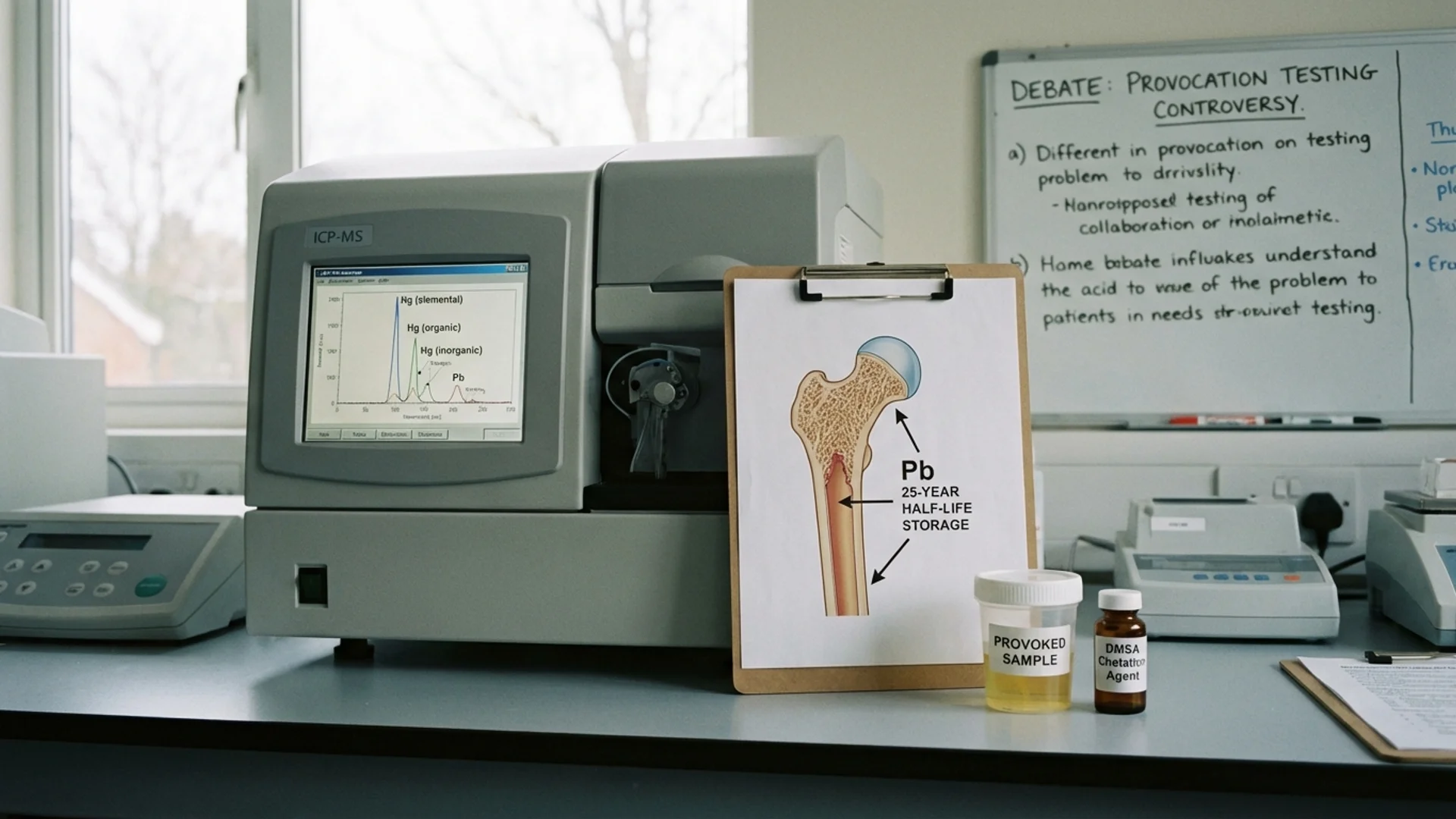
- Lead: Whole blood lead is the gold standard for assessing current lead exposure. The CDC reference value is less than 3.5 mcg/dL in children; under 5 mcg/dL in adults. Blood lead reflects recent exposure plus a contribution from bone stores (lead has a half-life of 30 days in blood but 10-30 years in bone).
- Mercury (methylmercury): Blood mercury reflects recent dietary exposure (primarily from seafood) over the past 1-3 months. Blood is the preferred matrix for organic mercury (methylmercury) because it binds to red blood cells.
- Arsenic: Blood arsenic levels are useful for acute or recent exposure assessment.
Limitations:
- Blood levels of most metals drop to “normal” within days to weeks of exposure cessation, even when significant amounts remain stored in tissue (bone, brain, kidney)
- A normal blood lead level does not rule out significant cumulative bone lead stores
- Inorganic mercury (from dental amalgams, industrial exposure) is poorly reflected in blood because it distributes rapidly to organs
When to Order Blood Testing
- Suspected acute or recent exposure (occupational, dietary, environmental)
- Lead exposure assessment (standard of care)
- Monitoring during chelation therapy (to confirm mobilization)
- Baseline assessment before environmental exposure evaluation
Unprovoked Urine Testing
What It Captures
A spot urine or 24-hour urine collection measures the metals your kidneys are actively excreting at baseline — without any chelating agent. This reflects the body’s natural excretion rate.
Best for:
- Inorganic mercury: Urine is the preferred matrix for inorganic mercury and elemental mercury vapor exposure (dental amalgams, industrial). Inorganic mercury concentrates in the kidney and is excreted in urine.
- Arsenic: 24-hour urine arsenic (with speciation to distinguish organic from inorganic forms) is the gold standard for arsenic exposure assessment.
- Cadmium: Urine cadmium reflects cumulative exposure and kidney burden. It is the best marker for chronic cadmium exposure.
Limitations:
- Metals stored deep in tissue (bone lead, brain mercury) may not be reflected in baseline urine excretion
- A normal unprovoked urine does not rule out significant tissue metal stores
- Dietary intake (arsenic from seafood, organic mercury from fish) can confound results
When to Order Unprovoked Urine
- Chronic low-level exposure assessment
- Inorganic mercury exposure (dental amalgams)
- Cadmium exposure (smoking, industrial)
- Arsenic speciation (distinguishing toxic inorganic from benign organic forms)
- When you need results comparable to published reference ranges

Provoked (Post-Chelation) Urine Testing
What It Captures
A chelating agent — typically DMSA (succimer), DMPS (unithiol), or CaEDTA (calcium disodium EDTA) — is administered orally or intravenously. The chelator binds metals in tissue and blood, forming water-soluble complexes that are excreted by the kidneys. Urine is collected for 6-24 hours after the chelation dose.
The theory: Chelators mobilize metals from tissue stores that are not reflected in baseline blood or urine testing, providing a more complete picture of total body burden.
The controversy: This is where the debate gets heated.
The Case For Provoked Testing
Proponents argue that:
- Unprovoked testing only shows what the body is excreting on its own — it misses tissue-sequestered metals
- Provoked testing reveals the total body burden that is potentially available for mobilization
- Some patients with significant metal-related symptoms have normal unprovoked levels but elevated provoked levels
- Serial provoked testing can monitor chelation therapy progress (declining levels indicate successful removal)
The Case Against Provoked Testing
The American College of Medical Toxicology (ACMT) and the American Academy of Clinical Toxicology (AACT) issued a joint position statement criticizing post-chelator testing for several specific reasons [1]:
- Reference ranges do not apply. Published reference ranges for urine metals are derived from unprovoked samples. Comparing provoked results to unprovoked reference ranges will almost always show “elevated” values — because the chelator increased excretion above baseline by design.
- Healthy individuals also show elevated metals after provocation. Studies have shown that DMSA provocation in healthy, asymptomatic individuals produces urine metal levels that would be interpreted as “elevated” — suggesting that the test identifies normal body stores, not pathological accumulation.
- No validated provoked reference ranges exist. Without established provoked-specific reference ranges, interpreting results is subjective.
- It may lead to unnecessary chelation therapy, which carries its own risks (mineral depletion, kidney stress).
What I Tell My Patients
Let me be direct about where I stand on this: both sides make valid points, and the absolutist position of either camp is not supported by the full picture of the evidence.
Unprovoked testing is the safer choice for initial screening. If unprovoked blood and urine metals are elevated, you have a clear answer without the controversy. If they are normal and the clinical suspicion for metal toxicity is low, you can stop there.
Provoked testing has a role when:
- Clinical presentation strongly suggests metal toxicity but unprovoked testing is normal
- You are monitoring the progress of an active chelation course (comparing serial provoked results to each other, not to unprovoked reference ranges)
- The patient has a clear history of significant exposure (occupational, dental amalgam removal, environmental)
The critical rule: never compare provoked results to unprovoked reference ranges. Compare provoked results to other provoked results from the same patient over time. This is a monitoring tool, not a diagnostic tool in isolation.
Which Test for Which Metal
| Metal | Best Blood Test | Best Urine Test | Provoked Useful? |
|---|---|---|---|
| Lead | Whole blood (gold standard) | Less useful for acute | CaEDTA provocation for bone stores |
| Mercury (organic/methyl) | Whole blood | Less useful | Less useful |
| Mercury (inorganic) | Less useful | Unprovoked urine (gold standard) | DMPS provocation debated |
| Arsenic | Acute exposure | 24-hr urine with speciation | Rarely needed |
| Cadmium | Acute exposure | Unprovoked urine (gold standard) | Not typically used |
| Aluminum | Less useful (serum available) | Unprovoked urine | Debated |
The Evidence
What We Know (Human Data)
- Blood lead and urine cadmium are well-validated biomarkers with established dose-response relationships to health outcomes
- The ACMT position paper (2013) provides a thorough critique of post-chelator testing [1]
- K-shell X-ray fluorescence (KXRF) of bone provides the most accurate assessment of cumulative lead exposure — but it is a research tool, not clinically available
- Hair analysis for heavy metals is unreliable and not recommended by any toxicology society
What I See in Practice
In our hospital, I assess heavy metals as part of the comprehensive workup for patients with chronic neurological symptoms, unexplained fatigue, or a history of significant environmental exposure. My approach:
- Start with unprovoked blood and urine testing (whole blood lead, blood mercury, urine mercury with speciation, urine cadmium, urine arsenic with speciation)
- If results are elevated — treat based on the specific metal and level
- If results are normal but clinical suspicion remains high — consider provoked testing with the explicit understanding of its limitations
- During chelation therapy — use serial provoked testing to monitor progress

Practical Application
What to Order First
For a general heavy metal screen:
- Whole blood lead (standard lab)
- Whole blood mercury (standard lab)
- 24-hour urine with mercury, cadmium, arsenic (with speciation), and thallium (specialty lab)
For suspected dental amalgam exposure:
- Urine mercury (unprovoked) — this is the most relevant matrix
For suspected lead exposure (older homes, occupational):
- Whole blood lead (the gold standard)
Interpreting Results
Always review results in the context of:
- Exposure history (occupational, residential, dental, dietary)
- Symptom pattern (different metals produce different symptom profiles)
- Time since exposure (blood captures recent; urine captures current excretion)
- Confounders (seafood intake before mercury testing, organic vs. inorganic arsenic)
Safety and Considerations
Testing itself carries minimal risk (blood draw, urine collection). The risk associated with provoked testing relates primarily to the chelating agent:
- DMSA can cause GI upset, rash, and transient elevation in liver enzymes
- DMPS can cause allergic reactions and mineral depletion
- EDTA carries risk of hypocalcemia and renal toxicity at high doses
Any provoked testing should be supervised by a physician experienced in chelation therapy, with adequate mineral repletion and monitoring. I discuss chelation therapy safety in detail here.
The Bottom Line
There is no single “best” heavy metal test. Blood captures recent exposure, unprovoked urine captures current excretion, and provoked urine attempts to reveal tissue stores — each answers a different question. Start with unprovoked testing for screening. Use blood for lead and organic mercury, urine for inorganic mercury and cadmium, and speciated urine for arsenic. Reserve provoked testing for high-clinical-suspicion cases where unprovoked results are discordant with the clinical picture, and never compare provoked results to unprovoked reference ranges. The right test depends on the right question.
References
- American College of Medical Toxicology. ACMT Position Statement on Post-Chelator Challenge Urinary Metal Testing. Journal of Medical Toxicology. 2013;9(4):318-325. PMC5711755.
- Klotz K, et al. The Health Effects of Aluminum Exposure. Deutsches Arzteblatt International. 2017;114(39):653-659. PMC5684567.
- Ruha AM, et al. Urine metal testing following chelation: an unreliable marker of metal body burden. Toxicology Communications. 2019;3(1):35-40.