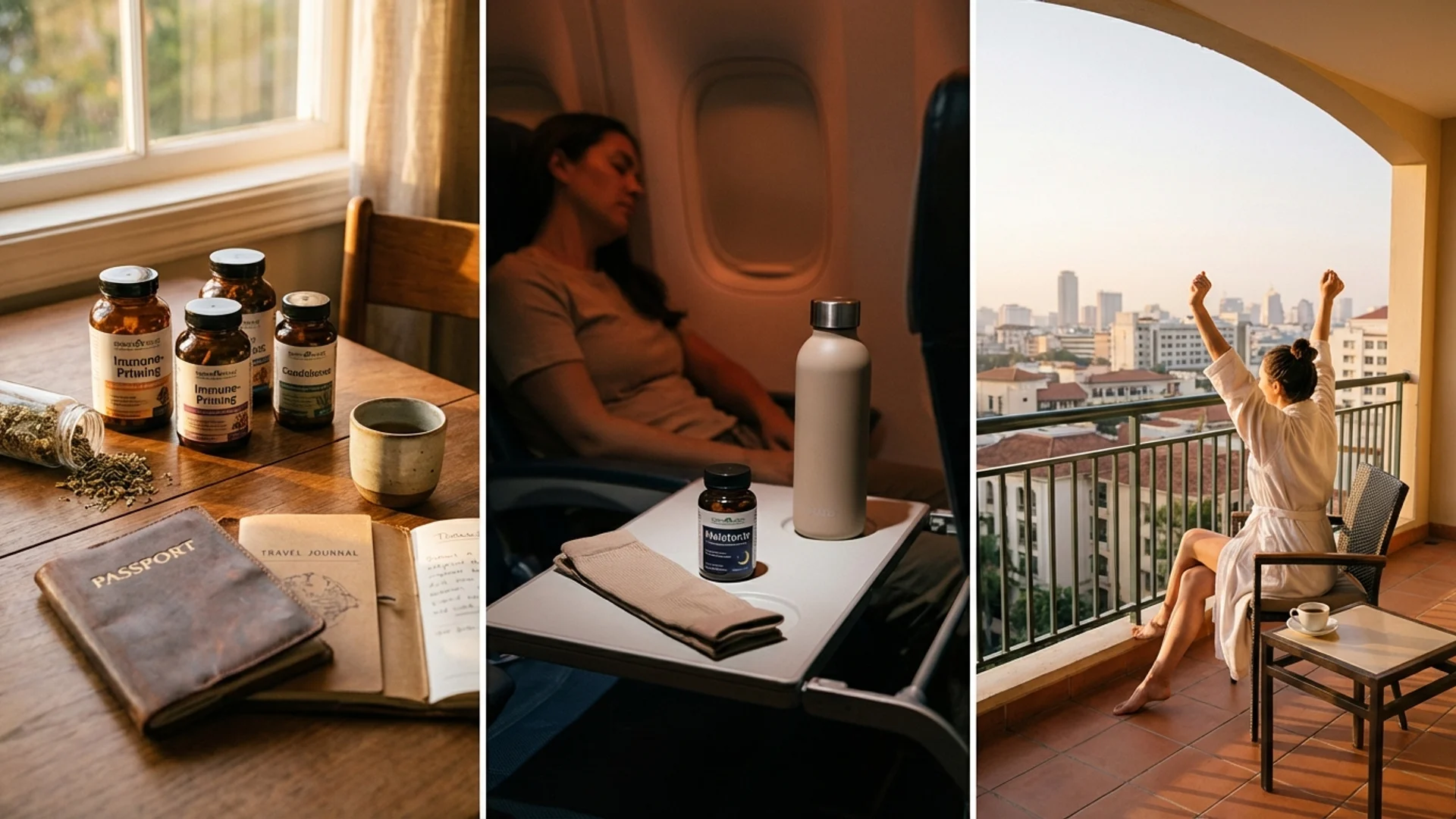
As a physician who treats patients from over 90 countries, I am acutely aware of what travel does to the body. It disrupts circadian rhythms, stresses the immune system, exposes the gut to unfamiliar microorganisms, and creates conditions (dehydration, confined spaces, sleep deprivation) that collectively impair the body’s defenses.
This protocol covers three phases — before travel, during travel, and after arrival. It is designed for international travel involving time zone changes, though the immune and gut components apply to any travel.
Pre-Travel (3-7 Days Before Departure)
Immune Priming
Supplement Dose Evidence Level Purpose
Zinc 30 mg daily Strong (RCTs) Immune function, pathogen defense
Vitamin D3 5,000 IU daily Strong (RCTs) Immune regulation
Elderberry extract 500 mg daily Moderate (RCTs for cold/flu duration reduction) Antiviral, immune activation
Probiotics 50 billion CFU daily Moderate (RCTs for traveler’s diarrhea prevention) Gut immune preparation
Saccharomyces boulardii deserves specific mention. Multiple RCTs have demonstrated its efficacy in preventing traveler’s diarrhea. Begin 5-7 days before travel and continue throughout. Evidence level: strong.
Circadian Preparation (Eastward Travel)
For eastward travel across more than three time zones, begin shifting your sleep schedule 30-60 minutes earlier each day for three to four days before departure. Combine with morning light exposure at the earlier time. This is the most effective non-pharmacological jet lag strategy. Evidence level: controlled studies.
For westward travel, circadian adjustment is generally easier and can be managed upon arrival.
During Travel
In-Flight Protocol
Intervention Details Evidence Level
Electrolytes Electrolyte supplement in water Moderate
Saccharomyces boulardii 250-500 mg before meals Strong (RCTs for traveler’s diarrhea)
Compression socks Knee-high, 15-20 mmHg Strong (RCTs for DVT prevention on long flights)
Movement Stand and walk every 90 minutes; ankle circles hourly Strong (DVT prevention guidelines)
Nasal saline spray Every 2-3 hours Traditional (cabin humidity is typically 10-20%)
Melatonin 0.5-3 mg if sleeping on the flight Moderate (controlled studies for in-flight sleep)
Infection Prevention
- Hand hygiene is the single most effective intervention. Carry alcohol-based hand sanitizer. Evidence level: strong (RCTs demonstrate significant reduction in respiratory and gastrointestinal infections).
- Tray tables and armrests on aircraft harbor bacterial contamination at levels comparable to bathroom surfaces. Clean with disinfectant wipes before use. Evidence level: environmental sampling studies.
After Arrival: Jet Lag Management
Jet lag is a circadian rhythm disorder caused by misalignment between the internal clock and the destination time zone. The primary symptoms — daytime fatigue, nighttime insomnia, cognitive impairment, gastrointestinal disruption — result from this misalignment.
Light Exposure Strategy
Light is the most powerful circadian entrainment tool. The timing of light exposure determines the direction of circadian shift:
Eastward travel (e.g., US to Europe):
- Seek bright light in the morning at destination
- Avoid bright light in the late afternoon/evening
- This advances the circadian clock to match the earlier time zone
Westward travel (e.g., Europe to US):
- Seek bright light in the late afternoon/evening at destination
- Avoid bright light early in the morning (for the first 1-2 days)
- This delays the circadian clock to match the later time zone
Evidence level: strong (controlled studies demonstrating circadian phase shifts with timed light exposure).
Melatonin Protocol
Melatonin is the most studied pharmacological intervention for jet lag. The Cochrane review (Herxheimer & Petrie, 2002) concluded that melatonin “is remarkably effective in preventing or reducing jet lag” when crossing five or more time zones.
Dosing: 0.5-5 mg (start with lower doses; higher does not mean better) taken at the destination’s bedtime for four to five days after arrival. Take 30 minutes before intended sleep time.
Evidence level: strong (multiple RCTs, Cochrane review).
Gut Recovery
Travel disrupts the gut microbiome through multiple mechanisms: time zone change (gut bacteria have circadian rhythms), dietary change, stress, and exposure to new microbial environments.
Supplement Dose Duration Evidence Level
Multi-strain probiotic 50 billion CFU daily Throughout trip + 2 weeks after Moderate
Digestive enzymes With meals During travel and 1 week after Moderate (clinical observation)
L-Glutamine 5 g daily If GI symptoms develop Strong (RCTs for gut barrier)
Destination-Specific Considerations
Food and Water Safety
In destinations where water quality is uncertain:
- Drink only bottled or purified water
- Avoid ice in drinks
- Avoid raw vegetables washed in local water
- Peel fruits before eating
- Activated charcoal (500 mg with meals) provides an additional layer of protection against ingested pathogens. Evidence level: mechanistic (adsorptive capacity is well-established).
Altitude
For travel above 2,500 meters, gradual ascent is the best prevention for altitude sickness. Acetazolamide is the standard pharmaceutical prophylaxis (consult your physician). Supportive measures include adequate hydration, avoiding alcohol for the first 48 hours, and iron status optimization before travel (altitude increases red blood cell production, which requires adequate iron).
When to Seek Medical Help
- Fever above 38.5 degrees Celsius that persists for more than 48 hours after travel
- Bloody diarrhea
- Diarrhea lasting more than three days or accompanied by severe dehydration
- Rash, particularly in combination with fever
- Jaundice (yellowing of skin or eyes)
- Any symptoms consistent with malaria if traveling from an endemic region (fever, chills, sweats — seek immediate care)
Disclaimer: This protocol is provided for educational purposes. It is not a substitute for pre-travel medical consultation. Vaccination requirements, malaria prophylaxis, and destination-specific health risks should be discussed with a travel medicine physician before departure.