
At a Glance
| Property | Detail |
|---|---|
| Evidence Level | Strong for dosing — formal pharmacokinetic data; regulatory-approved dosing regimen |
| Standard Dose | 1.6 mg subcutaneous injection |
| Standard Frequency | Twice weekly |
| Acute Protocol | 1.6 mg daily for 7-14 days |
| Route | Subcutaneous |
| Brand Name | Zadaxin (thymalfasin) |
| Regulatory Status | Approved in 30+ countries; not FDA-approved |
What Is the Correct Dose of Thymosin Alpha-1?
This is one of the few articles in our peptide series where I can give you a dose with genuine confidence. Unlike BPC-157 or TB-500, where all dosing is extrapolated from animal data, thymosin alpha-1 immune therapy has been through formal clinical development including pharmacokinetic studies, dose-finding trials, and regulatory approval in over 30 countries.
The standard dose is 1.6 mg administered subcutaneously. This dose was established through the clinical development of thymalfasin (Zadaxin) by SciClone Pharmaceuticals and has been used consistently across clinical trials for hepatitis B, hepatitis C, cancer adjunctive therapy, and immune support.
This does not mean the dose is perfect for every application or every patient. But it means we are working from a substantially stronger evidence base than is typical in peptide therapy. Here is what the evidence shows about how to use it effectively.
Pharmacokinetics: What Happens After Injection
Thymosin Alpha-1 pharmacokinetics have been formally characterized in human studies, which is unusual for peptides in this space:
| Parameter | Value |
|---|---|
| Bioavailability (SC) | ~80-90% |
| Peak plasma concentration (Tmax) | ~2 hours post-injection |
| Terminal half-life | ~2 hours |
| Elimination | Renal, via proteolytic degradation |
| Steady-state | Achieved within 1 week with twice-weekly dosing |
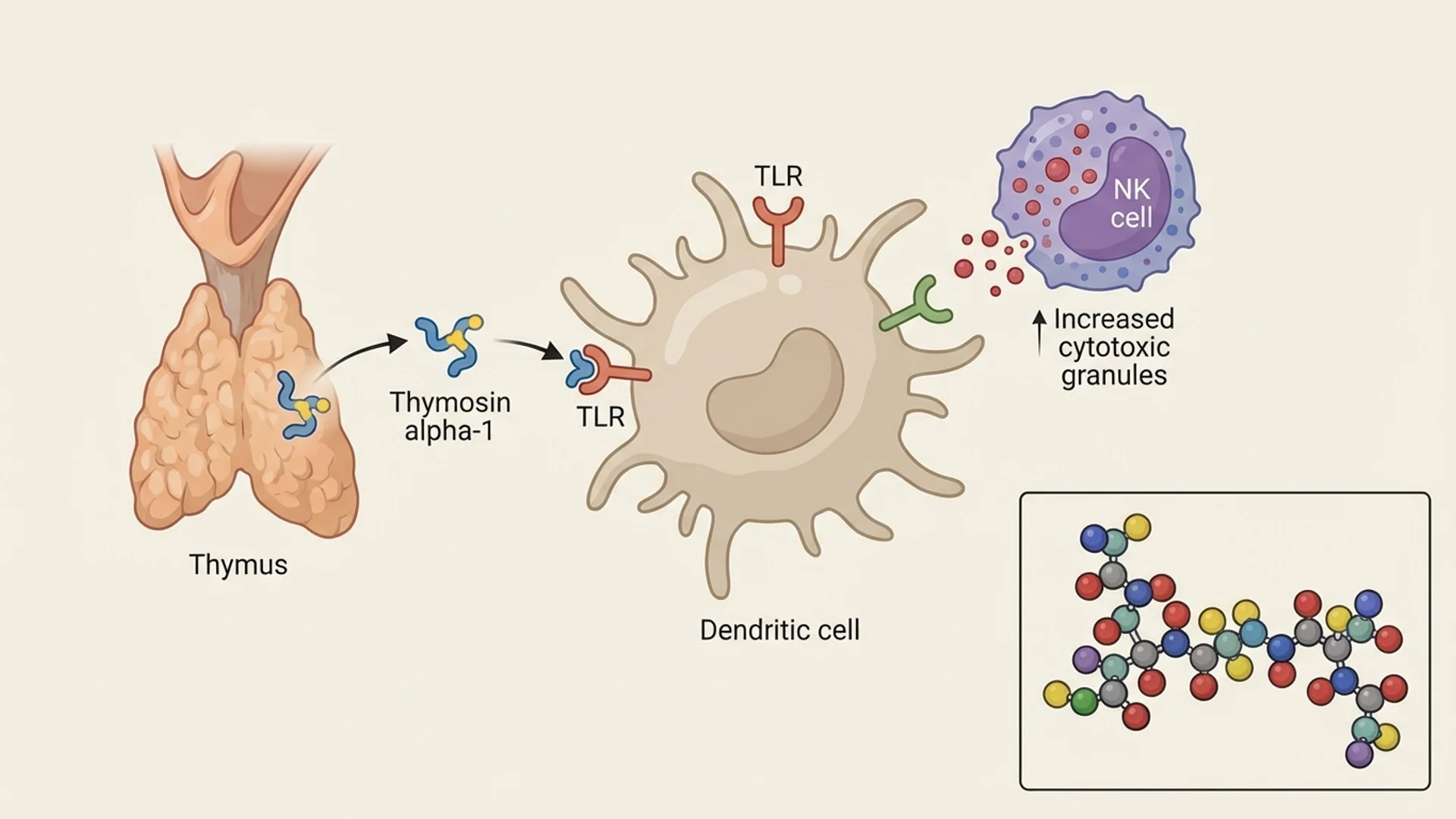
The relatively short plasma half-life (approximately 2 hours) might seem inconsistent with twice-weekly dosing. However, Ta1’s biological effects — particularly its impact on T-cell maturation and dendritic cell function — persist far longer than its plasma presence. This is because Ta1 triggers intracellular signaling cascades (through TLR2 and TLR9 activation) that continue to influence immune cell behavior for days after the peptide has been cleared from circulation.
Think of it this way: Ta1 is the ignition key, not the fuel. It starts processes that continue after the key is removed.
Standard Dosing Protocols
Chronic Immune Support
This is the most commonly used protocol for general immune modulation strategies, chronic infection management, and long-term immune optimization:
| Parameter | Detail |
|---|---|
| Dose | 1.6 mg SC |
| Frequency | Twice weekly (e.g., Monday and Thursday) |
| Duration | 6-12 months, reassessed quarterly |
| Monitoring | CBC with differential, lymphocyte subsets every 3 months |
Acute Immune Support
For acute situations — active infection, perioperative immune support, or the initiation phase of treatment for severe immune compromise:
| Parameter | Detail |
|---|---|
| Dose | 1.6 mg SC |
| Frequency | Daily for 7-14 days |
| Transition | Step down to twice weekly after acute phase |
| Duration of acute phase | 1-2 weeks maximum |
Cancer Adjunct Protocol
When used alongside chemotherapy, radiation, or immunotherapy:
| Phase | Dose | Frequency | Duration |
|---|---|---|---|
| Pre-treatment (when possible) | 1.6 mg SC | Twice weekly | 2 weeks before chemo starts |
| During chemotherapy | 1.6 mg SC | Twice weekly to daily | Throughout chemo course |
| Post-chemotherapy recovery | 1.6 mg SC | Twice weekly | 4-8 weeks post-completion |
| Maintenance | 1.6 mg SC | Twice weekly | Based on immune monitoring |
During active chemotherapy, some protocols increase frequency to daily injections during the immunosuppressive nadir (typically days 7-14 after chemotherapy administration). This intensification targets the period of maximum immune vulnerability.
For more on the cancer application, see Thymosin Alpha-1 for Cancer: Immunotherapy Support.
Hepatitis B/C Protocol (Approved Indication)
For reference, the regulatory-approved protocol in countries where Zadaxin is approved:
| Parameter | Detail |
|---|---|
| Dose | 1.6 mg SC |
| Frequency | Twice weekly |
| Duration | 6-12 months (hepatitis B); 6 months in combination with interferon (hepatitis C) |
Administration Technique
Injection Protocol
- Ta1 is supplied as a lyophilized powder (Zadaxin) or as pre-made compounded preparations
- If lyophilized, reconstitute with 1 mL sterile water for injection
- Inject subcutaneously in the upper arm, anterior thigh, or abdomen
- Rotate injection sites
- Store reconstituted peptide refrigerated (2-8°C); use within 24 hours if using sterile water (not bacteriostatic water)
Timing
There is no strong evidence favoring a specific time of day for Ta1 injection. Some clinicians prefer morning administration, hypothesizing that immune activation during daytime may align better with circadian immune rhythms. In practice, consistency of timing matters more than the specific time chosen.
Dose Adjustments
Body Weight
The 1.6 mg dose is a flat dose, not weight-adjusted. This is the dose used in clinical trials across a range of body weights. The rationale is that Ta1’s mechanism — triggering immune signaling cascades — operates through a threshold effect rather than a concentration-dependent effect. Once the signaling threshold is reached, additional peptide does not proportionally increase the response.
That said, for patients at the extremes of body weight:
| Body Weight | Dose Consideration |
|---|---|
| Under 50 kg | 1.6 mg remains standard; no reduction typically needed |
| 50-100 kg | 1.6 mg (standard) |
| Over 100 kg | Some clinicians use 3.2 mg (double dose) for the first 2-4 weeks, then 1.6 mg. Evidence for this is limited |
Renal Impairment
Ta1 is eliminated renally via proteolytic degradation. In patients with significant renal impairment (GFR below 30), clearance may be reduced. Formal dose-adjustment guidelines for renal impairment have not been established. In my practice, I use standard dosing with more frequent monitoring in patients with moderate renal impairment and consult nephrology for severe impairment.
Hepatic Impairment
Hepatic metabolism plays a minor role in Ta1 clearance, and the peptide has been used extensively in patients with hepatic disease (hepatitis B and C, hepatocellular carcinoma). No dose adjustment for hepatic impairment is typically needed.
Combination Protocols
With Other Immune Peptides
| Combination | Rationale | Protocol |
|---|---|---|
| Ta1 + LL-37 | Immune activation + direct antimicrobial activity | Ta1 1.6 mg 2x/week + LL-37 per protocol; used in chronic Lyme |
| Ta1 + Thymosin Beta-4 (TB-500) | Immune support + tissue repair | Ta1 1.6 mg 2x/week + TB-500 2 mg 2x/week; post-surgical recovery |
With Conventional Immunotherapy
Ta1 is being studied in combination with checkpoint inhibitors (anti-PD-1, anti-CTLA-4). The rationale is mechanistic synergy — Ta1 enhances T-cell function while checkpoint inhibitors remove inhibitory signals. Combination dosing follows the standard Ta1 protocol (1.6 mg twice weekly) alongside the scheduled immunotherapy regimen.
Duration of Treatment
How Long Should You Take Ta1?
This depends on the indication:
| Indication | Typical Duration | Reassessment |
|---|---|---|
| Acute infection support | 2-4 weeks | At resolution of infection |
| Chronic hepatitis | 6-12 months | Viral load monitoring |
| Cancer adjunct | Duration of cancer treatment + 4-8 weeks | Immune monitoring quarterly |
| Chronic immune deficiency | Indefinite (with monitoring) | Every 3 months |
| Longevity / immune optimization | 3-6 month cycles | Every 6 months |
For long-term use, quarterly monitoring of immune parameters (CD4/CD8 ratio, NK cell function and CD57 counts, total lymphocyte count) helps determine whether continued treatment is providing measurable benefit. If immune parameters have normalized and remain stable after discontinuation, a rest period may be appropriate.
What Makes Ta1 Dosing Different from Other Peptides
I want to highlight why the dosing confidence for Ta1 is fundamentally different from other peptides in this series:
- Formal pharmacokinetic studies — conducted in humans, published, and reviewed by regulatory agencies
- Regulatory approval data — submitted to and accepted by regulatory bodies in 30+ countries
- Consistent dose across trials — the 1.6 mg dose has been used consistently across diverse clinical applications
- Post-marketing surveillance — millions of doses administered under regulatory oversight, providing real-world safety and dosing data
- Pharmaceutical manufacturing standards — Zadaxin is manufactured to GMP standards, unlike compounded peptide preparations
This does not mean the dose is optimized for every possible application. But it means the foundation is substantially more evidence-based than extrapolated animal dosing.
The Bottom Line
Thymosin Alpha-1 is dosed at 1.6 mg subcutaneously, typically twice weekly for chronic use or daily for acute immune support. This dose is supported by formal pharmacokinetic data and regulatory approval in over 30 countries — a rare level of evidence in the peptide therapy space. Duration depends on the indication, ranging from 2-4 weeks for acute infections to indefinite maintenance for chronic immune deficiency. Monitoring immune parameters helps guide treatment duration and reassessment.
For the cancer-specific application, see Thymosin Alpha-1 for Cancer: Immunotherapy Support. For the full overview, see Thymosin Alpha-1: Immune Modulation Deep Dive.
References
- Goldstein AL, et al. “Thymalfasin: chemistry, activity, and clinical applications of the primary thymic hormone.” Expert Opin Biol Ther. 2009;9(5):593-608. PMID: 19392575.
- Garaci E, et al. “Combination treatment using thymosin alpha 1 and interferon after cyclophosphamide is able to cure Lewis lung carcinoma in mice.” Cancer Immunol Immunother. 1994;38(3):154-160. PMID: 8124685.
- Romani L, et al. “Thymosin alpha 1 activates dendritic cell tryptophan catabolism and establishes a regulatory environment for balance of inflammation and tolerance.” Blood. 2006;108(7):2265-2274. PMID: 16788103.
- Tuthill C, et al. “Thymalfasin: an immune response modifier with multiple clinical applications.” Ann N Y Acad Sci. 2010;1194:130-135. PMID: 20536459.
- King R, Tuthill C. “Immune modulation with thymosin alpha 1 treatment.” Vitam Horm. 2016;102:151-178. PMID: 27450734.
Disclaimer: This article is for educational purposes and reflects current published research and clinical observation. It is not medical advice. Thymosin Alpha-1 (Zadaxin) is not FDA-approved but is approved in other jurisdictions. Consult a qualified physician before pursuing any peptide therapy.