
At a Glance
| Property | Value |
|---|---|
| Topic | Peptide Sourcing: Hospital-Grade vs. Grey Market |
| Evidence Level | Limited (early-stage research) |
| Scope | Guide to peptide sourcing and quality. Compounding pharmacies vs research chemicals, testing standards, what to look for, and why source matters for safety. |
| Key Takeaway | Peptide quality ranges from pharmaceutical-grade products with verified purity and sterility to unregulated grey-market research chemicals that may contain… |
Key Takeaways:
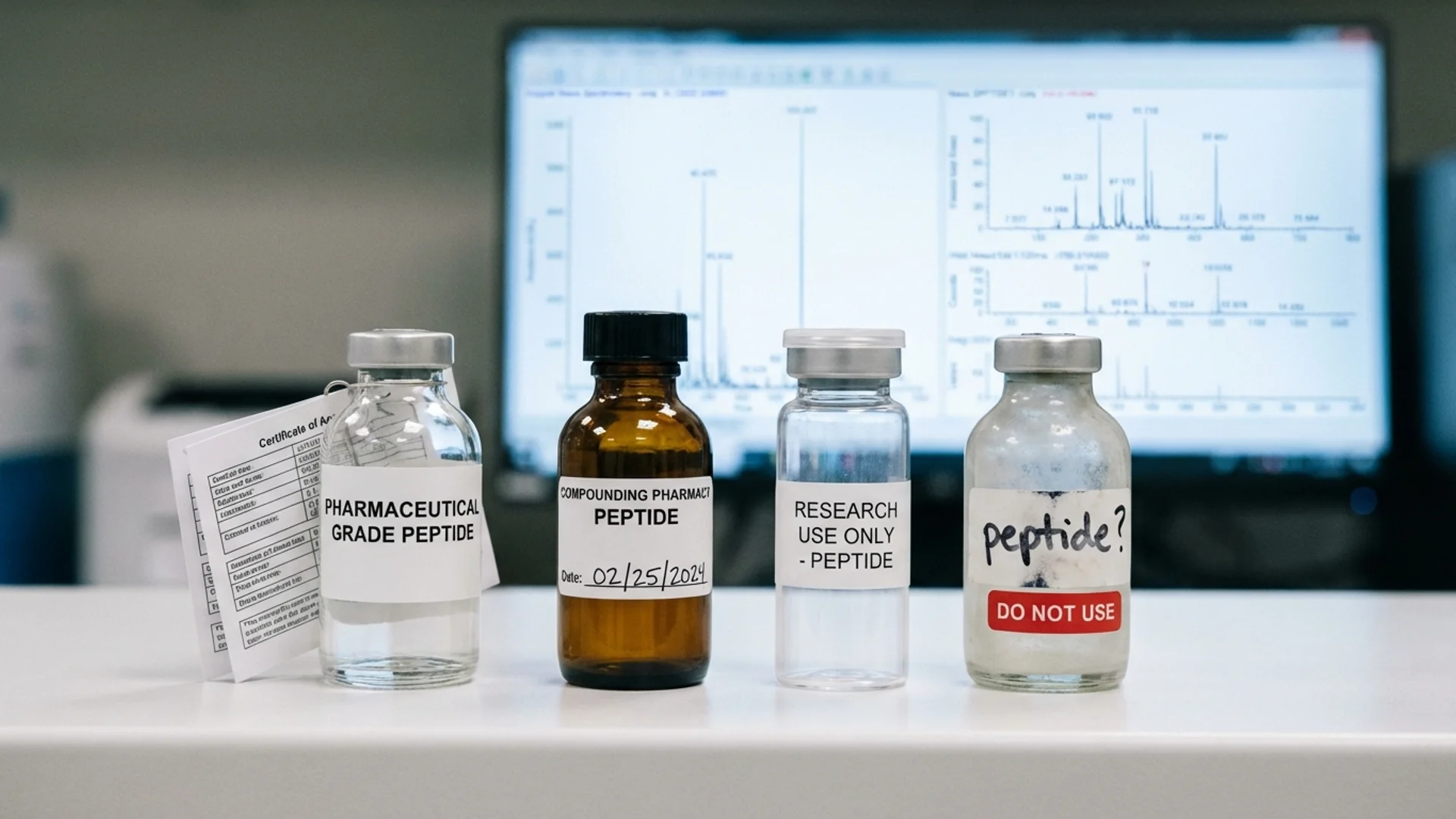
- The difference between pharmaceutical-grade and grey-market peptides is not marginal — it can be the difference between a sterile, accurately dosed product and a contaminated, mislabeled one
- Third-party testing (COA) from the supplier is necessary but not sufficient — independent verification is the only reliable quality assurance
- Compounding pharmacies vary enormously in quality, and not all are equivalent
- The cost difference between quality-assured and unverified peptides is real, but it reflects genuine differences in manufacturing standards
- What I tell my patients: if you cannot verify the source, do not inject it
Table of Contents
- Why Sourcing Matters More Than You Think
- The Quality Tiers
- Compounding Pharmacies: Not All Are Equal
- The Grey Market Problem
- What Testing Actually Means
- Red Flags and Green Flags
- The International Dimension
- Clinical Perspective
Why Sourcing Matters More Than You Think
I want to start with a statement that may seem obvious but that I find myself repeating to patients regularly: the best peptide protocol in the world is useless — and potentially harmful — if the product in the vial is not what you think it is.

Peptides are not like most supplements. A vitamin C tablet from a low-quality manufacturer may contain less vitamin C than advertised, but it is unlikely to contain something dangerous. An injectable peptide from an unverified source could contain bacterial endotoxins, heavy metals, degradation products, the wrong peptide entirely, or nothing at all. And you are injecting it directly into your body, bypassing all the protective barriers that oral administration provides.
In my practice, I have seen the consequences of poor-quality peptide sourcing: injection site infections from non-sterile products, unexpected side effects from mislabeled compounds, and patients spending significant money on products that contained little to no active peptide. These are not theoretical risks. They are documented, practical problems.
The Quality Tiers
Tier 1: Pharmaceutical Grade
This is the gold standard. Pharmaceutical-grade peptides are manufactured in facilities that meet Good Manufacturing Practice (GMP) standards, undergo rigorous quality testing, and are subject to regulatory oversight.
Examples: thymosin alpha-1 immune therapy as Zadaxin (SciClone/Immunomedics), pentosan polysulfate sodium as Elmiron (Janssen), insulin (multiple manufacturers).
What you can expect:
- Purity above 99%
- Sterility verified by testing
- Accurate concentration within narrow tolerance
- Stability testing to determine shelf life
- Batch-to-batch consistency
- Regulatory oversight and accountability
Limitation: Very few therapeutic peptides have achieved pharmaceutical-grade status. For most peptides used in clinical practice, this tier is simply not available.
Tier 2: Regulated Compounding Pharmacies
Compounding pharmacies operate under state pharmacy boards and, in some cases, federal oversight (503B outsourcing facilities in the US). They prepare medications to individual physician prescriptions or, in the case of 503B facilities, produce larger batches under FDA oversight.
What you can expect from a quality compounding pharmacy:
- GMP or near-GMP manufacturing standards
- Sterility testing of injectable products
- Identity and potency verification
- Certificate of analysis for each batch
- Pharmacist oversight of production
- Prescription required (physician involvement mandatory)
The variation problem: Not all compounding pharmacies maintain the same standards. Some operate small-scale operations with limited quality control infrastructure. The difference between a well-run compounding pharmacy and a poorly run one can be enormous.
Tier 3: International Compounding/Manufacturing
Peptides sourced from international manufacturers or compounding operations — often in China, India, or Eastern Europe. Quality ranges from excellent to abysmal.
The challenge: Some international manufacturers produce peptides to genuine pharmaceutical standards at lower cost. Others operate with minimal quality control, producing material that is suitable for research use only. Distinguishing between them requires independent testing, not reliance on the supplier’s documentation.
Tier 4: Research Chemical Suppliers
Online suppliers selling peptides labeled “for research purposes only” or “not for human consumption.” This labeling is a legal strategy to avoid drug regulation, not a description of the product’s intended use — everyone involved understands that these products are being purchased for human administration.
What you may get:
- Unknown purity (could be 60%, could be 99%)
- Unknown sterility (many products are sold as lyophilized powder requiring reconstitution by the user)
- Unknown identity (no guarantee the labeled peptide is what is in the vial)
- No regulatory accountability
- No physician involvement required
I want to be direct: I consider Tier 4 sourcing to be an unacceptable risk for injectable products. The potential consequences of injecting a contaminated or mislabeled product outweigh any cost savings.
Compounding Pharmacies: Not All Are Equal
Because most therapeutic peptides are available only through compounding, the quality of the compounding pharmacy is the single most important variable in peptide sourcing (after the peptide itself).
503A vs. 503B (US Framework)
503A pharmacies compound medications in response to individual patient prescriptions. They are regulated by state pharmacy boards. Quality standards vary by state and by pharmacy.
503B outsourcing facilities produce compounded medications in larger batches and are subject to FDA oversight, including current Good Manufacturing Practice (cGMP) requirements, regular FDA inspections, and adverse event reporting. 503B facilities generally offer higher quality assurance than 503A pharmacies.
What to Look For in a Compounding Pharmacy
- Accreditation: PCAB (Pharmacy Compounding Accreditation Board) accreditation is voluntary and indicates that the pharmacy meets rigorous quality standards. Not all good pharmacies are PCAB-accredited, but PCAB accreditation is a strong positive signal.
- Sterility testing: For injectable products, the pharmacy should perform USP compliant sterility testing. Ask about their testing protocols.
- Certificate of analysis (COA): The pharmacy should be able to provide a COA for each batch, showing identity, purity, potency, and sterility results.
- Third-party testing: The gold standard is independent third-party testing by a laboratory not affiliated with the pharmacy. Some pharmacies voluntarily submit samples for independent verification.
- Adverse event reporting: A reputable pharmacy will have a system for reporting and investigating adverse events.
- Pharmacist consultation: The pharmacy should be willing to discuss their manufacturing processes and quality control measures with the prescribing physician.
The Grey Market Problem
The term “grey market” refers to the distribution of products outside of authorized channels — not necessarily illegal, but not within the regulated pharmaceutical or compounding framework. In the peptide space, the grey market is substantial and growing.
Why the Grey Market Exists
The grey market exists because of the gap between patient demand and regulated supply. When the FDA restricts a peptide from compounding, patients who were using that peptide do not stop wanting it. They find alternative sources. This is entirely predictable from a public health standpoint, and it is one of the legitimate criticisms of overly restrictive regulatory approaches — they can push patients toward less safe sources rather than eliminating use.
The Risks
- No quality verification: Grey-market products have no regulatory oversight and no accountability for quality.
- Reconstitution risks: Lyophilized peptides sold as powder require reconstitution with bacteriostatic water. Improper reconstitution technique can introduce contamination.
- Storage degradation: Peptides are temperature-sensitive. Products shipped without cold chain maintenance may have degraded significantly before reaching the patient.
- No recourse: If a grey-market product causes harm, there is no regulatory pathway for accountability or recall.
What Testing Actually Means
Not all testing is equivalent. Understanding what different tests measure is essential for evaluating quality claims.
Identity Testing (HPLC, Mass Spectrometry)
High-performance liquid chromatography (HPLC) and mass spectrometry confirm that the product contains the correct peptide. This is the most fundamental quality test — without it, you do not know what you are injecting.
Purity Testing
Purity testing measures the proportion of the product that is the intended peptide versus impurities (degradation products, synthesis byproducts, residual solvents). Pharmaceutical-grade standards typically require above 98% purity. Research-grade products may be 90-95% — meaning 5-10% of what you are injecting is not the intended peptide.
Potency/Concentration Testing
Verifies that the product contains the stated concentration of active peptide. A vial labeled “5 mg” should contain 5 mg (within acceptable tolerance, typically plus or minus 10%).
Sterility Testing
Confirms the absence of viable microorganisms in injectable products. USP is the standard protocol. This test is critical for any injectable product and should be performed on every batch.
Endotoxin Testing
Endotoxin testing (LAL test, USP ) detects bacterial endotoxins that can cause fever and systemic inflammation when injected. A product can be sterile (no living bacteria) but still contain endotoxins from bacteria that were present during manufacturing and subsequently killed. This is why endotoxin testing is separate from — and complementary to — sterility testing.
The COA Question
A certificate of analysis (COA) is only as reliable as the laboratory that issued it. COAs from the manufacturer or supplier represent a potential conflict of interest. Independent, third-party COAs from accredited laboratories (ISO 17025 accredited) provide substantially higher confidence.
Red Flags and Green Flags
Red Flags
- Product sold as “research use only” or “not for human consumption”
- No COA available or COA from an unidentifiable laboratory
- Prices dramatically below market rates (if it seems too good to be true, it is)
- No prescription required for injectable products
- Shipped without cold chain packaging
- Website makes therapeutic claims while selling as “research chemicals”
- Unable or unwilling to answer questions about manufacturing and testing
- Batch-to-batch variation in appearance, solubility, or color
Green Flags
- Prescription required from a licensed physician
- PCAB accreditation or 503B outsourcing facility registration
- Independent third-party testing from ISO-accredited laboratory
- COA with complete identity, purity, potency, sterility, and endotoxin results
- Pharmacist available for consultation
- Adverse event reporting system in place
- Transparent about manufacturing processes and limitations
- Cold chain shipping with temperature monitoring
The International Dimension
For international patients — and at Klinik St. Georg, most of our patients are international — peptide sourcing is complicated by the fact that regulatory frameworks vary by country.
A peptide that is a restricted research chemical in the United States may be an approved pharmaceutical in South Korea (thymosin alpha-1), or an approved medication in Russia (Selank), or available through regulated pharmacy channels in Germany. Patients traveling for treatment may have access to different peptides and different quality tiers depending on the jurisdiction of treatment.
What I tell international patients is this: the quality principles are universal even when the regulations are not. Regardless of jurisdiction, you want verified purity, confirmed sterility, accurate concentration, and physician oversight. The regulatory pathway to achieving those qualities may differ, but the qualities themselves should not be negotiable.
Clinical Perspective
Sourcing is, frankly, the aspect of peptide therapy that concerns me most. I have seen the difference between pharmaceutical-grade and grey-market products, and it is not marginal. When I use peptides in my practice, I source exclusively through verified pharmaceutical or regulated compounding channels. This limits the peptides available to me — a constraint I accept because the alternative is administering products I cannot vouch for.
What I tell patients who ask about self-sourcing peptides is this: the cost savings of grey-market products are real, but so are the risks. You are saving money by accepting unknown purity, unverified sterility, and no accountability. For a topical product, this trade-off might be acceptable. For an injectable product, I do not think it is.
The peptide sourcing landscape will continue to evolve as regulatory frameworks adapt to the growing clinical use of therapeutic peptides. In the meantime, the principles I recommend to patients are straightforward: work with a physician who can source through verified channels, ask for certificates of analysis, understand what the testing actually measures, and do not inject anything into your body that you cannot verify.
The nuance matters here. I am not saying that all compounding pharmacies are equally reliable, or that all international sources are problematic, or that pharmaceutical-grade products are the only acceptable option. I am saying that quality verification should be a non-negotiable requirement for injectable peptide therapy, and that achieving quality verification requires more diligence than simply ordering from a website that looks professional.
References
- ISPE. “Good Manufacturing Practice Guide for Active Pharmaceutical Ingredients.” International Society for Pharmaceutical Engineering. 2020.
- FDA. “Compounding and the FDA: Questions and Answers.” US Food and Drug Administration. 2024.
- PCAB. “Standards for Compounding Pharmacies.” Pharmacy Compounding Accreditation Board. 2023.
- USP. “General Chapter Pharmaceutical Compounding — Sterile Preparations.” United States Pharmacopeia. 2023.
- Cohen PA, et al. “Quantity of active ingredients in dietary supplements and peptides.” JAMA Intern Med. 2020;180(6):803-806.
Disclaimer: This guide is intended for educational purposes and does not constitute medical advice. It does not endorse or recommend any specific pharmacy, manufacturer, or supplier. Always work with a qualified physician for peptide therapy decisions.